Doud Calls for Greater Trade Enforcement in Congressional Hearing, Ag Outlook Forum

NMPF President and CEO Gregg Doud told members of the House Ways & Means Trade Subcommittee on Feb. 25 that the U.S. government needs to make sure trade agreements are enforced, benefiting dairy producers, workers, and shippers who rely on exports.

“In addition to pursuing greater market access, Congress and the administration have a responsibility to work together to enforce existing U.S trade agreements,” Doud said in his oral remarks. “Trade enforcement is not a matter of political or legal technicalities. We have seen that inadequate enforcement has real-world consequences by restricting opportunities for American farmers.”

Exports are indispensable for U.S. dairy farmers and workers, Doud said in the opening of his testimony. Most of those dairy exports are shipped to markets where the United States has an existing bilateral trade agreement—underscoring the need for an initiative-taking U.S. trade agenda. Doud urged policymakers to pursue trade policies that empower U.S. dairy to compete with the European Union and New Zealand, who have benefited from increased market access from recent trade agreements made by their governments.

Priority U.S. trade agreements for enforcement and focus include the U.S.-Mexico-Canada Agreement (USMCA), Doud said. Roughly 44 percent of U.S. dairy exports are shipped to USMCA partners, illustrating why it is critical to ensure that Canada and Mexico are in full compliance and that the United States maximize dairy export opportunities with both partners, he said.

Doud in both written and oral testimony outlined specific USMCA enforcement issues the United States should prioritize, including Canada’s misadministration of its tariff-rate quota system and circumvention of dairy protein export caps. Doud emphasized the need for new deals that cut tariffs, tackle nontariff trade barriers, and are vigorously enforced.

A link to his written testimony can be found here.

Doud later that week spoke at the USDA’s annual Agricultural Outlook Forum, elaborating on his testimony with an overview of U.S. trade relationships around the world, specifically calling out the European Union for misusing rules and protections to shield their markets from U.S. farmers.

“If I say anything nice about the way Brussels does ag, it was completely by mistake,” he said. “I think it is also reasonable to assume its own farmers have the same opinion.”

Later that day Doud joined a roundtable discussion hosted by the House Agriculture Committee to discuss how Congress and the Trump Administration can promote trade policies that best support the dairy and agricultural industries.

NMPF’s Statement on Jamieson Greer’s Confirmation as U.S. Trade Representative

From Gregg Doud, President and CEO of NMPF:

“On behalf of the U.S. dairy industry, congratulations to Jamieson Greer on his confirmation as U.S. Trade Representative.

Exports play an indispensable role in supporting America’s dairy farmers and workers across the country. As I know first-hand from my prior work with him at USTR, Ambassador Greer will be a strong advocate for American farmers and American-made products. His talents as a trade lawyer are exceptional. We are eager to work with him and his team to secure opportunities for U.S. dairy producers to compete on a level global playing field and grow export markets.”

NMPF Works to Mitigate Port Strike Disruptions

A port workers strike that threatened millions in U.S. dairy exports was successfully limited Oct. 4, after NMPF and the U.S. Dairy Export Council (USDEC) called on the Biden Administration to intervene in the port workers strike.

NMPF and USDEC in an Oct. 1 joint statement and Oct. 2 industry letter co-signed by more than 270  agricultural, manufacturing, retail and additional supply chain stakeholders helped apply pressure on the negotiating parties, who agreed to resume work on Oct. 4.

More than $4.5 million in U.S. dairy exports moved through east and gulf coast ports in 2023 and a work stoppage forced exporters to cancel shipments and undertake costly reroutes. NMPF and USDEC relayed information between exporters and USDA to highlight and address storage and rerouting challenges as a result of the strike.

The International Longshoremen’s Association reached a tentative agreement with the United States Maritime Alliance to suspend the strike and resume normal operations on Oct. 3. NMPF and USDEC welcomed the end to the strike and pressed both parties to come to a long-term agreement before the current contract extension expires on Jan. 15, 2025.

U.S. Dairy Welcomes End to Port Strike, Urges Swift Conclusion of Contract Negotiations

The U.S. Dairy Export Council (USDEC) and the National Milk Producers Federation (NMPF) today welcomed news that the labor strike affecting East and Gulf Coast ports has come to an end, allowing port operations to resume. The two organizations emphasized the importance of quickly finalizing contract negotiations to provide long-term certainty for U.S. dairy exporters.

“We are grateful to the Biden Administration for its important role in getting the parties to return to work and resume port operations,” said Krysta Harden, president and CEO of USDEC. “This is a crucial step in ensuring that U.S. dairy products can continue to reach our international customers. We encourage both sides to continue their negotiations and reach a final agreement that protects the supply chain and strengthens the reliability of American exports.”

The dairy industry has been severely affected by the disruptions, as $1.7 billion in dairy exports flow through the East and Gulf coast ports each year. The three-day work stoppage has had ripple effects throughout the export supply chain, with dairy exporters reporting cancelled sales and added time and costs to reroute products.

“We still need the contract negotiations to conclude swiftly,” said Gregg Doud, president and CEO of NMPF. “International customers of U.S. dairy products need certainty that their orders will arrive on time, and dairy producers can’t afford further disruptions.”

Dairy exporters experiencing challenges with rerouting or repositioned equipment should reach out to Tony Rice (trice@nmpf.org) with questions.

CWT Secures 60 Contracts in September 

NMPF staff are continuing to reach out and answer questions for current and potential Cooperatives Working Together members during before NMPF’s Board of Directors meets Oct. 21 to discuss the self-help program going into 2025.

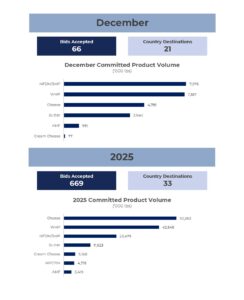
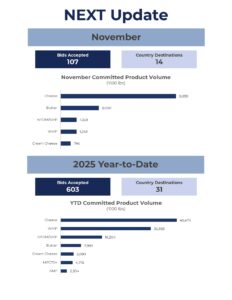
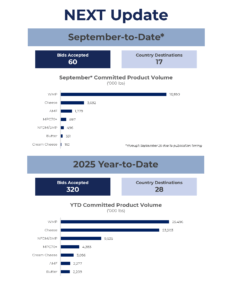
Meanwhile, CWT member cooperatives secured 60 contracts in September, adding 6.2 million pounds of product to CWT-assisted sales in 2024. In milk equivalent, this is equal to 56.1 million pounds of milk on a milkfat basis. These products will go to customers in Asia, Oceania, Middle East-North Africa and South America and will be shipped from September 2024 through March 2025.

CWT provides a means to move domestic dairy products to overseas markets by helping to overcome U.S. dairy’s trade disadvantages. The amounts of dairy products and related milk volumes reflect current contracts for delivery, not completed export volumes. CWT will pay export assistance to the bidders only when export and delivery of the product is verified by the submission of the required documentation.

NMPF, USDEC Call for Immediate Government Intervention to Resolve Port Labor Strike

The National Milk Producers Federation (NMPF) and the U.S. Dairy Export Council (USDEC) called on the Biden Administration to immediately intervene in the port labor strike that began at 12:01 AM EST today at East and Gulf coast ports. The dairy organizations warned that this disruption could have a devastating impact on American dairy farmers and exporters who rely on the smooth functioning of these ports to get their products to international markets.

“The administration must act now to bring both sides back to the table. The stakes are too high,” said Gregg Doud, president and CEO of NMPF. “This strike puts the livelihoods of American dairy farmers and the strength of our supply chain at risk. The administration needs to step in and end the strike before further damage is done.”

The U.S. dairy industry relies heavily on ports to maintain access to global markets. In 2023, over 530,000 twenty-foot equivalent units of dairy products, valued at $1.7 billion, were shipped through East and Gulf ports, accounting for 21% of total U.S. dairy exports by volume. The ongoing strike directly jeopardizes $32 million in dairy exports per week, with additional indirect consequences looming as exporters are forced to reroute shipments and face rising transportation costs.

“Global customers depend on the reliability of U.S. dairy products,” said Krysta Harden, president and CEO of USDEC. “Delays caused by this strike not only risk damaging those relationships but also severely impact perishable dairy products that require timely delivery. The negotiating parties need to come together to find a resolution and ensure port operations resume as soon as possible.”

Dairy exporters experiencing challenges with rerouting or stuck shipments should reach out to Tony Rice (trice@nmpf.org) with questions.

NMPF’s Rice Updates Dairy Radio Now Listeners on New Export Challenges

NMPF’s Director of Trade Policy Tony Rice tells Dairy Radio Now listeners how NMPF is working to prevent a loss of milk powder exports to Colombia, which is taking unjustified steps to raise tariffs on U.S. products. Rice also provides an outlook of the potential impact on the dairy sector if a threatened labor strike materializes next week in Eastern and Southern ports.

U.S. defends dairy in Colombia

Jaime Castaneda HeadshotBy Jaime Castaneda, Executive Vice President, National Milk Producers Federation 

NMPF and the U.S. Dairy Export Council (USDEC) are working to preserve market access for American dairy exports to Colombia following the Colombian government’s abrupt July 5 decision to initiate a politically driven “subsidies and countervailing measures” investigation into milk powder imports form the United States.

The move has little to do with U.S. milk and everything to do with Colombia’s domestic politics. In an effort to reverse slipping popularity with voters, the Colombian government has decided to misuse trade tools usually reserved for private industry to counter legitimate damage from “dumped” product sold at below market rates. In contrast to this, Colombia’s government has instead launched this case on its own, alleging that U.S. milk powder exports from 2020 to 2023 were unduly subsidized by U.S. government programs and damaged Colombian dairy producers. Unfortunately, due to the investigation’s political nature, the Colombian government could impose tariffs on imported U.S. milk powder products as early as September 16. That would be certain to stifle trade to the market.

NMPF and USDEC have been working with U.S. exporting cooperatives and companies, legal teams, and the U.S. government to submit a strong, data-driven defense proving that this investigation is without merit.

In their counterarguments, NMPF and USDEC note that the investigation is baseless for many reasons, including:

  1. Product comparison: Imported U.S. milk powder and domestically produced Colombian fluid milk are distinct products with different physical characteristics and end uses, making them non-comparable.
  2. Subsidy misinterpretation: The Colombian government incorrectly assumes that U.S. dairy producer support directly benefits milk powder manufacturers, which is not the case.
  3. Lack of causal link: U.S. milk powder imports haven’t caused any damage to the Colombian dairy industry. Evidence simply doesn’t exist.

Because of the political nature of this investigation, a fair result is not guaranteed, which means that U.S. government intervention may be necessary. NMPF and USDEC are urging U.S. Trade Representative Katherine Tai and U.S. Department of Agriculture Secretary Tom Vilsack to use all available tools to respond forcefully should Colombia impose tariffs on U.S. milk powder imports despite the lack of evidence meriting such a result.

Congress is also paying attention. A letter sent by the bipartisan leads of the U.S. House of Representative’s Agricultural Trade Caucus to the Colombian Ambassador to the United States highlights the U.S. dairy industry’s long-standing commitment to work with its Colombian counterparts and encouraged the two industries to work together to strengthen the dairy sectors in both countries instead of pursuing meritless investigations.

Colombia’s investigation will play out over months, starting with preliminary results and potential provisional measures as early as September 16, followed by a public hearing and additional comment periods.

At stake is $70 million in annual U.S. milk powder exports to Colombia.

While not a trivial amount by any means, this investigation could also set a dangerous precedent for like-minded governments to imitate. Over the past several years, protectionist sentiments have grown around the world, and Latin America is no exception. The region has become a battleground in the effort to preserve existing trade opportunities, flaring up from Peru and Ecuador to Brazil and Mexico.

While cooperating with the investigation, NMPF and USDEC continue to engage with policymakers and allied organizations to seek a positive conclusion. Regardless of which way this investigation turns out, it’s important for the United States to respond forcefully and let its trading partners know that such maneuvers will not be tolerated.


This column originally appeared in Hoard’s Dairyman Intel on Sept. 5, 2024.

NMPF Board Building a Better CWT Program

  • Member-driven proposals potentially expand exports
  • Plan gains support across memberships

A painstaking process toward an improved, renewed Cooperatives Working Together Program has highlighted 2024, with NMPF staff experts, member cooperative economists, and dairy farmer leaders from NMPF members together re-envisioning a critical program for boosting U.S. dairy exports, with NMPF’s Board of Directors on Aug. 22 approving a series of proposed improvements to CWT.

Proposed changes include expanding product eligibility to all cheese varieties, extended shelf life/aseptic fluid milk, evaporated/condensed milk and ice cream; piloting programs offering targeted support for value-added skim milk powder sales to Southeast Asia and cheese sales to Central America and the Caribbean; increasing bid flexibility to extend eligible delivery periods, and removing volume limits on a trial basis; providing increased insight on market dynamics driving support levels with participating cooperatives; and creating an advisory group to provide strategic direction.

The adjustments will be considered at NMPF’s annual board meeting in Phoenix in October and comes after months of advisory, member-led meetings and discussion. Meanwhile, the current program continues to deliver results for U.S. dairy farmers and cooperatives.

CWT member cooperatives secured 49 contracts in August, adding 5.2 million pounds of product to CWT-assisted sales in 2024. In milk equivalent, this is equal to 44.8 million pounds of milk on a milkfat basis. These products will go to customers in Asia, Central America, the Caribbean, Middle East-North Africa and South America and will be shipped from August 2024 through January 2025.

Exporting dairy products is critical to the viability of dairy farmers and their cooperatives across the country. Whether or not a cooperative is actively engaged in exporting cheese, butter, anhydrous milkfat, cream cheese, or whole milk powder, moving products into world markets is essential. CWT provides a means to move domestic dairy products to overseas markets by helping to overcome U.S. dairy’s trade disadvantages.

The amounts of dairy products and related milk volumes reflect current contracts for delivery, not completed export volumes. CWT will pay export assistance to the bidders only when export and delivery of the product is verified by the submission of the required documentation.

NMPF’s Castaneda on Colombian Trade, FMMO


NMPF Executive Vice President, Policy Development & Strategy Jaime Castaneda discusses potential dairy trade issues between the U.S. and Colombia, the latest on FMMO updates, and common food names with host Jesse Allen on this Agriculture of America podcast.