Taking Stock and Gearing Up for What’s Ahead

Editor’s Note: This column is adapted from remarks given Oct. 20 at NMPF’s annual meeting.


Over the past year, the dairy industry has faced a wave of challenges from Washington, state capitals, and markets around the world. Last month at our annual meeting in Kissimmee, FL, I talked about some of the big wins NMPF has shepherded for dairy in 2026, and I shared a few of my thoughts on what’s to come.

The theme of the annual meeting this year was “Committed. Resilient. Ready.” and I think that really sums this industry up beautifully. To be totally honest, it’s been a pretty darn stressful year in Washington. But time and time again, this industry has shown up and proven its commitment, its resilience, and its readiness for whatever comes next.

Right now, we’re advocating on dairy’s behalf on a number of key topics including labor, the farm bill, nutrition and trade.

The last time we talked about meaningful agricultural labor reform and actually accomplished it in the United States was in 1986, 40 years ago. Spend five minutes with any dairy farmer in this country, and you’ll hear why reform is long overdue. As we’ve said for years, dairy does not have a seasonal labor problem; we have a year-round workforce problem. Our farms operate 365 days a year, yet we have never had a visa program built for their needs. Over the past year, however, that message has gained traction in the halls of Congress and with the administration. We’ve worked with Chairman GT Thompson and the House Ag Committee. His bill, the Securing Agriculture’s Workforce Act, is one of the strongest we’ve seen on this issue and marks a major step forward. Together, these efforts have helped shift the conversation in Washington: more offices on Capitol Hill than ever before understand that dairy farmers need a year-round workforce, not just seasonal labor. That growing understanding is real progress, but it is only the beginning. We still have a long way to go, and we won’t stop until dairies across the country can find and keep a legal, stable workforce.

We are also as close as we’ve ever been in recent years to passing a new, comprehensive farm bill with significant wins for dairy. While we secured important wins to dairy programs, such as Dairy Margin Coverage (DMC), in the One Big Beautiful Bill Act, challenging market conditions have many producers wondering whether our risk management tools are keeping up. To that end, the NMPF board came together in Florida to support a package of improvements to both DMC and Dairy Revenue Protection as the House and Senate try to negotiate a farm bill in the final weeks of 119th Congress. NMPF is already hard at work trying to secure these improvements before the end of the year.

The issue of nutrition — the dietary guidelines, the broader debate about what goes on the American plate, defining “ultra-processed foods” — has taken a life of its own in Washington. We’ve been pushing everything we can think of from whole milk, defending flavored milk in schools, you name it, making the science-backed case that dairy is one of the most nutrient dense, accessible, and affordable foods that families have.

It’s been a very active couple of years on the trade front. We’ve been engaged in the USMCA joint review process since its beginning in July, working on Mexico and Canada to get them to live up to the commitments that they’ve made, especially Canada on their tariff rate quotas. Canada’s our second biggest market. It’s very important for us. We value this relationship, and I’m confident we’ll sort this out. Through August, U.S. dairy exports are up 12 percent, and if we can keep up this pace, we could set a record at $10.6 billion. Alongside the U.S. Dairy Export Council, we keep pushing to open new markets and defend the ones we have because, for a lot of our members, export markets aren’t just nice to have anymore; they’re essential.

NMPF also built out its state issues advocacy this year and tapped into state networks more than ever before to help address issues that may not have reached the federal level yet but still have major effects on our members.

The dairy industry has been tremendously committed and resilient, chipping away at these issues to make the future of dairy stronger. And we’re ready to adapt to the moment so our progress can continue.

The midterm election will result in a minimum of 83 new members of Congress next year out of the 435 House members and 100 senators. This nearly historic level of turnover will bring an immense challenge on Capitol Hill next year as we get to know all of these new members and their staff and find the ones who will work with us to advance not just dairy, but all of agriculture. It sure seems like it gets more difficult with each passing year to find staffers that understand the basic realities of dairy farming.

It is going to take all of us to deal with this. And my message is very simple: We will work with anyone we can find that is willing to pick up the mantle for dairy, regardless of what side of that aisle they are on. The issues we’re tackling are bigger than party politics.

The future of the dairy industry and its leadership is bright because we put in the time and effort in terms of staff in Washington to get these things done. We’ve had great success in Washington; we know what it takes to win, and that’s what makes this industry special.

Tomorrow’s election will bring about monumental levels of change, but we remain committed, resilient, and ready to advocate for you.

Gregg Doud

President & CEO, NMPF
 

Diving in on Dairy’s Legislative Agenda

President Donald Trump and Vice President J.D. Vance have now taken their oaths of office, and the 119th Congress has been seated. While the opening weeks of a new Congress and presidency focus on nominations and organization, these important housekeeping processes will soon give way to a busy legislative session.

We know dairy is ready for an action-packed 2025. NMPF’s major legislative goals begins with passage of a five-year farm bill, but what makes up that bill for dairy is just as important.

First, enabling schools to offer whole and reduced-fat milk is paramount. Milk provides 13 essential nutrients and is the top source of calcium, potassium, phosphorus, and vitamin D for children ages 2-18. However, just last month, the Dietary Guidelines Advisory Committee’s Scientific Report reaffirmed that 88% of all Americans are underconsuming dairy. The bipartisan Whole Milk for Healthy Kids Act, recently reintroduced in Congress, provides the solution. This bill would allow, but not require, schools to serve all varieties of milk, including whole and reduced-fat milk. A growing body of evidence demonstrates that dairy foods at all fat levels have a neutral or positive effect on health outcomes. NMPF strongly supports swift passage of this measure to solve a critical child nutrition problem.

This problem is made clearer by the data. Accurate, transparent data drives strong public policymaking. And that brings up another NMPF policy priority: remedying the persistent lack of accurate data when it comes to the costs of manufacturing raw milk into processed dairy products, which denies stakeholders an essential tool for assessing how milk pricing formulas ought to be structured.

A fix lies in the Fair Milk Pricing for Farmers Act, a bipartisan bill to require USDA to conduct mandatory dairy manufacturing cost surveys every two years. This will equip all voices in the dairy industry with better data to help drive future dairy pricing conversations.

Ongoing discussions on dairy pricing are vital for an industry that continues to innovate and advance. But milk pricing isn’t the only area where innovation is necessary. On the farm, U.S. dairy farmers benefit from safe and effective feed ingredients that can boost productivity in their herds and support environmental stewardship. However, the Food and Drug Administration’s current outdated review process for these ingredients hinders their timely approval and puts U.S. dairy farmers at a disadvantage with their global competitors. NMPF supports the bipartisan Innovative FEED Act, first introduced in 2023, to create a safe but expeditious process for FDA to review these products to help farmers make important gains and stay competitive.

These are just a handful of the major legislative efforts NMPF seeks to advance. Each of these bipartisan bills made headway last year as the House and Senate began their respective farm bill processes. With the new Congress getting ready to produce results, dairy stands ready to get these important priorities signed into law.


Gregg Doud

President & CEO, NMPF


NMPF’s Galen Explains Latest Development in Farm Bill Process in Congress

NMPF’s Senior Vice President Chris Galen explains for listeners of Dairy Radio Now how the House and Senate agriculture committees are each now seeking to advance their respective versions of the 2024 Farm Bill.  Galen describes how the measures may affect dairy policy, and what the next steps are for lawmakers this spring on Capitol Hill.


NMPF’s Bjerga on Agriculture and Ukraine’s Humanitarian Crisis

NMPF Senior Vice President of Communications Alan Bjerga discusses the widening humanitarian crisis in Ukraine and Eastern Europe on RFD-TV. NMPF’s Board of Directors last week moved to ask federal policymakers to expand all forms of domestic energy production to ease expected price spikes for farmers; meanwhile, the Board also encouraged NMPF to seek out ways dairy producers can offer humanitarian and agricultural assistance to Ukrainians, which is expected to be both a short- and longer-term effort.


NMPF’s Mulhern Speaks at Annual Meeting


NMPF President and CEO Jim Mulhern speaks at the organization’s annual meeting in Las Vegas, NV on Nov. 16.

NMPF Statement on Electoral-Vote Certification and Condemnation of Insurrection at U.S. Capitol

From NMPF President and CEO Jim Mulhern:

The National Milk Producers Federation congratulates incoming President Joe Biden and Vice President Kamala Harris, and we applaud the culmination of the democratic process achieved at the U.S. Capitol early this morning under previously unimaginable circumstances.

Yesterday’s reprehensible violence was an attack on our democracy, intended to undermine the results of a free and fair election and desecrate the sovereign will of the American people. Peaceful protest is a cornerstone of our society; yesterday’s insurrection put thousands of lives in danger in a brazen mob attempt to disrupt the peaceful transfer of power that has marked our country since its founding and has always set apart the United States as an example to the rest of the world.

We are grateful to the many professionals who kept our friends, colleagues and fellow citizens safe during this trying ordeal. We emphatically reject the rhetoric of elected officials whose words encouraged and perpetuated yesterday’s assault on our democracy. And we pledge to do our part to work with the Biden Administration and Congress to move our country forward this year, always supporting the democratic ideals that remain the foundation of these United States.

NMPF Celebrates Rep. Glenn Thompson’s Election as Ranking Member of House Agriculture Committee

The National Milk Producers Federation today congratulated Representative Glenn ‘GT’ Thompson (R-PA) on being elected by his colleagues to serve as the Ranking Member of the House Agriculture Committee in the 117th Congress. Rep. Thompson is the descendant of a long line of dairy farmers and been a champion of dairy producers on the House Agriculture Committee since coming to Congress in 2009.

“We have enjoyed working with Congressman Thompson and his team for years. GT has been a vocal and effective advocate for the needs of dairy farmers in Pennsylvania and throughout the country,” said Jim Mulhern, NMPF president and CEO. “He also has a keen understanding of the need to build a vibrant rural economy to sustain a safe, abundant, and affordable food supply to nourish our country and our planet.”

During his time in Congress, Rep. Thompson has played a critical role in enacting bipartisan policies that create an effective climate for dairy farmers and their cooperatives to produce safe, healthy dairy products in an environmentally sustainable manner. As Vice Chairman of the Agriculture Committee, GT worked with his colleagues to secure much-needed dairy policy reforms, culminating in the Dairy Margin Coverage program created in the 2018 Farm Bill.

Congressman Thompson served as Chairman of the Conservation and Nutrition Subcommittees during the writing of the last two farm bills. He has championed bipartisan legislation to improve the effectiveness of farm bill conservation programs and to enhance consumption of nutritious dairy products. In addition, GT has been a vocal advocate for expanding markets for all farmers, helping to push through the US-Mexico-Canada Agreement last year.

“Congressman Thompson’s bipartisan record of achievement speaks for itself, and we are eager to work with him to build on that record as he assumes his new role,” said Mulhern. “We congratulate GT on his appointment as Ranking Member and know he will continue to be a leading voice in the House for dairy and all of agriculture.”

NMPF featured Rep. Thompson on its Dairy Defined podcast earlier this year. The full interview is available here.

Looking To 2021, All Dairy Farmers Should Sign Up for DMC, NMPF Says

With the ongoing COVID-19 crisis teaching hard lessons on risk management throughout agriculture, and with dairy margins expected to be volatile over the next year, the National Milk Producers Federation is urging farmers to sign up for maximum 2021 coverage under the U.S. Department of Agriculture’s Dairy Margin Coverage program. DMC signup begins today.

“The DMC emphatically proved its worth this year, as payouts rapidly reacted to unprecedented price plunges and protected farmers exactly when they most needed help,” said Jim Mulhern, president and CEO of NMPF. “Coronavirus-related volatility in dairy markets is expected to continue well into 2021, with DMC payments a possibility. That makes it essential that farmers include DMC coverage in the robust risk-management plans they will need to ensure financial stability.”

DMC, the main risk-protection tool for dairy farmers enacted in the 2018 Farm Bill, is designed to promote stable revenues and protect against financial catastrophe on some or all of a farmer’s milk. Despite forecasts in late 2019 predicting that DMC assistance wouldn’t be needed by farmers in 2020, margins instead fell to their lowest levels in more than a decade in the first half of this year, triggering payments that undoubtedly kept many participating dairies afloat. And unlike difficult-to-predict federal disaster assistance that’s provided via specific legislation or administrative action, DMC coverage offers certainty in times of need, allowing for better financial planning and faster payment when necessary.

DMC also offers:

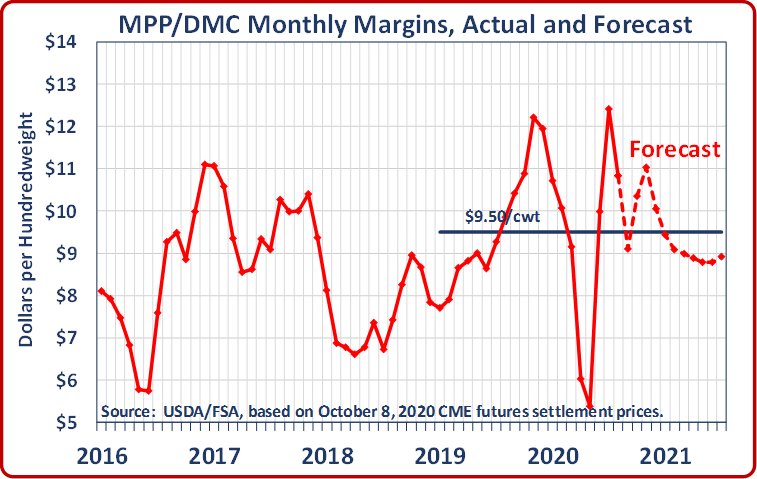
  • Affordable higher coverage levels that permit all dairy producers to insure margins up to $9.50/cwt. on their Tier 1 (first five million pounds) production history. Recent margin trends in reference to that $9.50 threshold is included in the graphic below.
  • Affordable $5.00 coverage that offers meaningful catastrophic coverage for farms of all sizes.

NMPF has a resource page on its website with more information about the DMC.