Dairy Brings Resilience for Ukraine Farmer

One year after Russia’s invasion of Ukraine, dairy cows are critical to keeping Kees Huizenga’s crop and livestock operation running as the war continues to bring hardship and suffering to the country and its agriculture.

When the war began, “I went to the people, to the old employees to talk to them and tell them not to panic and that we will all stay, and that we have to keep on running the farm and keep on feeding and milking the cows because they don’t care if it’s rockets or not. They have to be milked three times a day. And that’s what we did. And everybody stayed,” said Huizenga, who is now living in his home country of the Netherlands while managing the 2,000-cow dairy and crop farm he began more than 20 years ago near Cherkasy, Ukraine, about 120 miles southeast of its capital city of Kiev.

“The creamery, the processing factory, they never skipped one day in picking up the milk. They never skipped a day in paying. We gave them some milk for free and they processed it for free and they gave these products to refugees and to the army. And a lot of people, a lot of farmers did similar things.”

Looking at the next year, the biggest challenge for Ukrainian farmers is “the uncertainty,” he said. “You never know what’s going to happen tomorrow, if that rocket might hit your farm. We are still far away from the front line, but I know farmers who’ve been hit and who’ve been tortured and killed as well. So, I don’t know what the biggest uncertainties are. If there will be enough fertilizer available to grow a good crop. Seeds, are they more or less available. Prices because of these export complexities.”

The full podcast is here. You can also find the podcast on Apple Podcasts, Spotify and Google Podcasts. Broadcast outlets may use the MP3 file below. Please attribute information to NMPF.


NMPF Commends Farmers Speaking at House Farm Bill Listening Session

NMPF commended three NMPF cooperative members who spoke up for dairy producers today at a bipartisan House Agriculture Committee farm bill listening session held in Tulare, CA. California dairy producers Brad Bosch, Jared Fernandes and Tony Lopes each discussed farmer needs as lawmakers begin work on a reauthorization of farm programs due later this year.

House Agriculture Committee Chairman Glenn ‘GT’ Thompson, R-PA, presided over the session, accompanied by House Speaker Kevin McCarthy, R-CA, and Representatives David Valadao, R-CA, Jim Costa, D-CA, John Duarte, R-CA, Jimmy Panetta, D-CA, Doug LaMalfa, R-CA, Salud Carbajal, D-CA, David Rouzer, R-NC, and John Rose, R-TN. Held in one of the nation’s biggest milk-producing counties, dairy was top-of-mind as farmers and lawmakers discussed critical agricultural policies.

“Just as NMPF appreciates the work dairy producers do every day to nourish our nation and the world, we are grateful to each of our members for taking time out of their day to attend this important session,” said Jim Mulhern, president and CEO of NMPF. “We also thank Chairman Thompson, Speaker McCarthy, Representatives Valadao and Costa, and their colleagues for hosting today’s farm bill listening session.”

NMPF cooperative member farmers touched on critical issues NMPF is hoping the House Agriculture Committee will consider in crafting the 2023 farm bill, including key matters related to the Federal Milk Marketing Order system, the Dairy Margin Coverage program and other risk management tools, and the important sustainability opportunities that farm bill conservation programs provide to dairy producers of all sizes.

Among farmer comments:

Brad Bosch, southern California dairy farmer, California Dairies, Inc. and Dairy Farmers of America member-owner: “The dairy industry is working hard to reach a consensus on the Federal Milk Marketing Order improvements that will be submitted to USDA for consideration in a national federal order hearing.  Of most importance is returning to the ‘higher of’ Class I mover. The current formula is blamed for a nearly $1 billion loss over the last few years.

“Discussions in the industry are also focused on potential changes to the make allowance.  While make allowance changes will also go through a federal order process, the industry lacks the data to make good decisions on this issue. I hope that the next farm bill will include language giving USDA to authority to conduct mandatory plant cost studies so that we better understand the real cost of dairy manufacturing.”

Jared Fernandes, third-generation dairy farmer, Tipton, CA, Land O’Lakes, Inc. member-owner: “The 2018 Farm Bill made tremendous improvements to the dairy safety net, including through the Dairy Margin Coverage program. These changes provided better coverage levels, lower premiums and more flexibility for dairy farmers. We hope to build off of the improvements to both DMC and dairy insurance programs in the 2023 Farm Bill to continue providing dairy producers with straightforward, easy-to-use risk management tools.

“Next, we need bipartisan collaboration that encourages the adoption of conservation practices at scale. There is significant opportunity for farmers looking to utilize the USDA conservation programs, and the farm bill presents an opportunity to support and streamline these programs to make them easier for farmers to use and we encourage you to consider allowing the private sector, including farmer cooperatives and ag retailers, to extend the conservation delivery system.”

Tony Lopes, fourth-generation dairy farmer, Gustine, CA, CDI and DFA member-owner: “Across the California dairy industry, we largely view the 2018 Farm Bill as a legislative victory. It provided the much-needed safety net programs, the Dairy Margin Coverage as well as Dairy Revenue Protection, that has worked well for us through these unprecedented times through the pandemic and supply chain constraints. However, due to inflationary pressures, constraints related to how much milk volume can be enrolled in these programs as well as regionally different cost structures in calculating the milk-to-feed margin within the DMC, $9.50 is not the same as it was years ago, and it’s different in every region and every shape and size of operator. We just ask to echo Speaker McCarthy’s words with the opportunity to produce dairy on a level playing field with other regions across the country.

“Additionally, when we look at the Dairy Revenue Protection program, we ask that our friends in the dairy industry be afforded the same opportunity as our friends in the livestock sector to protect at 100% price coverage level, similar to that of the Livestock Risk Protection program. And lastly, recognizing the large component of the farm bill that is nutrition assistance. We just ask that you continue to prioritize U.S. dairy and beef production throughout that program.”


CWT Assists with 6.7 million Pounds of Dairy Product Export Sales

ARLINGTON, VA – Cooperatives Working Together (CWT) member cooperatives accepted 23 offers of export assistance from CWT that helped them capture sales contracts for 1.4 million pounds (618 MT) of American-type cheese, 50,000 pounds (23 MT) of butter, 4.9 million pounds (2,230 MT) of whole milk powder and 333,000 pounds (151 MT) of cream cheese. The product is going to customers in Asia, Central America, the Caribbean, Middle East-North Africa, and South America, and will be delivered from February through August 2023.

CWT-assisted member cooperative year-to-date export sales total 8.3 million pounds of American-type cheeses, 50,000 pounds of butter (82% milk fat), 17.8 million pounds of whole milk powder, and 1.2 million pounds of cream cheese. The products are going to 15 countries in five regions. These sales are the equivalent of 216.8 million pounds of milk on a milkfat basis. Over the last 12 months, CWT-assisted sales are the equivalent of 1.154 billion pounds of milk on a milkfat basis.

Assisting CWT members through the Export Assistance program positively affects all U.S. dairy farmers and cooperatives by fostering the competitiveness of US dairy products in the global marketplace and helping member cooperatives gain and maintain world market share for U.S. dairy products. As a result, the program has helped significantly expand the total demand for U.S. dairy products and the demand for U.S. farm milk that produces those products.

The amounts of dairy products and related milk volumes reflect current contracts for delivery, not completed export volumes. CWT pays export assistance to the bidders only when the export and delivery of the product is verified by the required documentation.

###

The Cooperatives Working Together (CWT) Export Assistance program is funded by voluntary contributions from dairy cooperatives and individual dairy farmers. The money raised by their investment is being used to strengthen and stabilize dairy farmers’ milk prices and margins.

NMPF Statement on Record Dairy Exports

From NMPF President and CEO Jim Mulhern:

“For the third consecutive year, U.S. dairy farmers have proven how their dedication to innovation and sustainability leadership increasingly have made them the world’s provider of choice for nutritious dairy products. In both value and in volume, U.S. sales are at all-time highs, and in 2022, a record percentage of U.S. milk production was exported overseas. This happened despite the headwinds our exporters battled last year, which included supply chain challenges, a lack of new trade agreements to establish more level playing fields abroad, and other barriers to trade that threatened to upend progress.

“Let this be a signal to the world: U.S. dairy farmers are, and will be, a growing force for global nutrition, sustainability and health, as shown by the increasing preference of consumers worldwide for the products they create. We’re excited to see today’s year-end export totals reflect a vision we’ve been pursuing for decades, and we look forward to seeing further progress in the years to come.”

NMPF’s Morris Talks Trade, Canada on Podcast

NMPF and USDEC Senior Vice President for Trade Shawna Morris discusses the need to hold accountable for its trade commitments on the Agriculture of America podcast. Canada’s improper allocations under its Tariff-Rate Quota system is impeding the market access promised U.S. dairy farmers under the USMCA trade agreement, making a legal remedy necessary. The U.S. needs to strongly defend its farmers, Morris said; while farmers are hoping for a fair solution with Canadian compliance, retaliatory tariffs against Canadian products may be necessary, she said.

CWT Assists with 608,000 Pounds of Dairy Product Export Sales

ARLINGTON, VA – Cooperatives Working Together (CWT) member cooperatives accepted eight offers of export assistance from CWT that helped them capture sales contracts for 88,000 pounds (40 MT) of whole milk powder and 520,000 pounds (236 MT) of cream cheese. The product is going to customers in Asia, Central America and the Caribbean, and will be delivered from February through June 2023.

CWT-assisted member cooperative year-to-date export sales total 6.9 million pounds of American-type cheeses, 12.9 million pounds of whole milk powder and 866,000 pounds of cream cheese. The products are going to 13 countries in five regions. These sales are the equivalent of 164.6 million pounds of milk on a milkfat basis. Over the last 12 months, CWT assisted sales are the equivalent of 1.1 billion pounds of milk on a milkfat basis.

Assisting CWT members through the Export Assistance program positively affects all U.S. dairy farmers and cooperatives by fostering the competitiveness of US dairy products in the global marketplace and helping member cooperatives gain and maintain world market share for U.S dairy products. As a result, the program has helped significantly expand the total demand for U.S. dairy products and the demand for U.S. farm milk that produces those products.

The amounts of dairy products and related milk volumes reflect current contracts for delivery, not completed export volumes. CWT pays export assistance to the bidders only when export and delivery of the product is verified by required documentation.

###

The Cooperatives Working Together (CWT) Export Assistance program is funded by voluntary contributions from dairy cooperatives and individual dairy farmers. The money raised by their investment is being used to strengthen and stabilize the dairy farmers’ milk prices and margins.

NMPF’s Bjerga On Equity in Federal Nutrition Programs


NMPF Senior Vice President for Communications Alan Bjerga discusses dairy’s need to promote its nutritional value for all consumers as concern for equity among all populations, including those that are lactose-intolerant, becomes a focus of federal nutrition policy. Bjerga also reveals his pick for the Super Bowl in an interview with WEKZ radio, Janesville, WI.

The Plant-based Lie That Needs to Die

There it was, #5 on a New York Times list of “10 Nutrition Myths Experts Wish Would Die.”

“Plant Milk is healthier than dairy milk.”

“It’s just not true,” said Kathleen Merrigan, professor of sustainable food systems at Arizona State University and a deputy secretary of agriculture under President Barack Obama, in the article. But indeed, the myth persists, despite how plant-based beverages have much-lower protein, numerous additives of dubious value, and a lack of uniform quality that should give anyone pause.

It’s also not shocking the misinformation continues. Money talks, and the plant-based sector is well-funded, with plenty of media allies and a ready-made base of support in a vegan community that insists a diet that’s impossibly difficult to follow and prone to malnourishment should be adopted by everyone. It also comes down to the names of the products themselves. If (whatever substance of the moment) is put in front of the word “milk,” then a false impression of nutritional equivalence, if not superiority, is easy to create. If that weren’t the intention, the plant-based beverage peddlers wouldn’t be doing it.

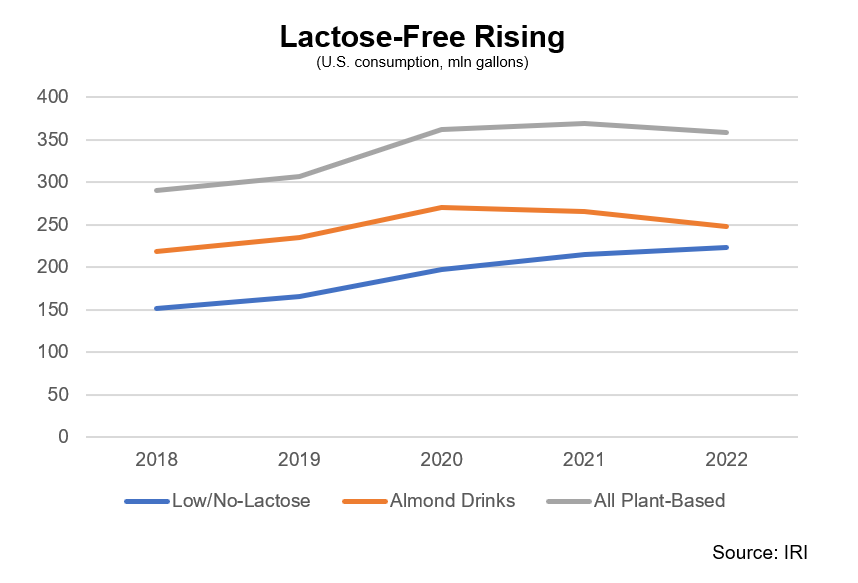
The good news is, nutrition experts are seeing through it – hence endorsement of integrity in dairy labeling from the American Academy of Pediatrics and others.  And consumers are seeing through it, which is why we’re seeing data like this, in which after years of gains, the plant-based tide is starting to recede.


But we still have the problem of the federal government — specifically the U.S. Food and Drug Administration — which often lags behind science and citizens.

Until the FDA enforces its own standards of identity for milk by getting dairy terms right – reserving them for the real thing to distinguish them from the nutritionally deficient concoctions that hide behind milk’s health halo – the lie of “healthy” plant-based “milk” is likely to persist. And as we’ve seen, that lie is proving difficult to eradicate.

For the sake of well-informed consumer choice, and better health and nutrition, it’s important that the government do its job to dispel the lie of plant-based beverages masquerading as “milk.” On that list, labeling integrity is #1.

NMPF’s Morris on Holding Canada Accountable


NMPF and USDEC Senior Vice President for Trade Shawna Morris discusses the latest round of conflict between the United States and Canada over over U.S. dairy access to that market. Morris praised the U.S. government’s willingness to take on Canada again after already winning on dispute before a USMCA dispute resolution panel. Morris speaks in an interview on RFD-TV.