NMPF Statement on Record Dairy Exports

From NMPF President and CEO Jim Mulhern:

“For the third consecutive year, U.S. dairy farmers have proven how their dedication to innovation and sustainability leadership increasingly have made them the world’s provider of choice for nutritious dairy products. In both value and in volume, U.S. sales are at all-time highs, and in 2022, a record percentage of U.S. milk production was exported overseas. This happened despite the headwinds our exporters battled last year, which included supply chain challenges, a lack of new trade agreements to establish more level playing fields abroad, and other barriers to trade that threatened to upend progress.

“Let this be a signal to the world: U.S. dairy farmers are, and will be, a growing force for global nutrition, sustainability and health, as shown by the increasing preference of consumers worldwide for the products they create. We’re excited to see today’s year-end export totals reflect a vision we’ve been pursuing for decades, and we look forward to seeing further progress in the years to come.”

NMPF’s Morris Talks Trade, Canada on Podcast

NMPF and USDEC Senior Vice President for Trade Shawna Morris discusses the need to hold accountable for its trade commitments on the Agriculture of America podcast. Canada’s improper allocations under its Tariff-Rate Quota system is impeding the market access promised U.S. dairy farmers under the USMCA trade agreement, making a legal remedy necessary. The U.S. needs to strongly defend its farmers, Morris said; while farmers are hoping for a fair solution with Canadian compliance, retaliatory tariffs against Canadian products may be necessary, she said.

NMPF Communicates Dairy Priorities to New Ag Trade Representatives, Congratulates Hill Leaders

NMPF and USDEC sent a letter on Jan. 23 to the U.S. Trade Representative’s Chief Agricultural Negotiator Doug McKalip and USDA Under Secretary of Trade and Foreign Agricultural Affairs Alexis Taylor congratulating them on their confirmations and detailing the market access and trade priorities that NMPF is looking to advance in 2023 and beyond.

After many months of delay, Congress finally confirmed McKalip and Taylor at the end of 2022. NMPF and USDEC strongly supported both McKalip and Taylor’s nominations and called on Congress to quickly confirm both nominees throughout the delay. NMPF looks forward to working with Taylor and McKalip to expand market access and push for other dairy priorities.

NMPF and USDEC also sent letters congratulating the new leadership of the House committees responsible for agricultural export promotion efforts and trade policy. The letters to Agriculture Committee Chairman Glenn “GT” Thompson (R-PA) and Ranking Member David Scott (D-GA), and Ways and Means Committee Chairman Jason Smith (R-MO) and Ranking Member Richard Neal (D-MA) relayed NMPF and USDEC’s dairy trade priorities, including increased funding for the Foreign Market Development and Market Access Programs, stronger protections for common names like “parmesan” and “feta,” and a more ambitious approach to tacking barriers to U.S. dairy exports.

NMPF will work closely with both committees to heighten the Congressional focus on agricultural trade issues in the coming year.

December CWT-Assisted Dairy Export Sales Totaled 7.1 Million Pounds

CWT member cooperatives secured 25 contracts in December, adding 7.0 million pounds of American-type cheeses and 37,000 pounds of cream cheese to CWT-assisted sales in 2022. In milk equivalent, this is equal to 65.2 million pounds of milk on a milkfat basis. These products will go to customers in Asia, Central America, the Caribbean and Oceania, and will be shipped from December 2022 through June 2023.

CWT-assisted 2022 dairy product sales contracts year-to-date total 99 million pounds of American-type cheese, 657,000 pounds of butter, 8.8 million pounds of cream cheese and 30.7 million pounds of whole milk powder. This brings the total milk equivalent for the year to 1.223 billion pounds on a milkfat basis.

Exporting dairy products is critical to the viability of dairy farmers and their cooperatives across the country. Whether or not a cooperative is actively engaged in exporting cheese, butter, anhydrous milkfat, cream cheese, or whole milk powder, moving products into world markets is essential. CWT provides a means to move domestic dairy products to overseas markets by helping to overcome U.S. dairy’s trade disadvantages.

The amounts of dairy products and related milk volumes reflect current contracts for delivery, not completed export volumes. CWT will pay export assistance to the bidders only when export and delivery of the product is verified by the submission of the required documentation.

NMPF’s Bjerga on Dairy’s Recent Policy Wins

As the year comes to a close, the National Milk Producers Federation is applauding two recent measures that support the dairy industry. NMPF Senior Vice President of Communications Alan Bjerga spoke with RFD-TV’s own Janet Adkison about how the Growing Climate Solutions Act and Sustains Act benefit dairy farmers, and what USTR’s announcement of a new request for dispute settlement consultations with Canada means for U.S. dairy.


https://www.rfdtv.com/two-recent-measures-from-congress-and-ustr-are-giving-a-boost-to-dairy-farmers

U.S. Dairy Salutes USTR’s Pursuit of Canadian USMCA Compliance

ARLINGTON, VA – The National Milk Producers Federation (NMPF) and U.S. Dairy Export Council (USDEC) commend the U.S. Trade Representative’s announcement today that it is filing a new request for dispute settlement consultations with Canada in order to expand the scope of the second U.S.-Mexico-Canada Agreement (USMCA) dairy dispute to include additional elements necessary to ensure that Canada fully complies with its USMCA obligations.

The initial USMCA dispute panel, launched by the United States in May 2021, found Canada in violation of USMCA’s tariff-rate quota (TRQ) provisions by reserving most of its preferential dairy TRQs for Canadian processors. In March 2022, Canada released its revised approach to USMCA TRQs, which still violated the USMCA, by providing inequitable advantages to Canadian dairy processors and failing to administer TRQs in a manner to ensure full use of TRQs as intended by USMCA. This prompted USTR to request formal consultations with Canada over the measures, the first step in bringing a second case before a USMCA dispute settlement panel.

Today’s actions are the culmination of months of painstaking work to evaluate the strongest basis for the United States’ case and find the best approach to bring Canada into compliance given its persistent violations.

“We thank USTR and USDA for their diligence in working to ensure that American dairy producers have the market access promised under USMCA. NMPF is committed to doing everything it can to support the case,” stated Jim Mulhern, president and CEO of NMPF. “At the end of the day, if Canada continues to flagrantly flout its obligations, the U.S. government has to be ready with retaliatory measures that make the Canadian government reconsider its actions.”

“It is deeply unfortunate that Canada simply refuses to honor the full terms of our agreement,” said Krysta Harden, president and CEO of USDEC. “USMCA is a fair deal that was thoroughly negotiated and agreed to by the Canadian government. The U.S. dairy community is thankful the administration and Congress have taken Canada’s violations seriously and are fighting for full export benefits that the American dairy industry earned.”


November CWT-Assisted Dairy Export Sales Totaled 18.6 Million Pounds

CWT member cooperatives secured 52 contracts in November, adding 6.2 million pounds of American-type cheeses, 348,000 pounds of whole milk powder and 1.2 million pounds of cream cheese to CWT-assisted sales in 2022. In milk equivalent, this is equal to 69 million pounds of milk on a milkfat basis. These products will go to customers in Asia, Central America, the Caribbean, Middle East-North Africa, Oceania and South America, and will be shipped from November through May 2023.

CWT-assisted 2022 dairy product sales contracts year-to-date total 92.1 million pounds of American-type cheese, 657,000 pounds of butter, 8.8 million pounds of cream cheese and 30.7 million pounds of whole milk powder. This brings the total milk equivalent for the year to 1.157 billion pounds on a milkfat basis.

Exporting dairy products is critical to the viability of dairy farmers and their cooperatives across the country. Whether or not a cooperative is actively engaged in exporting cheese, butter, anhydrous milkfat, cream cheese, or whole milk powder, moving products into world markets is essential. CWT provides a means to move domestic dairy products to overseas markets by helping to overcome U.S. dairy’s trade disadvantages.

The amounts of dairy products and related milk volumes reflect current contracts for delivery, not completed export volumes. CWT will pay export assistance to the bidders only when export and delivery of the product is verified by the submission of the required documentation.

NMPF Outlines Export Market Priorities to USTR

NMPF and the U.S. Dairy Export Council (USDEC) submitted comments to the U.S. Trade Representative (USTR) on Oct. 28 in response to the agency’s request for more information on foreign obstacles to trade and investment for its annual National Trade Estimate (NTE) report.

Over the last several years, the U.S. dairy industry has been put at a disadvantage by a lack of ongoing free trade agreement (FTA) negotiations and uneven enforcement of existing agreements. This inaction especially hurts American producers at a time when global demand for dairy products is rising. Given the great importance of exports to the success of the industry, NMPF called for the Administration to negotiate new FTAs and otherwise expand market access for U.S. exporters.

The comments also summarized country-specific barriers that governments around the world are implementing to impede U.S. dairy exports. Those measures include traditional tariffs, the misuse of geographical indications and overly burdensome health and safety regulations that target dairy products. In total, the comments outline trade issues with 37 countries or regions, as well as concerns related to Codex, World Health Organization and World Trade Organization issues.

Through its work with industry partners, NMPF will continue to encourage Congress and the Biden Administration to stand up for U.S. dairy and negotiate trade deals that support American dairy farmers.

NMPF’s Bjerga on the Congressional Elections and Dairy’s Challenges


NMPF Senior Vice President of Communications Alan Bjerga details some of the policy and marketplace challenges U.S. dairy is striving to meet, regardless of the cloudy outcomes of Tuesday’s congressional elections, in an interview with RFD-TV. Opportunities to grow markets via sustainability, an adequate safety net in the upcoming farm bill, and sensible industry regulation all loom in 2023, with dairy well-positioned to make progress.

Live, from the Dairy Bar, it’s NMPF!


NMPF Senior Vice President of Communications Alan Bjerga gives an impromptu tour of the Dairy Bar and the Joint Annual Meeting in Denver. From delicious products to critical information, the Dairy Bar has it all — and the meeting itself resulted in gains for dairy producers, as detailed in this interview with RFD-TV.

NMPF’s Bjerga on Annual Meeting, Dairy’s Challenges


NMPF Senior Vice President of Communications Alan Bjerga talks about some of the challenges dairy farmers face, and how they’re facing it together, in an interview with the National Association of Farm Broadcasters. As NMPF members gather in Denver this week for the organization’s annual meeting, milk-pricing modernization, sustainability and stewardship, and international trade are all taking the spotlight.

USDEC and NMPF Strengthen Ties with Sociedad Rural Argentina to Promote Science-Based Policy

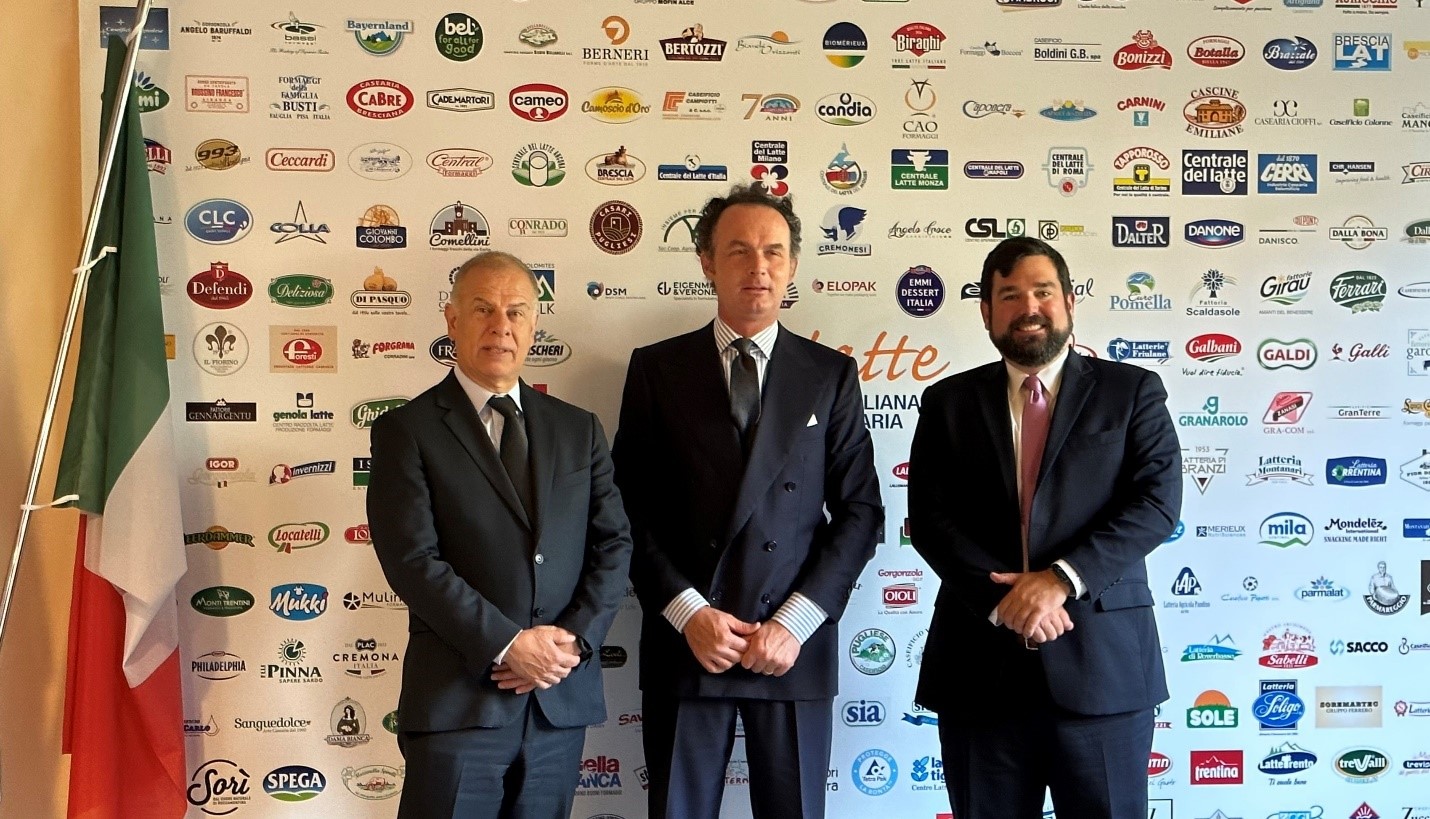
The National Milk Producers Federation (NMPF), U.S. Dairy Export Council (USDEC) and Sociedad Rural Argentina (SRA) today formalized an agreement to foster cooperation and collaboration between the three groups to advocate for science-based regulations across food and agricultural trade policy.

The Memorandum of Understanding (MOU) among the three groups sets forth a broad set of principles to guide collaboration on key issues that affect their members. The agreement spans two years and includes a strong focus on food policy priorities as well as Codex, sustainability, and food systems issues.

“U.S. dairy producers share common interests with their counterparts in Argentina, including global leadership on sustainability and regulatory standards,” said Jim Mulhern, president and CEO of NMPF. “SRA and its member recognize that we must ground new and evolving rules in the latest and best science, rather than allowing other agendas to distort food and ag policy.”

“We are proud to strengthen our partnership with Argentine agricultural producers on issues of common concern,” said Krysta Harden, president and CEO of USDEC. “Together we will work to ensure international regulatory policy is based in science, while we also endeavor to reduce unnecessarily burdensome barriers to trade between our two nations.”

“From the Sociedad Rural Argentina, we continue to work hard in pursuit of free trade, based on clear and fair rules, to achieve structural reforms to international trade in agricultural products, and in particular dairy products where there is great protectionism,” said Nicolás Pino, president of the SRA. “In this sense, we celebrate this agreement with North American milk producers and exporters that seeks to strengthen joint actions on the international agenda.”

The MOU between NMPF, USDEC and SRA complements agreements signed this year with the Inter-American Institute for Cooperation on Agriculture (IICA) and the Pan American Dairy Federation (FEPALE), providing USDEC and NMPF an additional avenue to communicate and engage with stakeholders in Latin America.