NMPF Annual Cheese Competition Goes Virtual

Due to the 2020 Joint Annual Meeting moving from an in-person to a virtual format, the 2020 NMPF Cheese Quality Competition is also going virtual. Because of travel restrictions and social distancing requirements, our cheese judges will evaluate select cheese classes at locations in California, Illinois, and Wisconsin on Oct. 15. Key changes this year include:

  • Co-ops will send cheese entries directly to the judges, divided by the classes each judge is judging;
  • The number of entries per co-op per class will be limited, to help keep the amount of cheese manageable for the judges;
  • Cheese entries should be no larger than 5 pounds. Cottage cheese entries should be in no larger than 2-pound containers; and
  • There has been minimal rearranging of the classes.

NMPF looks forward to having a great cheese contest that will showcase the wonderful cheeses our members make. More detailed instructions can be found here. Questions may be directed to jjonker@nmpf.org or mhanselman@nmpf.org.

Dairy Margins Decline on Prices; DMC 2021 Signup Begins Oct. 12

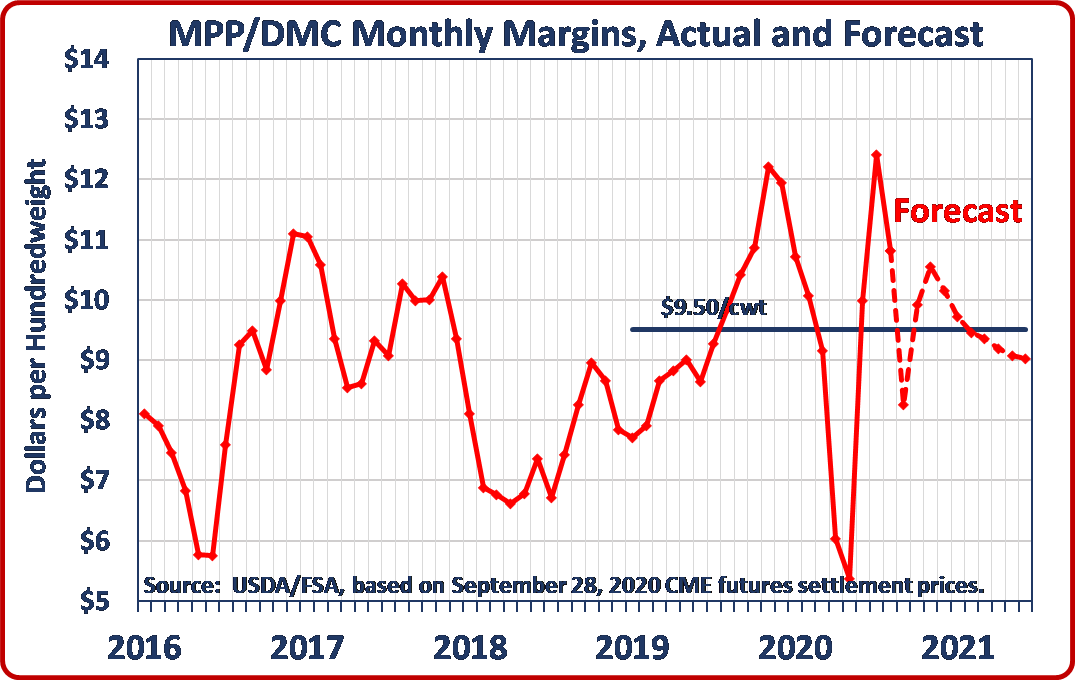
The monthly Dairy Margin Coverage (DMC) program milk price-feed cost margin for August was $10.83 per cwt. This was down $1.58 per cwt. from the July margin but still well above the $9.50 per cwt. needed to trigger payment under the DMC. The milk price dropped by $1.70 per cwt., from $20.50 per cwt. in July to $18.80 per cwt. in August. The feed-cost calculation for August was $0.12 per cwt. lower than in July, mostly on a lower corn price. The DMC feed cost has been dropping every month since April.

The USDA-sponsored DMC Decision Tool is currently anticipating a further drop in the margin to $8.26 per cwt. in September driven by lower prices, which would generate significant payments to the higher levels of coverage for the third month this year. Following this, the margin is expected to rebound above $9.50 per cwt. for the remainder of this year.

Signup for the DMC program for 2021 coverage will begin Oct. 12 and will run through Dec. 11. The USDA DMC Decision Tool is currently projecting the margin will begin to drop below $9.50 per cwt. starting in February next year and continue to drop at least through June. Enrolling in the program for next year is strongly recommended for those operations not already signed up under the previous multi-year enrollment option.

The DMC information page on NMPF’s website offers a variety of educational resources to help farmers make better use of the program.


NMPF 2020 Annual Meeting Free to Participants; Will Review Momentous Year for Dairy

The COVID-19 pandemic has changed, but not cancelled, NMPF’s 2020 annual meeting. This year’s joint meeting, held again in conjunction with the national checkoff groups overseen by Dairy Management Inc., will be held online and offered free of charge to all participants.

The two days of general sessions will be held midday Oct. 27-28, while other events associated with the annual meeting will be spread out before and after the main events. The NMPF Board of Directors will meet Friday, Oct. 16, then convene again on Thursday, Nov. 12, for its 2021 organization meeting, including a wrap-up of the Nov. 3 elections. The NMPF Delegates meeting will be Monday, Oct. 26, while NMPF Young Cooperator 2020 program sessions will be Oct. 29-30.

Registration information for the Oct. 27-28 programming can be found here. Sessions will include:

  • A panel featuring the farmer leadership of DMI, NMPF and the U.S. Dairy Export Council focusing on lessons learned during unprecedented times.
  • David Wasserman, House editor for The Cook Political Report, will offer an elections forecast.
  • NMPF’s Town Hall session, in which senior staff will share updates and answer questions regarding key policy issues that affect dairy farmers and U.S. dairy via a moderated discussion.
  • A dairy-organization executive panel will share promotion and policy priorities and plans for 2021 and beyond, including how COVID-19 has uncovered and accelerated opportunities for U.S. dairy. Featured panelists include DMI executives Tom Gallagher and Barbara O’Brien.
  • Peter Sheahan, founder of Karrikins Group, will share his thoughts on what creates innovation for companies looking to create value in their industries.
  • An industry spotlight panel will share critical updates and context around environmental stewardship and U.S. Dairy’s Net Zero Initiative. Panelists including dairy co-op, brand and organization leaders will share why this topic is more important than ever among dairy consumers and customers, and how U.S. dairy is positioning itself for today and in the future.

Congress Funds Government, Additional COVID Aid to Wait Until After Election

Congress returned to D.C. for a quick session in September before adjourning for the fall campaign season. Members passed a continuing resolution to keep the government funded through Dec. 11 but did not come to an agreement on another COVID-19 relief package.

The government funding measure includes an important provision that reimburses USDA’s Commodity Credit Corporation (CCC). The CCC is used to fund programs critical to dairy producers, such as the Dairy Margin Coverage (DMC) and other risk management programs and, more recently, USDA’s Market Facilitation Program and Coronavirus Food Assistance Program. NMPF joined other agricultural stakeholders to urge Congress to include CCC reimbursement in the funding measure.

“We are glad Congress reached a government funding deal that provides important support to farmers and families who have weathered incredibly difficult challenges all year long,” said NMPF president and CEO Jim Mulhern in a news release after the measure’s approval Sept. 30. “This measure not only avoids a government shutdown; it also ensures that additional COVID-19 assistance can be provided as further needs arise and provides important nutrition assistance to families in need.”

The funding measure paves the way for a final agreement on Fiscal Year 2021 Appropriations after the election. The House-passed Agriculture Appropriations measure contains multiple priorities for dairy, including a bipartisan amendment directing the U.S. Food and Drug Administration to allocate $5 million toward enforcing federal rules that reserve dairy-product terms for real dairy products. The bill also provides important funding for farmer stress programs, rural broadband, and nutrition assistance.

Congress did not agree on another round of COVID-19 relief, after months of discussions. Negotiations to resolve differences between the Democratic-controlled House measure, the HEROES Act, and various Senate Republican proposals stalled over disagreements on coronavirus-specific unemployment benefits, state and local aid, and other non-farm related issues.

The chambers’ plans agree more than they differ on dairy and agriculture provisions. The HEROES Act includes specific directives in how it funds USDA, including additional direct payments based on second-quarter losses without limits to those payments; $500 million for a new direct dairy donation program; $500 million for a new recourse loan program for dairy processors; and enhancements related to the Dairy Margin Coverage program. The Senate proposal provides $20 billion to USDA to support producers but gives less direction as to how the money should be spent.

The congressional sprint toward election day makes it unlikely that Congress will pass another COVID response bill anytime soon. NMPF will continue to work for further coronavirus relief for dairy, with the sector still reeling from coronavirus-related disruptions.

NMPF is advocating for emergency disaster assistance for dairy farmers that reflects losses regardless of an operation’s size or structure as well as additional direct dairy-product purchases for distribution to those in need, which will support communities and stabilize prices. NMPF also is working with members of Congress on a dairy donation program designed to maximize access to wholesome, dairy products for individuals and families facing food insecurity.

NMPF expects some type of additional support regardless of the outcomes of November’s election.

U.S. Dairy Exports to Benefit from New USDA-FDA Partnership

The U.S. Department of Agriculture (USDA) and Food and Drug Administration (FDA) today signed a Memorandum of Understanding (MOU) that will establish an interagency process to further support exports of U.S. dairy products. Both agencies play critical roles in facilitating foreign sales of American-made dairy products, which is recognized and appreciated by the U.S. dairy industry. This MOU will draw upon the expertise of FDA as well as USDA’s Agricultural Marketing Service (AMS) and Foreign Agricultural Service (FAS) to deepen and streamline their work together on the issues facing dairy exports to the benefit of U.S. dairy farmers and manufacturers.

The U.S. Dairy Export Council (USDEC) and the National Milk Producers Federation (NMPF) worked with both agencies to advance this new approach to dairy export collaboration. NMPF and USDEC deeply appreciate the USDA and FDA’s dedication to drafting this new MOU to facilitate U.S. dairy exports and their ongoing collaboration with the dairy industry. Foreign competitors are making advances in international markets, making efforts to expand overseas opportunities for U.S. dairy critical to the long-term health of U.S. dairy farmers and processors.

“Today’s announcement of an interagency MOU on dairy trade between USDA and FDA is the result of years of conversation and efforts between stakeholders within the U.S. dairy industry and the U.S. government to establish consistent guidance on tackling the rising number of export challenges facing our industry. This MOU will help our industry continue to grow in an increasingly competitive global environment,” said Tom Vilsack, president and CEO of USDEC.

“This new partnership ensures that the staff at USDA and FDA are working together in the most efficient way possible to lower barriers for our farmer’s dairy exports. Increasing U.S. dairy exports will strengthen the health of our farmers and rural communities, which is more important than ever as America’s dairy industry faces new and unprecedented challenges. We appreciate all of the hard work from both agencies and stand ready to support the USDA and FDA’s commitment to open new doors for U.S. dairy exports,” said Jim Mulhern, president and CEO of NMPF.

A Crisis Should Bring Opportunity – Not Opportunism

There’s an adage applied often in politics that “in the midst of every crisis lies great opportunity.” And while no one would ever wish for what’s happened in dairy markets over the past several months, this crisis does provide opportunities – to reaffirm the importance of cooperatives in marketing producers’ milk; to appreciate robust risk management protection initiatives like the Dairy Margin Coverage program, for which 2021 signup starts Oct. 12; and to remember the power that dairy has when it works together, both to stabilize markets and reassure consumers who turn to it in troubled times.

But it’s also important to distinguish between opportunities — which come from the lessons of a crisis — and opportunism, which exploits a crisis to push policies that may not lead to real improvements or prevent a similar crisis in the future. That contrast is important to remember when discussing what’s been a hot topic in dairy the past few months: the negative Producer Price Differentials that have resulted from the wild gyrations in markets, understandably frustrating farmers who don’t feel they’ve captured the full benefits of the market rebound we’ve seen.

Negative PPDs – which happen when milk-price swings among component classes fall out of sync — create an ugly accounting deduct line on a milk check. They’re frustrating, but they’re rare – in fact, negative PPDs have occurred during only 16 months out of the past 10 years. The ones we’ve seen recently have been based on extremely unusual circumstances, specifically the unprecedented price collapse that accompanied the COVID-19 pandemic and the impact of other factors, including the federal government’s response, which combined to whipsaw dairy markets.

When the pandemic hit this past spring, the nation’s foodservice industry ground to a halt, kneecapping a market that traditionally absorbs well over a third of total U.S. dairy sales and sending commodity markets into a tailspin. NMPF efforts weren’t limited to helping farmers with direct payments; NMPF and allied organizations also pursued federal government support to step in to purchase displaced dairy products and provide them for donation to those in need. Those efforts were hugely successful; they will result in hundreds of millions of dollars in federal government dairy-product purchases provided to food banks and other outlets, feeding families and buoying markets.

It’s important to keep in mind that while the federal government’s purchases of dairy products for donation contributed to bringing about the negative PPDs this summer, that outcome was vastly superior to the alternative of no government and industry action. The intervention sharply raised farm milk prices from catastrophic lows. Without this intervention, we were facing a sustained collapse of the U.S. dairy market, with ongoing massive losses within both the farm and processor communities.

While the government has purchased a variety of dairy products, the largest purchases have been for cheese. Those purchases, along with strong export sales, quickly and forcefully lifted commodity cheese markets from $1 a pound to nearly $3 a pound. That undoubtedly kept cheese plants open and saved family dairy farms – it also, in turn, dramatically boosted Class III milk prices. Meanwhile, the government to date has purchased limited amounts of butter and very little nonfat dry milk. That has resulted in much smaller increases in Class IV prices and created a large gap between Class III and IV.

That gap, along with the Federal Milk Marketing Order program’s standard advance pricing announcement of Class I fluid milk, led to high levels of Class III milk being de-pooled from federal orders rather than pay into the pool to share the revenue across the market. For co-op cheese plants that de-pooled, the revenue stayed within their farmer-owned operations and benefitted their members. Proprietary cheese plants may or may not have shared those monies with their farm suppliers.

The large amount of temporary de-pooling that occurred has certainly raised concerns in some markets. Those concerns could be addressed by looking at whether stronger pooling requirements are needed, something that is available and could be looked at on an order-by-order basis within the FMMO system.

Other, related issues could be examined as well — the FMMO system is always an area worthy of careful thought and consideration. But changes to a system that’s managed milk pricing for generations shouldn’t be the result of a knee-jerk reaction prompted by extremely rare, black swan events. Any suggestion otherwise isn’t one that’s seeking a genuine opportunity – it’s opportunism in a crisis, and it’s an approach of which dairy farmers should be wary.

We all know that making long-term policy changes in response to short-term disruptions and unprecedented conditions, even if challenging, rarely results in good policy. Instead, it can lead to longer-term unintended consequences that could permanently reduce farmer income without remedying any fundamental market shortcomings. Preventing negative PPDs can sound like a good idea – but how might a “fix” affect milk checks in more-normal times? Those are the questions that need to be explored. Concern with negative PPDs is understandable. But negative PPDs will largely go away once markets return to normal function, which ought to be our underlying goal.

At NMPF we are engaged in an ongoing review of the federal order system to identify areas for potential improvement, and for discussion with our members as we examine ways to create consensus among the nation’s dairy farmers and their cooperatives. We welcome input and ideas, and especially appreciate the thoughts expressed by our member cooperatives that so effectively represent their members’ collective judgment. This is what ensures that real opportunity is pursued.

This industry has been through a lot these past few months. Let’s use the time ahead wisely, gaining the most from the lessons we have learned as we seek together to benefit most from the opportunities that are certain to arise. These decisions should be made in a deliberate and organized manner, with dairy farmers and their cooperatives leading the effort.

NMPF Hails Funding Plan, Calls for Further COVID Relief

The National Milk Producers Federation today thanked Congress for sending bipartisan legislation to President Trump that extends government funding until Dec. 11 and urged Congress and the White House to reach agreement on another coronavirus relief package.

“We are glad Congress reached a government funding deal that provides important support to farmers and families who have weathered incredibly difficult challenges all year long,” said NMPF president and CEO Jim Mulhern. “This measure not only avoids a government shutdown; it also ensures that additional COVID-19 assistance can be provided as further needs arise and provides important nutrition assistance to families in need.”

The legislation passed by the House and Senate immediately replenishes the borrowing authority for USDA’s Commodity Credit Corporation. The CCC funds farm bill initiatives, including the Dairy Margin Coverage Program, as well as the Coronavirus Food Assistance Program, the second installment of which Agriculture Secretary Sonny Perdue announced earlier this month. Notably, it includes $8 billion in nutrition assistance and extends flexibility for school districts to make meals more affordable and accessible for students during the unprecedented COVID-19 pandemic.

NMPF hopes that, with the government funding debate resolved, Congress and the administration will now agree on another coronavirus relief bill. The House earlier this week released a revised version of its Heroes Act, which again includes important provisions such as a dairy product donation program that would help farmers and consumers. NMPF is continuing its push for additional, equitable support to all producers that reflects the losses they have suffered, no matter the size of the operation.

“The House and Senate both provide support for agriculture in their coronavirus relief proposals, and the House is reaffirming that support,” Mulhern said. “Congress and the administration need to bridge their differences and finalize a bipartisan plan that continues to provide needed disaster assistance to all dairy producers. The issues are challenging, but we believe policymakers are up to the task.”

Dairy Defined: Rep. ‘GT’ Thompson Praises Safety Net

The Dairy Margin Coverage program has worked well for the farmers who signed up for it, while other federal programs ranging from emergency loans to disaster payments have helped keep dairy farms afloat during the coronavirus crisis, said Rep. Glenn “GT” Thompson, R-PA, in an NMPF podcast.

On DMC, “I think we got it right,” said Thompson, the ranking member of the House Agriculture Committee’s General Farm Commodities and Risk Management subcommittee. He’s also a hopeful to become the top Republican on House Ag in the next Congress. “It has proven to be very, very helpful for those farmers that had the inclination the foresight to be able to sign up for that program.”

Thompson also decries the rise of “chalk water” rather than whole milk in school nutrition programs, advocates for improved milk options in the Women, Infants and Children (WIC) program, and discusses the state of politics this election season in the full podcast here. You can also find the podcast on Apple Podcasts, Spotify,  SoundCloud and Google Play. Broadcast outlets may use the MP3 file. Please attribute information to NMPF.


Ag Groups Call for More Resources to Protect Employees, Communities from Coronavirus

Over 160 farm, food and agriculture organizations today sent a letter to the White House Coronavirus Task Force calling for the federal government to take additional steps and devote new resources to help farmers, ranchers and growers across the country protect their employees from the novel coronavirus.

“Farmers continue to do our best to provide a safe workspace for all employees, promoting safety on and off the farm. Across the agriculture sector, employers have instituted best practices including social distancing, enhanced hygiene and sanitation procedures, employee training, and the use of personal protective equipment (PPE),” the letter states. “With the broad strain on PPE availability, testing, and other resources, however, we ask for your help as we continue to promote the health and safety of our farm employees and rural communities.”

Among the actions the groups recommend that the Task Force take are:

  • Adapting farmworker housing requirements to facilitate greater social distancing and allow for the use of alternative housing structures;
  • Ensuring that COVID-19 testing resources are accessible to agricultural employers and their employees and that results are available in a timely fashion;
  • Helping farmers offset the costs of COVID-19 mitigation expenses, while maintaining existing farm programs, by increasing Commodity Credit Corporation funds;
  • Prioritize PPE and future vaccine distribution for the food and fiber supply chain;
  • Leverage networks, in cooperation with states, counties, associations and community-based non-profits, to address the areas of community exposure risks to our workforce that are outside the occupational setting and ensure care is available and accessible to those who become ill, even in rural communities.

The letter notes that across many of these recommendations, expanding the pandemic response beyond the farm gate and into farming communities will be critical to ensuring the well-being of employees, their families and their neighbors.

A copy of the letter is available here.


About the Agriculture Workforce Coalition

The Agriculture Workforce Coalition (AWC) brings together organizations representing the diverse needs of agricultural employers across the country. AWC serves as the unified voice of agriculture in the effort to ensure that America’s farmers, ranchers and growers have access to a stable and secure workforce. For more information, please visit www.agworkforcecoalition.org.

Dairy Defined: Correction – Dairy Demand Is Not at a 56-Year High. It’s at a 60-Year High.

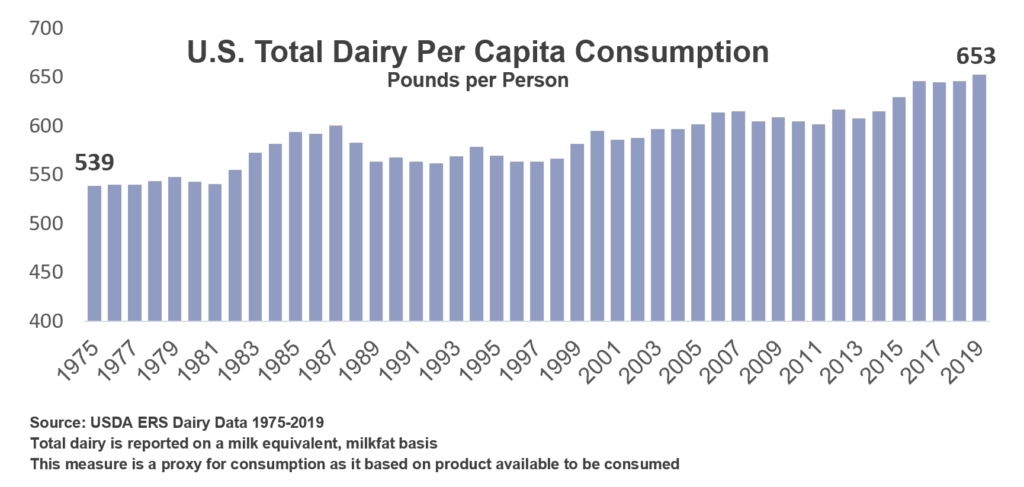
One year ago, Dairy Defined debuted with a simple piece of myth-busting, noting that, for all the vegan-activist-inspired dreams of the “death of dairy,” dairy products are growing only more popular, with U.S. per-capita consumption at a 56-year high. This information is now out of date.

U.S. per capita dairy consumption is no longer at a 56-year high. It’s at a 60-year high.

Increases in cheese and butter use last year pushed per-capita U.S. dairy to its most popular year since 1960. (People ate a little more ice cream too, but not thaaattt much more. Nothing to feel guilty about. Really.) Here’s the trend since 1975, when declining consumption stabilized and began to rise.

Yes, fluid-milk consumption dropped a little bit, and that’s always what dairy opponents like to cite when they talk about “decline.” Much of that decline, as we’ve noted, has to do with the rise of bottled water sales, not fake milk. But other dairy products more than offset the small fluid loss, with butter demand at its highest in more than five decades and cheese reaching another record, doubling its per-capita consumption from its levels during (speaking of cheese) the days of disco.

Even the fluid-milk numbers had its positives — whole milk consumption, for example, continued to rise, proving again that consumers are continually discovering that the more their milk tastes like milk, the more they like it. It’s worth noting that because these numbers are from 2019, aka Year 1 P.C. (Pre-COVID), it’s too early to tell how the pandemic will affect numbers next year. Restaurant and school disruptions have been a struggle that’s caused hardship for dairy producers. But robust retail sales bode well for the future, as did the emphatic vote of confidence dairy received from consumers when crisis set in.

Raise a glass to another milestone year in dairy demand. At Dairy Defined, the work of refuting the “death of dairy” is feeling a little bit easier than a year ago, though doing so remains as satisfying as ever, knowing that sometimes, actual facts still can carry the day. But the work is never done, as new myths inevitably arise. We look forward to dispelling them.

NMPF Offers Toolbox to Dairy Farmers as Latest CFAP Round Signup Starts Today

Following the USDA’s announcement last week of a new round of disaster assistance to agricultural producers, with signup beginning today, the National Milk Producers Federation has created a resource guide to help farmers understand and apply for the program. The toolbox, part of NMPF’s ongoing service to the dairy community during the coronavirus crisis, includes a breakdown of what the latest Coronavirus Food Assistance Program includes for dairy, as well as a link to relevant application resources.

“Helping dairy farmers understand complex government programs to gain their full benefits is especially important during this challenging time,” said Jim Mulhern, president and CEO of NMPF. “The best way to do that is to be there at the beginning, and we hope farmers will find these resources useful as they consider their options, starting today.”

Highlights of the so-called CFAP 2.0 include:

  • A dairy payment amounting to $1.20-per-hundredweight on a farm’s production during the last nine months of 2020. Dairy payments will be based on actual milk production from April 1 to Aug. 31, 2020. Milk production for Sept. 1, 2020, to Dec. 31, 2020, will be estimated by FSA, using daily average production from the April-August base period of known production.
  • 100% of the payment will be made once a farm’s eligibility is determined, meaning there will be no 20% holdback as with earlier assistance.
  • For dairy beef, producers are eligible for cattle inventory payment on bull calves and dairy steers, but not for breeding stock. The payment is $55-per-head on eligible cattle in inventory on a date between April and the end of August selected by the producer.
  • Significantly, this round’s payment limitation provision has been expanded to include trusts and estates for both rounds of CFAP payments, meaning those who were disadvantaged by restrictive trust-related payment interpretations in the first round will have their situation resolved for that round as well as in the latest tranche of aid. The application of direct attribution is also modified so payment limits won’t be reduced based on ownership shares, providing more equitable support to dairy farmers of various ownership structures.

A full range of coronavirus-related materials to help guide dairy producers, processors and allied businesses is available at nmpf.org/coronavirus. NMPF also has set up a separate webpage dedicated to resources to help dairy farmers struggling through natural disasters. That’s at nmpf.org/disaster-resources/.