Preparing for the unexpected

By The National Dairy FARM Biosecurity Program

Predicting the future is impossible. Preparing for the unexpected is possible. That was one of the topics discussed at the World Dairy Expo, where a panel explored the potential impact of emerging diseases on the dairy industry. As harvest wraps up and plans for 2026 get underway, consider creating continuity in your business plan if your dairy is unable to move raw milk or cattle for a few days – or longer.

Secure milk supply plan for continuity of business

Limiting animal and animal product movement is one strategy to control the spread of diseases. The Secure Milk Supply (SMS) Plan aims to support business continuity while not spreading disease. It was created because the dairy industry recognized how a “stop movement” of raw milk for a contagious animal disease would affect their business. The SMS Plan is a tool to use when cattle are affected by movement controls but not infected with foot and mouth disease (FMD) or a similar contagious animal disease. More information on FMD and the SMS Plan is available at www.securemilk.org.

The SMS Plan was created by the dairy industry and decision makers for the dairy industry and consumers. A group of dairy farmers, processors, milk haulers, veterinarians, disease and biosecurity experts at universities, and state and federal animal health officials came together to write the first SMS Plan. It was last updated in 2017, and both the dairy industry and disease response plans have changed. The National Milk Producers Federation (NMPF) recognized the need and assembled a stakeholder group in 2025 to propose updates. The SMS Plan development and updates were funded by USDA.

Benefits of SMS Plan updates

The SMS Plan updates include how to safely move raw milk and colostrum for animal feed and include new information on frozen semen and embryos. It’s expanding beyond FMD to include “similar contagious diseases” like highly pathogenic avian influenza (HPAI). This unexpected contagious disease spread to dairy cattle in 17 states, affecting animal health and business continuity. Updated resources for biosecurity are underway. Simplified movement guidance permit criteria are included. This broader set of preparedness tools helps the dairy industry, and ultimately, consumers of American dairy products.

Gathering feedback

NMPF and the stakeholder group seek your input on the proposed changes to the SMS Plan. Join a webinar, watch a recording of the changes, and submit comments by Dec. 20 at www.nationaldairyfarm.com.

The SMS Plan aims to help producers:

  • Develop contingency plans for interrupted movement.
  • Limit exposure to their herd through enhanced biosecurity.
  • Learn how to find early signs of disease.
  • Request an outbreak movement permit from state officials for raw milk (if required) and healthy animals going to harvest or another premises.
  • Continue to supply safe and wholesome milk to consumers.


Additional information:

What is foot and mouth disease (FMD)?

Sometimes called “hoof” and mouth disease, FMD is a very contagious foreign animal disease. It’s found in two-thirds of the countries of the world. The last U.S. case was in California in 1929. Germany, Hungary, and Slovakia had cases this summer after being FMD-free for over 50 years.

FMD causes blisters on the feet and in the mouth of two-toed (cloven-hooved) animals like cattle, sheep, pigs, goats, deer, bison, and other wildlife. Cattle with FMD will be lame, drool, and do not want to move or eat or be milked because of the painful foot, mouth, and teat sores. It does not affect people or food safety. Meat and milk are safe to eat and drink. An outbreak will have a significant mental health impact on individual farmers due to closed export markets, disease control measures, animal suffering, and financial uncertainty. Learn more about FMD at www.fmdinfo.org.


This column originally appeared in Hoard’s Dairyman Intel on Oct. 27, 2025.

U.S. Dairy Celebrates Market Access Advances in Southeast Asia

The National Milk Producers Federation and the U.S. Dairy Export Council praised today’s announcement of new trade agreements with Malaysia and Cambodia and new trade agreement frameworks with Thailand and Vietnam, strengthening U.S. dairy’s position in Southeast Asia’s high-growth market.

“With these new agreements, the administration has delivered big wins for America’s dairy farmers,” said Gregg Doud, president and CEO of NMPF. “Agreements like those struck with Malaysia and Cambodia will ensure we have fair access to Southeast Asia’s fast-growing markets. That’s essential so that our farmers and cooperatives can keep doing what they do best – producing top-quality milk and dairy products for families here at home and around the world. We look forward to working closely with the administration as they turn the new frameworks with Vietnam and Thailand into strong deals as well.”

“These agreements with Malaysia and Cambodia open new doors for U.S. dairy exports in two dynamic markets and the frameworks with Vietnam and Thailand offer the promise of more to come,” said Krysta Harden, president and CEO of USDEC. “By removing tariffs, addressing nontariff trade barriers and cutting red tape, the agreements will make it easier for U.S. suppliers to deliver the high-quality dairy ingredients and foods that Southeast Asia’s growing consumers demand. USDEC appreciates the great work of the U.S. negotiating team in securing these important results.”

The agreement with Malaysia will deliver meaningful gains for U.S. dairy exporters including the elimination of virtually all remaining dairy tariffs, state of the art protections for common cheese names, assurances regarding dairy certification, recognition of the U.S. dairy safety system, streamlining of facility registration requirements, and reinforcement of the vital importance of basing regulations on sound science.

The agreement with Cambodia delivers similar results extending to also include a full elimination of all tariffs on U.S. dairy exports and a prohibition on the establishment or maintenance of a facility listing requirement for U.S. dairy products.

The trade framework agreements with Thailand and Vietnam provide outlines of the provisions with each to come, both offering the promise of similarly strong outcomes on tariffs and nontariff barriers impacting dairy exporters.

Malaysia, Vietnam and Thailand are already among the top twenty export destinations for U.S. dairy products, account for $118 million, $127 million and $87 million respectively in sales last year. The new deal comes as the EU advances negotiations on free trade agreements this year with Malaysia and Thailand while Vietnam entered the sixth year of its FTA with the EU this year. All three also have long-standing deals with New Zealand and Australia. In light of this, the U.S. agreements are particularly important to maintaining U.S. competitiveness in this key region. While U.S. dairy exports to Cambodia totaled only $3 million last year, it too offers potential for further growth.

Enter to Win! Ayache Explains National Dairy Leadership Scholarship Program, Raffle

NMPF’s Nicole Ayache explains to Dairy Radio Now listeners how the National Dairy Leadership Scholarship Program supports graduate students enrolled in Master’s or Ph.D. programs who are actively pursuing dairy-related fields of research that directly benefit milk marketing cooperatives and the U.S. dairy industry at large. The scholarship is currently hosting a fundraising raffle to raise money for next year’s applicants. Use this link to enter the raffle by Nov. 12: https://go.rallyup.com/nmpf-raffle-2025/.


Dairy’s Future Bright, IDFA, NMPF Chairmen Say

Dairy’s future is bright, and it’s brightest when the industry is united toward common goals, the chairmen of the International Dairy Foods Association and the National Milk Producers Federation said.  

“$11 billion or so in projects are happening or about to happen that will significantly grow the industry capacity throughout the country,” said Daragh Maccabee, CEO of Idaho Milk Products and Chairman of the International Dairy Foods Association (IDFA) in the podcast released today. “That means the processor community is stepping up, and we all know that the dairy producer community will do its part as dairy farmers always, always do. And aligned with that investment also comes furthering innovation capabilities or further investment in innovation capabilities so that the U.S. can continue to lead the way in delivering value for milk in increasingly sophisticated ways.” 

The discussion covers the unique qualities of the U.S. dairy industry, including its scale, efficiency, and sustainability. Maccabee and Mooney, who serves as chairman of the National Milk Producers Federation and Dairy Farmers of America, the largest U.S. dairy co-op, with the strength of cooperatives and industry organizations are also highlighted as keys to industry progress. However, dairy faces challenges around labor shortages and trade uncertainty, they said. 

“We need new laws that help farmers continue to have the labor that we need on the farms to produce the milk. And without that, that’s the biggest critical issue that I see as what could affect future dairy production in this country, is just making sure the cows get taken care of and the cows get milked under the labor standards that we have today,” Mooney said. 

Still, the industry’s overall outlook remains something to cheer about, said Mooney, who soon will be stepping down as NMPF’s chairman. Reflecting on nearly two decades of leadership in that role, Mooney said it’s been an honor to be part of a profession that improves people’s lives.  

“This industry is going to be bright for the future of farming. It’s going to be bright for the producers,” he said. “And not only that, what makes me feel good at the end of the day is on our individual farms.” 

To hear more Dairy Defined podcasts, you can find and subscribe to the podcast on Apple Podcasts, Spotify and Amazon Music under the podcast name “Dairy Defined.”  


Shutdown brings disruption with no clear end

By Alan Bjerga, Executive Vice President, Communications & Industry Relations

The federal government shutdown is grinding through October, and it may only be the beginning. With both sides dug in and seeing little incentive to compromise, disruptions to federal services may be the new normal for some time — and that means farmers need to be prepared for what’s happening and coming next.

By now, the main contours of the shutdown’s effects on dairy farmers are in place.

  • Most Farm Service Agency (FSA) staff have been furloughed, and county FSA offices closed, although according to its shutdown plan, USDA should now be making available one employee per service center to complete urgent loan processing tasks for certain active loans. Still, no new loans will be processed at any point during the shutdown.
  • Meanwhile, most Natural Resources Conservation Service (NRCS) staff are furloughed and county NRCS offices closed, stopping payments and technical assistance on active contracts.
  • The recently announced Emergency Livestock Relief Program (ELRP) 2023 and 2024 flood program, a disaster assistance program that covers much of the nation, is paused.
  • Data reports covering U.S. milk production, trade data, and cold storage, are suspended, though USDA will continue to report pricing information, including the National Dairy Product Sales Report, and Market News information.
  • Many regulatory programs that are either funded by user fees or mainly run by states are continuing. USDA and FDA butter grading, the Agricultural Quarantine and Inspection (AQI) program or Animal Drug User Fee Amendments (ADUFA), to cite some examples of user-funded initiatives, are continuing to operate, while the Grade A milk program operated by states also continues.
  • Importantly, animal and plant health emergency programs, including those for New World screwworm, highly pathogenic avian influenza, exotic fruit flies, African swine fever, and rabies, are continuing.

Farmers caught one piece of good fortune in that the tax and spending package Congress passed earlier this year: The One Big Beautiful Bill Act reauthorized many farm bill programs, taking away that question mark. But, of course, administering those programs becomes more challenging when services aren’t available. Additionally, discussions of further assistance to farmers because of market disruption due to tariffs and other challenges are stymied until Congress surmounts the hurdles needed to get the government running again — another lost opportunity to shore up bottom lines battered by low commodity prices and economic volatility.

We at NMPF are monitoring the situation closely for signs of a thaw in the standoff, or of any changes in how government agencies are prioritizing limited resources during the shutdown. Any farmer can reach out to info@nmpf.org with concerns or questions as the shutdown evolves. The federal government touches lives in multiple ways, some that a farmer may not think about until it’s gone. We’re here to offer what support and information we can, hoping that the disruptions are settled as soon as possible.


This column originally appeared in Hoard’s Dairyman Intel on Oct. 13, 2025.

NMPF’s Bjerga shares latest shutdown updates


NMPF Executive Vice President, Communications & Industry Relations Alan Bjerga tells Dairy Radio Now listeners about the latest updates with the government shutdown and how it affects dairy farmers across the country.

Are You Dumber Than A European? A Quiz

This month’s Dairy Defined features an interactive quiz that’s a fun way to explore the difference between how plant-based beverages are labeled in the United States versus the European Union.

Plant-based peddlers in the United States have long insisted that they need to use dairy terms on their beverage products – in clear violation of FDA standards of identity – because if they don’t, consumers might not understand what they’re consuming. Au contraire, we argue. Using dairy terms for plant-based beverages is verboten in the European Union, yet somehow, those consumers comprenden that those beverages are for, you know, drinking and stuff like that.

So take the quiz and prove for yourself – are you dumber than a European? Can you figure out what plant-based beverage is, even without dairy terms? Take a chance! And disprove another lie. Let’s give it go and click the button below to start the quiz.


Take the Quiz


Caring for animals beyond the farm gate

By Beverly Hampton Phifer, Senior Director, FARM Animal Care

Fitness for transport is a term for an animal’s ability to withstand transportation, including length of trip, weather conditions, stocking density, and other factors, without compromising welfare. It is important to consider the entire trip a cow may take once it leaves the farm, not just its next stop — the sale barn — when determining an animal’s ability to withstand transport. Longer animal transport times increase risk of mortality and morbidity, particularly for calves and compromised animals, which are more likely to experience challenges during transport.

Consider the following when making dairy animal transportation decisions:

Overall animal health. Evaluate animal health, milk production, and other health factors. Exhausted or weak animals with a fever greater than 102.5°F should not be shipped.

Lameness/locomotion. Market animals when they first indicate signs of lameness or have mobility issues that could worsen.

Animals that have difficulty bearing weight on a limb and may also exhibit obvious back arch or head bob are not fit for transport. Animals in this category may be unable to move or be extremely reluctant to move, even when encouraged by a handler (Score 3 on the FARM Lameness scale).

Do not transport an animal that cannot stand for a period and repeatedly tries to lie down. That animal will likely also lie down in the trailer, causing injury.

Do not load nonambulatory (downer) cattle or animals that require assistance to rise — such as hip lifts or hobbles; this animal welfare issue will result in the animals being condemned at the plant.
 
Antibiotic stewardship. Any cattle being transported for slaughter must adhere to milk and meat withdrawal/withhold times.

Milk production. Ensure that cows are dried off or milked out. The 2022 National Beef Quality Assurance (BDA) report found that 74.9% of dairy cows had a full udder at the time of harvest which can create challenges in the slaughter process as well as serve as a potential contaminant.

Body condition. Thin animals, with minimal coverage around the tail head and short rib region, over the back, hooks, and pins should not be transported (Score 2 on the FARM Body Condition Scoring scale). Cattle that are extremely thin will not handle the rigors of transport because they are weak, don’t have enough energy stores, and are likely to become nonambulatory.

Calving. Cows that are close to calving, actively calving, or have very recently calved are not fit for transport. Slaughter facilities cannot process animals that are actively calving or have a retained placenta. Fresh cows need to have already passed their placentas before shipping.

 
Special considerations for calf transport

Calves are more susceptible than adult cattle to the stressors encountered during transport. The American Association of Bovine Practitioners (AABP) transportation guidelines outline that before relocating young stock, the following checklist should be completed:

Newborn calves receive colostrum or colostrum replacer.

Preweaned calves receive milk, water, and feed.

Animals are dry, well hydrated, able to stand without assistance, and free from illness and injury.

Animals that are not fit to transport may be suitable for processing locally if transported with special provisions. Treatment for illnesses, ailments, or low body condition may also be considered, as well as potentially euthanasia. Farmers should work closely with their veterinarian to determine next steps.

Current FARM Animal Care Version 5 standards require annual continuing education for anyone who handles animals on the farm, and a written protocol focused on fitness to transport. A fitness to transport informational booklet from the National BQA and the National Dairy FARM Program will be published this fall. For more information about the FARM Program, reach out to a cooperative or processor FARM evaluator, or visit nationaldairyfarm.com.


This column originally appeared in Hoard’s Dairyman Intel on Oct. 2, 2025.

Staff Promotions Recognize Expanded Work

NMPF announced two promotions within its economics team, taking effect as dairy faces market uncertainty amid trade challenges and cloudy economic forecasts.

Stephen Cain, who began at NMPF in 2020, is now Vice President of Economic Policy and Market Analysis, recognizing both his growing job responsibilities and his increasing position as a public representative of NMPF in industry conferences and other events.

Allison Wilton was promoted to Market Analyst, highlighting her continued growth and strong analytical contributions to NMPF. Wilton joined NMPF in 2022. Both Cain and Wilton also are active in NMPF’s NEXT program, blazing a new path in dairy trade globally.

NMPF Staff Deliver Outlooks, Trade Messages

NMPF staff reached out across dairy and agriculture audiences in September and during the August congressional recess with appearances in local and national meetings, discussing dairy’s economic outlook and the importance of free trade.

NMPF’s Jaime Castaneda, executive vice president for policy development and strategy, provided agricultural trade leaders and government officials a snapshot of opportunities and challenges for U.S. dairy exports in an unprecedented trade environment as a panelist at this year’s Midwest Agricultural Export Summit on Aug.13.

Hosted by South Dakota Trade in Sioux Falls, the event convened producers, policymakers and trade professionals in a forum to equip farmers and ranchers with the tools necessary to compete and grow in international markets. Castaneda joined a panel, “Breaking Down Barriers: Agriculture Industry Perspectives,” to discuss existing barriers to dairy trade and the Trump Administration’s newly announced trade frameworks.

Meanwhile, economics team staff addressed market outlooks domestically and internationally.

Will Loux, head of the joint economics team for NMPF and the U.S. Dairy Export Council, traveled Sep. 8-12 to Sydney, Australia to explore the potential for NEXT and U.S. dairy products in that market.

NMPF Market Analyst Allison Wilton gave a market outlook to the American Association of Bovine Practitioners in Omaha at its annual conference on Sep. 11. Later in the month she gave a similar presentation to Darigold staff in Seattle.

Stephen Cain, Vice President of Economic Policy and Market Analysis, in September presented at the U.S. Dairy Ingredient Supply Seminar in Ho Chi Minh City, Vietnam, and to Bangkok, Thailand for the U.S. Dairy Supply & Innovation Seminar.

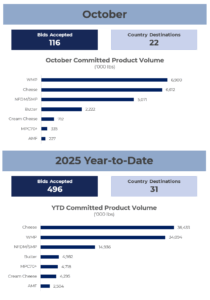
NEXT-Assisted Export Sales Near 24 Million Pounds as September Winds Down

NEXT member cooperatives secured 60 contracts in September, with one week still outstanding for the month; full-month data will be available later this week. These contracts added 23.9 million pounds of product in NEXT-assisted sales in 2025. These products will go to customers in Asia, Oceania, Middle East-North Africa, Central America, the Caribbean and South America and will be shipped from September 2025 through May 2026.

Exporting dairy products is critical to the viability of dairy farmers and their cooperatives across the country. Whether or not a cooperative is actively engaged in exporting, moving products into world markets is essential. NEXT provides a means to move domestic dairy products to overseas markets by helping to overcome U.S. dairy’s trade disadvantages.

The referenced amounts of dairy products reflect current contracts for delivery, not completed export volumes. NEXT will pay export assistance to bidders only when export and delivery of product is verified by submission of required documentation.