Dairy Engaged in Busy Lame-Duck Congressional Session

Congress is working to finish several key measures before adjourning for the year, one with special urgency for Democrats as Republicans take control of the House of Representatives in January.

While Republicans netted enough House seats to flip the chamber as a result of November’s elections, they did not win as many seats as they were expected and did not reclaim control of the U.S. Senate, making any shifts in the upcoming 118th Congress potentially less dramatic than some analysts anticipated before the election. Members are hoping to wrap up business that includes dairy farmer and cooperative priorities. Among highlights:

  • Getting ag labor reform across the finish line. The Senate is currently working on its own ag labor measure, refining and improving upon the reforms provided by the Farm Workforce Modernization Act, a bipartisan House-passed measure that would provide permanent legal status for current farm workers and their families and reform the H-2A agricultural guest worker program to include dairy and other year-round workers. Senators in both parties have been seeking to strike agreement on a compromise version that can garner 60 Senate votes. NMPF continues to work closely with Senate negotiators to seek a path forward for any such final measure.
  • Passing a fiscal year 2023 spending bill to fund the government. NMPF continues to advocate for enhanced funding for the Food and Drug Administration to review and approve animal feed ingredients that can reduce enteric methane emissions from livestock by as much as 30 percent, which will be critical as dairy seeks to reach its goal of achieving a net zero greenhouse gas footprint by 2050.
  • Another key dairy priority in appropriations is securing additional funding for dairy farmers whose reimbursements under USDA’s Pandemic Market Volatility Assistance Program were limited by the program’s five-million-pound per producer cap, as well as those farmers unable to receive program funds because their milk was not pooled on a Federal Milk Marketing Order but still endured similar price losses. USDA created the program last year to partially reimburse farmers for unintended COVID-19 pandemic losses caused by the heavy weighting of federal dairy purchases toward cheese combined with a change to the Class I mover formula in the 2018 Farm Bill.

CWT Assists with 2.3 Million Pounds of Dairy Product Export Sales

Cooperatives Working Together (CWT) member cooperatives accepted 17 offers of export assistance from CWT that helped them capture sales contracts for 1.6 million pounds (734 MT) of American-type cheese and 717,000 pounds (325 MT) of cream cheese. The product is going to customers in Asia, Central America, Middle East-North Africa, and Oceania, and will be delivered from December through May 2023.

CWT-assisted member cooperative year-to-date export sales total 92.1 million pounds of American-type cheeses, 657,000 pounds of butter (82% milkfat), 30.7 million pounds of whole milk powder and 8.8 million pounds of cream cheese. The products are going to 21 countries in six regions. These sales are the equivalent of 1.157 billion pounds of milk on a milkfat basis.

Assisting CWT members through the Export Assistance program positively affects all U.S. dairy farmers and cooperatives by fostering the competitiveness of US dairy products in the global marketplace and helping member cooperatives gain and maintain world market share for U.S dairy products. As a result, the program has helped significantly expand the total demand for U.S. dairy products and the demand for U.S. farm milk that produces those products.

The amounts of dairy products and related milk volumes reflect current contracts for delivery, not completed export volumes. CWT pays export assistance to the bidders only when export and delivery of the product is verified by required documentation.

Bipartisanship Advances Dairy as New Congressional Landscape Forms

With Congress’s “lame-duck” session underway and last month’s elections almost fully settled, it’s clear how quickly political fortunes can turn and conventional wisdom can be upended.

The Congress that’s seated next month will have a Democratic-led Senate, regardless of the outcome in the Georgia run-off, and a Republican-led House of Representatives. That’s after an election cycle in which Republicans achieved a narrow House majority but fell short of the red wave that many pundits expected. It’s yet another cycle where actual voters didn’t behave as predicted. In 2020, Republicans made solid gains in the House despite President Biden’s victory. And of course, everyone knows just how significantly the biggest upset of 2016 has affected American life.

These realities of uncertain futures and fast-changing fortunes only reinforce a principle central to the National Milk Producers Federation’s policy successes: We strive to be a studiously, emphatically, bipartisan organization. We believe in tangible, lasting gains for our members, which comes through successes that can’t be undone by an executive order or tempt an out-of-power party to overturn it the next time it’s in power again. The paths we chart in farm bills, the durable regulatory certainties we strive for our members, and the goals we pursue as the policy voice of dairy farmers and their cooperatives do not waver based on short-term political gains. We take a longer view of building bridges, not burning them, and of fostering positive relationships on both sides of the aisle rather than succumbing to toxic Washington partisanship.

This approach affords us confidence in our opportunities both in the current lame-duck session and in the upcoming 118th Congress. Immigration reform, a decades-long priority for our members, is gaining intense attention as the current Congress attempts to smooth the path for the next one. Thanks to our strong relationships on both sides of the aisle, we’re hopeful that the approach we endorsed in the imperfect, but essential, Farm Workforce Modernization Act can be improved in the Senate and signed into law. We’re working overtime to make it happen – you can get involved too by visiting the Call-to-Action found on our website.

At the same time, we’re confident that the sustainability gains we made in last August’s Inflation Reduction Act, including a critical new investment tax credit for methane digesters, can be furthered in the next Congress. Even though the larger bill was passed by the narrowest of partisan votes, our tax credit proposal had strong bipartisan support in both the House and Senate on its way to being signed into law. New Republican leadership undoubtedly will have its own approach to issues such as sustainability, and divided government always presents challenges when building the consensus needed to build bipartisan solutions.

But we also know that we have strong relationships with critical dairy advocates like incoming House Agriculture Committee Chairman Glenn “GT” Thompson of Pennsylvania, Senate Agriculture Committee Chairwoman Debbie Stabenow of Michigan, and others. And that puts our priorities and goals in a good position to advance in the next Congress as lawmakers work on issues ranging from the 2023 Farm Bill to trade policy and supply chain challenges.

Such lasting success only comes from the mutual respect and strong relationships we’ve built – and continue to build — in both parties. At a time when trust in Washington is low and fatigue over bitter partisanship is high, we’re excited for what lies ahead. We know we can make a difference for dairy because we’ve done it, are doing it, and will do so in the future regardless of the partisan alignment at any given time. Whatever twists the policy road may take, we’re well-prepared to travel it because of our own principles of service and progress.

That would have been the case regardless of whatever the electoral outcomes watched so closely in November had turned out to be. That’s behind us now. It’s time to focus on the months ahead.


President and CEO, NMPF

NMPF Calls on Congress to Act to Avert Dairy-Devastating Rail Strike

From NMPF President and CEO Jim Mulhern:

“Congress needs to take immediate action to avert a nationwide rail strike that would damage dairy producers and deprive consumers of critical nutrition. Dairy is a 24/7 industry producing a highly perishable commodity. Any disruption of national transit networks not only keeps products from moving efficiently to markets; it deprives farmers and their processing cooperatives of everything from the feed they need for their animals to the supplies needed to continue production.

“A rail strike also would bring chaos to agricultural supply chains, as its ripple effects on trucking and other industries would complicate transport of goods everywhere from grocery stores to export markets, all the while adding another cold blast of inflation to consumer expenses this winter as products inevitably become scarce.

“With a strike looming in mere days, now is the time to act. We urge Congress to make prevention of this strike today’s top priority.”

IDF World Dairy Summit a U.S. Dairy Opportunity

The International Dairy Federation (IDF) World Dairy Summit brings unique opportunities for U.S. dairy as the host nation for the Chicago event, to be held next Oct. 16-19. The global conference returns to the United States for the first time in three decades, at a moment when rising exports and world-leading sustainability gives the U.S. industry a great story to tell, according to three leaders in organizing next year’s events.

“It’s a really exciting time for our industry, and we think that there’s a tremendous opportunity, a tremendous amount of potential that dairy, globally, has here,” said Shawna Morris, Senior Vice President for Trade at the National Milk Producers Federation (NMPF) and the U.S. Dairy Export Council (USDEC). “Looking at how we tap into that together is what we’re focused on doing through the conference.”

“Bringing all of these folks to the United States creates an opportunity to get folks into facilities, to get them out to farms, to really show the rest of the global dairy industry what the U.S. dairy industry is all about,” said Nick Gardner, chairman of the U.S. International Dairy Federation, the Senior Vice President for Sustainability and Multilateral Affairs at USDEC, and with Morris the co-chair of next year’s summit.

“This is an excellent opportunity for the U.S. dairy industry to highlight its world leading dairy production from the farm through our cooperatives and processors and out to the consumers,” said Jamie Jonker, NMPF’s chief science officer and chair of IDF’s Science Program Coordinating Committee. “It’s a way for us to step on the world stage, reintroduce U.S. dairy, its innovation and technology to the global marketplace, and demonstrate how we are world leaders.”

Morris, Gardner and Jonker also discuss how the dairy community can get involved with supporting the event, already highlighted by platinum-level sponsor Dairy Management Inc., as planning for it is already in full swing. More in the summit can be found here. You can find the podcast on Apple Podcasts, Spotify, Google Podcasts and Amazon Music.


Happy Thanksgiving! There’s Plenty of Butter

First, the bad news (for consumers): Heading into the holiday baking season, butter prices are, indeed at an all-time high. That’s for a few reasons. The biggest one is simple demand. Americans love butter, with the highest per capita consumption since the 1960s leading to the highest overall demand ever for the nation’s pre-eminent spread and ubiquitous baking ingredient. Overseas markets are also getting in on the act, with another record year for dairy trade possible in 2022.

Meanwhile, butter supplies haven’t, as of yet, been able to keep up with that demand enough to stabilize prices. That’s especially been the case in the past couple months, when retailers traditionally stock up in anticipation of the holidays. And of course, once you get past the actual cost of making butter itself and then add transportation, packaging, labor, and all the other the costs that are making everything else more expensive too, you have a recipe for record butter prices on the grocery shelf. And that’s making consumers (and media) notice.

But are higher prices the same thing as a “shortage”? We posit, not. Are store shelves empty? There’s always some one-off instances somewhere, but with those exceptions, no. Are crowds of consumers lining up for blocks outside local supermarkets to buy out rationed supplies, like early-COVID toilet paper? (Everyone stand six feet apart, please!) No again. And is anyone who wants to buy butter currently being deprived of anything other than $5 should they choose a four-pack, maybe a little extra if it’s extra-creamy European Style?!?? (And often less is you catch a good sale.)

That’s three strikes, and still, no one’s out of butter.

It’s easy to understand the concern: Butter is, after all, nature’s most perfect sandwich spread, the ingredient that makes a top-quality croissant worthy of a nasal-sounding French pronunciation. And even with all this, the underlying concern that’s fueled the “shortage” worries is itself showing signs of fading. Milk production is on the rise again, and with that, butter futures traded on commodities markets are declining. While some product prices rise and stay that way, butter goes up and down. Take a look at this chart — a dozen years of butter-price history that includes both the value of butterfat to a farmer (blue line) and the cost at the grocery store (orange line). See how they move together – and see where the blue line’s expected to go in 2023.
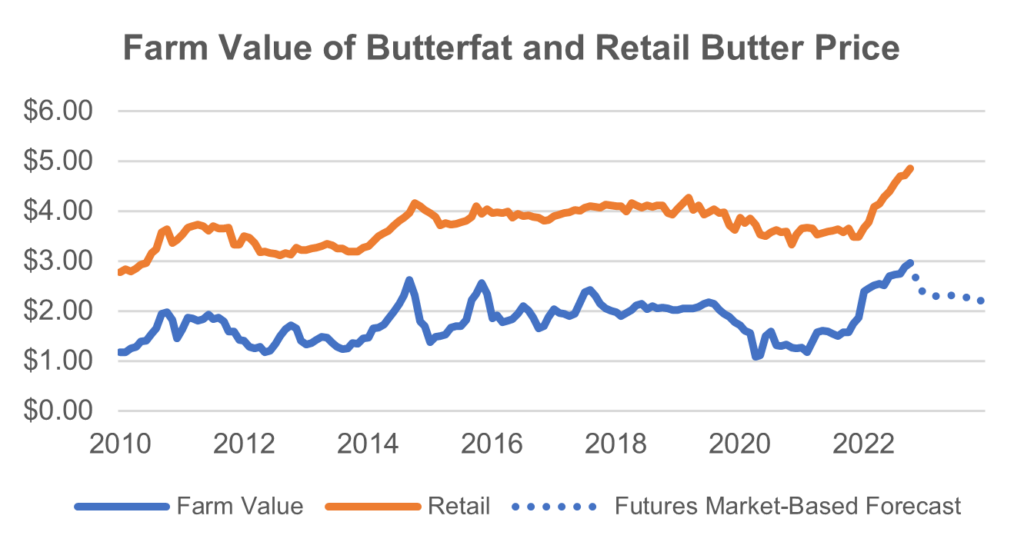


“What goes up, must come down” applies to butter. Production chases prices, and eventually higher production pushes prices down. That’s not always so great for farmers, by the way – and one nice thing for them about current pricing is that it’s helping farmers smooth out a challenging few years and rebuild the balance sheets they need to thrive. So be patient if you’re feeling sticker shock, and in the meantime, feel good that you’re helping a farmer.

But above all, don’t feel like you’re at risk of a butterless Christmas. The food chain, and the law of supply and demand, are ensuring that doesn’t happen. The holidays would be less happy without butter, but it just ain’t gonna happen. So Happy Thanksgiving. And here’s to, um, butter days ahead.

Congressional Balance Affects Dairy Policy but Doesn’t Shift Priorities

Control of the House of Representatives remains in doubt nearly one week after last Tuesday’s elections. But regardless of who is in charge in 2023, dairy’s priorities will move forward, says Paul Bleiberg, NMPF’s Senior Vice President for Government Relations, in a Dairy Defined podcast released today.

“The basic policy priorities remain the same,” said Bleiberg. “There are some areas where we might have more support from Republicans, some where we might have more support from Democrats, some where we might have more support on regional lines, and it’s really a question of strategy. Who’s going to be on the Agriculture Committee? Who’s going to be on the Appropriations Committee or the Ways and Means committee? Who are the members that we might go to kind of champion different priorities in those or other committees? That sort of is subject to those dynamics, but our priorities will be our priorities.”

You can also find the podcast on Apple PodcastsSpotifyGoogle Podcasts and Amazon Music. Broadcast outlets may use the MP3 file. Please attribute information to NMPF.

October CWT-Assisted Dairy Export Sales Totaled 5.1 Million Pounds

CWT member cooperatives secured 39 contracts in October, adding five million pounds of American-type cheeses and 77,000 pounds of cream cheese to CWT-assisted sales in 2022. In milk equivalent, this is equal to 47 million pounds of milk on a milkfat basis. These products will go to customers in Asia, Central America, Europe and Middle East-North Africa, and will be shipped from October through April 2022.

CWT-assisted 2022 dairy product sales contracts year-to-date total 86.1 million pounds of American-type cheese, 657,000 pounds of butter, 7.6 million pounds of cream cheese and 30.3 million pounds of whole milk powder. This brings the total milk equivalent for the year to 1.090 billion pounds on a milkfat basis.

Exporting dairy products is critical to the viability of dairy farmers and their cooperatives across the country. Whether or not a cooperative is actively engaged in exporting cheese, butter, anhydrous milkfat, cream cheese, or whole milk powder, moving products into world markets is essential. CWT provides a means to move domestic dairy products to overseas markets by helping to overcome U.S. dairy’s trade disadvantages.

The amounts of dairy products and related milk volumes reflect current contracts for delivery, not completed export volumes. CWT will pay export assistance to the bidders only when export and delivery of the product is verified by the submission of the required documentation.

FARM Participants Opt-In to the Environmental Stewardship Conservation Practice Questionnaire

Since its launch in August, when FARM Environmental Stewardship (ES) launched the Conservation Practice Questionnaire (CPQ), an optional add-on questionnaire to the FARM ES Version 2.0 evaluation. Since its launch, seven FARM Program participants have opted to implement it.

The existing FARM ES evaluation focuses on greenhouse gas emissions and energy use; this conservation questionnaire goes beyond these topics to ask about dairy farmers’ field and dairy-level conservation practices to capture a more holistic sustainability story. The questionnaire addresses areas covered in the industry’s 2050 environmental stewardship goals along with other topics that are of growing interest to customers and consumers.

Organizations that participate in FARM ES Version 2.0 have the option to voluntarily sign on to use the CPQ. Organizations may also choose not to use the CPQ with no impact on their participation in FARM ES. Interested participants should email dairyfarm@nmpf.org.

NMPF Provides Opportunities for FARM Participants, YCs at World Dairy Expo

The National Dairy FARM Program and YC Program joined industry stakeholders in Madison, WI Oct. 3-7 for the 2022 World Dairy Expo, boosting NMPF’s presence at the prestigious event for dairy farmers yet again.

FARM hosted a Lunch & Learn session with Zoetis and Alltech about employee management on, Oct. 6, with a session recording made available here. FARM also co-sponsored a Fitness to Transport “Knowledge Nook” session with Elanco Animal Health on Oct. 7.

The YC Program hosted a workshop, “Road Markers to the Future Business of Milking Cows,” on Oct. 6, in which YCs explored the steps that young and beginning dairy farmers must take to be successful today, and in the future. The session recording is available here. Forty YCs from seven member cooperatives participated in the session and reception later that day.

NMPF also sponsored a panel on the Federal Milk Marketing Order system, “The Future of our Dairy Markets – What Reforms Are Needed?” to introduce FMMO reforms and highlighted the NMPF internship program at the “Career Connections Networking Event”.