Tag: dairy economics
Trust is a Dairy Superpower
What makes dairy so valued that milk alone is in 94 percent of U.S. refrigerators? Nutrition is one factor. So is affordability. But perhaps the greatest value is one that data supports: People trust it.
The dairy checkoff’s latest consumer perception tracker, conducted by Kantar Group, shows just how much confidence dairy has from consumers – and it’s a great contrast to the loud braying of the anti-dairy fringe, which takes up more brain space among the sane and grounded than should. Rated on a 1-7 scale of trust, with 1 being none and 7 being total, 58 percent of consumers rated dairy at 5 or above, according to the nationally representative sample of consumers aged 13-65.
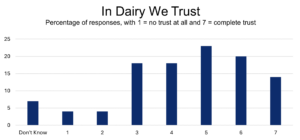
That same survey, conducted last November and December, showed 35 percent either strongly or completely trusting dairy, shown by ratings of 6 and 7. That high trust level held across generations. Baby boomers led at 38 percent of strong or complete trust; Generation X, a cohort famed for trusting no one, was lowest at 33 percent. And the future looks stable and bright. About 34 percent of teenagers strongly or completely trusted dairy, with young adults at 35 percent and Millennials at 36. And again, these were the highest ratings of trust – including less-fervent support, clear majorities spanned generations.
Dairy also did well when compared with other foods and industries. Dairy’s 58 percent trust level compares well with beef (53), almonds (51), tech (53, sorry Zuckerberg and Musk) and finance (43 – with apologies to Wall Street).
To sum up: In an increasingly fractured climate plagued by misinformation, dairy continues to attract broad-based support across wide swathes of society. In a superpower nation where trust is declining, dairy has its own superpower – trust from consumers that remains strong.
Pretty heavy stuff, when you think about it. But dairy can carry the load, with unparalleled nutrition, uncommon consumer reach and high levels of consumer trust. It’s a refreshing situation, appropriate for refreshing products.
June DMC Margin Gains $1.14/cwt to $11.66/cwt
The Dairy Margin Coverage Program margin in June was $11.66/cwt after adding $1.14/cwt over the previous month.
The June all-milk price was $22.80/cwt, up $0.80/cwt from May, and the DMC feed cost dropped by $0.34 for the month, mostly on a lower premium alfalfa price. The DMC margin calculated by USDA has risen $2.06/cwt over the past two months, reaching a level well above the threshold at which payments are generated by falling margins.
Futures-based forecasts at the end of July indicate that the DMC margin will average about $11.90/cwt during 2024, $0.40/cwt higher than similar forecasts indicated a month ago, with a peak in October, a sign that producers may have an opportunity to repair battered balance sheets over the next several months.
Supply-Demand Balance Pushes Milk Prices Higher
Dairy Data Delights, and Completes Your Summer Reading List
Impress your friends and dazzle your pub trivia team: Did you know that the average American worker only needs to work half as long to pay for a half gallon of ice cream as in 1960? Can you say, luxurious and affordable?
It’s in the numbers. Despite hourly wages that averaged $2.09 an hour the year John F. Kennedy was elected president (and both Joe Biden and Donald Trump were teenagers), the relative changes in wages and ice cream prices have made America’s favorite frozen dessert (Happy National Ice Cream Month) twice as affordable now, according to Labor Department data. What once took nearly 25 minutes of a U.S. worker’s hourly wage to buy takes less than 12 minutes now.
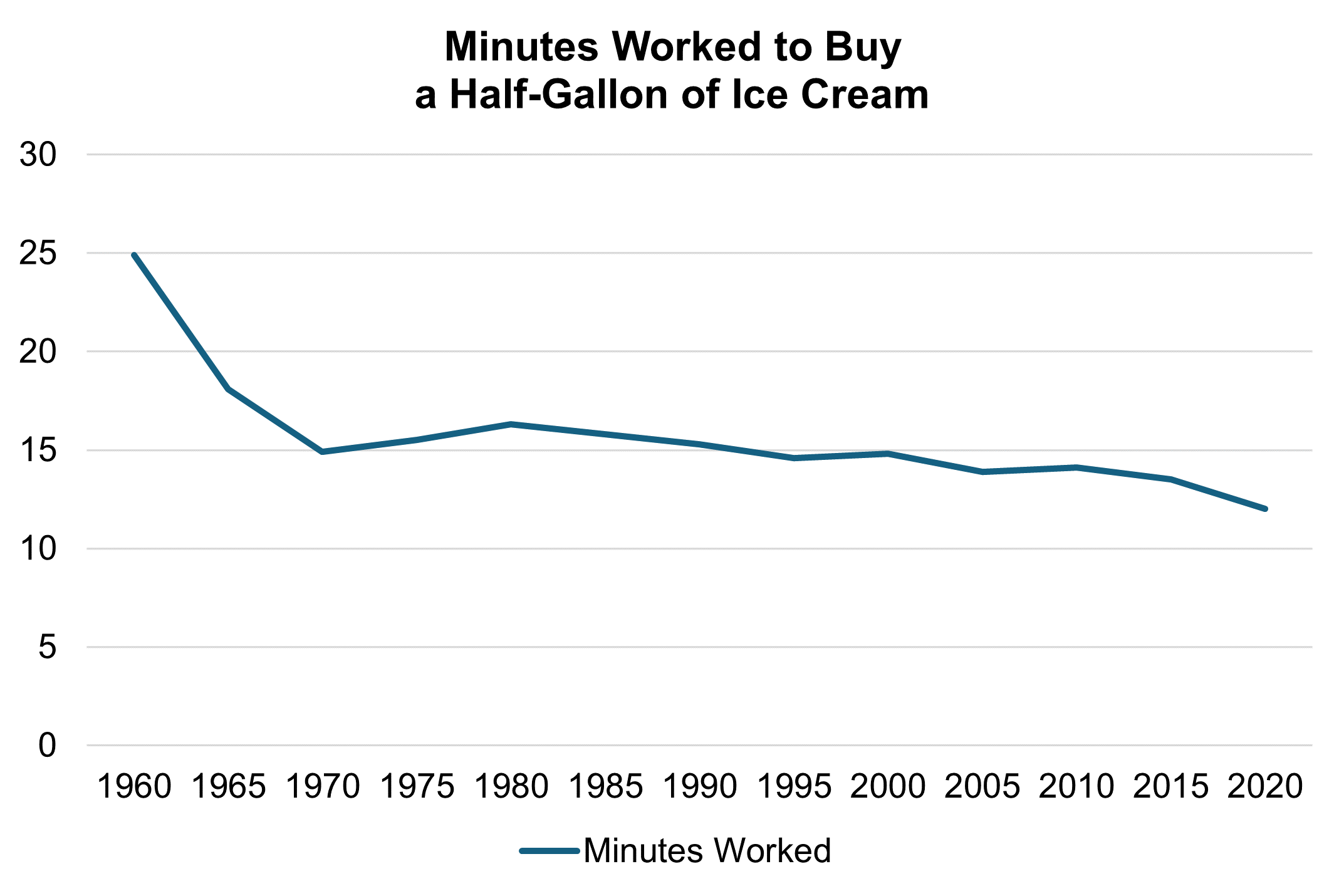
Butter holds a similar ratio, and whole milk and cheese affordability has also improved significantly. And still, some people long for the good old days.
You can find this information on page 85 of Dairy Data Highlights, a compendium of historical dairy statistics compiled by the NMPF/USDEC Dairy Economics Unit. The publication features facts on the evolution of farm sizes, milk production and dairy revenues, and the emphatic growth in the prominence of trade to the U.S. dairy economy. (Commercial dairy exports, 1985: 571 million pounds of milk equivalent. Commercial dairy exports, 2022: 40,581 million pounds.)
Suffice it to say, Dairy Data Highlights makes everyone’s summer beach reading list complete. And unlike current best sellers like “The Women,” or “On Call,” Dairy Data highlights is free – just download here.
That’s why the entire dairy community needs to know of this resource. See the rise in average herd sizes! Be wowed by the growth of processed gruyere exports! But mainly, know that this is out there. And use it as you need.
Fluid Milk Sales and Cheese Exports Surge Amid Production Decline
April DMC Margin Little Changed from March
The April Dairy Margin Coverage Program margin was $9.60/cwt, down by $0.05/cwt from March, just above the maximum $9.50/cwt maximum Tier 1 coverage level for the second month in a row.
The April All-Milk price dropped from March by $0.10/cwt to $20.50/cwt, and the April DMC feed cost calculation dropped by $0.15/cwt, on a $11/ton lower premium alfalfa hay price. Small changes in the corn and soybean meal prices offset each other on a per hundredweight of milk basis in the formula.
Available forecasts at the end of May indicate an increasingly high likelihood that the DMC margin will remain considerably above $9.50/cwt for the rest of the year.
Cheese Exports Boost U.S. Dairy Market
U.S. Dairy Exports Rebound as Milk Production Slowly Slips
Key Dairy Statistics Reveal Continued Production Decline
Dairy Products Stocks Fall As Milk Production Growth Remains Weak
NMPF’s Vitaliano Offers 2024 Dairy Economic Outlook
NMPF’s Vice President of Economic Policy Peter Vitaliano provides Dairy Radio Now listeners a look ahead at what farm-level milk prices will do in 2024. Farmers should benefit from lower feed costs, and with milk production expected to remain stagnant again this year, prices should gradually improve.