NMPF Lauds Establishment of Dairy Donation Program to Fight Food Insecurity

The National Milk Producers Federation (NMPF) today commended USDA for finalizing rules implementing the new Dairy Donation Program enacted by Congress last year. The program will help expand partnerships between dairy organizations and food banks to provide a wide range of dairy products to food-insecure households.

“We thank USDA leadership for their work to bring the Dairy Donation Program to fruition. This important program will help dairy farmers and the cooperatives they own to do what they do best: feed families nationwide,” said Jim Mulhern, president and CEO of NMPF. “Dairy stakeholders are eager to enhance their partnerships with food banks and other distributors to provide dairy products to those experiencing food insecurity, which the COVID-19 pandemic has only exacerbated.”

NMPF championed the proposal throughout the legislative process and worked closely with Senate Agriculture Committee Chairwoman Debbie Stabenow (D-MI), who led the effort to include this new program in COVID-19-related legislation enacted last year. The new Dairy Donation Program expands the original Milk Donation Reimbursement Program and has one-time funding of $400 million to reimburse farmers, cooperatives, and other dairy organizations for the full cost of raw milk needed to make finished dairy products for consumers.

NMPF worked closely with USDA to ensure that the program addresses additional costs, such as processing and transportation, as well as other elements that make the program more viable. The provision covering the cost of processing is a significant enhancement from the previous program. NMPF also worked closely with Feeding America to support the program and recommend approaches to ensure its effectiveness.

“We are grateful to USDA for helping ensure wholesome dairy products can be provided to food banks and other food distributors by reimbursing for some of these costs,” said Mulhern. “We have also been pleased to work with Feeding America to advance the partnership approach taken by this program as it will help to target dairy donations in a manner that effectively meets on-the-ground demand.”

“Feeding America applauds today’s announcement implementing the Dairy Donation Program, which has the potential to connect millions of additional pounds of dairy donations through food banks to the people we serve. We look forward to working with USDA and our dairy partners to make this program a success now and in the future,” said Vince Hall, Interim Chief Government Relations Officer at Feeding America.

Mulhern said NMPF appreciates Chairwoman Stabenow’s leadership in securing the program’s enactment last year, as well as the support for dairy donation offered by other key members, including Senate Appropriations Committee Chairman Patrick Leahy (D-VT) and House Agriculture Committee Ranking Member Glenn ‘GT’ Thompson (R-PA).

“We commend Chairwoman Stabenow for her leadership in authoring this program and look forward to working with Congress to secure additional funding for this program in the future to continue to minimize food waste by providing nutritious dairy products to those who need them most,” Mulhern said.

NMPF Statement on USDA Dairy Announcement

From NMPF President and CEO Jim Mulhern:

“NMPF is grateful to Agriculture Secretary Tom Vilsack and his team for working hard to provide needed support to dairy farmers. This includes implementing the congressionally-enacted Dairy Donation Program, which will foster partnerships between dairy organizations and food banks to help combat food insecurity and minimize food waste, as well as the Supplemental Dairy Margin Coverage program to reflect modest increases in farm milk production history. We also appreciate USDA’s work to incorporate the premium-quality alfalfa price into the Dairy Margin Coverage program; this will improve the DMC feed cost formula and enhance the dairy baseline ahead of the next farm bill, to the betterment of all farmers.

“While we will comment more fully on those initiatives once details are available, today’s announcement includes the Pandemic Market Volatility Assistance Program to compensate for some of the damage resulting from the pandemic. NMPF asked the department to reimburse dairy farmers for unanticipated losses created during the COVID-19 pandemic by a change to the Class I fluid milk price mover formula that was exacerbated by the government’s pandemic dairy purchases last year.

“When Congress changed the previous Class I mover, it was never intended to hurt producers. In fact, the new mover was envisioned to be revenue-neutral when it was adopted in the 2018 Farm Bill. However, the government’s COVID-19 response created unprecedented price volatility in milk and dairy-product markets that produced disorderly fluid milk marketing conditions that so far have cost dairy farmers nationwide more than $750 million from what they would have been paid under the previous system.

“NMPF has been working on approaches to right this unintended wrong to dairy farmers by recouping as much of the loss as possible. Today’s announcement is an initial step in this effort that will help many producers, but it unfortunately falls significantly short of meeting the needs of dairy farmers nationwide. The arbitrary low limits on covered milk production volume mean many family dairy farmers will only receive a portion of the losses they incurred on their production last year. These losses were felt deeply by producers of all sizes, in all regions of the country, embodying a disaster in the truest sense of the word. Disaster aid should not include limits that prevent thousands of dairy farmers from being meaningfully compensated for unintended, extraordinary losses.

“Additional work lies ahead to more fully remedy this shortfall for all dairy producers. We very much appreciate USDA’s persistence and efforts to find a way to cover some of these losses using existing authorities, but NMPF represents producers from all regions and of all sizes and believes that losses incurred by producers must be addressed equitably. Consequently, NMPF will work with Congress to seek supplemental funding to close this gap.

“NMPF also is continuing discussions about the current Class I mover to prevent a repeat of this problem. The COVID-19 pandemic may be a once-in-a-lifetime occurrence, but a large spread between Class III and IV milk prices is not, making it necessary to fix the Class I mover and put this problem to rest.

“We appreciate USDA’s attention to this problem as well as those in Congress who have advocated for addressing this unique loss to farmers and ensuring that it does not happen again.”

Farmer Focus: Florida Farm Family’s Ice Cream Thrives Through Pandemic

As America slowed down during the first months of the COVID-19 pandemic, dairy farmers and other essential workers stepped up. The Rucks family not only took care of their herd of 1500 on Milking R dairy in Okeechobee, FL, they were up until 2 or 3 a.m. each night making ice cream.

Sutton Rucks, his wife, Kris, and their two children, Lindsey and Garrett, started making ice cream before the pandemic to share during farm tours.

“People were just raving about the ice cream,” Sutton says. “We had a bunch of tours in the early spring of 2020, and it felt like we made more ice cream than we could give away in six months. Then COVID hit.”

In the latest Farmer Focus, the Rucks share how they connect with their community through delicious ice cream and sustainable production.

For more Farmer Focus stories, co-sponsored by NMPF and the FARM Program, check out NMPF’s Sharing Our Story page, which also includes its Dairy Defined thought-leadership series and CEO’s Corner, a monthly column from NMPF President and CEO Jim Mulhern.

FARM Evaluator Works as a Partner

National Dairy Farmers Assuring Responsible Management (FARM) Program evaluators provide a critical link between a dairy farmer and the consumer, working to ensure best practices. But they’re also a resource for farmers, said Janae Klingler, Manager of Animal Care and Sustainability for the Maryland and Virginia Milk Producers Cooperative Association, in the latest Dairy Defined podcast.

“We are a trusted advisor to our farms,” Klingler said. “Yes, we are here to make sure that our farms are meeting the program standards, but even a bigger part of our job is making sure that our farms get to that point of meeting those program standards and helping them figure out who can help them get there.”

The full podcast is here. You can also find the podcast on Apple Podcasts, Spotify and Google Podcasts. Broadcast outlets may use the MP3 file below. Please attribute information to NMPF.

Dairy Industry Commends Introduction of Ocean Shipping Reform Act

The National Milk Producers Federation (NMPF) and the U.S. Dairy Export Council (USDEC) offered their support for bipartisan legislation introduced today by Representatives John Garamendi (D-CA) and Dusty Johnson (R-SD), the Ocean Shipping Reform Act.

The dairy industry, as well as other exporters, has faced substantially increased costs to ship their goods overseas, challenges obtaining containers and other equipment to deliver their goods to ports and beyond, and often incur booking cancellations or delays for vessel space. Owing in part to the Covid-19 change in American online orders, imports have affected vessel operations and container availability, diminishing export options for American dairy products. Ocean carriers have exacerbated this situation with high detention and demurrage charges, the increased shipment of empty containers back to Asia, and other unfair practices.

The Garamendi-Johnson legislation is the result of a concerted effort by NMPF and USDEC, along with other agriculture producers and exporters, to highlight the challenges U.S. exporters face with port congestion and the unfair practices and charges implemented by ocean carriers. NMPF and USDEC are urging Congress and the executive branch to take swift action to address these critical problems.

The Ocean Shipping Reform Act would provide new authority to the Federal Maritime Commission (FMC) to address unjust and unreasonable practices by ocean carriers. It would institute new penalties against ocean carriers and marine terminal operators for violations of the Shipping Act, require expanded public disclosure from the FMC and carriers, and establish a series of new regulations against unfair carrier practices.

The bill also offers new oversight of carriers’ charges and fees and will permit the FMC to dedicate collected penalties as restitution to impacted exporters. NMPF and USDEC appreciated the opportunity to work closely with both Congressional offices as the legislation was drafted and are pleased to endorse the bill.

“We are grateful for the bipartisan leadership from Congressmen Garamendi and Johnson in developing and introducing the Ocean Shipping Reform Act,” said Krysta Harden, president and CEO of USDEC. “Dairy producers and manufacturers have faced unreasonable costs and unfair practices from ocean carriers that negatively affect U.S. exports, increasing costs and putting at risk established trading relationships. This legislation will hopefully curtail those abuses and encourage better export-oriented behavior moving forward.”

“Dairy exporters have faced unfair detention and demurrage charges, unreliable and unfair booking practices and cancellations, and unwarranted challenges trying to obtain containers and other equipment,” said Jim Mulhern, president and CEO of NMPF. “While some of these challenges are due to Covid-19 changes in retail purchases, carriers have abused the situation to their advantage. Our members need the U.S. government to act, and we welcome the introduction of this legislation as an important, positive step.”

The economic effects from these challenges are significant – the average cost of transporting a container is estimated to have increased by approximately 200% over the past year, while the estimated impacts to dairy producers from just January to May 2021 include over $200 million in added shipping and related costs, approximately 10 percent of the export value during the same period.

This legislation represents an important step toward implementing both short and long-term solutions, yet NMPF and USDEC continue to urge the importance of additional measures as well to address the challenges plaguing U.S. food and agricultural exporters expeditiously and fully. The organizations urged Congress to swiftly approve the Ocean Shipping Reform Act while at the same time championing the need for additional administrative solutions that could be implemented more immediately to address the ongoing shipping crisis.

NMPF Scholarship Recipients Announced, ADSA Winners Recognized

The National Milk Producers Federation (NMPF) today announced the recipients of its 2021 National Dairy Leadership Scholarship awards. The awards, presented by the NMPF Board of Directors, support the next generation of dairy leaders and researchers and are open to qualified graduate students who are actively pursuing dairy-related fields of study.

“The value these students bring to the dairy industry can’t be overstated,” said Brian Hardy, Utah dairy farmer and Chair of the NMPF Scholarship Committee. “This scholarship helps them pursue research that brings scientific solutions to dairy farmers, the animals we care for, and the entire dairy supply chain.”

NMPF this year awarded scholarships to:

  • Alycia Drwencke, a Ph.D. candidate in Animal Behavior at the University of California-Davis, whose research focuses on the welfare implications of caustic paste disbudding and pain mitigation for dairy calves. Prior to her Ph.D., Drwencke’s master’s program research focused on innovative detection and abatement of heat load in cattle.
  • Paulo Menta, a Ph.D. candidate in Animal Science at Texas Tech University, whose research focuses on minimizing antimicrobial use in dairy cows with metritis, or inflammation of the uterus. Menta is a Doctor of Veterinary Medicine and came to the U.S. in 2018 to pursue a master’s degree, researching calcium and energy metabolism of early lactation dairy cows.
  • Kelly Mitchell, a Ph.D. candidate in Nutrition at The Ohio State University studying the stimulation of microbial protein synthesis by branched volatile fatty acids. Mitchell said she realized her interest in fat metabolism during her master’s degree research on ketosis incidence in commercial herds at the University of California-Davis.

NMPF also sponsors student awards through the American Dairy Science Association (ADSA). The Richard M. Hoyt Award was created to recognize research efforts with direct application to the problems of the U.S. dairy industry.

This year’s winner, Achilles Vieira-Neto, was recognized at the ADSA Virtual Annual Meeting on July 11-14. His research focuses on the role of acid-base status in mineral metabolism and how vitamin D metabolites can be used during the transition period to improve mineral metabolism and health.

Lucas Rocha Rebelo and Hailey Galyon received first-place recognition as part of the NMPF Graduate Student Paper Presentation Contest in Dairy Production in the Ph.D. and M.S. divisions, respectively. Rebelo is a Ph.D. candidate studying dairy nutrition at Ohio State. Galyon is developing a bio-based polymer product to replace current agricultural single-use plastics.

Learn more about the NMPF scholarship program here. The 2022 application period will open in January 2022. For information about ADSA awards, visit its awards page here.

Like the Song of the Summer, Butter (and Dairy) is Hot

You mean, you haven’t heard? Where have you BEEN!?!?

All over the world’s airwaves and (of course, properly socially distanced) dance floors this summer, the song “Butter” by Korean group BTS has been ubiquitous, entrenched at the top of the Billboard pop charts.

Dairy approves. It always helps an industry when its products capture an upbeat cultural moment. But honestly, in the case of butter and “Butter,” it isn’t shocking. Butter’s been on the rise for years now. It was only a matter of time before pop culture caught up with what consumers increasingly understand: nothing else is “smooth like butter.”

Some fun facts on how “hot like summer” butter really is, according to consumer data:

  • In 2020, 78 percent of U.S. households bought butter or butter blends. That’s up from 74.5 percent in 2019. It really is everywhere.
  • The average shopper bought butter or butter blends on eight more shopping trips during the year, on average, during 2020 than in 2019. Consumers gotta have it!
  • Butter and blends accounted for 5.8 percent of all dairy products sold in grocery aisles in 2020. But they had a 7.8 percent share of dairy’s overall gain, another measure of butter’s growing prominence in the aisle.
  • In raw dollars, butter sales rose by $621 million – a 19 percent increase – from 2019 to 2020.

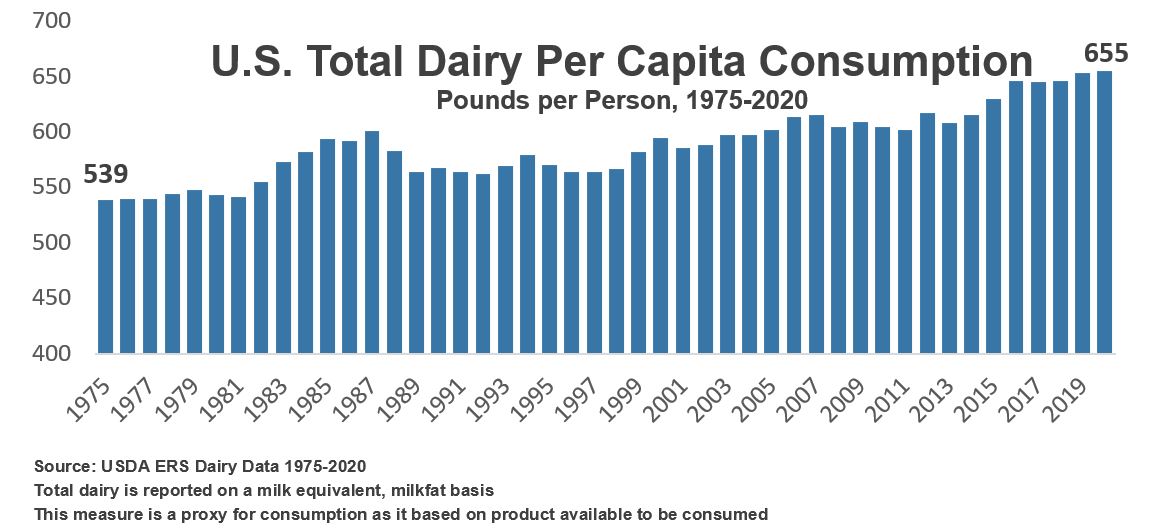
And butter, of course, is a part of the overall dairy story. Dairy grocery-store sales rose 14 percent in 2020 from 2019, to $67 billion. And while the 2020 numbers for overall dairy per-capita consumption aren’t out yet, the trend line is clear: Dairy is winning with consumers – and not just on the radio.

So if you’re channel-surfing and a certain catchy Korean pop song gets lodged in your ear, know you’re not alone. In fact, the number of butter adherents is growing every day. That’s what quality will bring you – and that’s why we know that butter’s time in the sun will last long after the chart run is over — though we’re more than happy to be topping it.

Dairy Farmers Reinforce Trade Priorities with Ambassador Tai at Agriculture Event Hosted by Rep. DelBene

The U.S. Dairy Export Council (USDEC) and the National Milk Producers Federation (NMPF) today thanked Representative Suzan DelBene (D-WA) for hosting U.S. Trade Representative Ambassador Katherine Tai for a roundtable in Burlington, WA to discuss agriculture trade priorities. At the event, Washington farmers and food producers from various sectors, including dairy, raised the importance of implementing a trade policy that expands agricultural exports.

Washington dairy farmers Jeremy Visser and Mike Schoneveld, member-owners of USDEC and NMPF-member Northwest Dairy Association/Darigold, conveyed the importance of exports and global market access for the dairy industry. Visser and Schoneveld praised Rep. DelBene for her leadership on dairy trade issues to help expand opportunities for dairy in international markets.

“NMPF appreciates the hard work that Rep. DelBene has long undertaken to encourage trade policies that help expand American agricultural exports. Her recognition of the critical role that exports play for farmers’ incomes and the rural economy has been central to the pursuit of trade policies that help deliver value to American dairy farmers and expand jobs in America. Dairy farmers are grateful to Ambassador Tai for launching the dispute settlement case against Canada’s restrictive access to U.S. dairy and appreciate Rep. DelBene’s advocacy on this matter as well. At the same time, dairy farmers are also keen to see a proactive trade agenda of opening new markets around the world,” said Jim Mulhern, president and CEO of NMPF.

“As solid as our track record has been to date, America’s dairy industry has not reached its full trade potential on the global stage. Each dairy product that we export – whether it’s cheese, milk powder, or another essential dairy ingredient – has a powerful impact across the entire supply chain.  Expanding while also defending market share abroad is critical to U.S. dairy manufacturers and exporters, especially cheese exporters that are encountering barriers disguised by the European Union’s Geographical Indications agenda,” said Krysta Harden, president and CEO of USDEC. “We thank Rep. DelBene for hosting Ambassador Tai to hear from Washington’s agricultural sector directly on how to support that work through new trade agreements, enforcing trade agreements, and resolving trade barriers in other countries.”

NMPF, NCFC Lead Coalition Call for Climate-Smart Ag Investments

The National Milk Producers Federation (NMPF) and the National Council of Farmer Cooperatives (NCFC) today led a coalition of 12 agricultural and conservation organizations on a letter advocating for significant new funding for climate-smart agricultural practices that can help farmers to build on their environmental stewardship leadership.

Congressional efforts toward infrastructure legislation provide opportunities for substantial new investments in conservation support, with more emphasis on climate-smart agricultural practices. USDA conservation financial incentives provide farmers with voluntary technical assistance to carry out numerous stewardship practices. But more can be done to enhance practices that can yield meaningful environmental benefits, such as climate-smart manure and feed management on dairy farms.

“Dairy farmers are proactive stewards of their land and water resources, but they are always seeking to innovate further. Dairy farmers in 2020 committed to become carbon-neutral or better by 2050 and maximize water quality around the country. Bolstering conservation investment and focusing on climate-smart practices better positions dairy farmers to fulfill the dairy sector’s 2050 environmental stewardship goals as envisioned in the Net Zero Initiative,” said Jim Mulhern, president and CEO of NMPF.

“America’s farmer co-ops and their producer-owners stand ready to help address the global challenge posed by climate change. Increasing conservation funding for climate-friendly farming practices is essential to giving them the tools they need to do that and to continue their stewardship of our shared natural resources,” said Chuck Conner, president and CEO of NCFC.

NMPF, NCFC, and their colleagues call in the letter for increased spending on conservation incentives, including strong technical and financial assistance, with a greater focus on climate-smart practices. The organizations also support new rural broadband resources in pending infrastructure legislation. The letter also reiterates the major concerns that many of its signers have already voiced regarding several proposed changes to tax policy that would undermine the transfer of family farms from one generation to the next.

Organizations joining NMPF and NCFC on the letter include the Agricultural Retailers Association, American Seed Trade Association, CropLife America, National Association of Conservation Districts, National Association of State Departments of Agriculture, National Association of Wheat Growers, National Farmers Union, National Potato Council, Produce Marketing Association, and U.S. Apple Association.