Whole Milk in Schools Becoming Law, and Dairy Celebrates
January 06, 2026Years of legislative effort ended with victory for schoolchildren, dairy farmers and their cooperatives as Congress passed and a presidential signature is imminent for the Whole Milk for Healthy Kids Act, a landmark restoration of choice in school meals.
The legislation gives schools the option of serving whole and 2% milk varieties in federally funded programs, returning fuller-fat varieties that had been left out of lunches since federal rules in 2012 pushed them out. Overwhelming congressional support, backed by newer nutrition science and pro-milk public sentiment, made legislation once considered aspirational a reality for dairy.
“It’s hard to overstate the significance of congressional passage of the Whole Milk for Healthy Kids Act, not only because it represents major progress in improving the nourishment of American schoolkids, but also because of what it says about how persistent, long-term effort can still bring bipartisan success in Congress,” NMPF President & CEO Gregg Doud said in a statement.
“Since 2012, when federal nutrition rules took whole and 2% milk out of school meals programs, dairy farmers and their cooperatives have pointed out the flaws in that decision, which wasn’t aligned with consumer choice. What was true then became even more true in years to come, as newer research consistently showed the value of milk at all fat levels and consumers moved even further toward fuller-fat varieties in their purchases.
“And now the day has arrived. We thank Chairman Glenn “GT” Thompson of Pennsylvania and Representative Kim Schrier of Washington for their critical roles in championing the most recent version of this important legislation to the finish line and the many other congressional leaders who preceded them in their efforts to protect access to nutritious milk in schools. Dairy doesn’t succeed without tireless advocates on Capitol Hill, and it’s been an honor to work with these members and their staff in this effort.
NMPF led the way in congressional lobbying, with Executive Vice President Paul Bleiberg’s efforts singled out in Senate and House floor speeches backing the measure. NMPF has approached the issue on multiple fronts. From working with senators and House members to meeting with USDA to filing regulatory comments, NMPF worked to successfully reinstate 1% flavored milk in school meal programs in 2022, setting the stage for further advances in whole milk.
The legislative lift complete, the next step will be USDA implementation, as dairy cooperatives prepare to supply schools with whole milk. NMPF will be monitoring developments closely and keeping members in the loop as whole and 2% milk returns to school meals. Meanwhile, the organization eagerly implements the announcement of new Dietary Guidelines for Americans, which also is expected to support dairy at all fat levels.
NMPF Leads Charge to Prioritize Dairy in 2026 USMCA Review
January 06, 2026As preparations continue for the 2026 review of the U.S.-Mexico-Canada Agreement (USMCA), NMPF and the U.S. Dairy Export Council are advancing a coordinated strategy to ensure the agreement delivers on its promises to U.S. dairy producers.
NMPF Executive Vice President for Trade Policy and Global Affairs Shawna Morris testified before the Office of the U.S. Trade Representative at a Dec. 3 hearing, to highlight the trade pact’s importance for U.S. dairy producers and emphasize the need for the administration to address violations of USMCA dairy commitments. Morris detailed how Canada continues to manipulate dairy tariff-rate quotas and offload surplus nonfat milk solids into global markets at artificially low prices. She also pointed to Mexico’s failure to implement USMCA protections for common cheese names like “feta.”
Congress reinforced the message the same day, as a bipartisan group of 74 House members sent a letter to U.S. Trade Representative Jamieson Greer urging the administration to address unresolved dairy issues in the USMCA review. Developed with support from NMPF, USDEC, and dairy stakeholders, the letter calls out Canada’s unfair import restrictions and global dumping practices, while pressing for full implementation of Mexico’s commitments on common cheese names.
NMPF and USDEC also took their case directly to Capitol Hill. NMPF Trade Policy Director Tony Rice participated in a pair of briefings for House Ways and Means and Senate Finance Committee staff on Dec. 9 and 10 as part of the new U.S. Agriculture Coalition for USMCA. Rice emphasized the importance of targeted improvements to the agreement, noting that 44 percent of U.S. dairy exports by value went to Mexico and Canada last year.
The progress builds on sustained engagement by NMPF and USDEC, including joint written comments submitted Oct. 31, an Aug. 5 appearance before the U.S. International Trade Commission, and multiple filings tied to the Commission’s investigation into nonfat milk solids competitiveness that will inform the administration’s approach to address Canada’s offloading of dairy proteins.
All together, these efforts reflect NMPF’s ongoing push to ensure the USMCA review strengthens the agreement, holds U.S. trading partners accountable, and delivers fair market access for American dairy producers.
Jonker Shares Importance of Animal Health Funding
January 06, 2026Chief Science Officer Jamie Jonker participated in three virtual listening sessions Dec. 9-11 hosted by USDA’s Animal and Plant Health Inspection Service to share NMPF’s stance on upcoming animal health funding needs.
APHIS is advancing animal disease preparedness and response through its Farm Bill animal health programs and increasing its budget to $233 million annually beginning in 2026. This includes:
- $153 million per year for the National Animal Vaccine and Veterinary Countermeasures Bank;
- $70 million per year for the National Animal Disease Preparedness and Response Program; and
- $10 million per year for the National Animal Health Laboratory Network.
During the stakeholder listening sessions, NMPF shared the importance of using the increased NAVVCB funding to expand antigen and vaccine stockpiles to ensure rapid deployment during an outbreak, using the NADPRP funding to expand biosecurity and animal disease outbreak resources, and using NAHLN funding to expand laboratory capacity, enhance diagnostic technology, and strengthen IT systems for faster data sharing.
DMC Margin Drifts Toward Payments
January 06, 2026The November margin under the Dairy Margin Coverage Program fell to $10.04/cwt in November, another month of decline, as margins neared the $9.50 trigger level for payments at the maximum level of coverage.
The November decline was driven by a $0.18/cwt rise in the DMC feed cost formula and a $0.30/cwt drop in the all-milk price over the month. At the end of the year, the DMC Decision Tool on the USDA website predicted the December margin would be $9.19/cwt, which would generate a $0.31/cwt payment for $9.50/cwt coverage should that occur. That would be the only DMC payment for 2025.
DMC margins declined in September and October, according to USDA data released after the recent government shutdown, were $10.87/cwt and $10.52/cwt, respectively.
U.S. Secures Continued Tariff-Free Access to Colombian Market
January 06, 2026NMPF efforts with the U.S. Dairy Export Council against a meritless Colombian investigation into milk power efforts paid off with a Dec. 30 Colombian government decision to terminate an ongoing case and not impose tariffs.
The Colombian Ministry of Commerce, Industry and Tourism decision to dismiss a Subsidies and Countervailing Measures investigation on milk powder imports from the United States due to lack of merit came after extensive U.S. government collaboration with NMPF, USDEC and their members in successfully rebut Colombia’s allegations.
NMPF and USDEC coordinated a multi-faceted response to the case, which was launched in 2024. It alleged, without factual basis, that U.S. milk powders were unfairly subsidized and harmed Colombian dairy producers. NMPF and USDEC demonstrated that the Colombian government’s methodology was flawed, that assumed benefits to the U.S. dairy industry were miscalculated, and that no evidence of harm to Colombia’s domestic dairy sector could be substantiated.
“The U.S. dairy industry secured hard-won access to the Colombian market more than a decade ago, and as of this year tariffs have now fully phased out,” said Gregg Doud, president and CEO of NMPF, in a statement after the decision. “Attempts to restrict U.S. access through bogus claims and misused trade tools set a dangerous precedent not only for dairy exports but for all U.S. trade. We commend the U.S. government and our members for working with us to coordinate a strong, credible defense and to send a clear message that efforts to evade trade agreement commitments will not be tolerated.”
NMPF and USDEC Executive Vice President Jaime Castaneda testified on behalf of the U.S. dairy industry at an October 2024 hearing, clarifying how USDA programs work to refute the unfounded claims by Colombian producers. Colombia initially imposed preliminary countervailing duties of 4.86% on U.S. milk powder imports but chose not to extend them when the temporary measures expired in January 2025, following the sustained campaign coordinated by NMPF and USDEC.
U.S. dairy exports to Colombia exceeded $128 million in 2024. Tariffs on U.S. dairy products were fully eliminated at the beginning of 2026 under the U.S.-Colombia Free Trade Agreement, which NMPF and USDEC worked with the U.S. government to secure in 2012.
2025 NEXT-Assisted Export Sales Surpass 141.5 Million Pounds
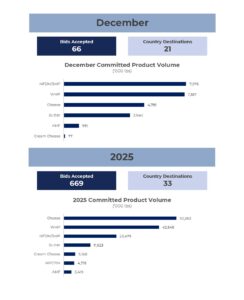
January 06, 2026NEXT member cooperatives secured 66 contracts in December, adding 24.2 million pounds of product to NEXT-assisted sales in 2025, capping off an impressive inaugural year. These products will go to customers in Asia, Oceania, North America, Middle East-North Africa, Central America, Sub-Saharan Africa and South America and will be shipped from December 2025 through May 2026.
NEXT-assisted 2025 dairy product sales totaled over 141.5 million pounds on product volume basis. Product destinations include Asia, Oceania, Central America, the Caribbean, North America, Europe, Middle East-North Africa, Oceania, Sub-Saharan Africa and South America.
Exporting dairy products is critical to the viability of dairy farmers and their cooperatives across the country. Whether or not a cooperative is actively engaged in exporting cheese, butter, anhydrous milkfat, cream cheese, or whole milk powder, moving products into world markets is essential. NEXT provides a means to move domestic dairy products to overseas markets by helping to overcome U.S. dairy’s trade disadvantages.
The amounts of dairy products reflect current contracts for delivery, not completed export volumes. NEXT will pay export assistance to the bidders only when export and delivery of the product is verified by the submission of the required documentation.
Merck, Meristem, NEDPA and C-Lock Join NMPF
January 06, 2026Merck Animal Health, Meristem Crop Performance, Northeast Dairy Producers Association and C-Lock joined NMPF late last year as associate members.
Merck Animal Health offers veterinarians, farmers, producers, pet owners and governments one of the widest ranges of veterinary pharmaceuticals, vaccines and health management solutions and services as well as an extensive suite of connected technology that includes identification, traceability and monitoring products. Merck Animal Health is dedicated to preserving and improving the health, well-being and performance of animals and the people who care for them.
Meristem Crop Performance helps farmers produce more bushels for less cost per bushel. As the global leader in delivering live, in-field biologicals through the patented BIO-CAPSULE™ Technology platform, Meristem significantly reduces waste in crop input systems through improved supply chain efficiency and advanced concentrates. Meristem was founded in 2018 and is headquartered in Powell, OH.
Northeast Dairy Producers Association (NEDPA) has served as the voice, resource and network for New York’s family dairy farms for more than three decades. NEDPA is an organization of dairy producers and industry partners committed to an economically viable, consumer-conscious dairy industry dedicated to the care and well-being of its communities, its environment, its employees and its cows.
C-Lock Inc. provides solutions for measuring and improving livestock efficiency and sustainability worldwide through GreenFeed and SmartFeed technologies. GreenFeed delivers precise methane and carbon dioxide emissions data, helping researchers and producers across the globe make informed decisions on nutrition, genetics, and environmental impact. SmartFeed tracks feed intake and efficiency, offering valuable insights into animal performance and health. C-Lock also offers SmartScale and SmartWater systems that give dairy producers precise measurement tools and valuable insights for improved herd performance. C-Lock is headquartered in Rapid City, SD and was founded in 2005.
NMPF Welcomes Forsyth as Vice President of Government and Regulatory Affairs
January 06, 2026Trey Forsyth, a native of Iowa agriculture with wide-ranging Washington experience, this week is joining NMPF as its new vice president of government and regulatory affairs.
In this role, Forsyth will oversee the development and execution of comprehensive legislative and regulatory strategies to advance NMPF’s goals for the dairy community at the national level.
Forsyth brings extensive experience in government affairs. In July 2025, he was named acting Deputy Under Secretary for Food Safety. In this role, Forsyth led the USDA Office of Food Safety, which oversees FSIS.
Prior to joining USDA, Forsyth served as a professional staff member for the Senate Committee on Agriculture, Nutrition and Forestry for Chairman John Boozman (R-AR). In this role, he handled livestock, poultry, dairy, animal health, food safety and tax portfolios. Additionally, Forsyth served as senior manager of federal and industry relations for Land O’Lakes, director of government affairs at the Torrey Advisory Group and policy advisor to the chief agriculture negotiator at the Office of the U.S. Trade Representative.
Forsyth holds a bachelor’s degree in agricultural business, public service and administration from Iowa State University and grew up on his family’s swine and row crop farm in northeast Iowa.