Whole milk is back. What now?

By Miquela Hanselman, Senior Director, Regulatory Affairs

Whole milk has made a splash recently in federal government policy. Years of effort by the National Milk Producers Federation to maintain dairy’s prominence in American diets and regain support for dairy products of all fat levels culminated in the Jan. 7 release of the 2025-2030 Dietary Guidelines for Americans by the Department of Health and Human Services and USDA. One week later, President Donald Trump signed into law the Whole Milk for Healthy Kids Act, which allows schools to offer milk of any fat level for student meals.

The dietary guidelines are updated every five years and affect government policies in numerous ways, such as guiding what can be served in school meal programs. The latest guidelines emphasize consuming “whole, nutrient-dense foods,” which includes the continued recommendation of three servings of dairy per day for those consuming a 2,000-calorie diet, and explicitly endorsing full-fat dairy consumption — including whole milk — a marked departure from previous guidelines that only recommended low- and nonfat milk. Additionally, these guidelines take a more aggressive stance on limiting added sugars.

Now that the new dietary guidelines have been released and the Whole Milk for Healthy Kids Act is now a law, USDA is in charge of implementing these changes by applying them across federal nutrition programs. USDA has already released a memo detailing the implementation requirements for the National School Lunch Program, which will help school districts across the country as they make purchasing decisions for upcoming school years. But the National School Lunch Program is not the only program affected; the school breakfast as well as the Special Milk and the Child and Adult Care Food programs will also need updates about what type of milk can be offered.

This is where the federal rulemaking process comes into play. The Dietary Guidelines for Americans (DGA) are the official nutrition guidance for all federal food programs, and for some of these, such as the Child and Adult Care Food Program, the law explicitly requires periodic updates to maintain consistency with the DGA. To do this, USDA proposes new regulations, or rules, which the public can review and comment on before the rule is final. This multi-step process can be lengthy, which is why USDA and other agencies often publish guidance that people can use in the meantime.

So, yes. Whole milk is back, but it might be a little while longer before you see it back on student meal trays.


This column originally appeared in Hoard’s Dairyman Intel on Feb. 5, 2026.

U.S. Dairy Supports Launch of New Ag Coalition for USMCA

The National Milk Producers Federation and the U.S. Dairy Export Council co-led today’s launch of “The Agricultural Coalition for USMCA,” an industry-wide effort to support the strengthening and renewal of the U.S.-Mexico-Canada Agreement (USMCA).

USMCA, which replaced the North American Free Trade Agreement (NAFTA) in 2020, mandates a “joint review” in 2026, which allows the countries to consider potential changes to the agreement. Since the stakeholder engagement process began in October 2025, the U.S. dairy industry has spoken to the importance of the agreement, while stressing that certain critical shortcomings must be addressed.

“USMCA has helped grow vital export opportunities that support dairy farm incomes across the country,” Gregg Doud, president and CEO of NMPF, said. “Unfortunately, Canada has clearly not upheld their end of the deal and Mexico needs to fully implement USMCA commitments to respect our use of common cheese names. We look forward to working with the Administration during the review to ensure our trading partners honor their commitments so the agreement can best deliver for dairy farmers.”

“USMCA has been critical to maintaining strong export demand for U.S. dairy farmers, manufacturers and exporters, providing greater opportunities in the Mexican market in particular,” Krysta Harden, president and CEO of USDEC, said. “At the same time, persistent market access barriers, particularly in Canada, limit the full potential of the agreement and must be addressed to ensure that U.S. dairy exporters receive the benefits they were promised.”

The U.S. dairy industry exported about $3.6 billion in dairy products to Canada and Mexico in 2024, which accounts for about 44 percent of total export value. At the same time, USMCA has fallen short in certain key areas. USDEC and NMPF will continue to fight for several priorities in the review, including through the Coalition:

  • Combatting Canada’s continued manipulation of its administration of dairy tariff-rate quotas, denying U.S. exporters the meaningful market access guaranteed under USMCA.
  • Tackling Canada’s circumvention of USMCA dairy protein export disciplines, which has resulted in continued offloading of artificially low-priced dairy proteins, undercutting U.S. products in both domestic and global markets.
  • Ensuring that Mexico upholds its USMCA commitments to protect common cheese names such as “feta.” The issue is increasingly pressing as European Union trade negotiations seek to restrict the use of generic terms worldwide.

NMPF and USDEC will continue to work with trade negotiators to address USMCA noncompliance areas ahead of the July 1 joint review deadline.

Dairy Farmers Need Assistance; NMPF Explores Options


With milk prices and margins projected to be low for several months, NMPF is looking for options to help farmers through harder times, NMPF Executive Vice President Alan Bjerga said in an interview with RFD-TV. Aid to help get whole milk in schools, USDA commodity purchases and enhancements to farmer risk-management portfolios are all tools that could help.

NMPF Announces Staff Promotions

NMPF is excited to share several well-deserved promotions that recognize the outstanding contributions and continued growth of key team members:

  • Maria Brockamp has been promoted to Senior Manager, Government Relations. Though relatively new to NMPF, Maria quickly demonstrated impressive capabilities, especially while taking on additional responsibilities during Paul’s absence.
  • Jessi-Ryah Cordova has been promoted to Communications Manager, FARM Program. Since arriving at NMPF as FARM Communications Coordinator in April 2024, Jessi-Ryah Cordova has shown skills and abilities that go well beyond her day-to-day responsibilities, leading FARM Communications initiatives. By effectively harnessing FARM’s disparate pillars into a coherent whole that is greater than the sum of its parts.
  • Miquela Hanselman has been promoted to Senior Director, Regulatory Affairs. Miquela has consistently taken on higher-level work and delivered excellent results. She has taken over leadership of NMPF’s engagement with the National Conference of Interstate Milk Shipments (NCIMS) and in 2025 successfully led our efforts on the Dietary Guidelines for Americans. Beyond her core responsibilities, Miquela championed the creation of a summer internship program and has assumed a leadership role in organizing the Cheese Contest at the Annual Meeting.
  • Tony Rice has been promoted to Senior Director, Trade Policy, in recognition of his expanded leadership and increased scope of responsibility across trade policy and supply chain issues. Over the past few years, Tony has played a vital role in advancing NMPF’s trade priorities on Capitol Hill and strengthening engagement with NMPF’s membership. Tony has earned widespread respect from members and colleagues alike for his leadership in developing practical tools and policy work that directly support members and NMPF–USDEC staff.
  • Bobby Yi has been promoted to Vice President, Information Technology. In his 27 years at NMPF, Bobby has continually expanded his responsibilities and capabilities as our staff at NMPF and USDEC have grown. Most recently, he has orchestrated our transition to a new cloud hosting infrastructure and expanded our security capabilities.
  • Stacey Young has agreed to shift from her temporary assignment to our new NEXT accounting staff. She will oversee the transition of work from our outsourced accounting team to in-house operations and provide additional budgetary support to the contract teams.
  • David West will have the new title of Chief Operating Officer to better reflect his current responsibilities as an absolute integral member of the NMPF senior leadership team.


FARM Shares Animal Care Program Insights

FARM Animal Care, in partnership with ACER Consulting, released two reports in January related to program development and on-farm practices. The program continues to identify areas for advancing animal welfare centered on science and best practices.

The Animal Care Version 4.0 Data Highlights summarizes the characteristics of participating herds, presents performance measures on each Animal Care Program standard under Version 4.0, and highlights key strengths and areas for improvement.

Version 4.0 affirmed the program area’s commitment with clearer requirements, mandatory documentation, expanded animal-based measures and structured corrective action plans to improve consistency and accountability.

The Animal Care Program is now administering Version 5 standards and guidelines after FARM extended the Version 4 cycle due to COVID-19. Version 5 will be in effect through January 2028. FARM revises Animal Care standards every three years.

The Animal Care Stakeholder Survey was conducted to inform early discussions related to the development of Version 2028. The survey launched last July and was available for seven weeks, capturing 557 usable responses.

The NMPF Animal Health and Wellbeing Committee, the FARM Animal Care Task Force and Farmer Advisory Council reviewed initial survey results. The summary findings will be considered alongside committee review, scientific input, and additional engagement as the version cycle is developed. This survey supports informed discussion and decision-making and is not a standalone directive for program changes.

To stay up-to-date on Version 2028 development, visit the FARM website.


NMPF Accepting Applications for 2026 Scholarship Program

The National Milk Producers Federation is now accepting applications for its National Dairy Leadership Scholarship Program for the 2026-2027 academic year.

NMPF annually awards scholarships to outstanding graduate students (enrolled in master’s or doctoral programs) who are actively pursuing dairy-related fields of research of immediate interest to NMPF member cooperatives and the U.S. dairy industry at large.

NMPF encourages graduate students pursuing research with direct benefit to milk marketing cooperatives and dairy producers to apply. Applicants do not need to be NMPF members to qualify. Recommended fields of study include but are not limited to: Agriculture Communications and Journalism, Animal Health, Animal and/or Human Nutrition, Bovine Genetics, Dairy Products Processing, Dairy Science, Economics, Environmental Science, Food Science, Food Safety, Herd Management, and Marketing and Price Analysis.

NMPF must receive applications no later than Friday, April 24. To apply, or for more information, please visit the NMPF website.

The National Dairy Leadership Scholarship Fund funds the program. If you would like to support the scholarship fund, please consider a donation here: https://donate.stripe.com/eVa7th6v18VcaT6144

U.S. Dairy Welcomes Central America Trade Deals

NMPF praised U.S. reciprocal trade agreements with El Salvador on Jan. 29 and Guatemala on Jan. 30 that included key provisions to facilitate dairy exports and came after NMPF advocacy issue on key dairy issues including common cheese names.

The deals expand upon the tariff-free access that NMPF worked to secure over a decade ago under the Central America-Dominican Republic Free Trade Agreement.

Both deals include commitments to preempt nontariff barriers to dairy trade, including El Salvador and Guatemala’s recognition of the safety of the U.S. regulatory system, a commitment to continue accepting certificates approved by U.S. regulatory authorities and streamlined product registrations. The provisions also preempt the introduction of duplicative dairy processing facility registration processes.

Following NMPF advocacy on the need for stronger protections for common cheese names, the reciprocal agreements included commitments for El Salvador and Guatemala to protect certain generic terms, including a list of 38 terms like “parmesan” and “feta.”

U.S. dairy exporters shipped $176 million to the two countries in 2024. NMPF will continue to work with the U.S. government to ensure full implementation of the agreements to ensure continued access to the growing markets.

NMPF Champions U.S. Dairy in Indonesia

NMPF executive vice president Shawna Morris joined a USDA Foreign Agricultural Service trade mission to Indonesia from Feb. 1–4, meeting with government officials and industry partners to discuss trade barriers and explore opportunities for expanded U.S. dairy exports.

NMPF’s continued engagement in Indonesia supports ongoing efforts to expand market access into the world’s fourth most populous country as reciprocal trade negotiations continue.

While in Jakarta, Morris met with Enny Indarti, director of fulfillment systems for the National Nutrition Agency’s Direct of Fulfillment Systems, to discuss how U.S. milk powders can be used to support the Indonesian government’s initiative launched in late 2024 to provide free milk in schools. She also met with officials from Indonesia’s Trade Ministry and the agency coordinating the school meals program.

Morris hosted a dinner to bring together NMPF and USDEC members attending the mission with key partners and dairy importers in Indonesia. She also moderated an industry partner roundtable session headlined by Under Secretary for Trade Luke Lindberg that included NMPF and USDEC members as well as one of USDEC’s formal partners in Indonesia, the Indonesian Food & Beverage Association. The roundtable explored areas for further industry collaboration to drive greater dairy consumption and trade between the U.S. and Indonesia dairy and food processing sectors.

The trade mission follows a July 2025 announcement of a reciprocal trade framework with Indonesia that included commitments to eliminate tariffs on the vast majority of U.S. exports and pledges to remove longstanding nontariff barriers affecting American dairy products. U.S. dairy suppliers are currently at a tariff disadvantage with New Zealand, with a potential additional disadvantage as the EU-Indonesia trade agreement nears conclusion.

Morris’ participation in the mission also builds on NMPF’s collaboration with the U.S. Dairy Export Council on a new U.S.-Indonesia Dairy Partnership Program to provide farmer training and education sessions in Indonesia. NMPF strengthened its network of in-country supporters in May 2025 with the signing of a memorandum of understanding with the Indonesian Chamber of Commerce (KADIN) to facilitate trade and grow dairy demand in the market.

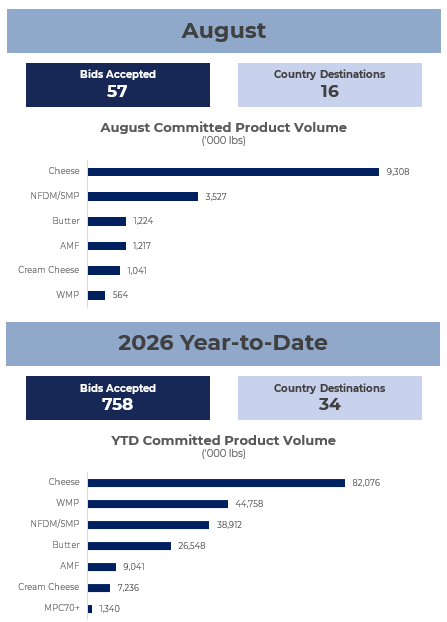
January NEXT-Assisted Export Sales Surpass 19 Million Pounds

NEXT member cooperatives secured 82 contracts in January, adding 19.3 million pounds of product in NEXT-assisted sales in 2026, as the program built on its record-level activity set in the second half of 2025. These products will go to customers in Asia, Oceania, Middle East-North Africa, South America, Central America, the Caribbean and Sub-Saharan Africa and will be shipped from January through December.

Exporting dairy products is critical to the viability of dairy farmers and their cooperatives across the country. Whether or not a cooperative is actively engaged in exporting, moving products into world markets is essential. NEXT provides a means to move domestic dairy products to overseas markets by helping to overcome U.S. dairy’s trade disadvantages.

The referenced amounts of dairy products reflect current contracts for delivery, not completed export volumes. NEXT will pay export assistance to bidders only when export and delivery of product is verified by submission of required documentation.

Signup Underway for Improved DMC as Margins Decline

With the Dairy Margin Coverage Program entering payment territory, NMPF is pleased that signup for the recently improved program is under way through Feb. 26.

The December margin under USDA’s Margin Coverage Program dropped by $0.62/cwt from November to $9.42/cwt, generating a payment, for the first and only time during 2025, of $0.08/cwt, for farmers insured at the highest $9.50/cwt coverage level. USDA is predicting margins below $9.50/cwt through July and averaging $9.53/cwt for the year. This would be $1.62/cwt lower than the $11.15/cwt the margin averaged in 2025.

“An improved DMC Program couldn’t come a moment too soon,” Gregg Doud, president & CEO of NMPF, said. “We appreciate USDA’s efforts to quickly update the DMC program, and we urge dairy farmers who will benefit from the program to sign up as part of their risk-management plans.”

The DMC changes were part of the One Big Beautiful Bill Act passed last year that included multiple benefits for dairy, including making the Section 199A tax deduction permanent and making more funds available for dairy farmers and their cooperatives to use for conservation programs.

DMC revisions published in the Federal Register include:

  • An opportunity to establish new production history based on the highest annual milk production level from any one of the 2021, 2022, or 2023 calendar years. Production history established between 2014-2025 will no longer be applicable for coverage.
  • USDA clarification on how new operations (i.e., those that began marketing milk after Jan. 1, 2023) will be able to establish production history.
  • Eligibility for operations to enroll their first 6 million pounds of production at the Tier 1 level, up from 5 million pounds, with all additional production covered under Tier 2. Premium rate fees under Tiers 1 and 2 are unchanged.
  • An opportunity for operations to make a one-time election of coverage level and coverage percentage, “locking in” those elections for a six-year period from January 2026-December 2031. Those who elect this option must participate in DMC at the same coverage levels for the six-year period and will receive a 25% premium discount for doing so.

NMPF will keep its members apprised of key developments, with staff available to answer questions as necessary.

Dairy’s Importance Reflected in New Dietary Guidelines

A yearslong effort by NMPF to maintain dairy’s prominence in American diets and regain support for dairy products of all fat levels culminated in the Jan. 7 release of the 2025-2030 Dietary Guidelines for Americans by the Department of Health and Human Services and USDA.

USDA and HHS update the guidelines every five years and affect government policies in numerous ways, including school meal offerings. The latest guidelines maintain the previous recommendation of three dairy servings per day for those consuming a 2,000-calorie diet. This year’s edition explicitly endorses full-fat dairy consumption, including whole milk, which is a marked departure from previous guidelines that recommended only low- and non-fat milk.

“NMPF thanks HHS and USDA for recognizing dairy’s critical role in a healthy diet in the new Dietary Guidelines for Americans, as shown by its continued recommendation of three servings of dairy for Americans, its recognition of dairy’s benefits at all fat levels, and dairy’s prominence in diverse diets,” NMPF President & CEO Gregg Doud said in a statement. “We are proud to benefit American health in fundamental ways, and we welcome the potential these guidelines hold for expanding upon dairy’s critical role in the diet.”

NMPF’s work to highlight advances in nutrition and scientific research showing the value of dairy consumption of all fat levels, including evidence that substituting higher-fat dairy for lower-fat dairy is not linked with increased risk of cardiovascular disease morbidity. The scientific review committee that makes recommendations for dietary guidelines previously acknowledged that reducing or eliminating dairy from the diet leads to undernourishment in key nutrients for millions of Americans, which is reflected in the final guidelines.

The new guidelines also include stricter limits on added sugars, stating that while no amount of added sugars or non-nutritive sweeteners is recommended or considered part of a healthy or nutritious diet, one meal should contain no more than 10 grams of added sugars. The naturally occurring sugar in milk is acknowledged as not counting towards those 10 grams; still, the new guidelines may pose a challenge for some flavored milks and dairy products, such as yogurt, as the administration signals work on a new school meals rule.

The accompanying document to the guidelines, “Daily Servings by Calorie Level,” also includes concerning language about “fortified dairy alternatives” in its definition of the “dairy” food group. Previously, the guidelines only acknowledged fortified soy as a dairy substitute.

NMPF has repeatedly emphasized that imitators do not offer the same consistent package of nutrition provided by real milk, which the scientific review committee agreed in its 2024 report. Any encouragement of plant-based alternatives when lactose-free milk is available to those who are lactose-intolerant is out of step with otherwise encouraging recommendations.

With the guidelines out, the federal government will begin applying them across federal programs.

Whole Milk Goes Back to Schools

With President Trump’s signature — and NMPF cooperative members in attendance to witness — the Whole Milk for Healthy Kids Act became law Jan. 14. Focus now shifts to USDA implementation.

“Dairy farmers and their cooperatives couldn’t be more thrilled that whole and 2% milk is returning to school meals,” NMPF President & CEO Gregg Doud said in a statement upon signing. “Dairy is a nutrition powerhouse that should be used to its fullest potential — and that means making it available in the same varieties families consume at home.”

Kevin Satterwhite and Thomas French, dairy producers with Maola, attended the bill signing at the White House to celebrate the legislative victory.

Focus now shifts to USDA implementation. The department published guidance for schools on the updated fluid milk requirements for school lunch programs Jan. 14. The department will move forward with formal rulemaking in the months ahead to address both whole milk and the updated Dietary Guidelines for Americans.

NMPF will be actively involved in the rulemaking process, working to ensure schools have the support they need to include whole milk on their menus.

“We are ready to help schools and USDA in any way we can as this important legislation is implemented,” Doud said in his statement. “We thank the Trump administration, our advocates on Capitol Hill, and everyone who has worked to make school meals better through increased access to dairy.”