 More than Half of Those Enrolled in New Safety Net Choose Added Coverage
ARLINGTON, VA – The U.S. Department of Agriculture provided more specific information Friday about the extent of coverage chosen by dairy farmers enrolled for 2015 in the new Margin Protection Program (MPP), including a state-by-state breakdown of the percentage of farms using the new safety net.
Earlier this week, the USDA announced that more than half of U.S. dairy operations have enrolled in the MPP. Today, USDA provided an estimate that 55% of those farms elected to pay additional premiums to purchase a higher level of coverage, above the basic, $4 per hundredweight level offered for $100 per year.
NMPF President and CEO Jim Mulhern said that the enrollment level represents “a vote of confidence in this new program, and highlights the importance of the MPP at a time when farmers need protection as margins will be challenged because of adverse conditions. The debut of the MPP comes during a year when margins will be compressed, making it the right solution at the right time for our farmers.”
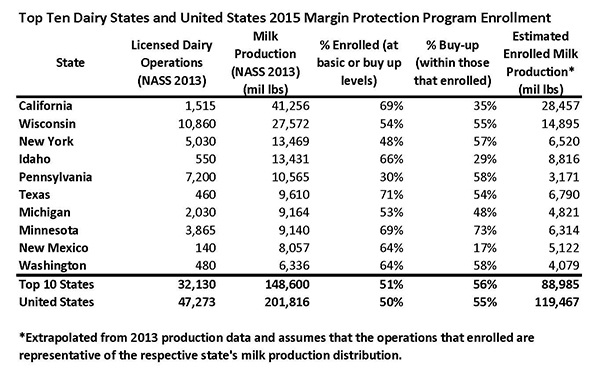
The USDA clarified that 50.4% of the nation’s dairy farms have enrolled in the MPP. The percentage ranges from a low in Wyoming of 5%, to a high in Nevada of 90%. The participation level in the ten largest dairy states was 51%, almost identical to the national average:
The next MPP sign-up period will begin in six months, during an open season enrollment window for MPP coverage in calendar year 2016. That enrollment period will run from July 1st until September 30th.
NMPF established its www.futurefordairy.com website to help educate farmers about the program, and worked with USDA and a group of university agricultural economists during 2014 to explain the benefits of utilizing the Margin Protection Program.
The National Milk Producers Federation, based in Arlington, VA, develops and carries out policies that advance the well-being of dairy producers and the cooperatives they own. The members of NMPF’s cooperatives produce the majority of the U.S. milk supply, making NMPF the voice of more than 32,000 dairy producers on Capitol Hill and with government agencies.
 After two extensions allowed dairy farmers an additional three weeks to consider their participation, the sign-up period for the new
 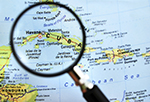 NMPF has joined more than two dozen other food and agriculture groups in supporting changes to travel and financing restrictions that impeded trade with Cuba.
 Fresh from victory in the fight for a one-year restoration of the Section 179 tax credit, NMPF and other farm organizations will focus on the importance of enacting a permanent extension in 2015.
 More than 190 million pounds of butter, cheese and whole milk powder, the equivalent of 2.5 billion pounds of milk on a milkfat basis. That’s how many dairy products
  With nine more dairy marketing organizations implementing the program since October, NMPF’s animal care program,
  Emily Metz Meredith, NMPF’s vice president for animal care, was honored last month by a leading communications newsletter as a Rising Star in public relations.
 Citing concerns over the risk of a Foot and Mouth Disease outbreak in the United States, NMPF opposed a proposal by USDA’s Animal and Plant Health Inspection Service to allow chilled or frozen beef imports from Northern Argentina.
 A revised Food and Drug Administration proposal for risk-based preventive food safety controls shows just how much dairy industry advocacy in federal rulemaking has paid off in this area. Much of the revised proposal – the most important regulation stemming from the major rewrite of federal food safety laws in 2011 – addresses issues that NMPF and the International Dairy Foods Association raised in earlier comments and meetings with FDA.
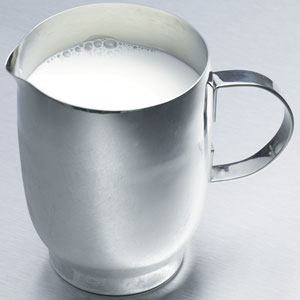 A new food safety study from the U.S. Centers for Disease Control and Prevention makes a strong argument for maintaining restrictions on the sale of raw milk to consumers.
 Graduate students conducting dairy-related research still have time to apply for NMPF’s National Dairy Leadership Scholarship Program for 2015-2016. Qualified applicants will be enrolled in a Master’s or Ph.D. program and conducting research of interest to NMPF-member cooperatives and the dairy industry in general.
 The U.S. dairy industry advised top U.S. trade negotiators last month that any final Pacific Rim trade agreement must put access to foreign markets for U.S. dairy interests first, and avoid pressure from other countries to regionalize access opportunities.