 Swedish beverage company Oatly needs to respect U.S. food labeling standards that restrict the use of the term “milk” to real dairy products, according to NMPF, especially because the brand already follows such rules in its native Sweden.
Oatly is the latest brand targeted by NMPF because it exploits the U.S. Food and Drug Administration’s (FDA) lax regulatory environment. In promoting its cereal-derived beverage as oat “milk,” Oatly is blatantly skirting U.S. food labeling regulations, which dictate that any product using dairy terms including “milk,” “cheese” or “yogurt” must have originated from an animal. NMPF has long insisted that FDA take enforcement action against similarly misbranded products, the same way the standard is enforced in Europe and many other nations.
NMPF criticized Oatly for complaining to FDA in an April 11 letter that it would be placed at a disadvantage if it could not call its product “oat milk.” Oatly’s complaint was sent to FDA in support of a petition by the vegan trade association Good Food Institute (GFI). GFI’s petition calls on FDA to modify existing food standards to endorse the current marketplace abuse of some food companies using dairy terms on products made from plants, not milk.
“Budding and innovative companies like Oatly would be placed at a serious disadvantage if we were no longer allowed to use terms that instantly and accurately convey what’s inside the carton,” said Oatly U.S. General Manager Mike Messersmith, in arguing that its product must be labeled as “oat milk.”
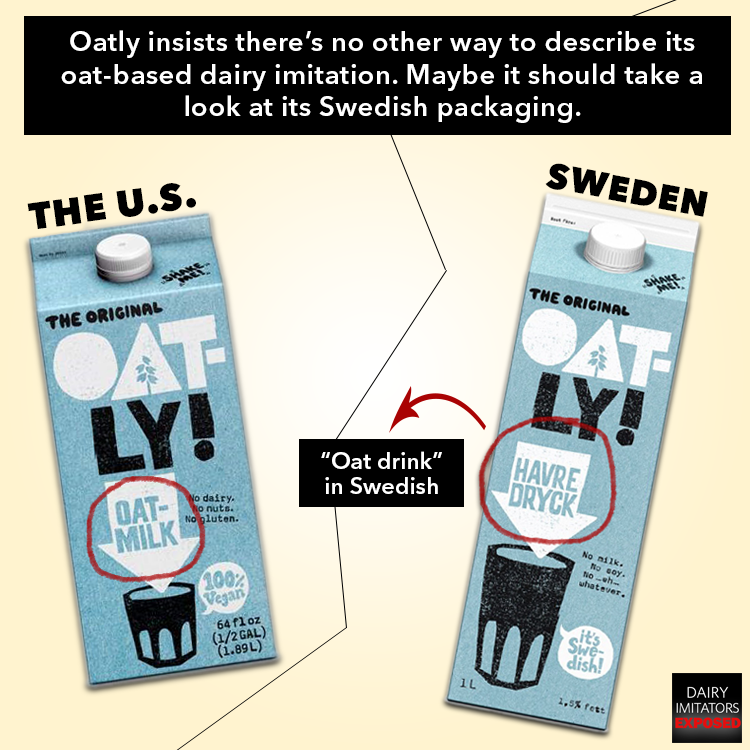
However, in its home market, Oatly is sold as “havre dryck,” or “oat drink” in Swedish. European Union (EU) regulations – similar to existing U.S. government standards – define milk as an animal product and do not allow plant-based milk copycats to use dairy terms. Messersmith’s letter did not explain this obvious contradiction to his argument.
To spotlight Oatly’s doublespeak to the FDA, NMPF has created a graphic that illustrates the difference between Oatly’s U.S. and Swedish packaging. This image will join others in NMPF’s “Dairy Imitators: Exposed” campaign, which calls out non-dairy imitation brands for ignoring federal standards and failing to live up to real milk’s complete nutrient package.
 To help promote the U.S. dairy industry as a job-creating and exports machine, National Milk has joined the U.S. Dairy Export Council (USDEC) and the International Dairy Foods Association (IDFA) to launch a year-long campaign titled “Got Jobs? Dairy Creates Jobs, Exports Create More.”
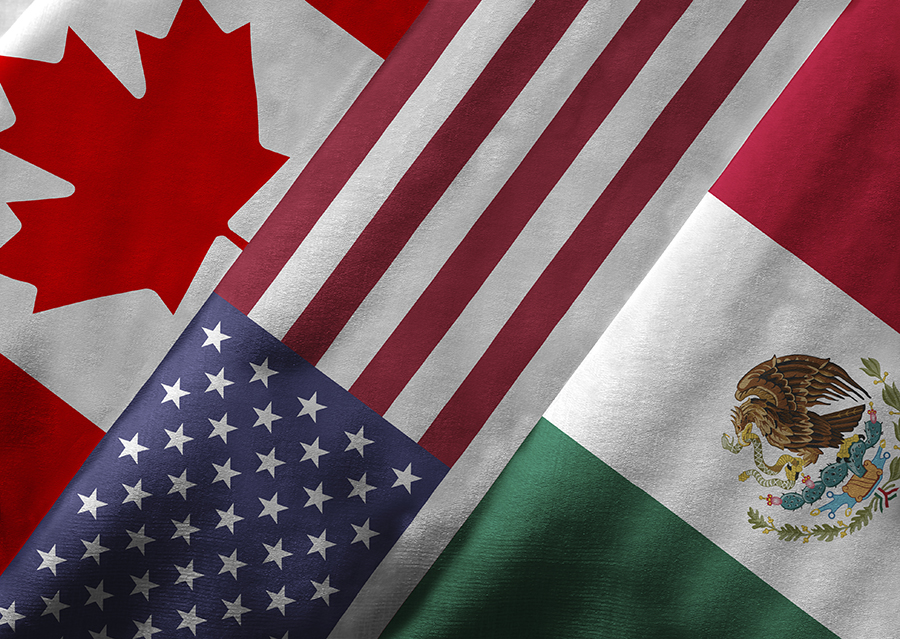 President Donald Trump has indicated he may be willing to wait until next year to reach a revised North American Free Trade Agreement (NAFTA) if it means getting a better deal from Canada and Mexico. NMPF continues to believe that the NAFTA talks are critically important and must be concluded, but not if that comes without the improvements the U.S. dairy industry needs.
 The U.S. Department of Agriculture (USDA) announced on June 7 that California dairy producers approved a Federal Milk Marketing Order (FMMO) for the entire state of California.
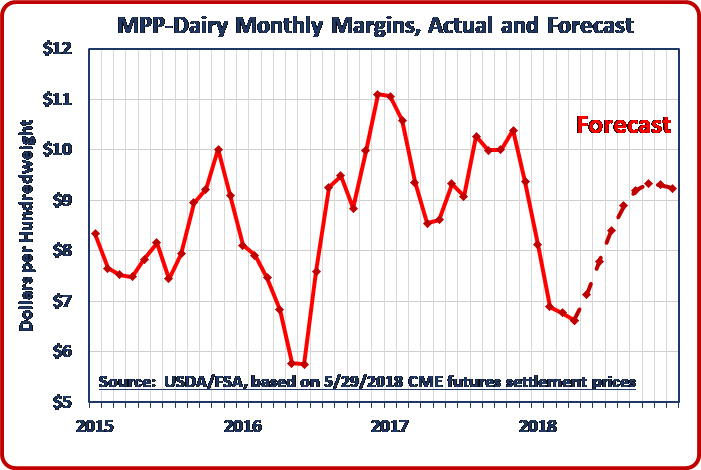 Under the dairy Margin Protection Program (MPP), the monthly margin for April 2018 decreased an additional $0.15 per hundredweight from March, to $6.62/cwt. This was the fifth consecutive drop in the MPP monthly margin. The April all-milk price increased by $0.20/cwt. from March, to $15.80/cwt. The April feed cost formula was up by $0.35/cwt. from March, with most of the increase – on a per-hundredweight-of-milk basis – due to an increase in the cost of alfalfa hay. The prices of corn and soybean meal also contributed smaller increases to the MPP feed cost formula calculation.
 An amendment to the 2018 House Farm Bill that would have allowed the interstate sale of unpasteurized milk was soundly defeated thanks to strong opposition from National Milk, its member cooperatives, several other key industry stakeholders, as well as consumer and public health advocates.
 NMPF continues to work with its congressional allies to ensure the enactment of a bipartisan, bicameral Farm Bill before the current one expires on Sept. 30. Both the House and Senate are making progress on their respective versions of the Farm Bill, with action likely in both chambers in June.
 The NMPF Board of Directors voted in early June to continue the Cooperatives Working Together (CWT) program, the historic dairy farmer self-help export assistance effort.