Dairy Leadership Crucial in U.S., Global Climate Debate

The recent below-zero temperatures in Texas and a blast of late-winter snowstorms aren’t the only signals that climate conversations are destined to become more prominent in agriculture. The Biden Administration is showing its desire to participate actively in global decision-making, rejoining the Paris Climate Accord and making climate an early focus of executive orders. Congress is expected to tackle climate-change legislation this session. And newly confirmed Agriculture Secretary Tom Vilsack has pledged to make climate change – and climate-friendly incentives for farmers – central to his agenda in his leadership return at USDA.

And that’s just in the United States. Globally, climate concerns and food-production discussions are merging, with sustainability increasingly moving from buzzword to marketplace demand, to potentially a requirement to participate in the global food system.

The United Nations is convening a Food Systems Summit in September in which agriculture and sustainability will be the central discussion, and we are working shoulder-to-shoulder with our colleagues at Dairy Management, Inc. and the U.S. Dairy Export Council to make sure U.S. dairy’s leadership is recognized and to partner with other organizations in underscoring the nutritional value of our products as well as the sustainability advances already achieved. But the UN conversation could easily turn negative for dairy, given the role that anti-animal agriculture voices are playing in driving it.

Real movement domestically – and real threats globally – make it imperative that dairy be active as important choices are made. Fortunately, the dairy community, through the hard work of farmers and support for their efforts throughout the entire supply chain, has a proactive, positive story to tell. The Summit offers an opportunity we must seize to tell our story, which is essential in this new era.

We in dairy know just how effective we are in sustainably managing our operations. The U.S. dairy industry is responsible for less than two percent of the nation’s greenhouse gas emissions. Much of that is methane, a relatively short-lived gas that has an impact many scientists say is likely overstated. Meanwhile, according to the Food and Agriculture Organization of the United Nations, North American dairy – which is dominated by U.S. production – is the only dairy region in the world where absolute emissions decreased from 2005 to 2015, by a total of 5 percent. That occurred even as milk production increased over that same period.

Dairy is already part of agriculture’s climate solution, but U.S. dairy is going even further. Our Net Zero Initiative will make domestic dairy production carbon-neutral by 2050 and is accompanied by quantifiable, verifiable goals that will guide the industry to that destination.

We are also playing a leading role in seeking the public-policy solutions and incentives necessary to make plans reality. Last week we announced our membership in the Food and Agriculture Climate Alliance, a coalition of organizations across food, agriculture and the environment that collectively seek voluntary, incentives-based and market- and science-driven approaches to tackle climate policy and build resilient rural communities. Through leading by example in agriculture and building consensus among its constituents, U.S. dairy farmers can meet ambitious goals that will improve our prosperity as well as the planet’s health, with benefits for all.

But before we paint an outlook that’s too rosy, an important note: For all our leadership within the U.S., numerous vocal advocates in the world are in a different place.

While we seek solutions, others, many of whom have an interest in agriculture but live outside it, are calling for certain farmers not to be part of a “solution.” Instead, such farmers would be swept up (and perhaps swept aside) by “revolution,” one they envision would create a sector with less (if any) livestock, fewer farm inputs, and a bias against technological innovation. As U.S. dairy relies more on global markets, and as global actions on climate-change increasingly affect how the U.S. does business, these realities become ever-more-important to address.

As always, the solution is to never shrink from the challenge. The common goal of improving the planet requires neither surrendering to a misguided agenda nor ignoring the problem. Again: We all know what a positive story dairy can tell and the sizable sustainability investments that the U.S. dairy sector in particular is making. Tangible progress on emissions. Innovative practices that can be widely adopted in all regions, on farms of all sizes, with proper incentives. Ambitious goals backed by data. The reality is the world would be better off if the rest of the global dairy industry became as efficient – in milk production and resource use – as U.S. dairy. But much of the global audience, through misunderstanding or simple self-interest, is skeptical of this message.

This is our task in advocacy. As we’ve seen in recent years, in our response to the coronavirus crisis and to our own economic challenges, we can get things done when we’re united and clear in what we set out to achieve. Dairy can and will be – and in fact, always has been – a positive contributor to sustainability solutions. Our products nourish people around the world, and we care for its resources well. Tumultuous weather will always be with us – but with growing shifts in climate, those challenges are becoming more calamitous. We are rising to the challenge as well, as a domestic and global solution and as an informed voice in all debates. We look forward to the opportunity.

Dairy Defined: The World Wants U.S. Dairy

The false-but-pernicious idea that dairy is dying has already been laid to rest multiple times. Per-capita consumption of all dairy is its highest since the 1950s. Even fluid-milk purchases (the dairy opponents’ cherry-picked data of choice) rose at grocery stores last year, as consumers sought out what they needed most during a time of higher stress.

But even all that analysis fails to point out another, increasingly important fact crucial to understanding U.S. dairy’s true importance: More than ever, it’s not just Americans seeking out these high-quality, high-nutrition products. U.S. dairy increasingly nourishes the world, with 2020 the most emphatic illustration of that point.

U.S. Dairy Exports Reach Record

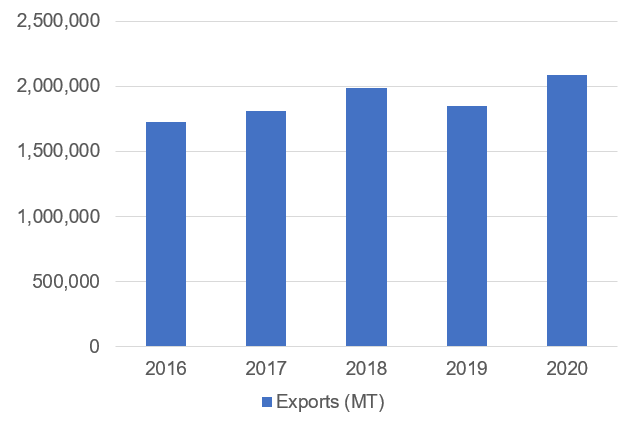
Last year, total milk solids exports (the measurement accommodates for the different types of products milk’s made into) topped 2 million metric tons for the first time, reaching 2.086 million, based on government data crunched by the U.S. Dairy Export Council. Revenues were the highest since 2014. And the percentage of U.S. milk production that’s shipped to other countries increased to 16 percent, showing just how important exports are becoming for U.S. dairy producers – and the consumers around the world who rely on them.

These gains will only continue, given the markets that most crave U.S. dairy. Of those exports, 27 percent were to Southeast Asian markets, 21 percent went to Mexico and 15 percent to China – all areas with growing populations, along with the growing wealth that correlates with greater demand for the high-quality proteins and nutrients that dairy provides.

As the world’s leader in dairy greenhouse-gas reductions and as a trailblazer in animal-care practices, U.S. dairy farmers play an increasingly vital role in sustainably providing nutrition well beyond its borders. The world’s consumers are taking notice. We hope its narrative-setters soon will too.

NMPF Statement on Additional COVID Relief Package

“NMPF is grateful to Congress for working to enact additional COVID-19 stimulus legislation. The pending bill includes critical additional agriculture and nutrition support intended to help farmers, rural communities, and food-insecure households throughout the nation.

“Throughout the COVID-19 pandemic, the federal government’s strong response has proven invaluable to dairy producers as they keep working, day-in and day-out, to sustainably provide families here at home and abroad with an abundant supply of nutritious dairy products. However, while the availability of a vaccine is cause for hope, difficult months remain ahead.

“NMPF appreciates the additional $3.6 billion Congress would provide to bolster food supply chains and facilitate additional purchases and donations of dairy and other food products to those who need them most. NMPF also supports the legislation’s increased funding for the Supplemental Nutrition Assistance Program and the Commodity Supplemental Food Program, which will provide dairy and other nutritious foods to those households and senior citizens who have faced added hardship and unique struggles during this challenging period.

“Finally, the package includes important provisions that strengthen resilience and improve equity in rural America and take critical steps to improve the livelihoods of historically underserved farmers, including debt relief and access to credit. These actions will better position all parts of the country to recover from the stresses of the pandemic and strengthen our communities for years to come.”

NMPF Statement on Confirmation of Tom Vilsack as Secretary of Agriculture

From NMPF President and CEO Jim Mulhern:

“All of U.S. agriculture has an effective advocate in Tom Vilsack, and the nation will be well-served by his return to public service leading the U.S. Department of Agriculture.

“We in the dairy community who have had the opportunity to work with him have seen first-hand his deep passion for rural America and his commitment to advancing agriculture and the communities it serves, from farmers and food-sector workers to the consumers and businesses that depend on USDA to meet their needs every day, in every way. That’s especially important in light of today’s pressing challenges, which include a farm economy battered by the COVID-19 pandemic; climate change, sustainability and the environment; nutrition and food insecurity; international trade policies that limit U.S. exports; labor shortages that are worsening with time; and the legacies of societal injustice that need to be addressed.

“Tom Vilsack’s experience and leadership will be crucial to meeting these challenges, and more. We congratulate him on his confirmation and pledge to do our best to contribute to his successful service.”

Dairy Playing Its Part as a Climate Solution, NMPF’s Jonker Says

Through commitments like the Net Zero Initiative and efforts like the National Dairy Farmers Assuring Responsible Management (FARM) Program, dairy farmers are well-positioned to be agricultural leaders in mitigating climate change, said Dr. Jamie Jonker, NMPF’s Vice President for Sustainability and Scientific Affairs, in an NMPF podcast released today.

“We’re producing more milk, we’re having less greenhouse gas emissions overall, which means that the U.S. dairy sector is already the most efficient in the world,” said Jonker, who also serves as chairman of the International Dairy Federation’s Science Program Coordinating Committee. Still, farmers face regulatory and financial challenges in their efforts to reduce greenhouse gas emissions and increase the sustainability of their resource use, he said. “The biggest challenge is really the technology and financial side. If we’re not able to have our dairy farmers afford to make changes in their operations, then they cannot put these technologies and best practices into practice on their farms.”

The full podcast is here. You can also find the podcast on Apple Podcasts, Spotify and SoundCloud. Broadcast outlets may use the MP3 file below. Please attribute information to NMPF.

Biden Immigration Plan the Starting Point for Negotiations

The Biden Administration this week put forward an immigration reform package that would give a path to citizenship for immigrants already in the United States. That plan would give priority to ag workers, but would not expand the H2A visa plan for those ag workers.  Paul Bleiberg of the National Milk Producers Federation joins Pro Farmer’s Jim Wiesemeyer and John Herath of Farm Journal to sort through the details of the immigration proposal on this week’s DC Signal to Noise Podcast.  The three see the Biden immigration package as an opening offer in what will be a series of negotiations over issues such as the ag exemption for overtime and an expanded H2A program.

Other issues covered in this episode:

    • USDA Ag Outlook projects record corn and soybean acres
    • Climate at the center of USDA Ag Outlook
    • When will CFAP money be released?
    • Update on COVID aid package


NMPF’s Yeiser Stepp Discusses Dairy-Farm Stewardship

NMPF Vice President of the National Dairy FARM Program Emily Yeiser Stepp discusses the inception and evolution of the FARM Program, what compels consumers to choose between dairy and alternative products, and what dairy farmers are doing to demonstrate their commitment to their animals and the environment, on the “Fallon Forum” podcast.

NMPF Statement on Proposed Immigration Reform Legislation

In response to the immigration bill introduced today in Congress, NMPF President and CEO Jim Mulhern offered the following statement:

“As a leader in agricultural labor reform efforts, NMPF knows all too well that immigration policy is one of the most controversial and difficult issues to solve. We applaud President Biden, Representative Sanchez, and Senator Menendez for stepping up and leading with the U.S. Citizenship Act of 2021, making clear that immigration legislation is a significant, immediate priority. Still, reforms to our immigration system must include changes crucial for the dairy workforce. These include extending to current workers and their families the legal protections they have earned and enabling dairy farmers to use a guest worker program to supplement their domestic workforce when needed.

“NMPF looks forward to continuing to work with our policy champions in Congress in a bipartisan manner, as well as the administration, to get ag labor reform across the finish line and secure the stable, legal workforce dairy needs to continue producing affordable nutritious food to feed our country and our world.”

Dairy Defined: To Reduce Greenhouse Gases, Dairy Has Solutions for All Sizes

The methane digester on Belden Farms in Hatfield, MA, owned and operated by Darryl and Lucinda Williams, generates almost 2.5 million kilowatt hours of electricity per year, avoiding 1,768 metric tons of greenhouse gas (GHG) emissions — equivalent to taking 382 cars off the road.

That’s a big reduction – and one from a farm without a lot of dairy cows. The farm’s mostly Holstein 174 milking-cow herd is much smaller than many other operations with the same technology. They make it work through cooperation: Their digestor is also supplied by the farm’s 30 beef cattle and food waste from local businesses.

The Williams family’s history of stewardship goes back to 1661, caring for their animals across 13 generations. A founding member family of the Agri-Mark cooperative, they have shown that tackling greenhouse gases in dairy can be scalable, as well as doable, for farms of all sizes today and in the future. That’s key to the dairy sector’s goal of net-zero greenhouse gas emissions by 2050. Solutions look different for different operations. They’re all united by a common goal, and common values.

On the other side of the country, in Sunnyside, Washington, Dan DeGroot has adjusted his cow housing at Skyridge Farm switching from an open lot to a free-stall operation beginning in 2003.

The DeGroots installed a variety of technologies – variable-speed drive (VSD) motors, programmable logic controllers (PLC), energy efficient lighting, and more – to save energy and make the cows more comfortable, decreasing emissions and increasing productivity along the way.

Other changes, like a recycling program, further technology upgrades and modified tilling, were all adopted after DeGroot systematically analyzed as many processes on his farm as possible and started selecting areas for improvement.

One of the tools available to farmers wanting to quantify and improve their sustainability efforts is the FARM Environmental Stewardship program area. Using a peer-reviewed model, the program estimates farm-level greenhouse gas emissions and energy use on dairy farms. It also provides tools for farmers to improve their carbon footprints.

Farms that undergo an environmental stewardship evaluation come away with a better understanding of how their current practices relate to greenhouse gas emissions. Then, with FARM resources such as its Continuous Improvement Reference Manual, they can set goals to decrease their emissions, helping to set the sector as a whole on a path toward Net Zero, along with a set of sustainability goals for 2050 that include becoming carbon neutral or better, optimizing water use while maximizing recycling, and improving water quality.

Right now, the U.S. dairy industry is responsible for less than two percent of GHG emissions in the country. Much of that is methane, which has an impact that many scientists say is likely overstated. According to the Food and Agriculture Organization of the United Nations, North America – which is dominated by U.S. dairy production – is the only region in the world where absolute emissions decreased from 2005 to 2015, by a total of 5 percent. That occurred even as milk production increased over that same time period.

That doesn’t happen because of luck. The DeGroots and the Williamses found tools that work for them and scaled them for success. But they’re far from the only dairy farmers who have done so – such stories can be told across the sector. Collectively, the efforts of these farmers show how U.S. dairy is already a force for good on the global climate stage. The work has already been going on for decades. Its impact only grows more powerful with each passing day.

NMPF Congratulates Senator Baldwin on Agriculture Appropriations Chair Selection

The National Milk Producers Federation today congratulated Senator Tammy Baldwin (D-WI) on her selection as Chair of the Senate Agriculture, Rural Development, Food and Drug Administration, and Related Agencies Subcommittee.

“During her time in both the House and the Senate, Senator Baldwin has been an effective champion for dairy farmers in Wisconsin and beyond,” said Jim Mulhern, NMPF president and CEO. “She has fervently fought for dairy’s good name in the face of FDA’s unwillingness to enforce clear, simple dairy product terms. She also has played a key role in efforts to positively reform dairy policy and tirelessly worked on the Appropriations Committee to champion dairy innovation, as well as initiatives to combat farmer stress in rural America.”

Senator Baldwin has served on the Agriculture Appropriations Subcommittee, which sets spending for agriculture and numerous nutrition programs along with the U.S. Food and Drug Administration, for six years. During that time she has sponsored the bipartisan DAIRY PRIDE Act, which would compel FDA to enforce current law by requiring marketers of imitation dairy products to use proper labeling. She has also advocated successfully for critical improvements to the dairy safety net both in the Bipartisan Budget Act and the 2018 Farm Bill. Finally, Baldwin sponsored the bipartisan FARMERS FIRST Act which reestablished USDA’s Farm and Ranch Stress Assistance Network to help farmers manage the unique stressors they face.

“Senator Baldwin becomes Chair of the Agriculture Appropriations Subcommittee with a strong record of bipartisan achievement at a critical time for our nation’s dairy producers and their cooperatives,” Mulhern said. “We look forward to working with her as our nation continues to weather the impacts of the COVID-19 pandemic and begins to tackle the challenges that will follow.”