House Advances Farm Bill with Key Dairy Provisions
May 05, 2026The National Milk Producers Federation welcomed U.S. House passage of the 2026 Farm Bill, a significant step forward for dairy farmers and the broader agricultural economy. The House‑approved package reflects many NMPF priorities and provides critical support at a time of continued volatility and uncertainty for producers.
The legislation strengthens the farm safety net, preserves conservation programs that work for dairy and livestock operations, bolsters trade promotion programs and protects common food names, reinforces dairy’s essential role in nutrition policy and continues support for vital animal health initiatives.
“NMPF commends lawmakers who today stood up for farmers by passing legislation that’s critically important for dairy producers,” NMPF President and CEO Gregg Doud said in a statement released after the final vote. “At a time where farmers face unprecedented challenges, Congress needs to provide the stability of a five-year, comprehensive farm bill. We will work with leaders in both chambers, from both parties, to get a farm bill signed into law.”
In addition to securing dairy priorities in the committee-approved bill, NMPF partnered with our member cooperatives to defeat harmful amendments related to animal health, Proposition 12, and food aid. NMPF also created an advocacy alert geared toward generating House support and is planning a separate campaign pushing for Senate passage.
NMPF praised House Agriculture Committee Chairman Glenn “GT” Thompson, R-PA, and other dairy champions for advancing the bill through the House and delivering a package that reflects months of stakeholder input and bipartisan work.
Attention now turns to the Senate. NMPF will continue collaborating closely with leaders in both chambers and across party lines to ensure that a comprehensive farm bill reaches the president’s desk — one that delivers certainty, supports innovation, and strengthens the future of U.S. dairy.
NMPF Backs Sterile Flies to Combat Screwworm
May 05, 2026NMPF submitted comments April 22 to the Environmental Protection Agency supporting its science‑based review of a USDA registration application for NovoFly, a sterile, male‑only New World screwworm developed as part of the proven Sterile Insect Technique used to prevent and respond to screwworm outbreaks.
“By improving male-only release ratios and reducing production inefficiencies, this technology strengthens the economic sustainability of the U.S.–Mexico barrier program that protects billions of dollars in agricultural value annually,” NMPF stated in its comments. “Investing in a more precise and scalable SIT tool is fiscally responsible and reduces the likelihood of far more costly emergency eradication campaigns in the future.”
To reinforce the importance of adding NovoFly male-only genetically engineered New World screwworm to the nation’s screwworm response and prevention toolbox, NMPF created an easy-to-use comment template for dairy farmers, cooperatives, state associations, and others to add their own support during the public comment period. Additional comments demonstrate broad dairy industry support for effective, environmentally responsible tools to protect U.S. livestock and agriculture from New World screwworm.
USDA on April 17 started building its domestic sterile fly production facility in Edinberg, TX, with operations projected to begin late next year. As of the beginning of May, the nearest screwworm detection has been reported 62 miles from the Texas border in Nuevo Leon. FDA also in April granted Emergency Use Authorization for the F10 Antiseptic Barrier Ointment with Insecticide for application in cattle, specifying a milk discard period of 10 days.
To get involved with NMPF advocacy campaigns, check out the Take Action page of NMPF’s website or visit nmpf.org/subscribe and be sure to check the “Advocacy Alerts” box on the form for future notifications.
DAIRY PRIDE Act Reintroduced in House
May 05, 2026NMPF partnered with congressional allies Reps. John Joyce, R-PA, and Josh Riley, D-NY, to reintroduce the bipartisan DAIRY PRIDE Act in the House of Representatives April 21, an important step in the ongoing efforts to ensure truth in labeling for milk and dairy products.
The legislation is a companion to the bipartisan Senate bill introduced in July 2025.
“Dairy farmers have spent generations building trust in the nutritional value and quality of real dairy products; allowing imitation products to borrow that reputation risks misleading shoppers and muddying the marketplace,” NMPF President & CEO Gregg Doud said.
The Food and Drug Administration for nearly five decades has failed to enforce its own standards of identity for dairy foods, allowing plant-based imitation products to use dairy terms like “milk,” “cheese,” and “yogurt” despite being nutritionally inferior. These standards exist to promote honesty, protect consumers, and ensure that product names carry clear expectations for nutritional value. Milk and dairy foods provide a unique package of 13 essential nutrients, including calcium, potassium, and vitamin D — nutrients of public health concern that many Americans already under-consume.
DAIRY PRIDE would direct FDA to finally uphold these longstanding standards by deeming imitation products with inaccurate milk claims as misbranded. The bill also requires FDA to issue guidance within 90 days to ensure consistent, nationwide enforcement, helping consumers better understand their choices at the grocery store and restoring fairness for dairy farmers who play by the rules.
NMPF strongly supports the DAIRY PRIDE Act and thanks Reps. Joyce and Riley for their bipartisan leadership. The organization will continue engaging Congress and the Administration to push for meaningful action that protects dairy’s identity, supports public health, and ensures a level playing field for America’s dairy farm families.
April NEXT-Assisted Export Sales Total 16 Million Pounds
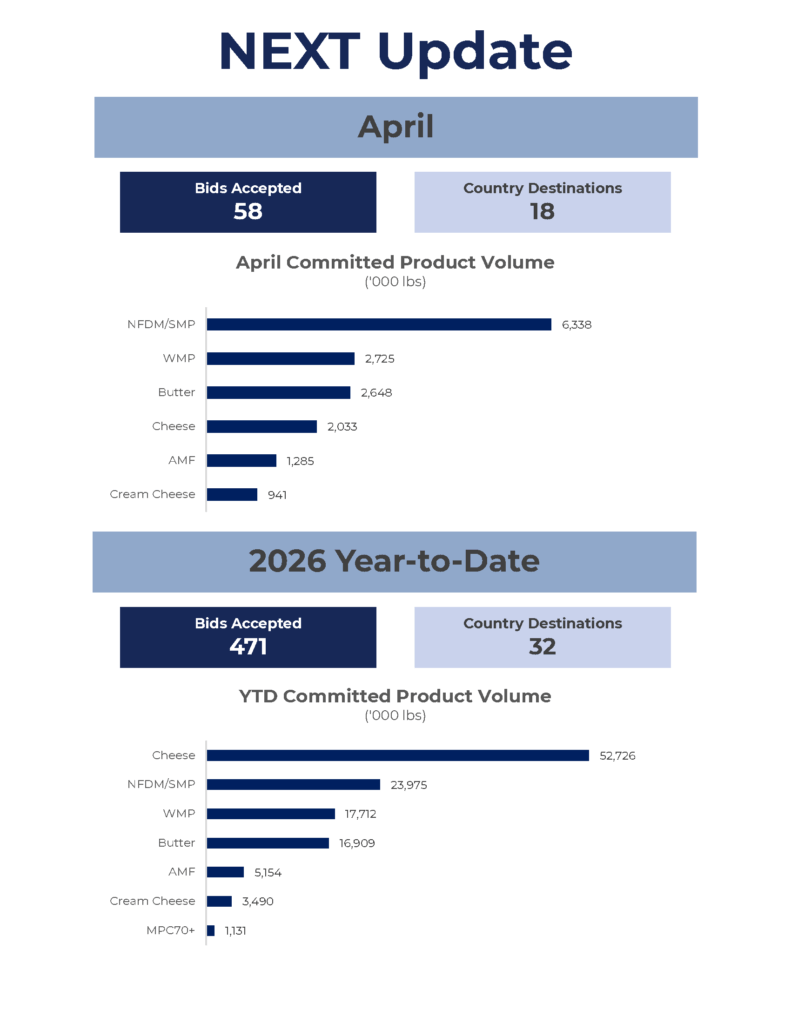
May 05, 2026NEXT member cooperatives secured 58 contracts in April, adding 16 million pounds of product in NEXT-assisted sales in 2026. These products will go to customers in Asia, North America, Oceania, Middle East-North Africa, South America, Central America and the Caribbean and will be shipped from April through November 2026.
Exporting dairy products is critical to the viability of dairy farmers and their cooperatives across the country. Whether or not a cooperative is actively engaged in exporting, moving products into world markets is essential. NEXT provides a means to move domestic dairy products to overseas markets by helping to overcome U.S. dairy’s trade disadvantages.
The referenced amounts of dairy products reflect current contracts for delivery, not completed export volumes. NEXT will pay export assistance to bidders only when export and delivery of product is verified by submission of required documentation.
FARM Builds Trust, Sets Stage for Progress
May 05, 2026The National Dairy FARM Program advanced U.S. dairy priorities in animal care, workforce development and environmental stewardship by presenting in two sessions at the 2026 Dairy Sustainability Alliance Spring Meeting on April 29. The program also aided in a panel discussion on how FARM delivers value across the supply chain.
Dr. Meggan Hain presented in “Landscape Level Set: Care for Animals and Communities,” exploring how the dairy industry is driving progress in animal care, food safety and workforce development. The session highlighted key focus areas for the industry in 2026 and shared resources for organizations interested in improving these focus areas.
FARM hosted a second session, “Building Trust Across the Dairy Value Chain,” as it explored perspectives that showcase how FARM delivers value by supporting market access, managing reputational risk and strengthening trust in U.S. dairy customers and consumers. Panel participants included Agri-Mark dairy farmer Val Lavigne; Kristy Miron, who serves as a sustainability & animal care manager for Land O’Lakes Inc.; and Adam Wylie, director of global responsibility for Leprino Foods.
FARM’s Nicole Ayache spoke in an informational panel about evolving global expectations and what they could mean for U.S. dairy: “What Global Reporting Expectations Mean for U.S. Dairy.” The panel shared insights into the most recent developments in E.U. sustainability directives that influence how global customers approach such topics.
The meetings also provided an opportunity to speak with farmers and industry stakeholders on current challenges, emerging animal health trends and advancements in science and technology.
NMPF Spotlights Stewardship Through Storytelling
May 05, 2026NMPF and the National Dairy FARM (Farmers Assuring Responsible Management) Program spent April telling one connected story across multiple media channels: how America’s dairy farm families are true stewards, not just for Earth Day, but every day.
NMPF’s latest Farmer Focus, CEO’s Corner column, and Dairy Defined Podcast episode spotlighted the people and programs behind the progress.
In Farmer Focus, the Van Hofwegen family shared how data opens doors for future generations, using FARM Environmental Stewardship to track and measure the farm’s environmental footprint.
Paloma Dairy in Gila Bend, AZ, is a family-owned and operated United Dairymen of Arizona member-farm producing high-quality milk since its founding in 2006. It’s managed by Robert Sr. and his four sons: Allan, Robert Jr., Arie and Kyle.
The farm uses energy audits and data collected from FARM ES evaluations to shape capital investments and business strategies. “You know, we call ourselves dairymen, but it’s agribusiness — business in capital letters,” said Robert Van Hofwegen.
NMPF President & CEO Gregg Doud’s monthly CEO’s Corner column touched on farmer stewardship, noting that much of what’s called “sustainability” is simply good business practices and efficiency.
“Public discussion about agriculture at times treats stewardship and profitability as parallel conversations — one is about social responsibility (whatever that may mean), while the other is about returns,” the column states.
“A dairy farmer’s reality is very different. On dairies, stewardship is a business strategy that improves efficiency, manages risk, and strengthens U.S. dairy’s competitiveness at home and abroad. Its success hinges upon being farmer‑led, incentive‑based, and grounded in economics rather than mandates.
“Efficiency has always been the foundation. To use a recent buzzword, do you know what “regenerative ag” is to me? It’s the stuff my dad has emphasized on the farm for the past 50 years, and its stuff dairy farmers do every day.”
Nicole Ayache, chief sustainability officer for NMPF, explained in April’s Dairy Defined podcast how the FARM Program puts farmers first. FARM provides a tool for farmers to track and measure their footprint, which they can use to make on-farm improvements. It also helps farmers access additional resources, such as grants, incentive programs, milk premiums and other revenue channels, and helps manage customer expectations while promoting the good story that happens on dairy farms daily.
Ayache, who leads the National Dairy FARM Program’s Environmental Stewardship initiative, noted how sound management of resources and a focus on efficiency has boosted dairy productivity and bottom lines, even as it reflects the dedication of the farmers themselves to serving consumers.
“A lot of stewardship is about efficiency” — but it’s also more than that, Ayache said. “Anyone who chats with farmers know that because you can hear every time you talk to them about their farm and their choices, you can hear their passion for the animals and the land and their care and the nutrition they provide to our country and the world.”
NMPF Hails USTR Report Highlighting Cheese Name Trade Barriers
May 05, 2026NMPF welcomed the U.S. Trade Representative’s April 30 release of its 2026 Special 301 Report, which cites as a priority trade barrier the European Union’s abuse of intellectual property tools to monopolize common cheese names like “parmesan.”
The support for positions taken by NMPF, the U.S. Dairy Export Council and the Consortium for Common Food Names, is essential as the organizations work with the U.S. government to secure protections for American dairy producers’ right to use common food names in global markets.
The annual document that details pressing intellectual property issues facing U.S. exporters this year highlights the administration’s successful efforts over the past year to use reciprocal trade agreement negotiations to secure commitments to keep common names free to use for American producers. These new deals are critical for pushing back against the European Union’s protectionist geographical indication (GI) policies, which restrict widely recognized terms like “parmesan” and “feta” to specific European producers and effectively cut U.S. exporters out of key markets.
NMPF and USDEC filed comments in January supporting CCFN’s more detailed submission to USTR, which documented the breadth of markets where those rights are under threat and expressed gratitude for the administration’s prioritization of the issue. NMPF’s Shawna Morris also testified at the public hearing USTR held as part of its efforts to develop the report. All three organizations will complement USTR and U.S. government monitoring the reciprocal trade agreements and hold trading partners to their successful implementation.
Additionally, NMPF will continue to push for protections in every ongoing trade negotiation, including the U.S.-Mexico-Canada Agreement Joint Review, to ensure that U.S. dairy exporters can ship their products to any market in the world, regardless of their common names.