FDA Rejects Mandatory Labeling of GMO Foods, Releases Own Recommendations

The conversation over genetically modified organisms flared up at the end of November, when the FDA made several big announcements on the issue. Most notably, it rejected a consumer activist petition seeking mandatory labeling of foods made with genetically modified ingredients, and then released its own recommendations on the voluntary labeling of GMO foods.

In its reason for the rejection, FDA said the petition did not provide enough evidence to show that foods derived from genetically modified ingredients present any different or greater safety concerns than foods developed traditionally.

By releasing its own recommendations for voluntary labeling, FDA said it recognized the desire of some consumers to know what goes into their food.

“These guidances provide recommended actions for manufacturers who may wish to voluntarily label their products with information about whether the foods contain ingredients from GE sources,” the agency said.

NMPF applauded both announcements in a statement.

“FDA’s rejection of the petition is a strong reaffirmation of the sound science policy underlying FDA’s approval process,” NMPF said. “Only products found to be safe for human or animal use should be approved. And if they are approved as safe, there is no basis for mandatory labeling.”

FDA also announced that it had approved genetically engineered salmon for human consumption, saying that the modified salmon is as nutritious and safe to eat as non-GMO salmon. This is the first GMO animal to be declared edible.

Comments Sought on Version 3.0 of the FARM Animal Care Manual

NMPF is looking for feedback on the third update to its reference manual from those participating in the National Dairy FARM (Farmers Assuring Responsible Management) Program. Open to all dairy farmers, co-ops and processors, the FARM Program sets the highest standards for dairy animal care. The reference manual, which outlines best management practices central to the program, is reviewed and reissued every three years.

This fall, NMPF’s Animal Health and Well-being Committee approved edits to the manual suggested by the FARM Program Technical Writing Group, comprising academics, veterinarians, producers and co-op staff who reviewed the latest research, discussed feedback received from FARM Program evaluators and sifted through recommendations from large dairy customers.

The committee’s draft includes both minor and substantive edits to all 11 chapters of the manual. Those interested in providing comments on the draft Animal Care manual should utilize the comment form.  All comments must be submitted to Emily Meredith, NMPF Vice President of Animal Care by Wednesday, January 6 at 5:00 pm. 

FARM Program Participates in First-Ever Antibiotics Awareness Week, Releases Drug Residue Prevention Manual

In honor of the first national Antibiotic Awareness Week, NMPF’s FARM Program participated in a social media drive to educate farmers and consumers on the proper use of antibiotics in animals. It also released an updated manual on drug residue prevention.

From Nov. 16-22, the Centers for Disease Control and Prevention and the World Health Organization hosted educational campaigns on antibiotic resistance. FARM focused its campaign on the agriculture sector. The program’s Facebook and Twitter accounts featured graphics, videos and facts about safely administering drugs to sick farm animals.

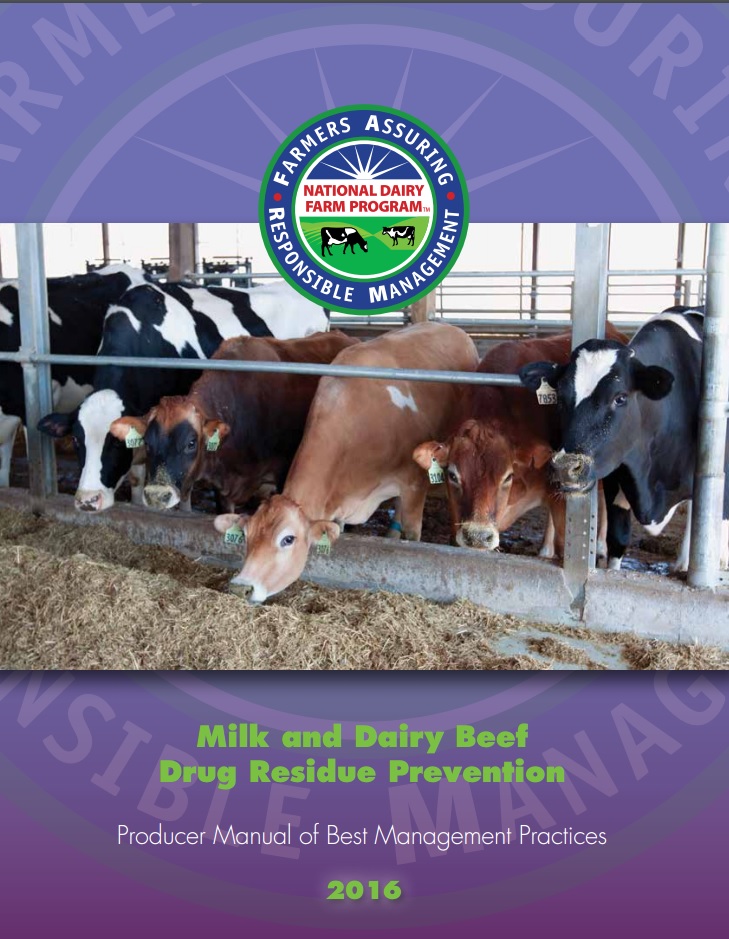
To coincide with this event, the FARM Program released its 2016 Milk and Dairy Beef Drug Residue Prevention Manual – one of the key components of the program. The manual offers a concise review of appropriate antibiotic use in dairy animals, and can also be used as an educational tool for farm managers as they develop their best management practices necessary to avoid milk and meat residues.

“We know that there is increased attention to the use of medicines in livestock, and in order to maintain the ability to use those products to treat sick animals, we have to demonstrate that we are using them judiciously,” said Jim Mulhern, President and CEO of NMPF.

NMPF Opposes Latest ‘Added Sugars’ Proposal from FDA

NMPF has opposed the Food and Drug Administration’s latest proposal to revise the Nutrition Facts Panel to include an amount and percent Daily Value for “added sugars” on the label for consumers.

In comments sent to the agency in October, NMPF disagreed with the FDA that its proposal will help consumers make better food choices and improve their diets, noting the FDA itself has concluded there is no scientific basis for a recommended daily intake for added sugars.

As with comments submitted last summer on FDA’s original proposal, NMPF again emphasized that the FDA incorrectly and inappropriately extended the definition of “added sugars” to include the lactose in many concentrated and dried dairy ingredients, even though lactose is a naturally-occurring sugar and is not used primarily as a sweetener.

“FDA’s proposed definition of ‘added sugars’ falls woefully short in this regard and leaves our industry confused and ill-served . . . .” the Federation said. It encouraged FDA to rewrite its added sugars definition “or risk significant consumer misunderstanding . . . ” 

NMPF Hosts Webinar on FSMA Preventive Controls for Human Food Rule

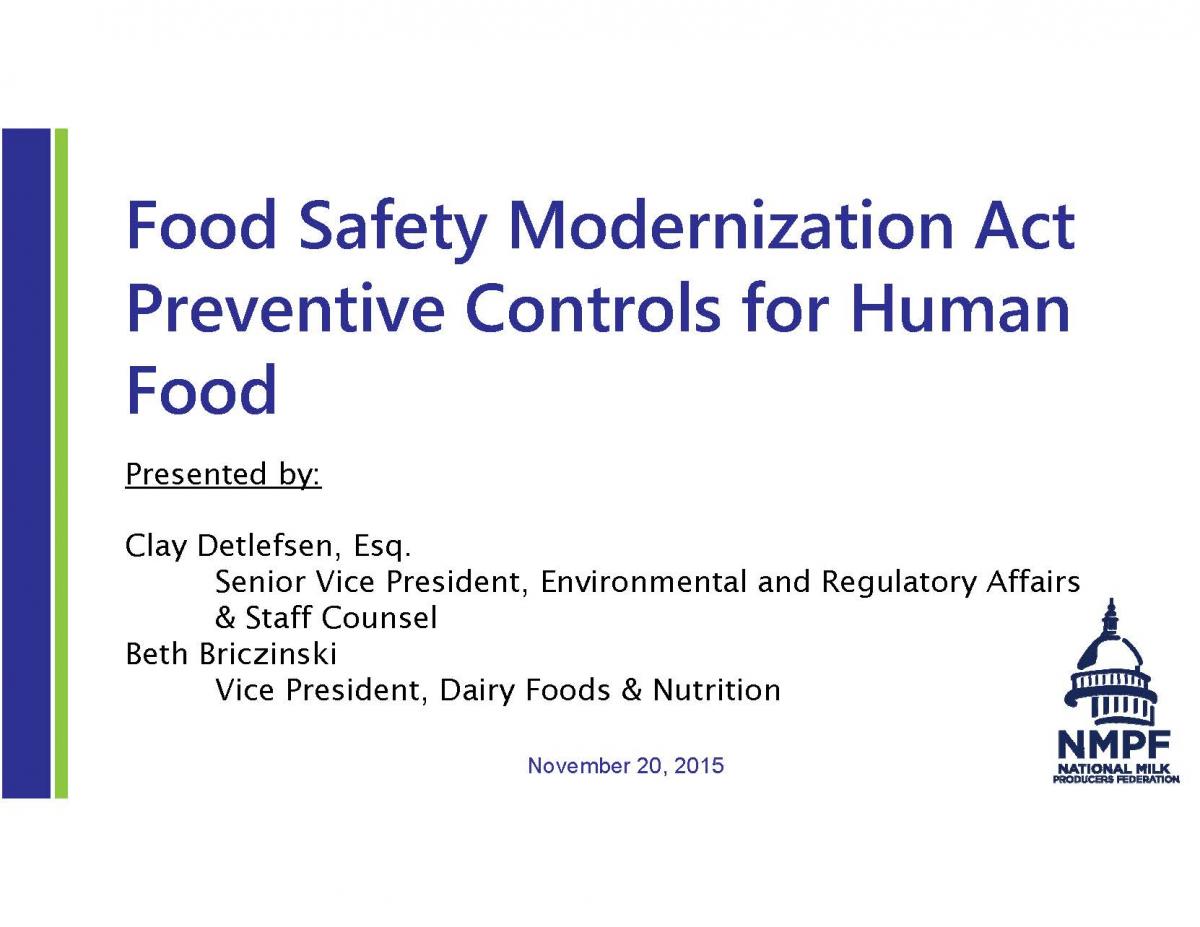
On Nov. 20, NMPF conducted its first Food Safety Modernization Act (FSMA) webinar. Clay Detlefsen, Senior Vice President of Regulatory & Environmental Affairs, and Beth Briczinski, Vice President of Dairy Foods & Nutrition, presented on the Preventive Controls for Human Food (PCHF) rule — the most significant of the seven major FSMA rules.

The preventive controls rule requires human food facilities to develop food safety plans that indicate any problems that could affect the safety of their products, then outline steps the facility would take to minimize the likelihood of those problems occurring.

Detlefsen and Briczinski outlined the rule’s requirements and provided some background on how it was developed, emphasizing that there is still considerable uncertainty about how effective and burdensome the PCHF rule will be. A much better assessment will be made when FDA releases numerous guidance documents on hazard analysis, preventive controls, allergen control and environmental monitoring, they said. However, there is no set date for the release of these documents.

NMPF plans to replicate this educational tool for other FSMA rules and guidance documents in the coming months, to ensure that cooperatives are well informed on the implications of the FSMA regulations.

NMPF’s Ryan Bennett Promoted to Senior Director of Industry & Environmental Affairs

Ryan Bennett was recently promoted to Senior Director of Industry & Environmental Affairs for NMPF, following three years as Director of Government Relations. In his new position, Bennett will focus on two critical areas of growing interest to NMPF members: animal care and environmental issues.

Bennett now works with Vice President of Animal Care Emily Meredith to enhance and expand NMPF’s FARM Program. He focuses extensively on farm and processor engagement, including evaluator training, participant outreach, managing the new and expanded database, and developing FARM program materials.

On the environmental side, Bennett works with Clay Detlefsen, Senior Vice President of Regulatory & Environmental Affairs for NMPF, to advance the organization’s work with the newly created Newtrient LLC, addressing on-farm environmental issues related to manure management.

CWT assists members in getting 10.1 million pounds of export sales contracts

Cooperatives Working Together assisted member cooperatives in November in getting 18 contracts to sell 4.786 million pounds of cheese and 5.331 million pounds of whole milk powder to customers in Asia and South America. The product will be shipped from November 2015 through May 2016.

These sales contracts bring CWT’s totals through October 2015 to 53.7 million pounds of cheese, 25.7 million pounds of butter and 40.4 million pounds of whole milk powder. In total, CWT-assisted transactions will move the equivalent of 1.368 billion pounds of milk on a milkfat basis to customers in 35 countries on five continents. These totals are adjusted for contract cancellations.

Developed by NMPF, CWT’s export assistance program is supported on a voluntary basis by dairy farmers across the nation. By helping to move U.S. dairy products into world markets, CWT helps maintain and grow U.S. dairy farmers’ share of these expanding markets which, in turn, works to keep dairy farmer milk prices at reasonable levels.

Renewal of the CWT program for the period 2016-2018 is underway. All cooperatives and dairy farmers are encouraged to add their support to this important program. Membership forms are available on the CWT website.

Dairy Groups Urge Congress to Fix Country-of-Origin Labeling Problem in Year-End Spending Bill

ARLINGTON, VA – Dairy producers and exporters today urged Congress to eliminate the threat of damaging new tariffs on dairy exports to Canada and Mexico by solving a trade dispute over country-of-origin meat labeling in the massive year-end spending bill currently being negotiated on Capitol Hill.

In a letter sent Thursday to House and Senate leaders, the National Milk Producers Federation and the U.S. Dairy Export Council expressed increasing alarm that new tariffs targeted at U.S. dairy exports to the two neighboring nations are potentially only weeks away.

The tariffs would be imposed under a World Trade Organization finding that parts of the U.S. country-of-origin labeling law violate international trade rules, allowing retaliation by our trade partners.

The WTO is set to announce on Monday the amount of retaliatory tariffs Canada and Mexico can place on U.S. exports as a result of the meat labeling law. After one more perfunctory approval step, the two countries could activate their tariff penalties as early as late this month.

“It is critical that Congress resolve this challenge in the end-of-year spending legislation in a way that Canada and Mexico agree sufficiently addresses their concerns in order to remove the threat of retaliation tariffs,” the joint NMPF-USDEC letter said.

The letter went to House Speaker Paul Ryan (R-WI), House Minority Leader Nancy Pelosi (D-CA), Senate Majority Leader Mitch McConnell (R-KY) and Senate Minority Leader Harry Reid (D-NV). A similar letter was sent to Senate leaders last month.

The WTO ruled last spring that Canada and Mexico could retaliate against U.S. exports in response to its finding that parts of the U.S. COOL program were not compliant with U.S. WTO obligations. American dairy products have been on Canada’s target list for retaliatory tariffs resulting from the ruling and Mexico has targeted dairy exports in prior retaliatory actions.

“Retaliation against dairy products would come at a particularly harmful time for our industry, given the depressed global dairy market,” said NMPF President and CEO Jim Mulhern. “Multiple cooperatives have already faced an oversupply of milk this year.”

“Retaliatory tariffs would back up exports further onto the U.S. market during a time of overly abundant milk supplies,” added USDEC President Tom Suber. “U.S. dairy producers and processors cannot lose this chance to avoid considerable damage to the export markets they have invested so heavily in developing in recent years.”

Canada and Mexico are two of the largest U.S. export markets. Together, they import more than $2 billion in U.S. dairy products annually. 

Congress has been discussing legislation to solve the COOL issue all year. The year-end omnibus spending bill, needed to fund the federal government after December 11, will be one of the last large measures considered by the House and Senate before they adjourn for the year.  

###

The National Milk Producers Federation, based in Arlington, Va., develops and carries out policies that advance the well-being of U.S. dairy producers and the cooperatives they collectively own. The members of NMPF’s cooperatives produce the majority of the U.S, milk supply, making NMPF the voice of nearly 32,000 dairy producers on Capitol Hill and with government agencies. For more on NMPF’s activities, visit www.nmpf.org.

The U.S. Dairy Export Council is a non-profit, independent membership organization that represents the global trade interests of U.S. dairy producers, proprietary processors and cooperatives, ingredient suppliers and export traders. Its mission is to enhance U.S. global competitiveness and assist the U.S. industry to increase its global dairy ingredient sales and exports of U.S. dairy products. USDEC accomplishes this through programs in market development that build global demand for U.S. dairy products, resolve market access barriers and advance industry trade policy goals. USDEC is supported by staff across the United States and overseas in Mexico, South America, Asia, Middle East and Europe. The U.S. Dairy Export Council prohibits discrimination on the basis of age, disability, national origin, race, color, religion, creed, gender, sexual orientation, political beliefs, marital status, military status, and arrest or conviction record. www.usdec.org

NMPF, IDFA Applaud Inclusion of Milk Hauling Amendment to Transportation Bill

ARLINGTON, VA – The National Milk Producers Federation and International Dairy Foods Association praise Congress for its decision today to include in a conference report a dairy-specific amendment that would benefit producers, processors and consumers.
The organizations now urge Congress to pass the report so that it can reach President Obama’s desk by the Dec. 4 deadline.

The bipartisan amendment, sponsored by Reps. Richard Hanna of New York and Elizabeth Esty of Connecticut and championed by House Transportation Committee Conferee Rep. Reid Ribble of Wisconsin, gives states the option to issue permits allowing milk haulers to increase their truck weights beyond Interstate Highway System limits. This would allow milk trucks in some states to carry more product without being forced to offload portions of it at other state borders.

The amendment was supported by a bipartisan group of lawmakers in both the Senate and House.

“If passed, fewer vehicles would be needed to transport milk, cutting transportation costs and easing the burden on farmers, consumers and commuters,” said IDFA President and CEO Connie Tipton.

“This amendment recognizes the specific challenges in transporting milk,” said NMPF President and CEO Jim Mulhern. “It’s great to see bipartisan support for something so critical to our dairy producers.” 

The bipartisan agreement comes as part of a massive push by Congress to deal with several pieces of legislation before they adjourn for the year.

###

The International Dairy Foods Association (IDFA), Washington, D.C., represents the nation’s dairy manufacturing and marketing industries and their suppliers, with a membership of more than 550 companies within a $125-billion a year industry. IDFA is composed of three constituent organizations: the Milk Industry Foundation (MIF), the National Cheese Institute (NCI) and the International Ice Cream Association (IICA). IDFA’s nearly 200 dairy processing members run nearly 600 plant operations, and range from large multi-national organizations to single-plant companies. Together they represent more than 85 percent of the milk, cultured products, cheese, ice cream and frozen desserts produced and marketed in the United States. Visit www.idfa.org.

The National Milk Producers Federation (NMPF), based in Arlington, Va., develops and carries out policies that advance the well-being of U.S. dairy producers and the cooperatives they collectively own. The members of NMPF’s cooperatives produce the majority of the U.S, milk supply, making NMPF the voice of nearly 32,000 dairy producers on Capitol Hill and with government agencies. For more on NMPF’s activities, visit www.nmpf.org

Fighting the Right Fight


Helping dairy farmers confront the shifting tide of public opinion on animal care practices is one of the defining challenges faced by NMPF in the 21st century.  The roster of standard operating procedures and recommended practices on dairy farms is evolving, which is really nothing new.  What is new is that this evolution is being driven increasingly by both measurable animal welfare outcomes and by societal pressures about what is acceptable, as expressed by the clear and unequivocal expectations of our customers. 

That’s why the National Dairy FARM (Farmers Assuring Responsible Management) program needs to help manage and direct these mounting pressures so that dairy farmers are not constantly whipsawed by demands from the marketplace. Having in place an industry-led, science-based animal care program in the form of FARM – employed now by more than 90% of the milk supply in the nation – gives us an advantage that most of the other livestock species groups don’t have. 

The consequences of not acting prudently and proactively, but only reactively and defensively, can be seen on an almost daily basis elsewhere in animal agriculture. In the egg industry, the shift to cage-free housing has come rapidly, even in states where there is no legislative mandate.  Just last month, Taco Bell joined other fast food restaurants including McDonalds, Burger King, Starbucks, Dunkin’ Donuts and Panera Bread in switching to cage-free. Food marketers across the country are demanding cage-free housing even if lawmakers are not.  As a result, essentially all the new hen housing being constructed focuses on open colonies, not cages. 

The same is increasingly true in pork production:  Demands for gestation stall-free farrowing operations are leading to big changes in hog housing, as more and more food companies make such a system the cost of serving the market.

Where dairy farming is concerned, NMPF’s advocacy approach has been clear:  Defend those practices that are defensible, critique those that are not, and exercise the wisdom and discretion to differentiate between the two.  This approach led to the decision earlier this fall to accelerate the phase-out requirement for tail docking on dairy farms enrolled in the FARM program.  NMPF’s Board of Directors voted in late October to move up the deadline to end tail docking to January 2017, after which it will no longer be an acceptable practice.

This decision was certainly not without controversy, but it also was not a game-changer.  The NMPF Board had actually decided three years ago to end tail docking for dairies in the FARM program; this resolution merely changes the timing of when it is to be phased out. October’s vote to hasten the demise of tail docking was driven by the same factors that led to the initial decision in 2012: Veterinary science does not support the practice, and neither does consumer expectation.

When leading veterinary groups condemn routine tail docking, and no research exists to justify its practice from a milk quality or animal health standpoint, it becomes impossible to promote as credible a program that allows docking to continue.  Unlike dehorning and disbudding, which is used by virtually all dairy farmers as an obvious benefit to animal and worker safety, tail docking has not been universally utilized. In fact, FARM Program data indicates that less than 23% of the U.S. herds have docked tails. Thus, the practice becomes harder to defend as essential to milk production – especially since switch trimming exists as a suitable alternative.

Whether in state ballot initiatives, state legislatures, or increasingly, in company boardrooms and family households, the focus on livestock practices is going to continue. While much of the initial focus on these issues is driven by the animal rights crowd, it is naïve to assume that concerns about certain practices begin and end with vegan activists.  So we must make intelligent choices about which issues are going to be battlegrounds.  When companies within a supply chain are divided – as the egg industry has been with confinement cages, and as the swine sector is with gestation stalls – our opponents can use the tactics of divide and conquer to achieve their goals, and fragment the farming community.

We need to unite around preserving important animal husbandry tools for our herds, such as disbudding, or the therapeutic use of antibiotics, or the use of quality feed ingredients that may have a genetically modified trait.  Fighting to hold onto practices that aren’t credible or defensible to our consumers will only undermine the rationale and support for our national, science-based, independently verifiable dairy animal care FARM program.  It would lead to a confusing hash of marketer- or state-directed demands that only add costs and exacerbate the challenges facing farmers.  That’s an outcome we must fight to avoid.