New Spanish-language Resources on Drug Residue Management Now Available

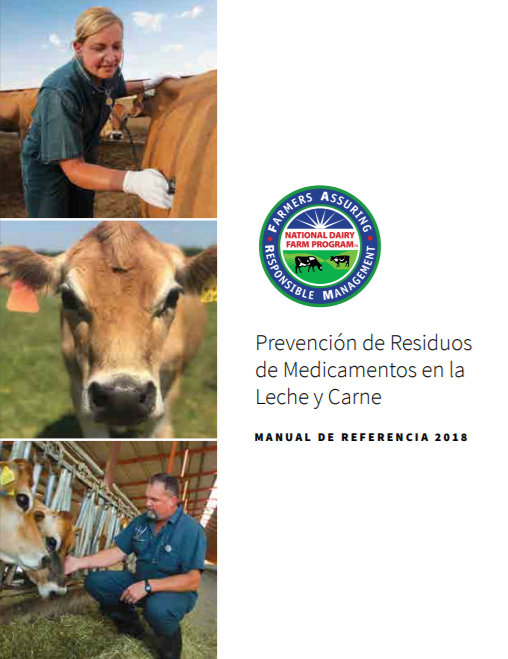
To create relevant on-farm resources for Hispanic farm workers not fluent in English, the National Dairy Farmers Assuring Responsible Management (FARM) Program is releasing two Spanish-language tools: The 2018 Spanish Drug Residue and Prevention Manual is now available for download and the 2018 Spanish Pocket Guide is available for purchase in the FARM Store.
The 2018 edition of the FARM Program’s Milk and Dairy Beef Drug Residue Prevention Manual is the primary educational tool for dairy farm managers on the judicious and responsible use of antibiotics, including the avoidance of drug residues in milk and meat. The manual and pocket guide are resources that allow dairies to review what antibiotics are approved for use in dairy cattle, and can also be used as an educational tool for farm managers as they develop best management practices necessary to avoid milk and meat residues on their operations.

The manual is updated on annual basis in partnership with Merck Animal Health, Elanco Animal Health, Zoetis, Merial, Charm Sciences Inc. and National Beef Quality Assurance.

FARM Animal Care Kicks Off Version 4.0 Revision Process

The National Dairy Farmers Assuring Responsible Management (FARM) Animal Care Technical Writing Group met in June to kick off the FARM Animal Care Version 4.0 revision process.
During the first in-person meeting of the technical writing group, members reviewed the program evaluation form and started discussions on which standards or guidelines need to be updated. Accountability measures and program implementation standardization were also a focus.

There was also discussion about the FARM Program’s new Farmer Advisory Council, which will comprise dairy farmers who will share guidance and input toward the program’s ongoing and future development. Nominations to be on the council have been received and the selection committee will be convening soon to select members.

The FARM Program, the U.S. dairy industry’s animal care quality assurance program, was established in 2009 and operates on a three-year revision cycle. Each cycle, the Technical Writing Group reviews current program standards, new and relevant science, and comments provided by industry stakeholders to incorporate into the new version of the program. The group will provide recommended updates for Version 4.0 to NMPF’s Animal Health & Well-being Committee this fall.

Once approved by the committee, final approval for the updated version will be made by NMPF’s Board of Directors, with ultimate implementation slated for Jan. 1, 2020. FARM Animal Care evaluators will undergo training during the summer and fall of 2019.

FDA Issues First Intentional Adulteration Guidance Document

On June 19, the U.S. Food and Drug Administration (FDA) released the first of three draft guidance documents designed to support compliance with the Intentional Adulteration (IA) Rule under the agency’s Food Safety Modernization Act (FSMA). The remaining two documents are expected to come out later this year.

In the coming weeks, NMPF will review the nearly 100-page guidance document and provide feedback to FDA. Following initial review, the document appears to be consistent with the views NMPF has expressed during the numerous vulnerability assessments that it has engaged in over the years. However, a more thorough review is still warranted.

The final rule on intentional adulteration is designed to address hazards that may be intentionally introduced to foods with the intent to cause wide-spread harm to public health. Unlike the other FSMA rules that addresses specific foods or hazards, the IA rule requires the food industry to implement risk-reducing strategies for processes in food facilities that are significantly vulnerable to intentional adulteration.

Food facilities covered by the rule will be required to develop and implement a food defense plan that identifies vulnerabilities and mitigation strategies for those vulnerabilities. These facilities will then be required to ensure that the mitigation strategies are working. Dairy processing facilities are covered by the rule, but dairy farms are not. The first compliance date for large facilities is in July 2019.  Small businesses have an additional year.

FDA will announce plans to hold a public meeting on the draft guidance when the second installment is released. All three parts will be available for public comment upon release. NMPF has been collaborating with FDA on intentional adulteration since 9/11. It has participated in numerous vulnerability assessments and exercises, chaired the Food & Agriculture Sector Coordinating Council (FASCC), and is part of the Food Safety Preventive Controls Alliance Intentional Adulteration Subcommittee, which develops IA training programs for FDA.

CWT-Assisted Export Sales Contracts Reach 11.8 Million Pounds in June

CWT helped member cooperatives secure 44 contracts to sell 5.88 million pounds of American-type cheeses, 194,007 pounds of butter and 5.69 million pounds of whole milk powder to customers in Asia, Central America, the Middle East, North Africa, Oceania and South America. The product will be shipped to customers in 15 countries in six regions of the world during the months of June-December 2018.
These contracts bring the 2018 total of CWT-assisted product sales contracts to 40.25 million pounds of cheese, 11.23 million pounds of butter and 15.87 million pounds of whole milk powder. These transactions will move overseas the equivalent of 740.06 million pounds of milk on a milkfat basis.

Assisting CWT member cooperatives gain and maintain world market share through the Export Assistance program in the long-term expands the demand for U.S. dairy products and the U.S. farm milk that produces them. This, in turn, positively impacts all U.S. dairy farmers by strengthening and maintaining the value of dairy products that directly impact their milk price.

The amounts of dairy products and related milk volumes reflect current contracts for delivery, not completed export volumes. CWT will pay export assistance to the bidders only when export and delivery of the product is verified by submission of the required documentation.

All cooperatives and dairy farmers are encouraged to add their support to this important program. Membership forms are available on the CWT website.

NMPF Urges USTR to Hold India, Indonesia Accountable

India and Indonesia are using policy tools to impact market access for American dairy producers, and because of this, should not receive trade benefits under the U.S. Generalized System of Preferences (GSP), according to testimony last month from NMPF’s Shawna Morris before the U.S. Trade Representative (USTR).

Speaking on behalf of NMPF and the U.S. Dairy Export Council (USDEC) on June 19, Morris recommended that USTR ask President Donald Trump to suspend GSP benefits that would allow in certain products duty-free to participants in the program. India, she said, has a 14-year record of using unscientific sanitary and phytosanitary requirements to erect barriers to dairy trade in a way that fails to comply with the GSP program’s congressionally mandated requirements.

“In practice, [India’s] requirements have created an unjustified impediment to U.S. exports despite extensive and creative efforts spanning three administrations to reopen the market,” she said. “It is unfortunate that India has not chosen over the past 14 years to engage constructively with the U.S. to resolve this issue in full and reopen the market. U.S. dairy products are safely consumed by people in countries all around the world and we would very much like to offer the people of India the choice to consume our products, as well.”

In 2003, India introduced new requirements for the government-issued health certificates that must accompany dairy imports. The United States has pursued resolution of one challenge after another in the hopes of re-opening access to India for U.S. dairy products. Those efforts included data, evidence and solution-based proposals to work through each topic, but the market remains closed to most U.S. dairy products due to continued intransigence by India on certain animal feeding provisions that go well beyond international guidance.

During the day-long hearing on various countries’ GSP standing, Morris also testified on one of the dairy industry’s most important export markets in Southeast Asia: Indonesia. Indonesia has long been a strong U.S. trading partner. In 2017, the United States exported $133 million in dairy products to Indonesia. It has been the third-largest market for skim milk powder and is a top-10 U.S. dairy export market. But new local content policies for dairy are intended to curtail imports from a variety of sources, including the United States.

In 2017, the Indonesian Ministry of Agriculture issued a new regulation that required local milk processors to procure locally-produced milk or invest in ways to support the local dairy farming sector. Businesses that only import, and do not have manufacturing facilities in Indonesia, are also required to enter into agreements to provide support to or promote the local dairy industry. U.S. companies have reported being required to submit such “partnership plans” to be assured of access to import licenses in 2018.

The United States has been working extensively since 2017 to convey concerns about the policy to Indonesia. To date, however, Indonesia has not yet agreed to change course. “We are spotlighting our concerns here today through this process in the hopes of preserving what has long been a positive relationship on dairy trade, rather than allowing a deterioration of that dynamic,” Morris said.

Canada’s Dairy Trade Practices Take Center Stage

NMPF’s efforts to elevate the dairy industry’s concerns with Canada’s harmful dairy trade practices have had a noticeable impact in the White House: during the past month, President Donald Trump repeatedly pointed out the excessive nature of Canada’s exorbitant dairy tariffs, a move that shows that the administration is intent on rectifying the current dairy trade imbalance with Canada.
Although significant work remains in the North American Free Trade Agreement negotiations, Canada’s dairy trade barriers have become a key focal point within talks over a modernized NAFTA. With no end yet in sight, NMPF and its members continue to stress the importance of addressing Canada’s Class 7 pricing scheme and exorbitant tariffs that deny the ability of the U.S. industry to fairly compete.

President Trump’s recent statements came after his previous acknowledgement that Canada’s other non-tariff policies (primarily Class 7) have been harmful to the U.S. dairy industry. While on a trip to Canada last month, Agriculture Secretary Sonny Perdue also noted that “…they can’t use their supply management system to negatively affect our dairy producers south of the border.” While there, Secretary Perdue also reiterated his previous comments that Canada’s supply management system needs to manage its supply “…so it’s not over produced and spilling over into the export market.”

In addition to communicating with the White House and Congress, NMPF’s education efforts have also been directed at helping shape public support for these priorities by ensuring the news media is armed with the facts and why they are so important for American dairy farmers. As part of that broad-based outreach effort, NMPF President and CEO Jim Mulhern provided U.S. dairy’s perspective at a highly- attended NAFTA panel discussion hosted by the Washington International Trade Association on June 21.

In his remarks, Mulhern highlighted the trade differences between Mexico and Canada as the United States works to improve NAFTA. In Mexico, he said, the United States has historically enjoyed a two-way street when it comes to dairy trade.

“In that market, we’ve worked collaboratively with our industry colleagues there to grow total dairy demand and have established a critical partnership that has allowed our industry to weather the various policy ups and downs driven by non-dairy issues over the years,” Mulhern said. Maintaining that relationship is critical in a NAFTA rewrite.

NMPF’s goals with Canada are simple, he said. “With respect to tariffs, we want parity for dairy; we want what virtually every other sector of the U.S. and Canadian economies has enjoyed for decades – free trade between our two countries. In the context of a free trade agreement, that is about as traditional a goal as it gets. And we need to put a stop to Canada’s habitual use of policy tools to thwart trade, such as the Class 7 pricing scheme. Canada started the program over a year ago, and the U.S. is not the only nation with concerns about Class 7.”

NMPF Expresses Concern about Impact of Mexico, China Tariffs on Dairy

Two of U.S. dairy’s top trading partners, Mexico and China, have enacted new tariffs against U.S. dairy products in response to American tariffs on Mexican steel and aluminum, as well as soon-to-be imposed tariffs on a variety of imports from China. National Milk, in collaboration with the U.S. Dairy Export Council (USDEC), has raised concerns about the financial impact of these actions on America’s dairy farms.
In the case of Mexico, retaliatory tariffs are already beginning to deliver a blow to the U.S. dairy sector, which is increasingly reliant on exports. On June 5, Mexico, dairy’s the largest cheese export market for American producers, applied tariffs of 10-15 percent on various U.S. cheeses. Those cheese tariffs were increased further to 20-25 percent on July 5. Through joint work with USDEC, NMPF secured a phase-in of these tariffs to soften the immediate blow, but the impact is still a significant setback for U.S. dairy farmers.

NMPF, again in collaboration with USDEC, helped collect farm group and cheese processor signatures on a broad-based industry letter sent to President Donald Trump last month that outlined concerns about the impact of Mexican cheese tariffs, and requested that the administration suspend the steel and aluminum tariffs on Mexican products in light of their constructive engagement on negotiations over the North American Free Trade Agreement (NAFTA). NMPF supported USDEC in helping disseminate news of the letter to ensure that a wide range of policy-makers were aware of this important message. NMPF believes it is essential to focus U.S.-Mexico trade discussions on restoring duty-free trade, which is vital to achieving an updated NAFTA.

In China, retaliatory tariffs of 25 percent on U.S. goods including milk powder, cheese, whey, yogurt, butter and butter oil, fluid milk and cream will start on July 6. China is the industry’s second-most important export market, last year accounting for a total of $577 million in U.S. dairy exports. These tariffs will make U.S. dairy exports considerably more expensive than those from our competitors also selling in China.

The one-two punch of Mexico’s retaliatory tariffs on cheeses and China’s subsequent tariff announcement sent U.S. dairy futures plummeting last month. Based on futures price expectations from a few days before the Mexico announcement to a few days after the one from China, the average price impact during the second half of 2018 reflected a loss of about $1.10/cwt per month. Dairy futures losses already exceed $2 billion for the balance of 2018.

Immigration Reform Legislation Again Fails to Pass the House

The U.S. House of Representatives failed last month to pass an immigration reform bill, as members of Congress considered two different versions, but couldn’t muster the votes to pass either one. The outcome means dairy farmers and other agricultural employers are again left without a functioning agricultural worker program – although House leaders have committed to a separate vote on a guest worker visa program once Congress returns to Capitol Hill in July.
As the controversial issue of migrant families being separated at the U.S.-Mexican border drew intense scrutiny in recent weeks, members of Congress were faced with increasing public pressure to deal with the separation policy, along with establishing a reprieve for the “Dreamer” immigrants that are seeking longer-term legal protections.

House leaders packaged together several immigration policy items in both bills the chamber considered in June.  The initial bill contained several agriculture workforce provisions backed by NMPF, while the second one did not. After the first bill faltered, National Milk urged lawmakers to include a farm guestworker visa program in the second version of the immigration legislation, which House leaders brought to a vote on June 27. Continued infighting between House Republicans led to the bill’s demise. However, NMPF noted appreciation for the efforts of key members of Congress to improve the agriculture workforce provisions in the run-up to the second vote.

President and CEO Jim Mulhern expressed dissatisfaction that Congress again failed to pass any immigration measure, despite the palpable need to create an agriculture guestworker program.

“We are deeply disappointed that a small group of House members chose to undermine this process by refusing to compromise, undermining good faith negotiations and ultimately preventing forward progress,” Mulhern said. “This kind of hostage-taking cannot continue if Congress is to make meaningful progress on a critical issue for our country.”

Still, Mulhern remained appreciative of the congressional allies who fought to address farm workforce needs in the immigration policy process, as it “demonstrated the need to tackle the farm worker issue sooner rather than later.”

“We commend Reps. David Valadao (R-CA), Dan Newhouse (R-WA) and Jeff Denham (R-CA) for their exemplary negotiations on this bill. We also thank House Judiciary Committee Chairman Bob Goodlatte (R-VA) for his ongoing efforts to establish a farm guestworker visa program, as well as House Agriculture Committee Chairman Mike Conaway (R-TX) for his work to secure key improvements.”

House, Senate Pass Separate Farm Bills; Versions Now Enter Conference Process

Adoption of a 2018 Farm Bill took two major steps toward realization in late June when both the U.S. House of Representatives and the Senate passed their versions of the bill. The two chambers must now reconcile the two versions through a conference committee process before voting on a final, compromise version.
Both bills contain several significant provisions beneficial to U.S. dairy farmers, among them improvements to the dairy safety net. Both versions raise the maximum covered margin in the dairy Margin Protection Program (MPP) to $9/cwt. and broaden the range of a farm’s milk production history that can be insured. Such changes will improve the program for dairy producers of all sizes. The bill also includes a provision to improve milk price risk management, reflecting an agreement reached between NMPF and the International Dairy Foods Association.

These improvements in dairy policy resulted from NMPF’s engagement with House and Senate Agriculture Committee leadership, as well as other key congressional allies. On the House side, NMPF thanked House Agriculture Committee Chairman Mike Conaway (R-TX) and Ranking Member Collin Peterson (D-MN) for their work to improve dairy risk management programs. In the Senate, the Federation commended Agriculture Committee leaders Sens. Pat Roberts (R-KS) and Debbie Stabenow (D-MI) for their leadership, as well as Sens. Dianne Feinstein (D-CA) and John Cornyn (R-TX) for their efforts to improve dairy policy for producers of all sizes.

“Dairy farmers, along with many other food producers, need a better safety net as they struggle with a very daunting economic situation,” said NMPF President and CEO Jim Mulhern. “It was critical that both the House and Senate pass their bills in June, which should give them sufficient time to generate a compromise bill that Congress can approve by September 30.”

The two bills also contain new elements in their respective conservation titles, which will help producers access technical and financial assistance to carry out multiple conservation practices on their land and water. Under the trade titles, both Farm Bills authorize the trade promotion programs that are very useful to dairy farmers and their cooperatives. The two bills also feature helpful provisions intended to increase fluid milk consumption.

NMPF to USDA: Proposed Bioengineered Food Labeling Standard Should Be Clear, Consistent and Informative

ARLINGTON, VA – Any regulatory standard for the labeling of bioengineered food ingredients must ensure that consumers receive clear, accurate information about the foods they eat, and not stigmatize bioengineering when scientific evidence proves otherwise, according to the National Milk Producers Federation (NMPF).

As a member of the Coalition for Safe Affordable Food, NMPF was a signatory on comments submitted today that offered detailed input on the Agriculture Department’s (USDA) proposed rule to implement the National Bioengineered Food Disclosure Standard. The coalition comprises a variety of farm and food organizations that worked together to help pass the labeling law.

NMPF said it supports a science-based approach in determining how foods made using bioengineering should be regulated. Since bioengineered foods have repeatedly been found to be completely safe by both domestic and international science and research organizations, NMPF has said that a bioengineered labeling standard should focus on providing consumers accurate information, while discouraging misleading marketing tactics or meaningless absence claims.

“Food labels should not be used to scare consumers on purchasing decisions, especially with labels that suggest a distinction in which there is no real difference,” said NMPF President and CEO Jim Mulhern. “It is simply wrong to try to manipulate consumers through unfounded fears, and it’s not fair to the other food companies that don’t engage in such dishonest marketing.”

In addition to supporting the coalition’s comments, NMPF filed its own set of comments to highlight several elements of the rule, including how it addresses the labeling of milk and meat from animals that consume bioengineered feed. Congress recognized when it passed the law that giving farm animals grains developed through biotechnology has no effect on the animals or products derived from them, NMPF has said, and the standard should reflect this.

“Some food companies are implying that their products derived from animals that have not been fed bioengineered grain are better or safer. That is untruthful, that is false, that is misleading,” said NMPF. “USDA should express its disdain for such contemptuous and wrongful marketing practices in the strongest way possible.”

Also an issue was USDA’s failure to exempt bioengineered enzymes from triggering disclosure. Over 60 countries with a bioengineered food disclosure exempt such enzymes, often used in the production of cheese. NMPF said USDA should ensure the United States is consistent with other countries.

The comments also touched on NMPF’s concerns with voluntary disclosures and their potential to be false and misleading. A qualifying statement, NMPF said, would properly educate the consumer and thus alleviate this concern. As an example, the Federation proposed the following: “No material difference has been shown between ingredients created using bioengineering and ingredients created without bioengineering.”

Finally, National Milk stressed that the bioengineered food disclosure standard is really a measure to regulate food marketing, not food safety. Therefore, in determining the level of a substance needed for a product to be considered bioengineered, NMPF endorsed the coalition’s suggestion that USDA use a 5-percent threshold for inadvertently bioengineered ingredients and 0.9 percent for intentionally bioengineered ingredients.

“Our response to USDA’s proposed rule is meant to help create a fair and honest marketplace for consumers and companies,” said Mulhern. “We hope the department will heed our concerns and ensure any future labeling standards do not stigmatize a perfectly safe scientific process.”

###

The National Milk Producers Federation (NMPF), based in Arlington, VA, develops and carries out policies that advance the well-being of dairy producers and the cooperatives they own. The members of NMPF’s cooperatives produce the majority of the U.S. milk supply, making NMPF the voice of dairy producers on Capitol Hill and with government agencies. For more on NMPF’s activities, visit our website at www.nmpf.org.

The Power and Importance of Hanging Together

The increasing number of news stories in the past year focused on dairy farmers losing their milk markets has brought into sharp focus the crucial role cooperatives play in protecting their members’ economic interests.  As economic disruptions among some private milk handlers have cascaded downstream, hundreds of independent dairy farmers have been left in the lurch by their buyers. Some co-ops have lost contracts, as well. While both have been hurt, the greatest harm has befallen those independent direct-ship producers who were not co-op members. Many are now finding it difficult to secure a new buyer in a saturated market.

The affected cooperatives have scrambled to find new outlets for their displaced milk, but finding markets for milk is what cooperatives do, day in and day out. Farmer-members know that, because they have invested in the co-op; their milk has a home, seven days a week, 365 days a year. Even in those temporary situations where milk deliveries exceed processing capacity and some milk must be dumped, the co-op members know they still have steady, predictable access to markets for their milk, thanks to the crucial role played by cooperatives.

There are some parallels in the current situation to what farmers faced more than 100 years ago, when co-ops first rose to prominence in the U.S. dairy marketplace. Even back then, when milk marketing was a much more local enterprise, the milk (in cans, not tankers) was leaving farms on a daily basis and farmers were at a competitive disadvantage to processors who, because they were fewer in number and purchased large milk volumes, could drive hard bargains with their suppliers, with their highly perishable and bulky product to sell.

This competitive dynamic not only led farmers to band together to start up cooperative businesses, it also prompted those co-ops to form the National Milk Producers Federation in 1916 to have representation in Washington.  Twenty years later, NMPF led the charge to create the federal milk marketing order system to level the playing field for farms of different sizes and in different parts of the country. This has ensured a more equitable means of reaching consumer markets for farms of varying sizes, and has harmonized pay prices among producers, regardless of the end use of their milk.

Milk marketing today isn’t the small-scale, county-by-county business it once was. For that matter, neither is food retailing, as producers – regardless of commodity – must contend with the market dominance of a handful of powerful manufacturers, supermarket chains and foodservice enterprises that loom large in scale over any one dairy cooperative.

The need for critical mass among farmers as a countervailing force in the marketplace is one reason why 81 percent of the milk produced in the United States is marketed through cooperatives. That figure hasn’t changed markedly in the past two decades, in fact it’s even higher than it was 75 years ago. The United States also has a wide range of dairy farm sizes which are able, through cooperatives, to work together to market their milk.

In filling this crucial role of counterbalancing the power of milk buyers, cooperatives have become one of the most important parts of the total marketing channel that delivers fresh milk and dairy products from farm to table. Dairy cooperatives are the primary assemblers of milk from individual dairy farms for delivery to plants – either co-op or privately owned – where it is processed into a wide variety of products.

Cooperatives operate complex logistical operations that balance the supplies of milk coming from the nation’s dairy farms with the delivery requirements of the nation’s dairy product processors, requirements that change seasonally, weekly, daily and even hourly. There are economic costs borne by cooperatives for this market balancing function, but the farmer-member benefit is a daily market for all their milk – a market that some independent dairymen tragically no longer have.

The role of cooperatives is a big reason why the dairy farmer’s share of the retail dollar is higher than for most other food commodities. It’s also a reason why more than 95 percent of dairy operations remain family-owned and controlled businesses, rather than just serving as contract suppliers to a vertically owned processor, as is common across the livestock sector.  Put simply, the cooperative business structure is good for farm families and consumers.

The strong role of dairy co-ops also allows them to form endeavors such as Cooperatives Working Together (CWT), the 15-year-old self-help program that its members recently voted to extend for an additional three years. CWT is a unique cooperative venture that allows its members – and only those farmer-owned businesses – to pool their resources to bolster exports without the red tape that comes with government programs.  We know from repeated comments that dairy exporters in other nations are envious of CWT’s role in helping U.S. products compete and win business deals around the world.

Looking back on my nearly 40 years in dairy, it’s clear to me that we’ve taken for granted the critical role co-ops play in our industry.  Cooperatives can’t defy market forces – the economic laws of supply and demand are real, and we see them play out constantly. But for more than 100 years, dairy co-ops have been providing consistent markets for their members who produce the most highly perishable of all major commodities. Today, at a time of lost markets and economic stress in the dairy producer community, that’s a lesson worth remembering.