NMPF Calls for Fast Farm Bill Implementation as Government Reopens

ARLINGTON, Va. – With the federal government poised to reopen for three weeks after a 35-day partial shutdown that delayed implementation of the 2018 Farm Bill, the National Milk Producers Federation today sent a letter to Agriculture Secretary Sonny Perdue urging quick implementation of the law’s dairy provisions.

“Dairy farmers have just completed a fourth consecutive year of depressed milk prices and are facing an uncertain outlook for 2019,” wrote Jim Mulhern, president and CEO of NMPF. “We believe that the significant dairy policy reforms we worked successfully with Congress to enact in the new farm bill will be critically important to helping farmers better manage difficult periods of low margins.”

Implementation of the law, passed in December, has been slowed by the recent shutdown. Dairy programs should be fast-tracked because of the nature of farm bill reforms, NMPF said.

“Because the dairy provisions of the law simply modify the pre-existing margin program, it is clear from Congress’ direction that USDA can move forward to enact the new provisions without conducting a formal rulemaking process,” Mulhern wrote. “We encourage you to utilize this flexibility to help add momentum to the process, especially in light of the fact that the government shutdown has delayed the department’s ability to proceed.”

NMPF looks forward to working with USDA on a farmer-friendly sign-up process that gives producers time to understand their options, with quickly updated online tools to streamline the process. The new farm bill includes several critical provisions important to dairy. The new Dairy Margin Coverage program (DMC) offers much more affordable and higher coverage levels than previous initiatives, with all dairy producers able to insure margins up to $9.50/cwt. on their Tier I (first 5 million pounds) production history. The DMC also offers lower-cost $5.00 margin coverage, a higher level of affordable catastrophic protection for operations wishing to cover more than 5 million pounds of production.

###

The National Milk Producers Federation (NMPF), based in Arlington, VA, develops and carries out policies that advance dairy producers and the cooperatives they own. NMPF’s member cooperatives produce the majority of U.S. milk, making NMPF the voice of dairy producers on Capitol Hill and with government agencies. For more, visit www.nmpf.org.

NMPF Supports EPA Efforts to Codify Manure Air Emission Exemption

In comments filed Dec. 14, NMPF expressed support for the U.S. Environmental Protection Agency’s efforts to permanently end the reporting of manure air emissions under the Emergency Planning Community Right-to-Know Act (EPCRA).

NMPF had been disappointed with the April 11, 2017, decision by the U.S. Court of Appeals for the District of Columbia’s elimination of the rule, which limited the scope of reporting air emissions from manure. Both EPRCA and the Comprehensive Environmental Response and Liability Act (CERCLA) statutes were designed to assist government agencies in identifying releases of hazardous substances and facilitate remedial action.

NMPF has argued that requiring farmers to report air emissions from manure under either law impedes responses to actual emergency releases by creating paperwork backlogs and using resources that should be utilized for such emergencies. The emergency response community is opposed to receiving manure air emission reports under EPCRA. The U.S. Coast Guard, which receives hazardous release reports under CERCLA, is also opposed to receiving such reports.

NMPF and other agriculture groups worked in 2017 and 2018 to inform Congress of the ramifications of the court’s ruling. Congress passed the bipartisan FARM Act, which ended air emission reporting under CERCLA, while EPA issued an interpretation that reporting was unnecessary under EPCRA. In addition, a 1986 report on EPCRA made it clear that air emission reporting of these releases was unwarranted and contrary to what Congress intended.

Survey: Only 1-in-5 Consumers Think Plant-Based Imitators Should be Called Milk

ARLINGTON, Va. – With only six days to go before the U.S. Food and Drug Administration (FDA) comment period on fake milks ends, new consumer research shows Americans widely disapprove of dairy terms being appropriated by fake-milk producers, as well as confusion on the nutritional content of milk versus plant-based imitators, offering further evidence that FDA must enforce long-existing standards of identity on dairy imposters.

The national survey conducted by IPSOS, a global market research and consulting firm, found:

  • Only 20 percent of all consumers said plant-based beverages should be labeled milk, as U.S. dietary guidelines do not recommend imitators as a substitute for dairy milk; even when limited to buyers of plant-based drinks, support for mislabeling rose to only 41 percent.
  • About 50 percent of consumers mistakenly perceive that the main ingredient of a plant-based beverage is the plant itself; such drinks are mostly flavored water.
  • More than one-third of consumers erroneously believe plant-based beverages have the same or more protein than dairy milk. Milk has up to eight times more protein than its imitators.

“This new data is more proof that the plant-based food and beverage industry is exploiting consumer confusion to boost their bottom line, and consumers don’t like it,” said Jim Mulhern, president and CEO of the National Milk Producers Federation (NMPF). “Plant-based beverage brands that sell nutritionally inferior products under the health halo of milk mislead consumers. FDA must enforce its existing regulations.”

The new data builds on previous surveys, including one from August showing that 53 percent of all consumers said they believed that plant-based food manufacturers labeled their products “milk” because their nutritional value is similar, even though products widely vary in content. An October poll found one-quarter of consumers either thought almond drinks contained cow’s milk or weren’t sure. Meanwhile, a January survey found consumers, by nearly a 3-to-1 margin, calling for FDA to end the mislabeling of fake milks.

The online IPSOS poll – commissioned by Dairy Management Inc. – was conducted Oct. 30-31, 2018, and surveyed 2,006 adults nationwide. Full results are available here, under “Phase II.”

###

The National Milk Producers Federation (NMPF), based in Arlington, VA, develops and carries out policies that advance dairy producers and the cooperatives they own. NMPF’s member cooperatives produce the majority of U.S. milk, making NMPF the voice of dairy producers on Capitol Hill and with government agencies. For more, visit www.nmpf.org.
Phase 2 of WOTUS Repeal and Replace Process Begins

After years of uncertainty and ambiguity regarding the Waters of the U.S. (WOTUS) rule, the U.S. Environmental Protection Agency (EPA) and the U.S. Army Corps of Engineers have proposed a new definition of what constitutes “waters of the United States” under the Clean Water Act meant to be more understandable for farmers and regulators.

Unlike the 2015 definition of WOTUS that was widely criticized as being confusing and cumbersome, a more straightforward definition would result in significant cost savings, protect the nation’s navigable waters, help sustain economic growth, and reduce barriers to business development. It would also provide clarity, predictability, and consistency so that the regulated community can easily understand where the Clean Water Act applies.

The proposal would replace the 2015 definition with one providing states and landowners with more certainty to manage their natural resources and grow local economies. Under the new initiative, a farmer should be able to look out of his truck and understand whether he was looking at federally regulated water without relying on lawyers and consultants, according to the EPA.

Under the agencies’ proposal, traditional navigable waters, tributaries to those waters, certain ditches, certain lakes and ponds, impoundments of jurisdictional waters, and wetlands adjacent to jurisdictional waters would be federally regulated. The plan also explains what are not “waters of the United States,” including features that only contain water during or in response to rainfall (e.g., ephemeral features), groundwater, many ditches (including most roadside or farm ditches), prior converted cropland, stormwater control features, and waste treatment systems.

The agencies accepted pre-proposal recommendations and received more than 6,000 – NMPF included. The agencies are requesting comments for 60 days once it is published in the Federal Register, which is expected early this month. EPA and the Army Corps will hold an informational webcast on Jan. 10 and a listening session in Kansas City, Kansas, on Jan. 23.

Regulatory Changes Allow for More Milk Options in Schools

The U.S. Department of Agriculture announced at the beginning of December that it was implementing regulatory changes needed to add low-fat flavored milk to more schools. The final rule was published later in the month in the Federal Register.

USDA’s decision allows schools to offer low-fat flavored milk without requiring them to demonstrate either a reduction in student milk consumption or an increase in school milk waste, bureaucratic hoops that had limited their ability to offer low-fat flavored milk in the 2017/18 school year.

“USDA’s own studies have shown that students drank less milk after low-fat chocolate milk was removed from schools,” said NMPF President and CEO Jim Mulhern. “Returning low-fat flavored milk to school menus will help reverse this harmful trend.  Milk has been an integral part of school meals since their beginning, and greater milk consumption equals better nutrition for America’s kids. The new rule is good news for schools, students and American dairy farmers.”

The final rule makes permanent the changes Agriculture Secretary Sonny Purdue implemented in 2017 to streamline the process by which schools can serve low-fat flavored milk. In 2012, the agency eliminated low-fat flavored milk in the school meal and a la carte programs, after which milk consumption in schools dropped. Students consumed 288 million fewer half-pints of milk from 2012-2015, even as public-school enrollments grew.

NMPF has long advocated that milk is an integral part of the National School Lunch and School Breakfast programs, and that greater milk consumption equals better nutrition for America’s kids. NMPF thanked the bipartisan efforts of numerous members of Congress who advocated for the rule change, most notably Reps. Glenn ‘GT’ Thompson (R-PA) and Joe Courtney (D-CT).

December CWT-Assisted Sales Raise 2018 Sales to Over 1.3 Billion Pounds of Milk

Cooperatives Working Together (CWT) assisted in the sales of 13 million pounds of cheese, butter and whole milk powder in the last month of the year. This raised the 2018 total export sales to 72.5 million pounds of America-type cheeses, 17.4 million pounds of butter and 41.6 million pounds of whole milk powder. The milk equivalent of these sales is 1.36 billion pounds on a milkfat basis.

In total, an estimated 108 million pounds of CWT-assisted dairy products were shipped out of the United States and into overseas markets in 2018, the milkfat equivalent of 1.12 billion pounds of milk. Additional shipments contracted in 2018 will ship during early 2019.

In December, CWT helped six member cooperatives secure 62 sales contracts to send 7.9 million pounds of American-type cheeses to six countries in Asia, the Middle East, Central America and South America. Six butter contracts accounted for 1.5 million pounds of butter headed to two countries in the Middle East, while five contracts will send 3.6 million pounds of whole milk powder to three countries in Central and South America. The products will be shipped during the months of December 2018 through June 2019.

Helping CWT member cooperatives gain and maintain world market share through the Export Assistance Program positively impacts all U.S. dairy farmers by strengthening and maintaining the value of dairy products that directly impact their milk price. It does this by expanding the demand for U.S. dairy products beyond the domestic market, thereby increasing the total demand for U.S. farm milk.

The amounts of dairy products and related milk volumes reflect current contracts for delivery, not completed export volumes. CWT will pay export assistance to the bidders only when export and delivery of the product is verified by the required documentation.

All cooperatives and dairy producers benefit from CWT’s activities and should support to this program in the new year. Membership forms for 2019-2021 are available on the CWT website.

NMPF Applauds Legislative Step Toward Immigration Solution

ARLINGTON, Va. – National Milk Producers Federation President and CEO Jim Mulhern issued the following statement supporting congressional action to resolve critical immigration issues facing the U.S. dairy industry:

“We applaud Rep. Zoe Lofgren (D-CA) and Senate Judiciary Committee Ranking Member Dianne Feinstein (D-CA) for their efforts to begin advancing the process in this Congress on immigration legislation. Rep. Lofgren and Sen. Feinstein have long been leaders in the immigration policy debate, and we look forward to working with them this Congress.

“The Agricultural Worker Program Act, introduced this week in both chambers of Congress, works to address agriculture’s needs by providing farmers with access to a legal workforce, a key element in the solution to the dairy industry’s workforce challenges.

“NMPF is eager to work with Rep. Lofgren and Ranking Member Feinstein on this issue, as well as on solutions to establish a program for future agricultural workers, which is another critically important component of the debate.

“As we have with previous legislative efforts, NMPF looks forward to working with Congress to enact a solution to our industry’s critical workforce challenges. This bill enables that conversation to start and we commend its introduction.”

###

The National Milk Producers Federation (NMPF), based in Arlington, VA, develops and carries out policies that advance dairy producers and the cooperatives they own. NMPF’s member cooperatives produce the majority of U.S. milk, making NMPF the voice of dairy producers on Capitol Hill and with government agencies. For more, visit www.nmpf.org.

MPP/DMC Forecast: February 2019

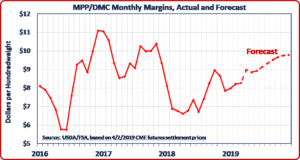
The monthly margin under the dairy Margin Protection Program (MPP) for November 2018 was slated to be announced on Dec. 31, but the current government shutdown has stalled the announcement and any announcement of the prices used to calculate it. The Agriculture Department’s (USDA) online MPP Decision Tool has projected it at $8.15/cwt., which would be $0.81/cwt. lower than the October margin, but high enough to not trigger any payments under the 2018 program provisions.

The Agriculture Improvement Act of 2018, the farm bill enacted into law late last month, makes significant changes to the MPP, including renaming it the Dairy Margin Coverage (DMC) program. Those changes took effect on Jan. 1.  The MPP continued in effect until then, including the eventual announcement of last year’s margins for November and December, neither of which is likely to generate any payments under the applicable MPP rules – although December’s margin is likely to be close to $8.00, a coverage level at which thousands of dairy farmers are enrolled for coverage.

The new DMC program rules do not change the calculation of the margin. The Decision Tool’s margin forecasts, based on the Jan. 2 CME dairy futures settlement prices are shown in the accompanying chart. However, DMC rules permit producers to enroll for coverage at a margin of up to $9.50/cwt. The current USDA forecast shows the margin remaining under this level for the first 10 months of 2019, which makes signing up at the new, higher maximum coverage level a viable option for many dairy producers next year. No date has yet been set for USDA to announce the sign-up period for DMC coverage in 2019.

The new farm bill also removes the previous restriction that prohibited producers from enrolling milk in both the margin program and the Livestock Gross Margin (LGM-Dairy) program during the same month. It further allows farmers who were previously prevented from enrolling in MPP during 2018 due to this restriction to enroll retroactively in MPP and collect payments for 2018 for the months during which they were prevented from doing so.

USDA’s MPP margin forecasts can be accessed online.

USDA Issues Final Bioengineered Food Disclosure Standard

The U.S. Department of Agriculture (USDA) unveiled its long-awaited bioengineered food labeling rule on Dec. 20 detailing how companies will disclose the presence of bioengineered ingredients in their food products.

The rule defines bioengineered foods as those that contain detectable genetic material that has been modified through certain lab techniques and cannot be created through conventional breeding or found in nature. The implementation date is Jan. 1, 2020 (the date for small food manufacturers Jan. 1, 2021). The mandatory compliance date is Jan. 1, 2022. Regulated entities may voluntarily comply with the standard until Dec. 31, 2021. USDA has formulated several frequently asked questions that can assist in understanding the rule.

By January 2022, packages of food that contain bioengineered ingredients must include one of three disclosure options: a USDA-selected logo that includes an image of a field with the letters “BE”; the phrase “bioengineered”; or a QR code.

In a regulatory victory for NMPF, the rule reiterated that meat or milk from animals consuming bioengineered grains does not make that meat or milk a bioengineered food. USDA stated that under any voluntary disclosure, it would be inappropriate to label that same meat or milk as being “derived from bioengineering.”

Overall, the rule follows the statute closely, especially with respect to the definition of “bioengineered food.” For example, if it is determined that a bioengineered ingredient is refined to the point that it does not contain detectable genetic material that has been modified using recombinant DNA (rDNA) technology, that will not trigger a disclosure. As a result, most bioengineered ingredients in dairy products (e.g. enzymes, vitamins) will not require reporting.

As the disclosure deadline approaches, dairy companies should verify whether their flavorings, sweeteners, enzymes, and other ingredients contain genetic material. If not, then no disclosure is needed. NMPF believes that most finished dairy products will not need to have a mandatory bioengineered disclosure.

NMPF Posts Strong Trade Policy Finish in 2018

Three federal filings by NMPF regarding trade deals in North America, the European Union and Asia highlighted U.S. dairy-farmer interests for the attention of government trade policy officials as 2018 ended. The first filing came Nov. 30, the same day the Trump Administration signed the U.S.-Mexico-Canada Agreement (USMCA), and the submissions continued until just before Christmas.

NMPF President and CEO Jim Mulhern said the work late last year will give American dairy farmers a stronger voice in key trade deals this year and beyond.

“We’re at a very important point right now for trade, with the prospect of an updated North American trade treaty at hand and new trade agreements about to launch with other major trading partners,” Mulhern said. “NMPF is ensuring that dairy farmers’ priorities are clearly communicated to our policy makers as they prepare to move forward on both fronts.”

U.S.-Japan Trade Agreement

NMPF’s Jaime Castaneda testified Dec. 10 at a U.S. International Trade Commission hearing on the proposed U.S.-Japan Trade Agreement, following the submission of NMPF’s written comments the previous week. Castaneda said America’s dairy farmers are pleased to see the United States moving forward with a deal with Japan – fourth among U.S. export markets, with exports valued at almost $300 million in 2017 – given the risk posed by standing still. But Castaneda cautioned that the U.S. must push strongly on Japan to provide greater dairy market access than the country’s leaders currently appear willing to offer.

“Our market share in Japan is at risk as our competitors will be receiving the benefits of the soon-to-be implemented Comprehensive and Progressive Agreement for Trans-Pacific Partnership (CPTPP) and the EU-Japan Economic Partnership Agreement (EU-Japan EPA),” said Castaneda. “We therefore urge the administration to swiftly begin negotiations and pursue ambitious results.”

Among NMPF’s recommendations:

  • Rejecting a pre-determined ceiling on the level of agriculture trade and instead determining the results of the agreement through negotiations;
  • Securing a better outcome than the CPTPP or the EU-Japan EPA for each tariff line to achieve larger TRQ volumes and a shorter tariff phase-out period;
  • Building upon the work done within the USMCA on topics of geographical indications and sanitary and phytosanitary commitments to safeguard access for U.S. exports to Japan.

U.S.-European Union Trade Agreement

NMPF focused on a possible U.S.-European Union Trade Agreement later in the month by teaming up with the U.S. Dairy Export Council (USDEC) to file recommendations with the Office of the U.S. Trade Representative (USTR) and testify at a USTR hearing on the potential agreement. NMPF pointedly emphasized that improved agricultural trade with Europe can only happen if the European Union (EU) is prepared to make major reforms to its protectionist and trade-distorting agricultural and regulatory policies.

“Anything less would pose a very high risk of simply exacerbating the present and deep agricultural trade imbalance that greatly benefits European farmers and companies at the expense of those in the United States,” said NMPF. “To date, the EU has shown no inclination to reform its ways. Instead, various actions over the past year have indicated a further entrenchment of EU protectionism via regulation.”

Among the priorities for EU trade that the dairy industry outlined:

  • Remove EU-imposed restrictions on common cheese names in the EU market and other U.S. export markets through the misuse of geographical indications (GIs), and require the EU be WTO-compliant in its GI system.
  • Fully recognize the safety of U.S. dairy products, eliminating problematic EU certificates pertaining to dairy, and assuring that future unscientific trade restrictions will not be imposed on U.S. dairy exports.
  • Eliminate dairy tariffs in a coordinated manner – EU tariff rates are triple those in the United States – if all nontariff concerns are fully addressed.

NMPF and USDEC also jointly wrote Ambassador Robert Lighthizer directly to underscore the high stakes for the dairy industry, given the $1.4 billion annual dairy trade deficit between the United States and European Union.

Focus on Mexico

In a submission to the United States International Trade Commission on Dec. 20, NMPF outlined the likely impact of the USMCA on the U.S. dairy industry, noting that work still remains to ensure American dairy farmers have fair access in North America and urging that the USMCA’s progress be used in future U.S. trade negotiations. This work includes:

  • Ensuring the reclassification of products after the end of Class 7 is done appropriately to genuinely reflect their end use, as called for by the agreement;
  • Enforcing export surcharges on skim milk powder, milk protein concentrate and infant formula as outlined in the USMCA and preventing the proceeds from being redistributed to the Canadian industry;
  • Lifting U.S. metal tariffs on Mexico in exchange for Mexico lifting its cheese tariffs;
  • Avoiding trade quota administration in Canada in a manner that discourages full market access granted to the U.S. under the agreement;
  • Making sure Canadian market access under the USMCA is provided in addition to the access Canada already agreed to; and
  • Benchmarking language in the USMCA that could be used in other trade negotiations in Japan, the United Kingdom and Vietnam.

Despite a challenging trade environment, dairy exports hit record highs in 2018, growing 4.5 percent from the year before. Still, tariff headwinds blunted the positive impact this should have otherwise had on returns to dairy farmers – moving exports out but having to cut margins to keep those sales means farmers don’t see good returns.

New Poll: Consumers, by Nearly 3-to-1 Margin, Want FDA to End Mislabeling of Fake Milks

ARLINGTON, Va. – New national survey data released today finds that consumers – by a nearly 3-to-1 margin – want the U.S. Food and Drug Administration (FDA) to enforce existing regulations and prohibit non-dairy beverage companies from using the term “milk” on their product labels. FDA is soliciting public comment regarding front-of-package dairy labeling regulations through Jan. 28.

The national survey conducted by IPSOS, a global market research and consulting firm, found that 61 percent of consumers believe FDA – which currently defines “milk” as the product of an animal, but doesn’t enforce that labeling rule – should restrict non-dairy beverage companies from using the term “milk” on their product labels. Only 23 percent said FDA should not limit the term “milk” to dairy products, while 16 percent were uncertain.

“Consumers have spoken, and they are clear in their desire for FDA to enforce its own rules,” said National Milk Producers Federation (NMPF) President and CEO Jim Mulhern. “FDA must listen to their voice and end deceptive labeling by plant-based beverage manufacturers.”

Plant-based beverage brands regularly exploit lax regulatory enforcement to label their products as “milk,” and polling data shows that consumers are widely misinformed by mislabeling. A survey by IPSOS from last August showed that 73 percent of consumers erroneously believe that almond-based drinks had as much or more protein per serving than milk. In a separate poll from the International Food Information Council Foundation released in October, one-quarter of consumers either thought almond drinks contained cow’s milk or weren’t sure.

The newly announced online IPSOS poll – commissioned by NMPF – was conducted Jan. 4-7, 2019, and surveyed 1,005 adults nationwide.

The question was: “The U.S. Food and Drug Administration currently defines ‘milk’ as the product of an animal, but doesn’t enforce that labeling rule. Do you believe that the FDA should restrict non-dairy beverage companies from using the term ‘milk’ on their product labels?”

About the study:

For the survey, a sample of 1,005 adults 18+ from the continental United States, Alaska and Hawaii were interviewed online in English. The source of these population targets is U.S. Census 2016 American Community Survey data. The sample drawn for this study reflects fixed sample targets on demographics. Post-hoc weights were made to the population characteristics on gender, age, race/ethnicity, region, and education.

Statistical margins of error are not applicable to online polls. All sample surveys and polls may be subject to other sources of error, including, but not limited to, coverage error and measurement error. Where figures do not sum to 100, this is due to the effects of rounding. The precision of IPSOS online polls is measured using a credibility interval. In this case, the poll has a credibility interval of plus or minus 3.5 percentage points for all respondents. Ipsos calculates a design effect (DEFF) for each study based on the variation of the weights, following the formula of Kish (1965). This study had a credibility interval adjusted for design effect of the following (n=1,005, DEFF=1.5, adjusted Confidence Interval=+/-5.0 percentage points).

###

The National Milk Producers Federation (NMPF), based in Arlington, VA, develops and carries out policies that advance dairy producers and the cooperatives they own. NMPF’s member cooperatives produce the majority of U.S. milk, making NMPF the voice of dairy producers on Capitol Hill and with government agencies. For more, visit www.nmpf.org.

NMPF “Naughty or Nice” List Features Imitators Who Follow, Don’t Follow Labeling Rules

In the holiday spirit, NMPF released its own version of a “Naughty or Nice” list the week before Christmas featuring plant-based drink manufacturers that do and do not employ dairy terms on their labels.

On the “naughty” side: beverage brands that use the word “milk” to sell nutritionally inferior non-dairy products. These include Almond Breeze, Oatly, Great Value (Walmart), Simply Balanced (Target), Muscle Milk, and So Delicious.

The “nice” side includes brands that lead with truthful food labeling by avoiding the term “milk” and offering an accurate description of what their products are – non-dairy beverages. Trader Joe’s, Quaker, Pacific Foods, and Kirkland (Costco) are on this list.

NMPF’s “Naughty or Nice” list comes as the U.S. Food and Drug Administration (FDA) continues to solicit public comment through Jan. 28 on the proper names for plant-based beverages. FDA defines dairy foods as “products made exclusively or principally from the lacteal secretion obtained from one or more healthy milk-producing animals.” NMPF is calling on FDA to enforce its own rules and end deceptive labeling of fake dairy products.

NMPF provided members with background materials and several data points at its Annual Meeting in October, and has since has expanded its toolkit of resources to include an instructional video, colorful graphics, a dedicated webpage and a social media marketing campaign – all intended to demonstrate  why the FDA needs to enforce its existing labeling standards. NMPF is urging not just its members, but also consumers, family members and even pediatricians to explain to FDA how misbranded dairy imitators mislead consumers and harm public health.

Informational materials now available on the NMPF website include:

  • A four-page document that includes instructions for submitting comments and key points
  • An instructional video with screen grabs illustrating the step-by-step process of how to comment on the FDA docket
  • A library of graphics to share in newsletters or on social media

Dairy farmers, and the entire dairy community, will also have opportunities to ask questions and offer their own input on what dairy should be doing to get the FDA to enforce its own rules in upcoming webinars, as well as a Twitter chat scheduled for 11 a.m. Eastern time on Thursday, Jan. 17. Watch the @nmpf Twitter handle for more details.