If you’re looking for an indication that dairy’s recent gains in the consumer marketplace are meant to last, cottage cheese would be a good place to start.
Flashback to… 2023, a time not so long ago. “Barbiecore” ruled a pink-hued fashion scene. “Quiet luxury” was in. A new drug called Ozempic seemed to hold promise. Pundits were gearing up for the Trump-Biden presidential rematch… and America fell in love again with cottage cheese.
Inspired by TikTok trends and embraced by Generation Z, cottage cheese was a meme for the cultural moment, spurring increased sales after decades of decline. But was that all it was destined to be? When the influencers moved on, would cottage cheese inevitably fade back into the dowdy, food-for-your-grandparents doldrums to which it had seemingly been consigned in the past?
Nope.
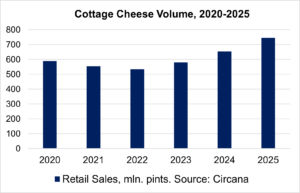
With two more years of data in, cottage cheese clearly isn’t a food fad that was tried and discarded. Sales that had bottomed out in 2022 at 534.6 million pints rose by 9.4 percent the next year — certainly a buzzworthy jump. But in 2024, volume rose another 12.5 percent. And in 2025, cottage cheese sales volumes jumped another 14.3 percent, to 746.6 million.
That, friends of dairy, is what is called a lasting trend. And an accelerating one, at that. So how high could it go?
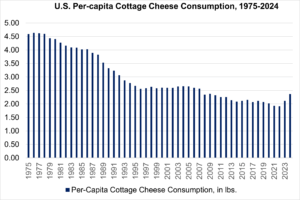
USDA per-capita consumption numbers tell a similar story. That data, which ends in 2024 but goes back to 1975, adds another layer of intrigue. As in the retail sales data, per-capita consumption bottoms out in 2022, at 1.91 pounds per American, per year. The next two years increase, with 2024 at 2.37 pounds. That’s what someone would expect, given the retail numbers.
But here’s the interesting part. Dairy consumption overall is its highest since the 1950s. Butter’s at its highest since the 1960s. Cottage cheese is at its highest since… 2009. 2009? The year that Kanye West interrupted Taylor Swift at the VMAs? The year vampires ruled entertainment? The year Barack Obama became the first black president? That’s not so long ago. And thus not as impressive, you might think.
That’s exactly the point. This trend has room to grow. In 1976, as America celebrated its Bicentennial (and “Disco Lady” topped the pop charts — OK, now we’re getting old), per-capita cottage cheese consumption was 4.63 pounds, nearly twice what it was in 2024.
That’s a lot of room to roam. And America’s turning 250 this year.
So when people look back nostalgically at 2026 (because someone will, someday, somehow), perhaps they won’t think of it as an era of cottage cheese — because they’ll be eating a lot more of it than we did at the time. But we will be the ones who were there for the revival, when a nutritious, nutrient-dense snack was just beginning its comeback.
All the signs are there. Dairy just has to maintain the momentum. And the message. (A helpful hint: Please post this column on social media, where the comeback purportedly began.)