Graduate Students Conducting Dairy Research Wanted for Scholarship Program

Graduate students researching dairy-related subjects are encouraged to apply for the National Dairy Leadership Scholarship Program. Each year, NMPF awards scholarships to Masters- or Ph.D.-level students conducting research of interest to NMPF member cooperatives and the dairy industry in general.

Recommended fields of study include agricultural communications, dairy science, animal health, animal or human nutrition, bovine genetics and herd management. Applicants do not need to be affiliated with NMPF members.

Candidates have until March 27 to apply for scholarships for the 2015-2016 academic year. Recipients will be selected by the NMPF board of directors in June and notified soon after afterward. Visit the NMPF website or call 703-243-6111 for details.

EPA Withdraws Water Guidance as Result of NMPF Objections

As the result of objections raised by the National Milk Producers Federation, the U.S. Environmental Protection Agency (EPA) has withdrawn a regulatory guidance issued last year concerning when farmers must seek Clean Water Act permits for a long list of normal farming activities near wetlands.

On Friday, January 29, the EPA and the U.S. Department of Army signed a memorandum withdrawing the “Interpretive Rule Regarding the Applicability of Clean Water Act Section 404(f)(1)(A).” Last summer, NMPF requested that the Interpretive Rule be withdrawn because it could have actually discouraged water conservation and environmental best practices.

“Our concern with the initial proposal from last year is that it could have altered the long-standing and productive relationship between farmers and the USDA’s Natural Resources Conservation Service, in a way that would have made it harder for farmers to implement water conservation measures,” said Jamie Jonker, NMPF’s Vice President for Sustainability & Scientific Affairs.

“We’re pleased the EPA and Army have recognized that this regulation could have backfired, and that they’ve taken the necessary step to withdraw it,” Jonker said.

The EPA guidance, officially called an Interpretive Rule, was issued in March 2014. It said farmers are only exempt from needing Clean Water Act permits for more than 50 routine farming practices if they comply with detailed NRCS technical conservation standards. Historically, these standards have been voluntary, and the farming practices exempt from the permit process.

In comments filed last July, NMPF said the guidance changes NRCS’s role from that of a conservation partner to that of an enforcer of the Clean Water Act, on EPA’s behalf.

Had the interpretive rule not been withdrawn, “the NRCS would have been thrust into the role of enforcer, rather than remaining a source from which farmers could seek conservation advice. This could have hindered rather than helped conservation efforts,” he said.

Jonker noted that NMPF has drawn up a detailed environmental handbook based on NRCS standards but tailored specifically to dairy farmers. Those who followed the guidelines in the book apparently would not have qualified for a permit exemption, “challenging the very notion of why the handbook was created in the first place,” Jonker added.

Established initially the 1930s, the NRCS provides voluntary help to farmers who want to conserve the resources on their farms.

The now-withdrawn Interpretive Rule was intended to be part of the larger Waters of the U.S. proposal issued last year by the EPA. The larger proposal is still under review by both EPA and the Army Corps of Engineers, and is also being scrutinized by Congress.


The National Milk Producers Federation, based in Arlington, VA, develops and carries out policies that advance the well-being of dairy producers and the cooperatives they own. The members of NMPF’s cooperatives produce the majority of the U.S. milk supply, making NMPF the voice of more than 32,000 dairy producers on Capitol Hill and with government agencies.


Rhymes and Reasons

Mark Twain observed that history doesn’t repeat itself, but it does rhyme. We can hear those rhymes while listening to the familiar patterns of the dairy market, particularly as the 21st century unfolds. The question we have to answer, as history echoes around us, is what can and should we be doing differently in this New Year to help make the rhymes of our economy be as harmonious as possible?

As 2015 gets underway, farm-level milk prices have dropped from their record high at the end of last summer. January’s Class III price will be at least one-third less than the September peak of $24.60, with further declines in the offing. World prices have already seen an enormous retrenchment in the past six months. What’s remarkable about this turn of events is that it’s not remarkable in the least; in fact, it’s emblematic of the cycle we’ve been observing in recent decades. The years 2003, 2006, 2009 and 2012 all brought downturns in milk prices. And yes, these troughs were interspersed with years of much stronger prices, like what we saw in 2014, but the trend is clear that 2015 will be a year of weaker milk prices.

As the familiar axiom correctly states, high prices tend to cure high prices, and the rhyme is the same for low prices. It’s a function of how markets respond to price-driven pivots in supply and demand. Yet, the issue remains: how can individual farmers and other relatively small players in the global market for dairy foods protect themselves from the times when the pendulum swings, and aims to knock them from their feet?

There are several answers, the most obvious of which is that America’s dairy farmers now have a new tool to hedge against the combination of lower milk prices and high feed costs. The U.S. Department of Agriculture announced last month that approximately half of America’s 46,000 dairy farmers enrolled for 2015 in the new Margin Protection Program. For a brand new program, initiated in a year of record-high prices, a 50% enrollment rate represents a glass that’s more than half-full.

This is especially true in light of the fact that during most of the signup period last fall, the forecast for milk prices in 2015 was sufficiently solid that the corresponding MPP margins would not have produced any payouts. It was only in December, when commodity prices stumbled, that the real need for the MPP became apparent. If it does generate payments this year, interest in the program will certainly become greater still for coverage in subsequent years.

Another tool to help blunt the impact of the roller coaster is Cooperatives Working Together. Now in its 13th year of operation, CWT remains the only farmer-funded and managed tool to help build U.S. dairy sales overseas, reduce domestic stocks of products, and stimulate farm-level prices for America’s farmers. One of the big reasons why U.S. values for cheese and butter did not decline with the same speed or to the same degree as world prices last year, was because of the effort employed by CWT to assist the export of products that help domestic dairy farmers.

CWT just reported in its 2014 year-end summary that the equivalent of 2.5 billion pounds of milk was exported last year through the program’s acceptance of 582 bids to sell more than 190 million pounds of cheese, butter and whole milk powder. Importantly, the combination of these sales helped boost farmers’ milk checks by a collective 38 cents per hundredweight. As China and Russia have become more challenging markets for all exporters, the ability of U.S. dairy marketers to utilize CWT cannot be underestimated.

One area in which history does not rhyme, where CWT is concerned, is that we’ve learned, from the price collapse suffered in 2009, to do things differently. At that time, CWT did not invest all of its member dues in export assistance. Due in part to that dynamic, and the role of the now-defunct price support program, U.S. exports dwindled – even though overall global dairy sales did not. The U.S. ceded markets to its competitors, and our prices languished lower and longer than they could or should have. That’s a discordant note we don’t want to repeat again, in this year or any other.

Ours is a commodity business, prone to regular cycles of high and low. Eventually, conditions correct themselves. What we don’t want to have happen is that all of the correction be borne by farmers who burn through their equity – or worse, have to exit the business – to endure the troughs. Thanks to the MPP, and CWT, the dairy industry is learning from history, and editing the script so the future is an improvement, not an echo, of the past.

114th Congress Will Include a Large, Bipartisan Dairy Farmer Caucus

ARLINGTON, VA – The new 114th Congress will feature a large and active group of House members looking out for the interests of dairy farmers, according to the National Milk Producers Federation.

A bipartisan group of legislators is reestablishing the six-year-old congressional Dairy Farmer caucus, and NMPF expects the new group to be even larger than the Dairy Farmer caucus in the 113th Congress.

“The 85-member caucus in 2013-14 was nearly one-fifth of the House,” said NMPF Vice President for Government Relations John Hollay. “We expect the 2015 caucus will be at least that large.” Hollay added that the dairy group is one of the most bipartisan and regionally diverse of the many caucuses in Congress.

The Dairy Farmer caucus educates House members on dairy industry issues and helps build consensus on legislation impacting milk producers and processors. For example, Hollay said, the caucus played a key role in enacting the 2015 farm bill, which included the most significant rewrite of federal dairy policy in more than a generation. The congressional Dairy Farmer caucus was initially started in 2006 to provide a bipartisan forum to collaborate on policy issues that addressed the interests of dairy producers nationwide.

In recent years, the caucus has worked closely with NMPF and the dairy industry to secure emergency funding for farmers suffering from low prices and disasters, protect dairy trade interests and secure passage of federal nutrition programs that deliver nutritious dairy products to school aged children.

The eight House members who will serve as co-chairs of the congressional Dairy Farmer caucus in the 114th Congress are: Reid Ribble (R-WI), Peter Welch (D-VT), Michael  Simpson (R-ID), Joe Courtney (D-CT), David  Valadao (R-CA), Timothy  Walz (D-MN), Tom Reed (R-NY) and Suzan  DelBene (D-WA). The bipartisan group issued an invitation to their colleagues to join the caucus this week.


The National Milk Producers Federation, based in Arlington, VA, develops and carries out policies that advance the well-being of dairy producers and the cooperatives they own. The members of NMPF’s cooperatives produce the majority of the U.S. milk supply, making NMPF the voice of more than 32,000 dairy producers on Capitol Hill and with government agencies.

USDA Provides Additional Data on Dairy Farms Enrolled in Margin Protection Program

More than Half of Those Enrolled in New Safety Net Choose Added Coverage

ARLINGTON, VA – The U.S. Department of Agriculture provided more specific information Friday about the extent of coverage chosen by dairy farmers enrolled for 2015 in the new Margin Protection Program (MPP), including a state-by-state breakdown of the percentage of farms using the new safety net.

Earlier this week, the USDA announced that more than half of U.S. dairy operations have enrolled in the MPP. Today, USDA provided an estimate that 55% of those farms elected to pay additional premiums to purchase a higher level of coverage, above the basic, $4 per hundredweight level offered for $100 per year.

NMPF President and CEO Jim Mulhern said that the enrollment level represents “a vote of confidence in this new program, and highlights the importance of the MPP at a time when farmers need protection as margins will be challenged because of adverse conditions. The debut of the MPP comes during a year when margins will be compressed, making it the right solution at the right time for our farmers.”

The USDA clarified that 50.4% of the nation’s dairy farms have enrolled in the MPP. The percentage ranges from a low in Wyoming of 5%, to a high in Nevada of 90%. The participation level in the ten largest dairy states was 51%, almost identical to the national average:


The next MPP sign-up period will begin in six months, during an open season enrollment window for MPP coverage in calendar year 2016. That enrollment period will run from July 1st until September 30th.

NMPF established its www.futurefordairy.com website to help educate farmers about the program, and worked with USDA and a group of university agricultural economists during 2014 to explain the benefits of utilizing the Margin Protection Program.


The National Milk Producers Federation, based in Arlington, VA, develops and carries out policies that advance the well-being of dairy producers and the cooperatives they own. The members of NMPF’s cooperatives produce the majority of the U.S. milk supply, making NMPF the voice of more than 32,000 dairy producers on Capitol Hill and with government agencies.

New Margin Protection Program Coverage Period Begins for More than Half of Nation’s Dairy Farmers

After two extensions allowed dairy farmers an additional three weeks to consider their participation, the sign-up period for the new Margin Protection Program closed on December 19th, even while those electing coverage for calendar year 2015 are now insured against tighter margins as the New Year begins.

The U.S. Department of Agriculture announced this morning that more than 23,000 dairy operations – about half of the total number of licensed dairy operations in the U.S. – chose to enroll in the program. Local and state U.S. Department of Agriculture offices are still tabulating the volumes insured under the program, with official results expected in the coming weeks. Anecdotal reports indicated that the extensions granted after Thanksgiving, coupled with a sharp downturn in milk price forecasts, encouraged additional participation prior to the December 19th cutoff.

NMPF expressed appreciation to the Agriculture Department for allowing additional opportunities for dairy farmers to insure themselves through the MPP.

“This an encouraging start to this crucial new safety net program for our industry,” said Jim Mulhern, President and CEO of the National Milk Producers Federation. “The MPP is now the only widely-available tool to help farmers protect against both lower milk prices and higher feed costs. It represents a new paradigm in shared responsibility between farmers and the government to cover the cost of that insurance.”

The next sign-up period will begin in six months, during an open season enrollment window for MPP coverage in calendar year 2016. That enrollment period will run from July 1st until September 30th.

Dairy Industry Joins Others in Favoring an End to the Cuban Trade Embargo

NMPF has joined more than two dozen other food and agriculture groups in supporting changes to travel and financing restrictions that impeded trade with Cuba.

NMPF, the U.S. Dairy Export Council and the International Dairy Foods Association are all members now of the U.S. Agriculture Coalition for Cuba, a group of nearly 35 trade associations and companies that favor an end to the half-century-old U.S. trade embargo on Cuba.

The groups want travel restrictions to Cuba lifted and, more importantly, payments for agricultural products to pass from Cuba directly to U.S. banks. Right now, these payments must be routed through banks in other countries.

Recently, Cuba has imported approximately $200 million in dairy products annually, virtually none of it from the United States.

NMPF President and CEO Jim Mulhern said unilateral U.S. actions should not hinder U.S. dairy exporters from selling products to any nation. “Right now, we are ceding the Cuban market to our competitors,” Mulhern said. “This is a natural export market for U.S. dairy products and we look forward to expanding our ability to provide Cubans with the safe, nutritious dairy products we produce here.”

Trade reforms announced last month by the Obama administration only slightly relax the rules for Cuban payments to American farmers. The changes sought by the Agricultural Coalition for Cuba require congressional action.

2015 to See Push for Permanent Extension of Section 179 Tax Credit

Fresh from victory in the fight for a one-year restoration of the Section 179 tax credit, NMPF and other farm organizations will focus on the importance of enacting a permanent extension in 2015.

The one-year extension was included in a bill temporarily reinstating more than 50 federal tax breaks. The bill passed last month and was sent to the White House in the closing hours of the 114th Congress.

The Section 179 tax credit allows farmers to write off up to $500,000 in machinery and equipment costs immediately, instead of spreading the write-off over several years.

But the measure that cleared Congress December 16 applies to 2014 tax returns only. Making the tax break permanent requires additional legislation, either another “tax extenders” bill or a more comprehensive general tax reform measure. Republicans in Congress have expressed an interest in passing tax reform legislation in the new legislative session that begin this week.

NMPF President and CEO Jim Mulhern thanked the House and Senate for send the temporary extension of Section 179 to the White House before leaving for the holidays. “Dairy farming requires significant investments in equipment,” Mulhern said. “But farmers shouldn’t have to wait until the last few weeks of the year to find out how they can write off a new tractor or milking machine. Failure to restore Section 179 permanently will add to the financial strains on farmers who already find it difficult to pass on their farms to the next generation.”

CWT Assistance Total for 2014: 2.5 Billion Pounds of Milk Exported

More than 190 million pounds of butter, cheese and whole milk powder, the equivalent of 2.5 billion pounds of milk on a milkfat basis. That’s how many dairy products Cooperatives Working Together, the dairy-farmer-funded export assistance program, helped 10 U.S. member cooperatives sell in overseas markets in 2014.

The total includes 103 million pounds of cheese, 53 million pounds of butter and 35 million pounds of whole milk powder. The customers for these products are located in 45 countries on six continents.

In December, CWT accepted 21 requests for assistance in selling 2.9 million pounds of American-type cheeses in Asia, the Middle East and South Pacific. The CWT-member cooperatives making the sales included Dairy Farmers of America, Northwest Dairy Association (Darigold) and Tillamook County Creamery Association.

Through October 2014, shipments of CWT-assisted dairy products totalled 164.1 million pounds, including 93 million pounds of cheese, 55.4 million pounds of butter and 15.7 million pounds of whole milk powder. Those volumes are equal to 56 percent of total U.S. American-type cheese exports, 47 percent of butter exports and 15 percent of whole milk powder exports during the same period.

CWT is a voluntary membership organizations funded by contributions from 37 dairy cooperatives, as well as more than 100 individual farmers, representing 70 percent of the milk produced nationwide.

Since 2011, CWT has focused exclusively on expanding markets for U.S. dairy farmers overseas. Member cooperatives submit requests for help with sales in specific foreign markets. Only if the amount is economically justified is the bid accepted and financial assistance provided. The bidder then has six months to deliver the product to the overseas purchaser.

NMPF President and CEO Jim Mulhern credits CWT with helping to keep U.S. dairy prices high amid steep decline in world prices this year. “By moving more dairy products into world markets,” Mulhern said, “CWT has helped keep domestic inventories low and demand high. In turn, that has buoyed U.S. milk prices across the board, which benefits all U.S. dairy farmers.”

National Dairy FARM Program Reaches 80 Percent Participation

With nine more dairy marketing organizations implementing the program since October, NMPF’s animal care program, Farmers Assuring Responsible Management, now encompasses more than 80 percent of the U.S. milk supply.

At the NMPF annual meeting in October, the NMPF Board of Directors unanimously voted to adopt several program changes, including mandating that any participating dairy co-op or proprietary processor must ensure completion of a second-party, on-farm evaluation from all of its farmer suppliers.

Additionally, the board approved provisions that delineate a clear process for addressing allegations of willful animal abuse or mistreatment on farms enrolled in the program. Any such farm will be independently reviewed, and if the allegations are substantiated, the farm will be placed on probation, pending execution of a corrective action plan to address any issues. If needed remedial actions are taken, the dairy operation will be reinstated in the FARM program.

NMPF President and CEO Jim Mulhern said this new policy will further strengthen the consistency of the program, and help such farms improve their animal care practices. “The goal of the FARM program is to assure a high level of quality animal care on our farms,” Mulhern said. “We want the program to be inclusive and adaptive. And where we find problems, we want to address and improve the situation rather than find ways to exclude individual farms from the program.”

NMPF staff will work this year to improve the functionality of the FARM user-database to keep up with the significant increase in program participation. Additionally, NMPF is engaged in efforts to communicate the integrity and rigor of the FARM program to retailers and consumers as well as developing employee training modules for producers that focus on animal care and highlight approved FARM guidelines.

Ag Communicator Meredith Honored as 30 & Under ‘Rising PR Star’

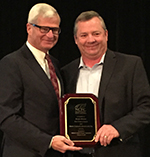
Emily Metz Meredith, NMPF’s vice president for animal care, was honored last month by a leading communications newsletter as a Rising Star in public relations.

Meredith was recognized in the 30 and under category at PR News’ annual PR People Awards lunch, held at the National Press Club in Washington.

Meredith (in the photo), was nominated for the award by the Animal Agriculture Alliance, where she worked until October. In two years with the Alliance, she substantially increased the organization’s news coverage and was interviewed by news outlets ranging from Al Jazeera to The Washington Post. She also defended livestock agriculture on The Daily Show with Jon Stewart.

Meredith oversees NMPF’s animal care program, Farmers Assuring Responsible Management (FARM).  She is a Wisconsin native with a degree in mass communications and international affairs from The George Washington University. She also has a law degree from Seton Hall University.