 By Will Loux, Senior Vice President, Global Economic Affairs
Protein claims are seemingly everywhere in the United States — from milk protein-based cereal to gimmicky cocktails. Rock-solid science showing dairy protein’s unique benefits and innovative products capturing consumer attention are enabling U.S. protein manufacturers to win a share in the marketplace. In fact, more new products featuring whey protein are launching today than ever before, despite record high prices.
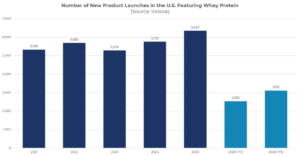
Yet as ubiquitous and seemingly insatiable as demand for protein is in the U.S., I would argue the most optimistic long-term argument for milk and whey proteins is the untapped demand abroad, where per-capita protein consumption remains far below the U.S.
In many markets, protein-rich products are just now breaking out from beyond the sports nutrition category and into the mainstream, accelerated by U.S. Dairy Export Council (USDEC) helping integrate dairy proteins into local cuisines. This work has helped keep international demand for milk and whey proteins resilient, even as prices have soared. Global whey protein concentrate 80 (WPC80)+ trade fell just 2% over the past 12 months, despite export values rising by more than 37% during that time.
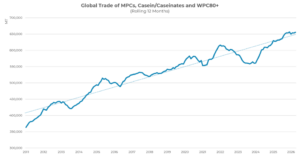
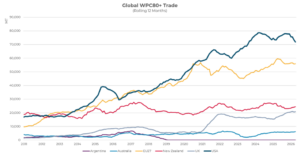
Rather than lack of demand, the main challenge to global trade over the past year has been the lack of exportable supply, particularly out of the United States, where exports of WPC80+ have declined by 21% through April. Fundamentally, even as U.S. WPC80 and whey protein isolate (WPI) production have grown, there hasn’t been enough supply to go around — a scenario which has historically meant the domestic customer is prioritized.
However, a domestic-centric strategy is not without risks. Even as the U.S. retains its position as the largest exporter of high-protein whey products, other origins are actively investing to compete in the market. Arla, FrieslandCampina, Tirlán, and plenty of others have all completed or announced additional whey protein concentrate capacity within the past year. Putting numbers behind this threat, in April, U.S. WPC80+ exports declined by 20% year-over-year, while shipments from competitor origins, namely the EU, New Zealand, the U.K., Australia, Canada, and Turkey, all rose, completely negating the retreat from the U.S.
This challenge is only going to become more acute over time. While the U.S. remains the most likely milkshed to grow significantly in the coming years, three-quarters of the liquid whey processed in the country is already being used in WPC80 and WPI. Meaning, there is a limit to sourcing additional whey solids without additional new cheese capacity. By contrast, the EU has a much larger stockpile of sweet whey — over 1 million metric tons — that will continue to transition toward higher concentrations in time.
Thus, as optimistic as we all remain on dairy protein, the U.S. cannot be complacent in global markets, particularly as domestic demand is unlikely to continue at this pace indefinitely. That does not mean U.S. manufacturers need to be in every country or try to fill every overseas order, but focusing on key growth markets and maintaining close ties to strategic partners is likely to pay dividends in the long run. Otherwise, those customers are likely to look for alternatives — whether in Europe, Oceania, or outside of dairy.
This column originally appeared in Hoard’s Dairyman Intel on July 16, 2026.