USDA Dairy Purchases Match NMPF Request
March 03, 2026USDA took steps to boost low milk prices and expand dairy consumption through $148 million in Section 32 purchases announced Feb. 19, pledging to buy a balanced, effectively targeted mix of dairy products, including the first major butter purchases in five years, in keeping with NMPF efforts that dated to November.
“Dairy farmers have shared in the struggles faced throughout the agricultural economy, and these purchases will provide important relief to producers who will benefit from the additional demand, helping them provide nutritious dairy products to Americans and the world,” NMPF President and CEO Gregg Doud said in a statement.
The USDA purchase plan includes:
- $75 million of butter;
- $32.5 million in cheddar cheese;
- $20.5 million in fresh fluid milk;
- $10 million of Swiss cheese; and
- $10 million in Ultra-High Temperature (shelf-stable) milk.
The purchases match the amount requested by NMPF in a letter sent to USDA last November, which was followed by extensive conversations and further official communication with USDA and compare favorably with other recent USDA purchases intended to boost the farm economy, which include $80 million for specialty crops and $100 million for seafood.
USDA Section 32 purchases, authorized by the Agricultural Adjustment Act of 1935, allow USDA to buy surplus, domestically produced agricultural products to stabilize farm products and provide food to federal nutrition assistance programs.
Under the program, USDA’s Agricultural Marketing Service notifies industry and stakeholders of new opportunities by issuing Purchase Program Announcements throughout the year. Now that the announcement has been made, USDA is inviting offers from approved USDA vendors and awarding purchase contracts. For more information, visit USDA here.
NMPF Advocates for a Stronger, Better USMCA
March 03, 2026NMPF significantly escalated its public engagement ahead of this summer’s U.S.-Mexico-Canada Agreement Review, with an NMPF cooperative farmer testifying before Congress and the head of its trade team speaking on behalf of a new coalition NMPF launched to help strengthen the agreement.
Ted Vander Schaaf, an Idaho dairy farmer and board member of both the Northwest Dairy Association/Darigold and the Idaho Dairymen’s Association, an NMPF associate member, testified at a Feb. 12 Senate Finance Committee hearing on the importance of USMCA for the dairy community and the targeted improvements that must be addressed.
Vander Schaaf emphasized that USMCA is vital for providing open and predictable market access, particularly to Mexico, while also highlighting areas where the agreement has fallen short. He emphasized the glaring shortcoming of Canada’s continued manipulation of its dairy tariff-rate quotas and its circumvention of USMCA dairy protein export disciplines to shortchange U.S. dairy exporters. He also noted Mexico’s delay in fully implementing its commitments to protect common cheese names and explained its importance to dairy producers and processors.
NMPF also played a leading role in the Feb. 5 launch of the Agricultural Coalition for USMCA, an industry-wide effort to support renewing and strengthening the agreement. The coalition will work with congress and the Administration to ensure USMCA’s shortcomings are rectified before renewal.
“USMCA is an extremely strong agreement, but it’s not perfect,” said NMPF Executive Vice President Shawna Morris at the coalition’s launch press conference. “The USMCA review offers an unmissable opportunity to make targeted enhancements so the agreement can live up to its full intended potential.”
February NEXT-Assisted Export Sales Surpass 54 Million Pounds
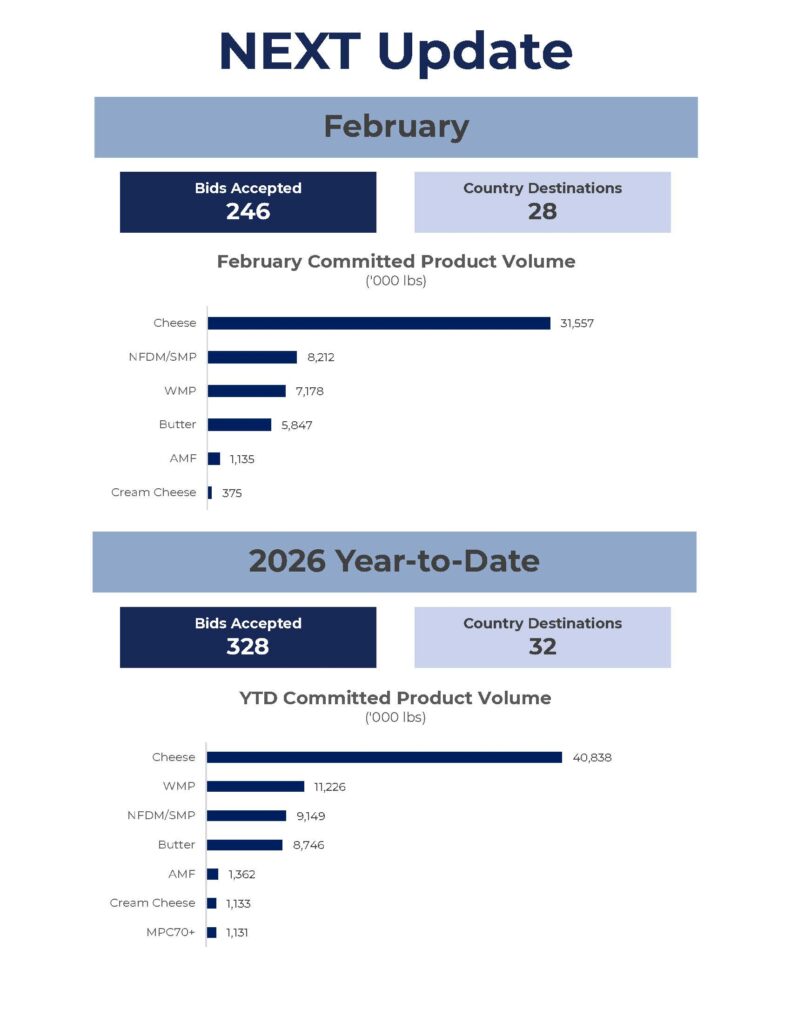
March 03, 2026NEXT member cooperatives secured 246 contracts in February, adding 54.3 million pounds of product in NEXT-assisted sales in 2026. These products will go to customers in Asia, Europe, North America, Oceania, Middle East-North Africa, Eurasia, South America, Central America, the Caribbean and Sub-Saharan Africa and will be shipped from February through July.
NEXT is a critical tool for participating U.S. dairy cooperatives to grow export sales, which have become increasingly important for dairy farmers and their cooperatives nationwide. Whether or not a cooperative is actively engaged in exporting, moving products into international markets is essential to generate dairy demand. For more information on the NEXT Program, contact the team at NEXT@nmpf.org.
The referenced amounts of dairy products reflect current contracts for delivery, not completed export volumes. NEXT will pay export assistance to bidders only when export and delivery of product is verified by submission of required documentation.
DMC Generates $1.69/cwt Payment in January
March 03, 2026The Dairy Margin Coverage Program margin for January was $7.81/cwt, generating a payment of $1.69/cwt for coverage at the maximum $9.50/cwt level.
The low margin was driven by a $1.50/cwt drop in the all-milk price from December and a rise of $0.11/cwt in the January DMC feed cost formula, primarily due to a higher cost of premium alfalfa hay.
At the beginning of March, the DMC Decision Tool on the USDA website projected a similarly low margin in February, followed by a margin rebound to well above $10.00/cwt for the remainder of 2026, with an average of $10.57/cwt for the year.
New Trade Deals Include Key Dairy Priorities
March 03, 2026Following significant engagement from NMPF and the U.S. Dairy Export Council, the United States signed new trade agreements in February with Indonesia, Taiwan, Argentina and Bangladesh that strengthen export opportunities for America’s dairy farmers. These deals secure reliable market access and remove long-standing non-tariff barriers that have limited sales of U.S. dairy products abroad.
The Indonesia, Taiwan and Bangladesh agreements would end tariffs on all U.S. dairy exports, remove and forestall burdensome facility listing requirements, as well as commit trading partners to protecting over three dozen common cheese names like “parmesan” from European monopolization.
The three markets imported $3.6 billion in total dairy products last year, with just 9% coming from the United States. Removing trade barriers will improve U.S. suppliers’ competitiveness in key Asian markets where dairy consumption is growing quickly.
The Indonesia agreement also builds on NMPF’s strong relationship with the Indonesian dairy industry and government, including a memorandum of understanding (MOU) signed last May with the Indonesian Chamber of Commerce and Industry (KADIN) to expand dairy trade and strengthen commercial ties. NMPF and USDEC also forged an MOU with the Dairy Association of Taiwan last September that combines efforts in growing domestic dairy consumption and support a school-milk initiative.
The Argentina agreement comes at a critical moment, as the South America country moves toward implementing the EU-Mercosur trade agreement that would grant EU suppliers greater market access and potentially hand them exclusive use rights for certain common name cheeses. In the U.S.-Argentina deal, NMPF worked to secure increased market access for several key dairy products, commitments to protect generic terms and measures to preempt more nontariff barriers to trade.
As cleared advisors to U.S. trade negotiators, NMPF and USDEC emphasized the importance of securing durable access to these growing markets, helping ensure that U.S. dairy farmers can compete on a level playing field as the European Union continues to pursue aggressive trade agreements worldwide.
NMPF and USDEC have worked with the administration to ensure new opportunities for U.S. dairy exports are included in all nine of the reciprocal trade agreements signed to date and will continue working closely with USTR and U.S. government partners to ensure full implementation. Implementation timing is uncertain. NMPF will work to ensure that Indonesia, Taiwan, Argentina and Bangladesh fully meet their commitments, supporting open, predictable, and growing export markets for U.S. dairy producers.
FDA Finalizes Cottage Cheese Exemption
March 03, 2026After nearly a decade of back-and-forth, FDA announced Feb. 19 that Grade “A” cottage cheese is getting an exemption from FDA’s Food Traceability Rule.
This exemption from the added traceability requirements tied to foods on the Food Traceability List will reduce the record-keeping burden on Grade “A” cottage cheese manufacturers who are already meeting the highest standards set by the Grade “A” Pasteurized Milk Ordinance and regulated by the National Conference on Interstate Milk Shipments.
NMPF supported the passage of the Food Safety Modernization Act in 2011 and agrees that food traceability measures and adequate record keeping are important to food safety. However, since Congress passed FSMA, NMPF has disagreed with the FDA’s approach to determining the list of “high-risk foods” as defined in Section 204 of the law.
Despite NMPF’s many objections, FDA passed a final rule in November 2022 in which all cheeses other than hard cheeses are considered high-risk foods. FDA’s risk-ranking model under this rule places “pasteurized cheese, other than hard” as the highest risk level of all foods in the marketplace — even above cheese made from raw milk. The final rule set a compliance date of January 20, 2026, for all manufacturers to meet the rule requirements, but efforts by NMPF and other industry organizations led FDA to extend the compliance date for the rule by 30 months to July 20, 2028. This extension creates more opportunities for NMPF to push for changes. The Grade “A” cottage cheese exemption from the Food Traceability List announced this month was one change for which NMPF, in conjunction with the International Dairy Foods Association, pushed very hard. The Food Traceability List originally included cottage cheese because it falls into the category of “Cheese (made from pasteurized milk), fresh soft or soft unripened.”
FDA ultimately agreed with the case NMPF made in September 2024 comments that the oversight already in place from the PMO and its built-in safeguards make extra traceability steps unnecessary. This common-sense outcome reduces burden while keeping strong food safety protections.
NMPF Staff Outreach Runs from Phoenix to Peru
March 03, 2026The new year has seen NMPF staff sharing expertise and supporting the industry domestically and abroad.
Vice President of Economic Policy and Market Analysis Stephen Cain gave a protein-focused economic outlook Feb. 10 at the Farm Journal Top Producers meeting in Nashville. Senior Vice President of Global Economic Affairs Will Loux presented to the Board of Directors of Lone Star Milk Producers Feb. 18 in Dallas, followed by a Feb. 24 presentation to the Dairy Management Inc. Board in Phoenix.
The FARM Program partnered with Saputo and the University of Wisconsin-Madison’s Dairyland Initiative for the inaugural USA Dairy Welfare Roundtable, a collaborative discussion of dairy farmers and animal welfare scientists Jan. 21-22 in Madison, WI.
The roundtable focused on prevalent topics within the animal welfare sector, such as lameness, social housing and calf care. Discussion amongst the group helped frame what’s in store for the industry, using a SWOT analysis approach to identify key issues and potential ways to navigate those challenges.
In trade policy, NMPF’s team of Executive vice presidents Shawna Morris and Jaime Castaneda, and Senior Director Tony Rice, along with Senior Director of Regulatory Affairs Miquela Hanselman, spent the week of Feb. 24 in Lima, Peru at the Latin America Nutrition Congress hosted by the U.S. Dairy Export Council.
And NMPF Executive Vice President Alan Bjerga spoke to dairy farmers Jan. 28 at the Colorado Farm Show in Greeley, focusing on recent policy wins and efforts to support farmers during a time of low milk prices.
Organizations interested in having NMPF staff take part in their events should contact Casey Kinler, ckinler@nmpf.org.