Dietary Science is Awakening from a 50 Year Sleep

     In the 1973 Woody Allen comedy “Sleeper,” Allen’s character awakes from two centuries of suspended animation to find that his preferred diet of wheat germ, organic honey and tiger’s milk has fallen out of favor. Scientists in the future have concluded that the benefits of those substances, believed in the 1970s to contain life-preserving properties, were inferior to deep fat, steak, cream pies and hot fudge. Nutritional science in the 22nd century found that what was once viewed as “health food” was, in fact, the opposite of what later came to be understood as healthy.

Although it was intended to be a parody of 1970s counter-culture excess, Sleeper serves as an important reminder that food fads come and go, and that what passes for mainstream dietary dogma at a given point in time can evolve. The really startling news is that we’re seeing precisely such a shift in the 21st century because of the accumulation of recent research suggesting that saturated fats from dairy foods are not the dietary villains they have been portrayed to be for many years.

The most significant of these findings was published this spring in the Annals of Internal Medicine. After reassessing the results of 72 different studies, a team of British researchers concluded that “Current evidence does not clearly support cardiovascular guidelines that encourage high consumption of polyunsaturated fatty acids and low consumption of total saturated fats.”

A similar conclusion was published in the medical journal Atherosclerosis, which earlier this year found that “Animal product intake (unprocessed red meat, egg, dairy) is not necessarily associated with increased cardiovascular risk.”

These findings add to a 2010 compilation of research published in the American Journal of Clinical Nutrition, which found that “There is no significant evidence for concluding that dietary saturated fat is associated with an increased risk of heart disease or cardiovascular disease.”

The accumulation of research like these peer-reviewed reports is finally beginning to chip away at more than a half-century’s worth of accepted of medical doctrine: the long-questioned theory that dietary intake of saturated fat from meats, eggs, and dairy, is directly tied to higher cholesterol levels leading to increased coronary heart disease.

What’s also become obvious is that, as fats were villainized and skimmed out of foods in the past two generations, they were replaced in many cases by simple sugars and other refined carbohydrates – a deal with the devil that is now looking more like a major source of the obesity epidemic in our society, and others as well. To put it in plainer terms: We’ve been fighting a war against fat, and fat – consumed in moderation – is not the enemy.

Heavily-processed foods are now being viewed with the jaundiced eyes once reserved for products containing saturated fats. Witness the renaissance of butter, sales of which are sizzling, even as margarine – a heavily-processed imitator if there ever was one – is in a long-term slump. The awareness that trans-fats are a greater health concern than saturated fats has put margarine on the defensive, and led to a resurgence in use of butter.

It will take additional research to verify this growing body of opinion that balanced diets in otherwise healthy people need not fear dairy fats. There are plenty of indications that consumption by children and adults of dairy products such as milk and yogurt is tied to healthier body weights. As the National Dairy Council has reported, the evidence from observational studies has shown that the consumption of dairy foods as part of a balanced diet is not associated with increased weight gain over time, and in many cases, is associated with less weight gain. Research has also shown that consumption of milk, even flavored milk, doesn’t contribute to a higher body mass index in kids.

Rolling back the conventional wisdom where fats are concerned is not going to happen overnight. Many people and organizations have staked their reputation on the premise that fat is bad. They will not go quietly into that good night.

But the process is underway, and will hopefully lead to a more reasoned discussion about the need for a balanced diet, with less strident rhetoric about good versus bad foods. Hot fudge sundaes – even in the 22nd century – may never achieve health food status, but even now, chocolate (at least the dark kind) is seen by many as having health benefits. And that’s no joke.

NMPF, USDEC Praise Congressional Letter Urging Agricultural Market Access to Japan and Canada in TPP

The National Milk Producers Federation (NMPF) and the U.S. Dairy Export Council (USDEC) praised a letter to President Obama yesterday from 140 members of the U.S. House of Representatives expressing concerns about the status of agricultural market access negotiations with Japan and Canada in the Trans-Pacific Partnership (TPP). The bipartisan letter was led by Devin Nunes (R-CA), chairman of the U.S. House Ways and Means Subcommittee on Trade, and Ranking Member Charles Rangel (D-NY).

“This Congressional letter reinforces the message that a unified dairy industry expressed last month in a letter to Ambassador Froman and Secretary Vilsack and that is the importance of a high-quality dairy outcome with Japan and Canada,” said USDEC President Tom Suber. “We share the concerns of Congress over the efforts of Japan and Canada to evade meaningful market access in the TPP.”

“We believe that TPP needs to be a high standard agreement that maximizes export opportunities for U.S. dairy products,” said Jim Mulhern, president and CEO of NMPF. “To that end, we concur with the Congressional message that the key to a good agricultural outcome with Japan and Canada is an agreement that is meaningful and comprehensive. The letter’s core message, urging the U.S. Trade Representative to obtain the best deal possible, is very much in line with the type of ambitious and balanced outcome our members believe is necessary.”

Both organizations also remain focused on addressing another U.S. dairy industry priority regarding the lingering impacts of New Zealand government dairy policies that have intentionally advantaged a single national champion at the expense of other competitors.

Many U.S. agricultural organizations united in support of the Congressional letter. While the goals of various agricultural organizations in the TPP may differ, the unifying aim is a desire to see significant movement by Japan and Canada to greatly expand market access opportunities for U.S. agricultural exports. NMPF and USDEC remain hopeful that the TPP negotiations will result in a final package that can garner the endorsement of the U.S. dairy industry.

NMPF Supports FDA’s Draft Food Shipment Safety Regulations

ARLINGTON, VA – Milk producers joined milk processors yesterday in supporting the Food and Drug Administration’s proposed regulations on the safe shipment of food, saying the draft rules largely write into regulations what the dairy industry is already doing.

“Dairy foods are safely transported already, and there is no need to improve on current practices,” said Beth Briczinski, vice president for dairy foods and nutrition for the National Milk Producers Federation. “As a result, we basically support what the FDA is proposing.”

NMPF, the voice of 32,000 dairy farmers in Washington, submitted comments on the draft regulations issued in February as part of efforts to implement a major update of the nation’s food safety laws enacted in 2011.

NMPF did note several areas where the proposal could be clarified or modified. In particular, it urged expanding waivers from the regulation for dairy products if a shipper is licensed under the Grade “A” milk program. NMPF urged including outbound shipments of finished products – such as yogurt, cottage cheese and sour cream – as well as inbound shipments of unpasteurized milk under the waiver.

Other areas NMPF suggested clarifying included language regarding short or intra-company food shipments and the transportation of frozen dairy desserts. On the latter, the organization said the final regulations should specify that ice cream and other frozen dairy desserts should not be included under the proposed regulations because when ice cream is temperature-abused it doesn’t present a food safety risk. Instead, it melts. 

The proposed rules were issued under the 2011 Food Safety Modernization Act, as well as a separate 2005 law covering safe transportation of foods.

“We supported the FSMA and have been pleased to work with the FDA to implement its provisions,” said Briczinski. “We share the desire for food transportation rules that are broad, goal-oriented, aligned with current practices, and adaptable to the many transportation activities conducted in our industry.

“For the most part, FDA’s draft regulations are just that,” Briczinski added. 

Dairy Industry to Congress: Korea Trade Pact Beneficial, But Cheese Access Remains Restricted Due to Korea’s Agreement with the European Union

The U.S. dairy industry told the Senate Finance Committee’s trade subcommittee today that the 2010 U.S.-Korea Free Trade Agreement has further strengthened U.S. dairy exports to the Korean market, even though it is not yet fully implemented.

At the same time, Shawna Morris, vice president for trade for the National Milk Producers Federation (NMPF) and the U.S. Dairy Export Council (USDEC), said a new and growing type of trade barrier involving common food names has emerged that is restricting access to the Korean market for key U.S. cheeses. 

“(Korea’s restrictions on the use of several common cheese names) are the direct result of their separate free trade agreement with the European Union,” Morris, shown at right, testified. “In a nutshell, the European Union has been leaning on countries around the world to block imports of products by confiscating common food names and reserving them exclusively for cheese producers in their member countries.” 

The U.S.-Korea free trade agreement eliminated nearly all Korean tariffs on America’s dairy exports. Morris said even though the agreement has only been in place since 2012, and its full impact is still years away, U.S. dairy exports to Korea in 2013 more than doubled the average of the three previous years. 

Morris said the Korea FTA’s dairy provisions could be a good model for the Pacific trade liberalization agreement now being negotiated with Japan, Canada and eight other countries. “We hope that Trans-Pacific Partnership will result in an agreement that we can support as robustly as we have supported the Korea-U.S. Free Trade Agreement,” she testified.

Despite the positives under the U.S.-Korea FTA, Morris said, a separate 2011 Korea-European Union free trade agreement is abusing geographical indications regulations to inappropriately restrict U.S. access to the Korean market for gorgonzola, feta, asiago and fontina cheese. 

“Since approval of the EU-Korea FTA, the EU has expanded around the world the model it first developed in that agreement,” Morris said. “EU pressure has resulted in similar restrictions in Central America, Peru, Colombia and most recently in South Africa. Canada has also agreed to restrict cheese names. And we understand the EU is pursuing similar objectives in Singapore, Japan, the Philippines, Malaysia and Vietnam, as well as China.”

Moreover, Morris said, it is clear the Europeans want to impose cheese name restrictions on the United States through the planned Trans-Atlantic trade agreement, which is also currently being negotiated. That is “entirely unacceptable,” she said, adding that the U.S. dairy industry, together with other food industries and many members of Congress, want already-imposed GI restrictions rolled back instead.

“Our negotiators should only come to an agreement on Geographical Indications with the EU if it simultaneously rejects restrictions in the U.S. market on common names, addresses the trade barriers erected against U.S. exports to third-country markets, and restores access to the EU for key U.S. exports such as parmesan and feta,” Morris said. 

Morris’ complete testimony can be found here


University of Florida Grad Student Receives NMPF Dairy Research Award

KANSAS CITY, MISSOURI – Eduardo de Souza Ribeiro, a doctoral student in animal sciences at the University of Florida, today received the National Milk Producers Federation Richard M. Hoyt Award for dairy-related research. 

Ribeiro was recognized during the awards ceremony at the annual meeting of the American Dairy Science Association in Kansas City. NMPF Vice President for Dairy Foods and Nutrition Beth Briczinski made the scholarship presentation.

A native of São Joaquim, Brazil, Ribeiro (pictured at right) has done extensive research in reproductive physiology and management of dairy cows. He earned a master’s degree from the University of Florida in 2011 and is currently in the animal molecular and cellular biology program there. His research has resulted in 24 publications, of which he was the lead author on eight.

Briczinski called Ribeiro an exemplary student who has already made significant contributions to the U.S. dairy industry. “In light of his ongoing work to advance dairy science, Eduardo richly deserves this award,” she said.

The Richard M. Hoyt Award is a joint project of NMPF and ADSA, with NMPF providing the scholarship money. The award recognizes research efforts with direct application to problems in the dairy industry. The winner must be enrolled in or have completed a program leading to an advance degree in dairy science, dairy production, dairy processing or a similar curriculum.


NMPF Endorses Draft U.S.-Canadian Plan for Regionalization of Trade If Countries are Confronted with Outbreak of Serious Animal Disease

The National Milk Producers Federation on July 14 endorsed a draft plan for allowing the U.S. and Canada to cope with an outbreak of a serious foreign animal contagion, such as foot-and-mouth disease, suggesting the plan is a template for similar plans involving other important dairy export markets.

The plan, drafted by the Agriculture Department’s Animal and Plant Health Inspection Service, calls for the United States and Canada to recognize each other’s efforts to control an outbreak, while regionalizing how the outbreak is handled, so as to allow continued trade with disease-free areas of the country.

In comments filed with APHIS Monday, NMPF, the voice of 32,000 dairy farmers in Washington, noted that Canada is the second-largest export market for U.S. dairy products, and that an outbreak of a highly contagious animal disease such as FMD in either country could be catastrophic for the U.S. dairy industry.

“We applaud the Agriculture Department for working with its Canadian counterparts to prepare for a foreign animal disease outbreak,” said Jamie Jonker, NMPF’s vice president for sustainability & scientific affairs. “We fully support the draft plan and see it as an effective tool for dealing with an outbreak.”

The plan, officially termed a framework, calls for the two countries to cooperate in establishing quarantine areas that would be the focus of disease eradication efforts in an outbreak. Trade could then resume or continue in areas considered free of disease. 

“The framework will facilitate continued trade between disease-free areas, while safeguarding animal health in both countries,” said Jonker. “NMPF encourages USDA to use this approach as a template for other countries that are important U.S. dairy export markets.” These countries include Mexico, China, Philippines, Indonesia, South Korea and Japan.

This is in contrast to another USDA proposal earlier this year, which NMPF determined had significant flaws, because it will allow imports of fresh beef from certain parts of Brazil which have a history of foot and mouth disease. 

“We are happy to have Brazil export its enthusiasm for soccer,” said Jonker, “but the last thing we need is for that country to send us its FMD problems.”

Over the last decade, U.S. dairy exports have increased more than 20 percent annually and the United States is now a global leader in exports for products including cheese, skim milk powder, whey products and lactose.

Vermont Dairy Farmer, Mother & Blogger Discusses Biotechnology Benefits at House Hearing

Farmers need to do a better job at connecting with the public when talking about the benefits that biotechnology brings to producers, consumers and the environment, said Joanna Lidback, a dairy farmer from northeast Vermont, today. Lidback, who also keeps a blog documenting her family’s life on the farm (farmlifelove.com), testified during a hearing of the House Agriculture Subcommittee on Horticulture, Research, Biotechnology and Foreign Agriculture.

“I believe that biotechnology plays a major role in our collective ability to not only feed a growing global population but also to make individual improvements on our own farms, be it 45 cows or 4500; a row crop operation or an apple orchard; a multiple-generation farm or a beginning farmer,” she said. “The science shows that GMOs are safe and bring tremendous benefits, but we in agriculture have failed to communicate this effectively with the public.”

Lidback testified on behalf of Agri-Mark, a dairy cooperative with more than 1,200 members in New England and New York, and the National Council of Farmer Cooperatives, a national association representing America’s farmer cooperatives. Agri-Mark is a member of both the National Milk Producers Federation and NCFC.

Lidback also highlighted the impact that being forced to use non-GMO feed would have on the 45 cow dairy farm that she operates with her husband.

In speaking with our dairy nutritionist earlier this week, he pointed out that the only non-GMO feed he could get us right now was organic. Doing the math, our feed costs would go from $5,160 a month to $11,370 a month; over the course of a year, that means our feed costs alone would increase by $74520,” she testified. “I do not see how we could survive, let alone farm profitably, in the long term with those increased feed costs.”

Lidback concluded her statement by reiterating the need for producers to engage more with the public on issues relating to agriculture’s use of biotechnology.

“I’m happy to continue speaking up for our right to farm in whatever way we choose which in our case includes biotechnology and the use of GMOs. It’s important to share my knowledge about the opportunities and challenges we face as modern-day farmers and modern-day parents,” Lidback concluded. “When I have one person, or ten people, reach out to me for a question or appreciating my hands-on and practical perspective from the farm, then I have succeeded.”

A full copy of the testimony is available online here.


NMPF Asks EPA to Withdraw Guidance that Could Hinder Water Conservation on Farms

The National Milk Producers Federation on July 7th asked the Environmental Protection Agency (EPA) to withdraw recent guidance concerning when farmers must seek Clean Water Act permits for a long list of normal farming activities near wetlands.

NMPF, the voice of more than 32,000 dairy farmers in Washington, said the EPA’s proposal could have the perverse effect of discouraging water conservation, by changing the long-standing relationship between farmers and the Agriculture Department’s Natural Resources Conservation Service.

The EPA guidance, officially called an Interpretive Rule, was issued in March. It says producers are only exempt from needing Clean Water Act permits for more than 50 routine farming practices if they comply with detailed NRCS technical conservation standards. Until now, these standards have been voluntary, and the farming practices exempt from the permit process.

In comments filed Monday, NMPF said the guidance changes NRCS’s role from that of a conservation partner to an enforcer of the Clean Water Act on EPA’s behalf. 

“Until now, NRCS has been the place producers could go for conservation advice, while EPA was charged with ensuring compliance with the Clean Water Act,” said Jamie Jonker, NMPF’s Vice President for Sustainability & Scientific Affairs. “The cooperative relationship with NRCS made it more likely farmers would adopt water conservation practices.

“Unfortunately,” Jonker said, “the interpretive rule moves NRCS into an enforcement role and, in the process, could set back conservation efforts.”

In its comments, NMPF used harvesting hay as an example. Under the Interpretive Rule, farmers harvesting hay may be exempt from needing a CWA permit only if they follow NRCS Conservation Practice Standard No. 511:  four pages of criteria covering timing of the harvest, moisture content of the hay, length of the cut hay, stubble height and much more.

“Many dairy farmers harvest hay without any reference to NRCS standards,” said Jonker.  “Will these farmers now be forced to comply with Standard No. 511? If so, many will simply choose not to work with the NRCS. As a result, there will be less water conservation on farms, not more.”

Jonker noted that NMPF has drawn up a detailed environmental handbook (shown above left) based on NRCS standards but tailored specifically to dairy farmers. “Under the IR, producers who follow the handbook apparently will not qualify for a permit exemption,” Jonker said. “Having invested time and money in producing the handbook, NMPF is now forced to ask if it was worth it to try to do the right thing.”

Additional points in the NMPF comments:

• While EPA argues that meeting the NRCS standards is still voluntary, in practice it is mandatory, since failure to comply may expose farmers to legal liability.
• More than 100 farming practices covered by NRCS standards but not listed the IR are left under a “cloud of suspicion” and further expose farmer to legal liability.
• As a major policy change, the IR should have been issued as a proposed regulation, with public comments in advance of approval, rather than as guidance that is immediately applicable.

“NMPF and its members are committed to protecting U.S. waterways through voluntary efforts and regulatory compliance with the Clean Water Act,” NMPF said. “(But) the IR will have the perverse impact of harming the longstanding trust and cooperative relationship between producers and NRCS.  Consequently, water quality improvements will be adversely impacted.”

Established initially the 1930s, the NRCS provides voluntary help to farmers who want to conserve the resources on their farms.

In May, NMPF urged the Environmental Protection Agency to allow more time to examine a controversial draft regulation expanding the waterways subject to regulation under the federal Clean Water Act. That request was granted on June 10th.
 

EPA Grants More Time to Consider Controversial ‘Waters of the U.S.’ Regulation

Ten days after NMPF requested it, the Environmental Protection Agency agreed to allow more time to examine its controversial draft regulation expanding the waterways subject to pollution controls under the federal Clean Water Act. The new deadline for submitting public comments is October 10. 

NMPF cited two reasons for requesting more time:  First, the EPA and the Army Corps of Engineers had not completed the report providing the scientific underpinning for the regulation; and second, many of the key concepts discussed in the draft are unclear or subject to interpretation by government regulators.

“Dairy farmers are committed to protecting U.S. waters both voluntarily and under the Clean Water Act,” said NMPF President and CEO Jim Mulhern, “but the EPA needs to go about this effort in the right way. Allowing more time to consider EPA’s draft will give everyone the chance to adequately consider the issues raised in the draft and provide an opportunity for a more informed process.”

Unveiled in March, the draft regulation expands the waterways covered under the 1972 Clean Water Act to nearly all those connected to U.S. navigable waters. Concerns have been raised by many farm organizations that the proposed rule could have a devastating impact, particularly on agriculture. 

“Given the scope and complexities of the proposed rule and its supporting documents, it was essential that EPA allow more time to consider the issues it raises,” Mulhern said.


Apparent Demise of Immigration Legislation in Congress Frustrating for Farmers, Consumers

NMPF President and CEO Jim Mulhern reacted sharply to the apparent demise of immigration reform legislation in Congress this year. But Mulhern added that NMPF remains committed to the cause of reform, which, he said, will happen eventually.

“It is very frustrating for America’s dairy farmers that our elected officials could not set aside partisan politics this year to finally address the dysfunctional policy of our immigration system,” Mulhern said in a statement. “The irony is that virtually everyone on both ends of Pennsylvania Avenue admits the status quo is unacceptable; yet we seem destined to continue suffering from it, because common-sense reforms remain beyond our reach.”

In addition to the headaches the immigration dilemma causes dairy farmers, Mulhern said, the lack of an immigration fix is bad news for America’s consumers, who depend on a domestic food production system that itself is dependent on immigrant workers.

“The reality is that most major public policy controversies take multiple efforts, by a variety of stakeholders working together in common cause, to finally make things happen,” Mulhern added. “Immigration reform will happen. It is only a matter of time. We remain committed to that effort.” 


NMPF Makes Implementation Recommendations to USDA on New Dairy Safety Net

NMPF has made a series of recommendations to the Agriculture Department on how to implement the new dairy safety net included in the 2014 farm bill. The recommendations cover issues that are either unclear in the legislation or were left up to USDA to decide. The issues include such things as the timing of enrollment, the timing and structure of premium payments, and the treatment of farms with changing ownership structures.

The new safety net, called the Margin Protection Program (MPP), is required to be established by September 1. It replaces price supports, MILC payments and other, less effective federal programs. It will help protect against the type of catastrophic equity loss that many dairy farmers experienced in 2009 and again in 2012.  NMPF is pleased with its discussions with the Agriculture Department on MPP to date.

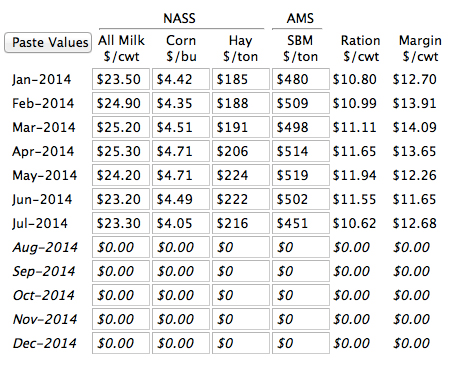
In order to help dairy farmers understand the new Margin Protection Program, NMPF is providing a set of data examining how the MPP margin has varied over time, dating back to 2007, up until the current month for which data is available.

This set of tables listing feed and milk prices is available below to download in Excel as well as PDF.  It will be updated by NMPF every two months going forward, using the same calculations that the USDA is expected to use as the program is implemented later in 2014.


Common Sense Prevails in Connecticut School Milk Debate

The latest skirmish in the battle over chocolate milk in schools ended June 12 when Connecticut Governor Dannel Malloy (left, drinking milk) vetoed legislation that would have effectively banned chocolate milk from state schools. The bill, passed on the final day of the legislature’s 2014 session, would have prohibited the sale of chocolate milk by setting a tight limit on the sodium allowed in drinks offered in Connecticut schools.

“I love chocolate milk, I love chocolate shakes, I like chocolate,” said Malloy. “I’m also a big milk person so looking at this … this was the right decision to make.”

“It’s encouraging to see reason and common sense returning to the debate over chocolate milk in schools,” NMPF President and CEO Jim Mulhern said in a statement.

“Schools that remove chocolate milk from the cafeteria are simply throwing the nutritional baby out with the bathwater. They deprive kids of calcium, protein and other needed nutrients while they increase waste and boost costs. Governor Malloy is to be congratulated for thinking this through, and not opting for the quick, easy but wrong solution.” NMPF had urged Malloy to veto the bill.