NMPF Senior VP of Communications, Alan Bjerga, discusses the benefits of DMC signup on WEKZ-FM radio, Janesville, Wisconsin.
Uncategorized
NMPF’s Galen on trade assistance and the Dairy Margin Coverage program
Listen to the latest updates on trade mitigation payments and the Dairy Margin Coverage program with Chris Galen, senior vice president of membership services and strategic initiatives on Dairy Radio Now.
2019 Scholarship Winners Announced
The NMPF Scholarship Committee selected three graduate students at its June meeting to receive scholarships as part of the 2019 NMPF National Dairy Leadership Scholarship Program. These students are conducting research in areas that will benefit dairy cooperatives and producers.
The 2019 Hintz Memorial Scholarship, given to the top scholarship candidate, was awarded to Amber Roberts, an MS candidate in Applied Economics at the University of Minnesota – Twin Cities studying the factors that influence resilient dairy farms.
Additional scholarships were awarded to:
Cesar Matamoros, a PhD candidate in Integrative and Biomedical Physiology at the Pennsylvania State University studying the role of volatile fatty acids as metabolic regulators of mammary lipogenesis in the bovine.
Russell Pate, a PhD candidate in Ruminant Nutrition at the University of Illinois at Urbana-Champaign studying nutritional and environmental stressors and their effect on performance and immunological parameters in dairy cattle.
Congratulations!
FARM Welcomes New Staff Member
The FARM Program welcomes Tyler Knapp as FARM Program Coordinator. Tyler, who holds degrees from the Oregon State University, the University of Arkansas, the University of Georgia and Ghent University, most recently worked in community and economic development with the University of Arkansas Extension Service.
Knapp will also assist FARM Program participants with managing and troubleshooting within the FARM Database, as well as handling administrative duties. “It is really exciting to get to work on projects for the dairy industry that will help farmers remain profitable while improving the welfare of cows, the environment and workers,” he said.
FARM Trains Evaluators, Discusses Standards
As part of the leadup to the implementation of FARM Animal Care Version 4.0, the National Dairy FARM Program hosted the first of four FARM Animal Care Version 4.0 Evaluator and Evaluator Trainer Courses in Madison, Wisconsin July 15–17. FARM also held its fourth annual evaluator conference July 23-25.
FARM Animal Care Version 4.0, which will launch on Jan. 1 through the end of 2022, establishes a more refined process for animal care evaluator selection and training, including an increase of previous on-farm experience, more robust initial application and increased length of training. These updates, the focus of the training sessions, serve to increase the integrity and consistency of implementation of the FARM Animal Care Program. Evaluator requirements and application can be found here.
At the evaluator conference held in Denver, evaluators from across the country gathered to network and discuss updates to FARM. Evaluators had the opportunity to listen to speakers discuss relevant topics such as implementing FARM Environmental Stewardship at the participant level and the impact on animal welfare due to labor-related matters.
CWT-Assisted Sales Contracts Near 10 Million Pounds of Dairy-Product Exports in July
CWT assisted member cooperatives in securing 44 contracts to sell 5.3 million pounds of American-type cheeses, 3.8 million pounds of whole milk powder, 35,274 pounds of anhydrous milkfat (AMF), and 504,859 pounds of cream cheese to customers in Asia, Central and South America, the Middle East, North Africa, and Oceania. The product will be shipped to customers in 12 countries in those six regions of the world during the months of July through December 2019.
The contracts bring the 2018 total of the CWT-assisted product sales contracts to 35.8 million pounds of cheese, 4.2 million pounds of butter, 35.6 million pounds of whole milk powder, 189,598 pounds of AMF and 3.6 million pounds of cream cheese. These transactions will move the equivalent of 726.4 million pounds of milk on a milkfat basis overseas.
Assisting CWT member cooperatives gain and maintain world market share through the Export Assistance program, in the long-term expands the demand for U.S. dairy products and the U.S. farm milk that produces them. This, in turn, positively impacts all U.S. dairy farmers by strengthening and maintaining the value of dairy products that directly impact their milk price.
The amounts of dairy products and related milk volumes reflect current contracts for delivery, not completed export volumes. CWT will pay export assistance to the bidders only when export and delivery of the product is verified by the submission of the required documentation.
All cooperatives and dairy farmers are encouraged to add their support to this important program. Membership forms are available at http://www.cwt.coop/membership.
NMPF Works to Keep the Science in Scientific Mandate
The Codex Executive Committee met the first week of July in Geneva, Switzerland, with the question of whether to preserve the scientific basis of international food standards high on the agenda. The committee recommended that Codex should not embrace other non-scientific factors in its decision-making, a topic then hotly debated during the Codex Alimentarius Committee meeting. The U.S. emerged victorious against an EU-led charge to undermine Codex’s scientific mandate.
This win would not have been possible without the efforts of NMPF staff to build partnerships and strengthen U.S. relationships with overseas authorities and organizations.
For years, the United States struggled to rally support from other countries for the U.S. position on Codex. However, NMPF has worked hard to drive greater cooperation and build allies internationally. USDEC colleagues leveraged the Memorandum of Understanding established with our FEPALE partners to rally support for the U.S. position and to present a united front against the EU’s effort to seek revisions to Codex’s scientific mandate.
Continuing to build upon these international relationships will be key to defending Codex’s science-based standards. NMPF is pleased to report the signing of a new Memorandum of Understanding (MOU) with the Inter-American Institute for Cooperation on Agriculture (IICA). This MOU will complement the one NMPF already shares with FEPALE and provide NMPF with another way to engage directly with stakeholders in Central and South America.
NMPF Backs Bipartisan Environmental Mitigation Bill
NMPF has endorsed the bipartisan Agriculture Environmental Stewardship Act (H.R. 3744), reintroduced July 12 in the House by Representatives Ron Kind (D-WI) and Tom Reed (R-NY), both members of the tax-writing House Ways and Means Committee.
NMPF has worked in partnership with the bill sponsors and the American Biogas Council to craft this proposal, which makes nutrient recovery and biogas systems eligible for a Section 48 Investment Tax Credit to cover 30 percent of the upfront capital costs of installing the technologies.
“This measure recognizes the value that biogas systems can have for dairy producers of all sizes as they continuously improve their sustainability nationwide,” said Jim Mulhern, president and CEO of NMPF. “The creation of this new investment tax credit would also address the value of nutrient recovery technologies, which can transform manure into fertilizer for crops and bedding for cows. These technologies are important, but expensive. If passed, this bill will help farmers incorporate these new technologies into their operations, for the benefit of everyone.”
The bill would enable dairy farmers to increase their investment in technologies that help recover and recycle nutrients from animal waste, in turn improving water quality in communities.
NMPF Speaks to Dairy’s Diet Importance at Second Dietary Guidelines Meeting
NMPF regulatory expert Miquela Hanselman testified on July 11 at a joint U.S. Department of Agriculture and U.S. Department of Health and Human Services meeting soliciting public comment on the upcoming update of the Dietary Guidelines for Americans, making the case that dairy needs to remain its own food group, plant-based products shouldn’t be included in the dairy category, and that dairy protein is superior to plant protein.
“Dairy foods are one of the top sources of calcium, protein, phosphorus, magnesium, potassium, vitamins A, B12, D and riboflavin in children’s diets,” Hanselman said. “In fact, it was determined in 2015 that 42% of individuals over the age of 1 don’t get enough calcium or vitamin D–two micronutrients that dairy products are full of. If dairy were removed from the diet, people would fall significantly below the estimated average requirement.”
The meetings began with each of the DGAC’s six subcommittees and one working group presenting draft protocols or proposed scientific approaches which then will be used to examine the scientific evidence. These protocols include analytic frameworks, inclusion and exclusion criteria, and search strategies, all of which are available online.
While the committee continues to put together the 2020 guidelines, a comment period will remain open for anyone who would like to submit comments. Submissions may be made here.
The second part of the meeting focused on comments from members of the public. The dairy industry was united in promoting the importance of dairy in healthy diets, even as some public comments were anti-dairy and not supported by scientific literature. NMPF and the National Dairy Council commented on key areas regarding dairy’s important place in the dietary guidelines.
Key priorities for dairy include:
- Maintaining dairy as a separate nutritional group
- Maintaining the recommendation of three dairy servings per day
- Preventing non-dairy beverages from being allowed into the dairy group
- Emphasizing the protein quality of dairy products
You can find the full statement here. NMPF will submit written comments and continue to monitor the dietary guidelines as more information is released. The next public meeting will be on October 24-25 in Washington, D.C.
United for USMCA: NMPF Members Advocate for Free Trade
focused on the importance of trade to agriculture and the need for Congress to quickly pass USMCA, focusing on the dairy industry.
In his remarks, Pence recognized CDI members Jim Wilson, Johnny Fagundes III, and John Fagundes IV and highlighted the benefits that USMCA will bring to our nation’s dairy farmers.
“I have to tell you, I watched this president drive a hard bargain,” on dairy during USMCA negotiations with Canada, Pence said. “The USMCA is a win for American dairy.”
Also as part of USMCA advocacy, Northwest Dairy Association Board Chairman and NMPF executive committee member Leroy Plagerman recently hosted a Farmers for Free Trade event at his family farm near Ferndale as part of the nationwide #MotorcadeForTrade.
NMPF is encouraging its members to take the opportunity to engage their representatives while they are in their home districts in August to emphasize the dairy-specific benefits of USMCA, such as locking in existing access to Mexico and disciplining Canada’s milk-pricing system.
NMPF has created an internal document on USMCA with background information, talking points, and an extensive list of actions taken to help move this agreement forward. Click here to download this reference document to help shape any comments. NMPF has also created a flyer on USMCA’s dairy benefits.
NMPF Encourages Government Collaboration to Support Dairy Exports
NMPF and its USDEC colleagues sent a letter July 12 to FDA and USDA encouraging the agencies to negotiate and make final a Memorandum of Understanding (MOU) establishing a smooth-functioning interagency process to support dairy exports, citing the indispensable role such exports play in supporting U.S. dairy farms.
“A successful MOU should outline key roles and responsibilities of each agency in order to foster the ability of the agencies to work in a collaborative manner on the various tasks involved in keeping American-made dairy products flowing freely abroad,” NMPF and USDEC wrote.
FDA has taken proactive steps in recent years to work in conjunction with USDA and better support the U.S. dairy industry in facilitating exports around the world. But more work remains.
Without careful coordination within the dairy industry, disagreement and communication breakdowns can derail export avenues. The MOU would tackle this challenge and proactively eliminate obstacles to expanding trade opportunities for the U.S. dairy industry.
June DMC Payment Higher than May as Feed Costs Push Down Margins
The margin for June under the Dairy Margin Coverage program will be $8.63 per cwt, $0.37 per cwt lower than a month earlier, as rising feed costs negated any economic gains created by a higher milk price. The falling margin will generate a June DMC payment of $0.87 per cwt for producers who purchase coverage at the DMC maximum level of $9.50 per cwt for up to 5 million pounds of production history. Thus far, margins under maximum DMC coverage would generate a payment for every month of 2019.
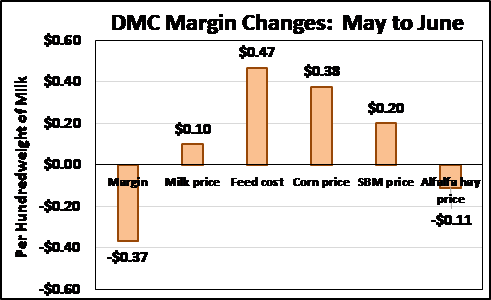
The All-Milk Price in June was up by 10 cents a hundredweight over May, but the June feed cost calculation was $0.47 per hundredweight higher than a month earlier, as the effects of this year’s weather disruptions in the heart of the country began to take effect began to hit feed prices. On a per hundredweight of milk basis, the calculated feed cost for June rose 38 cents from May because of higher corn prices and 20 cents due to a higher soybean meal price, offsetting a decline of 11 cents in the average alfalfa hay price.
The June feed cost would have been 16 cents a hundredweight of milk lower, raising the June margin and lowering DMC payments by the same amount, had the dairy quality alfalfa pay price not been added into the calculation.
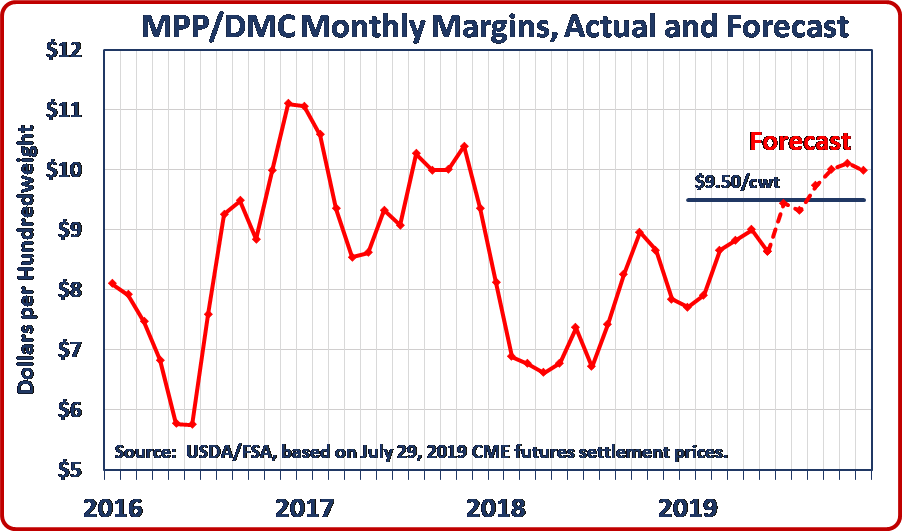
As of July 29, USDA’s DMC Decision Tool, which can be accessed online, projected the margins shown below. These calculations would generate payments averaging $0.51 per cwt., net of sequestration, for all of 2019 to producers who sign up for $9.50 per cwt coverage on up to 5 million pounds of production history. Coverage at this level costs $0.15 per cwt for a one-year signup, or $0.1125 for the year, if signing up for five years. Producers have until September 20th for 2019 enrollment.
NMPF’s DMC information page on its website offers a variety of educational resources to help farmers make better use of the program.