Dairy will always lead through unity

By Randy Mooney, NMPF Chairman 2008-2025
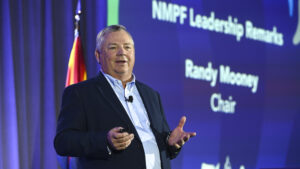
Editor’s note: This is an edited transcript of the author’s remarks at the National Milk Producers Federation’s annual meeting Nov. 11 in Arlington, Texas.

I’ve been part of National Milk for more than two decades, and I’m in awe with how this industry has grown and evolved while never losing sight of who we serve: the dairy farmers. As many of you know, this is my last annual meeting as chairman. And while I’ll continue to serve on the board, this moment marks a meaningful transition.

I’m proud to pass the baton to Brian Rexing, a leader who carries forward the spirit of dedication, vision, and integrity that defines national milk in our entire industry. I’ve known Brian for a long time, and he always gets the job done.

Progress doesn’t happen overnight, and I’ve seen firsthand the grit and work it takes to move something forward. It all happens when people come together. We roll up our sleeves and stand shoulder to shoulder, stay rooted in shared values, and keep the course. We’ve done just that, working as one as we’ve built something we should be very, very proud of.

We’ve built stronger foundations for dairy farmers across the country by ensuring that each and every day, farmers, no matter the size of their operation or where they call home, have the tools, the support, and the representation they need to succeed on their operation for generations to come. We’ve moved the industry forward on major policy fronts and together, we’ve made our collective voice stronger in Washington.

We’ve improved coordination across the industry, and we continue investing in programs that secure markets for U.S. milk and dairy products, capturing bipartisan wins along the way. We’ve created and continued to evolve the FARM program. Together, we’ve developed and adopted a program that our customers and our consumers recognize, a program that nearly 100% of farmers in the country belong to. We’ve developed risk management tools starting out in 2009 that have evolved into DMC and DRP, which recognizes different sizes of farms. Now, those aren’t perfect, but they are risk management tools that we didn’t have in the past.

On taxes, we’ve worked to make certain that our co-ops and our farmers benefited from the tax breaks in the One Big Beautiful Bill. This includes Section 199 and estate tax issues that allow us to pass the farm on to the next generation. We’ve advocated in farm bills for policies that strengthen farms, families, and growing children. On nutrition, we’ve worked on the Whole Milk for Healthy Kids Act, expanding healthy fluid milk incentive programs, child nutrition acts, and school meals. And by defending dairy’s name against plant-based beverages, we’ve driven home the message of dairy’s nutritional superiority. We took three years updating the Federal Milk Marketing Order program into a system that reflects today’s market’s realities.

On trade policy, we’ve worked on bilateral and multilateral trade negotiations and dairy export incentive programs. We’re currently working with the administration on tariffs and trade policies. We fought to protect dairy’s rightful place in the American diet through the Dietary Guidelines for Americans, reminding policy makers that 90% of the people in this country don’t get enough dairy. On our workforce — our labor — we’ve tackled one of agriculture’s most persistent challenges: advocating for the H-2A reform recommendations through the Ag Labor Working Group and working to ensure dairy has access to a reliable year-round workforce.

At National Milk, that’s the number one issue to solve right now. I applaud the administration for securing the border, but we also need immigration reform so we can have ag labor on our farms. We need to be specific about what we want. So, you’re going to see National Milk setting up a task force of some of the leaders in this room to figure that out. Then, we’re going to have to be nimble. As it goes through Congress, things change. We’re going to have to be able to change and adapt and to make sure that we fit into whatever legislation that gets passed.

And we remain resilient throughout all of this, because that’s the dairy community. We show up for each other. We work to make sure funds are available to help dairy farmers who have been devastated by natural disasters. And one thing stands clear. When we work together, there is nothing that we can’t accomplish. When we work as one, when we speak with one voice, when we lead with unity and purpose, there’s almost nothing that we can’t do.

The challenges ahead are real, from labor to climate pressures, to market volatility and changing consumer expectations, but our momentum is real as well. We have strong leadership in place. We have dedicated farmer leaders who are ready to step up, and we have a legacy of resilience, innovation, and integrity to build upon.

To the farmers in the room, thank you. You are the heart of this organization. You’re the ones who’ve shown what’s possible when we lead with unity and purpose, when resiliency is alive and at the core of who we are as the dairy farmers. You’ve made me proud to serve on your behalf in this position, and I’m deeply optimistic about what’s to come. Thank you very much.


This column originally appeared in Hoard’s Dairyman Intel on Nov. 20, 2025.
Dairy Has Persevered Through a Successful Year

Note: These remarks are adapted from NMPF President & CEO Gregg Doud’s remarks at NMPF’s annual meeting in Phoenix, Oct. 22, 2024.

In reflecting on where we were a year ago in this industry, it wasn’t very pretty in terms of prices. There wasn’t a lot of optimism. We have experienced several stressful headlines and considerable market risk in the last year, but look at where we are now. The situation has greatly improved — but there is still work to be done.

Let’s start with the long-overdue update of USDA’s Federal Milk Marketing Orders. Then there is the ongoing revamp of the Cooperatives Working Together program (yes, we need to come up with a new name) to make our dairy exports more competitive. We didn’t sign up for H5N1, but it’s here, and we have to deal with it. The Farm Bill, the Dietary Guidelines and ongoing efforts regarding trade issues – they have all been big challenges this year and we cannot let our guard down for a minute in the months ahead. Importantly, we have a tremendous team in Washington. They are rock solid and up for the task.

And that’s critical in areas such as Federal Milk Marketing Order modernization. As I was just coming on board, I went to a couple of the hearings in Carmel, IN. And although I’m an ag economist, it gave me a headache. What a challenging conversation. But what I also saw was the unbelievable expertise and leadership of numerous NMPF members. Our unanimous message made all the difference. It forced the government to listen.

We’ve seen similar impressive accomplishments on Capitol Hill as well. Late last year we had one of the most interesting votes I’ve seen in 32 years in Washington, when the House of Representatives voted 330 to 99 to put whole milk back in schools. This was a situation where some good old-fashioned shoe-leather lobbying, where you sit down with a member of Congress and say, ‘This is the science. This is the better product. We need to put whole milk back in schools.’ The result was that a majority of both Democrats and Republicans in the House, 330 to 99, agreed. Unfortunately, we have yet to be successful in the Senate on this important issue — but the year isn’t over.

I’m not sure when we’re going to pass the Farm Bill. It could be in the lame duck. It could be next year. It could be the year after. Regardless of who is in the White House or Congress next year, the 2025 congressional agenda complicates the Farm Bill legislative process. The next Congress will likely start by navigating issues such as the debt ceiling, budget reconciliation and executive branch nominations. However, the huge issue will be the five-year expiration of our tax code. The “delta” or difference in terms of the Farm Bill and what we’re debating over is about $10 billion when it comes to reference prices. My understanding is, if Congress does nothing in 2025 on taxes, on Jan. 1, 2026, the tax bill for everyone in this country goes up by $5 trillion. This will be the first big debate of the next Congress and, for the farm economy, it dwarfs any other issue. A reasonable expectation is that this discussion will consume the first half of next year, leaving the Farm Bill debate for the last half of the year, squeezed between the process of approving appropriations bills.

We also have to continue to pay close attention to H5N1. Sometimes when we make investments in animal disease preparedness, we’re not sure if the event will ever actually occur. One of those investments, via the checkoff, we made a while back was in terms of foot and mouth disease, and people said, ‘We haven’t had that in nearly a hundred years, why are we investing in that?’

In reality, this little bit of foresight paid huge dividends this year. When H5N1 hit, we pulled these biosecurity plans off the shelf, we adapted them to this virus, and we plugged them in for a webinar for 1,300 people in this industry, in three days — an unbelievable accomplishment. When we look back to the lessons learned on H5N1, this initial investment, and the subsequent on-farm biosecurity implementation efforts that were a result, made a big difference. We must continue to look around the corner to determine what new investments must be made to ensure we’re ready for the next event, whatever that might be.

On the regulatory side, we’ve been investing in the fight against plant-based beverage mislabeling, and we’ve been proactive on the Dietary Guidelines and other nutrition issues. The team effort with incredible dairy nutrition research coming from the checkoff side, along with numerous industry partnerships along the way has been terrific. We’re going to continue to make our case respectfully, but we are not going to give an inch.

We continue to lead and innovate with improvements in our FARM Program and the ongoing work with the U.S. Dairy Export Council on these always thorny trade issues must be a priority to improve the demand environment for U.S. dairy, domestically and internationally.

This industry has a tremendously bright future. There’s never been a year like this year, in terms of headline risk in the agricultural commodity business. My contemporaries talk about this all the time with wars, inflation, viruses, et cetera. Yet, despite all of this, dairy farmers have persevered and had a tremendously successful year. Our future success will also come from the roughly $7 billion in new processing investments now being made in this industry. This is an investment in you, the dairy farmers of this great nation, and for good reason!

It has been an honor to be a part of the NMPF team in Washington this past year, and I look forward to working with you, and fighting for you in Washington, going forward.


Gregg Doud

President & CEO, NMPF