 The issue of labeling foods made with genetically modified ingredients took center stage on Capitol Hill as March drew to a close.
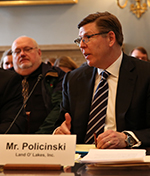
On March 24, Vermont dairy farmer Joanna Lidback, below, and Land O’Lakes Chief Executive Officer Chris Policinski, above, were among six witnesses testifying on mandatory GMO labeling laws before the House Agriculture Committee. The following day, NMPF joined numerous other agriculture groups in endorsing new, bipartisan federal legislation establishing a protocol for food marketers wishing to voluntarily label foods with GMO ingredients.
Lidback said the need to build a viable small business led her family to embrace using genetically modified seeds for feed. “I also believe that biotechnology enables us to lessen the environmental impact that growing can have because less fertilizer and pesticides are used to grow an abundant crop,” she said. If the marketplace forced her to use non-GMO feed grains – most of which would be certified organic – her farm’s feed bill would more than double each month, from $5,328 to $12,000, Lidback added.
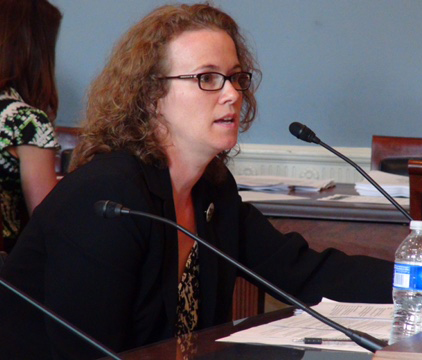 Lidback’s family has 50 cows on 200 acres in northeast Vermont. Her state was the first to enact a mandatory GMO labeling bill, which is being challenged in court but scheduled to go into effect next year. Lidbeck testified on behalf of Agri-Mark, a dairy cooperative member of NMPF.
Policinski called mandatory GMO labeling “an effort to stigmatize a form of technology and attempt to drive it out of the marketplace.” He said a state-by-state patchwork of mandatory GMO labeling laws “would be a logistical nightmare, creating dozens of different standards, different definitions, and different exemptions.”
A better approach, he said, would be voluntary national labeling, which would respect both the consumer’s right to choose in the marketplace but also a farmer’s right to choose a safe, proven technology.
The day after the committee hearing, a bipartisan group of 17 House members reintroduced the Safe and Accurate Food Labeling Act, under which the Food and Drug Administration would set national standards for companies wishing to label their products as either containing or not containing genetically modified ingredients.
NMPF immediately endorsed the bill. “Rather than create a confusing patchwork of state policies, this federal legislation would establish uniform rules and a national certification program for foods that have been produced without bioengineering,” said NMPF President and CEO Jim Mulhern. “If food companies wish to voluntarily label their products as GMO-free, this legislation lets them do it.”
 Efforts to target farm program spending in the congressional budget process sputtered out in March, as separate House and Senate budget resolutions made no significant changes in the farm bill approved early last year.
 Mid-March and early April were active periods for NMPF on the trade front.
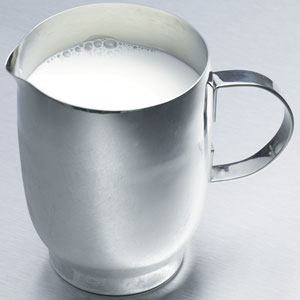 NMPF thanked West Virginia Governor Earl Ray Tomblin for vetoing legislation April 2 that would have allowed consumers in that state to obtain unpasteurized milk through herd-shares. NMPF urged a veto of SB 30 in a joint letter with the International Dairy Foods Association in March.
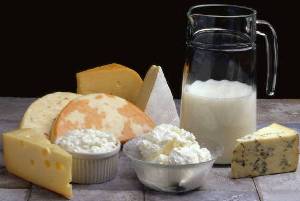 NMPF has urged the Departments of Agriculture and Health and Human Services to continue recommending at least three servings of dairy a day as part of the 2015 Dietary Guidelines for Americans.
 In March,
 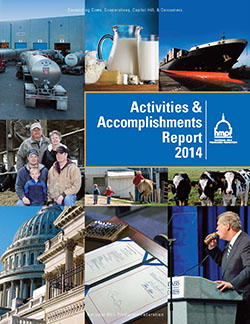 NMPF’s latest Activities and Accomplishments Report is available on the organization’s website. Published annually, the report is an account of NMPF’s actions and achievements on all the issues it faced in the previous year.
 The joint
  The Animal Agriculture Alliance will hold its 2015 Stakeholders Summit in Kansas City on Wednesday and Thursday, May 6-7. Dairy producers interested in attending can register through the organization’s website.
 The dairy industry today praised the more than 75 House members who have urged the Obama Administration to negotiate a strong market-access outcome for the U.S. dairy