Truth in Labeling Finally Moving Forward


For most of the past 20 years that genetically modified crops have been cultivated in the U.S., their use has progressed with all the excitement of watching corn grow.  In recent years, however, the verdant presence of bioengineered crops has drawn fear-mongering and undeserved scrutiny across the food chain.  The pressure has fueled efforts in some states to force GMO cultivation bans, or mandatory food labels that threaten farming practices which are demonstrably beneficial to the environment and to society.

Fortunately, the U.S. Congress has finally begun stepping in to provide some clarity on the labeling of foods that do – or do not – contain genetically-modified ingredients.  In late July, the House of Representatives passed the Safe and Affordable Food Act.  This legislation, designated H.R. 1599, would establish a national, uniform standard so consumers who want to purchase food without GM ingredients can be confident in what they are eating.  Those companies that want to assert that their ingredient supply chain is GMO-free will have a process to vouchsafe those claims, overseen by the U.S. Department of Agriculture.  This national GMO-free certification program, modeled on the National Organic Program, will give consumers who prefer to buy non-GMO foods a transparent, consistent means of doing so. 

Just as importantly, a new federal standard for GMO absence claims will prevent the sprouting of state labeling mandates, similar to what happened last year in Vermont.  H.R. 1599 ensures one national standard for food labeling, keeping consumers informed rather than misled.  It’s similar to what the dairy industry has done for the past 20 years in following federal guidance on which label claims are allowed regarding milk from farms that do not use recombinant bovine somatotropin (rBST). 

The vocal critics of GMO – and they are nothing if not loud and organized – assert that GMO use should require mandatory labeling.  But decades of scientific research and hundreds of studies have found no difference in the products containing GMO processes or ingredients.  Food labels are intended to quantify nutritional information, and qualify the safety of the product.  Because there are no nutritional differences in GM ingredients, and absolutely no food safety issues, mandating labeling of genetically modified foods is not relevant to these key criteria.

The Safe and Affordable Food Act does need further modification as the Senate begins consideration of a similar measure.  The House version would not allow livestock products to display a “GMO-free” claim if the cattle, pigs or poultry were fed GMO grains.  Where the science is clear that there is nothing genetically modified in foods like milk or meat, there is no reason to use a new federal labeling law to create potentially stigmatizing discrepancies between foods.

The anti-biotech bandwagon has subtly shifted its criticisms in the past year.  Initially, their strategy was to raise questions about the safety of the crops, and the resulting grains and oilseeds. While this tact successfully created groundless fears among some consumers, the science has been unequivocally clear that food safety is not an issue with GMOs.  Now, the critics are scrambling for a new message. Apparently the latest strategy is to criticize the role of the herbicide glyphosate in controlling weeds in fields planted with GMO seeds.  This is also a disingenuous line of attack, since glyphosate (Roundup) – a product found in millions of suburban garages and tool sheds across America – is far more benign than many other weed killers that were in use long before the adoption of GMO seeds, and are still being used today.  

The reality is GMO seeds help farmers use fewer chemicals, water and fuel, and allow more crops to be harvested without plowing over additional acres of land. Those who don’t see or appreciate these benefits are entitled to remain opposed to GMO crops, but they are not entitled to subvert longstanding food policy to mandate labeling of what amounts to a distinction without a difference. The creation of a new voluntary labeling standard for GMO claims is the appropriate compromise approach to this issue.  Hopefully, the Senate will finally make it a reality.

Groups Praise Senate Finance Committee Leaders for Demanding that Canada Accept More Dairy Imports — July 24

The National Milk Producers Federation (NMPF) and U.S. Dairy Export Council (USDEC) today praised the Senate Finance Committee’s bipartisan leadership for urging Canada to allow more trade in agricultural products, including dairy, as an outcome of the negotiations over the Trans-Pacific Partnership. If Canada is not willing to allow more dairy trade as a result of the TPP, it risks being left out of the agreement, according to the Senate members.

In a letter to Gary Doer, Canada’s ambassador to the United States, Committee Chairman Orrin Hatch (R-UT) and senior Democrat Ron Wyden (D-OR) said Canada’s ability to “commit to significant and commercially meaningful market access for all remaining agricultural products, including dairy, will have a significant impact on Congress’ view of the final agreement. In fact, our support for a final TPP agreement that includes Canada is contingent on Canada’s ability to meet the TPP’s high standards.”

The letter from Hatch and Wyden echoed a similar appeal last week by 21 members of the House of Representatives led by Representatives Reid Ribble (R-WI) and Ron Kind (D-WI), as well as Ways and Means Chairman Paul Ryan (R-WI) and Agriculture Committee Chairman Mike Conaway (R-TX). That letter also went to Canada’s ambassador to the U.S.

The letter comes at a pivotal time, as negotiators from across the Pacific are currently meeting in Hawaii to finalize key issues in the TPP talks, including agricultural trade.

NMPF and USDEC said the Senate letter reinforces the message that a vital element to achieving a balanced outcome in the TPP negotiations is increased access to that country’s dairy market. The two groups want significant increases in access to the Canadian and Japanese dairy markets, as well as ultimately a balance between these sizable new export gains and any new access to our market granted for New Zealand dairy farmers.

“Senators Hatch and Wyden are to be commended for adding their strong voices to the demand that Canada get serious about meeting this agreement’s market access obligations,” said NMPF President and CEO Jim Mulhern. “Canada’s highly protected dairy market is one of the final issues in the TPP, and so far its negotiators have refused to live up to their commitment to satisfactorily address it.”

“We fully agree with this clear Congressional message that if Canada is looking for a pass on the type of tough decisions that all other TPP countries are being asked to make, it is better to move TPP ahead without them,” added USDEC President Tom Suber. “Our dairy industry is willing to do its part, but Canada needs to do the same if it wants to be part of this agreement.” 

###


The National Milk Producers Federation (NMPF), based in Arlington, Va., develops and carries out policies that advance the well-being of U.S. dairy producers and the cooperatives they collectively own. The members of NMPF’s cooperatives produce the majority of the U.S, milk supply, making NMPF the voice of nearly 32,000 dairy producers on Capitol Hill and with government agencies. For more on NMPF’s activities, visit www.nmpf.org.

The U.S. Dairy Export Council (USDEC) is a non-profit, independent membership organization that represents the global trade interests of U.S. dairy producers, proprietary processors and cooperatives, ingredient suppliers and export traders. Its mission is to enhance U.S. global competitiveness and assist the U.S. industry to increase its global dairy ingredient sales and exports of U.S. dairy products. USDEC accomplishes this through programs in market development that build global demand for U.S. dairy products, resolve market access barriers and advance industry trade policy goals. USDEC is supported by staff across the United States and overseas in Mexico, South America, Asia, Middle East and Europe. The U.S. Dairy Export Council prohibits discrimination on the basis of age, disability, national origin, race, color, religion, creed, gender, sexual orientation, political beliefs, marital status, military status, and arrest or conviction record.


Dairy Groups Aligned with Congressional Leaders in Disapproving of GI Treaty

The dairy industry today praised leaders of the Senate and House Judiciary committees, the Senate Finance Committee, and the House Ways and Means Committee for expressing “grave disappointment” over recently approved treaty changes that are likely to severely limit the use of many generic food names in export markets. 

Among those hurt by the changes are U.S. dairy producers and processors that have relied for decades on well-established cheese names like parmesan and feta.  

In a strongly worded letter to the World Intellectual Property Organization (WIPO), the eight congressional leaders objected to an expansion of geographical indications protections that will limit the use of certain food names to a specific region or country without sufficient protections for other users of the names. They also objected to a WIPO decision to force those harmed by the changes to help fund them.

“We urge you to take appropriate steps to rectify the funding situation and to implement the agreement in a fair and balanced way that adequately protects the interests of trademark owners and users of generic names,” the committee leaders wrote. “We will continue to monitor closely these developments and other areas of WIPO’s work to ensure that WIPO effectively functions as a global forum for the protection of intellectual property rights.” 


he letter also questioned whether the treaty provisions violated other international trade agreements. “We are very concerned that parties to this agreement will implement it in a manner inconsistent with existing international trade obligations, including under the World Trade Organization’s Agreement on Trade-Related Aspects of International Property Rights,” it said.  

Those signing the letter were Senate Judiciary Committee Chairman Chuck Grassley (R-IA) and Ranking Member Patrick Leahy (D-VT), House Judiciary Committee Chairman Bob Goodlatte (R-VA) and Ranking Member John Conyers (D-MI),

Senate Finance Committee Chairman Orrin Hatch (R-UT) and Ranking Member Ron Wyden (D-OR), and House Ways and Means Committee Chairman Paul Ryan (R-WI) and Ranking Member Sandy Levin (D-MI).

Leaders of the National Milk Producers Federation, the U.S. Dairy Export Council, and the International Dairy Foods Association all praised the Congressional letter for strongly objecting to WIPO’s actions. 

“The deep concern expressed by the United States and many other WIPO members must be taken seriously not only by WIPO but by the World Trade Organization,” said NMPF President and CEO Jim Mulhern. “These eight congressional leaders are to be commended for objecting to an agreement that hamstrings many users of common or generic food names around the world.” 

Tom Suber, president of the U.S. Dairy Export Council, said, “The letter correctly notes that WIPO missed an opportunity to develop a consensus agreement and instead approved a one-sided document that ignores the concerns of the United States and many other WIPO members. If this is WIPO’s model for the future, the United States will need to reassess the benefits of belonging to the organization.” 

Added Connie Tipton, president and CEO of the International Dairy Foods Association: “WIPO needed to be called out for pushing through an agreement that includes new geographical indications for a wide range of agricultural and non-agricultural products. The congressional letter does that. We hope WIPO sits up and takes notice.” 

The World Intellectual Property Organization is a United Nations agency charged with developing a balanced international intellectual property system. It approved the treaty changes at a meeting in Geneva, Switzerland, in May.  

###

The National Milk Producers Federation (NMPF), based in Arlington, Va., develops and carries out policies that advance the well-being of U.S. dairy producers and the cooperatives they collectively own. The members of NMPF’s cooperatives produce the majority of the U.S, milk supply, making NMPF the voice of nearly 32,000 dairy producers on Capitol Hill and with government agencies. For more on NMPF’s activities, visit www.nmpf.org.

The U.S. Dairy Export Council (USDEC) is a non-profit, independent membership organization that represents the global trade interests of U.S. dairy producers, proprietary processors and cooperatives, ingredient suppliers and export traders. Its mission is to enhance U.S. global competitiveness and assist the U.S. industry to increase its global dairy ingredient sales and exports of U.S. dairy products. USDEC accomplishes this through programs in market development that build global demand for U.S. dairy products, resolve market access barriers and advance industry trade policy goals. USDEC is supported by staff across the United States and overseas in Mexico, South America, Asia, Middle East and Europe. The U.S. Dairy Export Council prohibits discrimination on the basis of age, disability, national origin, race, color, religion, creed, gender, sexual orientation, political beliefs, marital status, military status, and arrest or conviction record.

The International Dairy Foods Association (IDFA), Washington, D.C, represents the nation’s dairy manufacturing and marketing industries and their suppliers, with a membership of 550 companies within a $125-billion a year industry. IDFA is composed of three constituent organizations: the Milk Industry Foundation (MIF), the National Cheese Institute (NCI) and the International Ice Cream Association (IICA). IDFA’s nearly 200 dairy processing members run nearly 600 plant operations, and range from large multi-national organizations to single-plant companies. Together they represent more than 85 percent of the milk, cultured products, cheese, ice cream and frozen desserts produced and marketed in the United States. IDFA can be found online at www.idfa.org.

Dairy Groups Commend House Members for Urging Canada to Increase Market Access

ARLINGTON, VA – The National Milk Producers Federation and the U.S. Dairy Export Council today commended a bipartisan and regionally diverse group of House members for urging Canada to allow more imports of U.S. dairy products as an outcome of the Trans-Pacific Partnership (TPP) trade talks. If Canada cannot provide more dairy market access, it risks being left out of the massive Pacific Rim trade agreement now in the final stages of negotiation, according to a letter from key members of Congress.

In the letter to Canada’s ambassador to the U.S., Gary Doer, the House members said U.S. access to the Canadian dairy market will have a significant impact on how Congress views the final, 12-nation TPP agreement. “It will be difficult for us to support Canada’s inclusion in TPP if significant new dairy access is not part of the deal,” they wrote. 

he letter was spearheaded by Representatives Reid Ribble (R-WI), Ron Kind (D-WI), David Valadao (R-CA) and Suzan DelBene (D-WA). Among the signers were Paul Ryan (R-WI), Chairman of the Ways and Means Committee, Mike Conaway (R-TX), Chairman of the Agriculture Committee, and Pat Tiberi, Chairman of the Ways and Means Committee’s Trade Subcommittee.

NMPF and USDEC hailed this congressional message as a vital element to achieving the type of ambitious and balanced market access result that is still needed in the Trans-Pacific Partnership agreement. 

“We applaud this group of House members for demanding that Canada get serious about allowing more dairy imports,” said NMPF President and CEO Jim Mulhern. “Creating meaningful U.S. export opportunities in the Canadian market is one of three critical dairy market access issues remaining in TPP and so far Canada has refused to live up to its commitment to address it. If U.S. dairy farmers are ultimately asked to grapple with greater competition under this agreement, it’s only right that they be able to have comparable product opportunities to tap into exports to Canada, as well as Japan.”  

“Our members had hoped that TPP would eliminate all dairy tariffs in the region; that now appears unlikely,” added USDEC President Tom Suber. “Despite this, we see the prospect for ample market access gains – particularly into Japan and Canada. We hope to support a final agreement that ensures the United States gains at least as much increased dairy market access into those markets for major dairy commodities as it grants to our largest competitor in this agreement. Our industry is willing to do its part; Canada needs to do so as well if it wants to be part of TPP.”

Also needing to be addressed in the final phase of the TPP negotiations is the further expansion of access to the Japanese market for certain core dairy commodities. NMPF and USDEC have consistently stated that the final agreement must include net trade benefits for exports of major dairy commodities into Japan and Canada, TPP’s major dairy import destinations, in comparison with new dairy access into the United States for New Zealand, the world’s largest dairy exporter, for each of those products. 

###

The National Milk Producers Federation, based in Arlington, Va., develops and carries out policies that advance the well-being of U.S. dairy producers and the cooperatives they collectively own. The members of NMPF’s cooperatives produce the majority of the U.S, milk supply, making NMPF the voice of nearly 32,000 dairy producers on Capitol Hill and with government agencies. For more on NMPF’s activities, visit www.nmpf.org.

The U.S. Dairy Export Council is a non-profit, independent membership organization that represents the global trade interests of U.S. dairy producers, proprietary processors and cooperatives, ingredient suppliers and export traders. Its mission is to enhance U.S. global competitiveness and assist the U.S. industry to increase its global dairy ingredient sales and exports of U.S. dairy products. USDEC accomplishes this through programs in market development that build global demand for U.S. dairy products, resolve market access barriers and advance industry trade policy goals. USDEC is supported by staff across the United States and overseas in Mexico, South America, Asia, Middle East and Europe. The U.S. Dairy Export Council prohibits discrimination on the basis of age, disability, national origin, race, color, religion, creed, gender, sexual orientation, political beliefs, marital status, military status, and arrest or conviction record. www.usdec.org


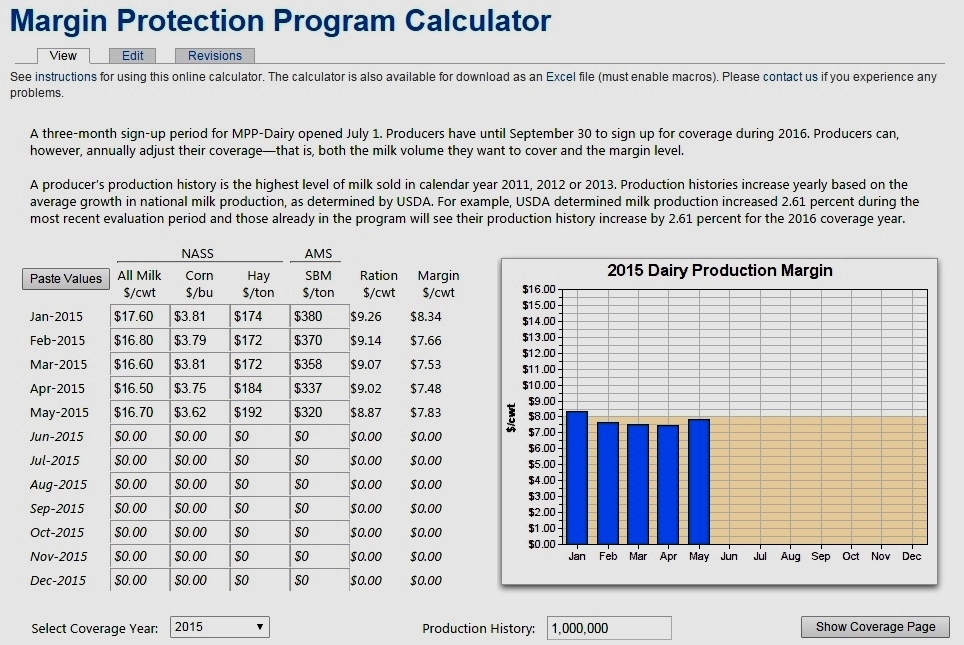
NMPF Offers Online Tools to Help Dairy Farmers During Margin Protection Program Enrollment Period

July 13 –  The National Milk Producers Federation has updated its online tools for dairy farmers considering their enrollment options in the second year of the Margin Protection Program, the new federal dairy safety net included in the 2014 farm bill.

A three-month sign-up period for the program, also known as MPP, opened July 1st. Producers have until Sept. 30th to enroll for coverage in calendar year 2016.  Producers currently covered by MPP in 2015 can elect now to make coverage changes in 2016.

To help producers make decisions, NMPF’s dedicated website, www.futurefordairy.com, offers the following materials:
• A six-page brochure explaining the program and its benefits to dairy farmers;
• A PowerPoint slide deck explaining the program in more detail;
Four pages of Frequently Asked Questions;
• A Excel spreadsheet with milk and feed prices, and margins, dating back to 2007;
• An interactive calculator allowing farmers to estimate future margins based on their forecasts of feed and milk prices.

The Margin Protection Program was designed to insure against the kind of catastrophic losses that many dairy farmers experienced in 2009 and again in 2012. Instead of tying government support to milk prices, MPP allows farmers to protect against the difference between milk prices and feed costs. Dairy farmers insure their farms on a sliding scale, deciding both how much of their production to cover, and the level of margin to protect. The program offers more extensive coverage for low-margin conditions than the previous programs it replaced.

According to the Agriculture Department, more than half of the nation’s 45,000 dairy producers enrolled in the Margin Protection Program during the inaugural sign-up period last fall.  The USDA also reported that approximately 80% of the nation’s milk supply enrolled in the program.  Of the farms in the program, approximately 55 percent elected to pay a premium for coverage above the basic, $4 per hundredweight coverage level.

NMPF was instrumental MPP’s development and strongly encourages producers to use the program.

”The Margin Protection Program is more flexible, more comprehensive and more equitable than any previous federal dairy safety net,” said Jim Mulhern, NMPF’s president and CEO. “It is risk management for the 21st century, and we strongly encourage farmers to choose a coverage plan that fits their circumstances. The updated materials available on our websites can help them do that.”

NMPF among 18 Authors of a New Guide to Water Quality Trading

NMPF was among 18 organizations that in June unveiled an online guide to water quality trading programs designed to help farms, utilities and others reduce pollution.

Like energy trading, water quality trading rewards those who act responsibly with credits that they can keep or sell to others. For example, a farmer who reduced runoff can earn credits that can be sold to a wastewater treatment plant that is discharging into a river.

While regulations vary from sector to sector — wastewater plant regulations are different from those that apply to farms — water quality trading leads to cleaner waterways at lower cost.

But establishing a trading program can be challenging. Start-up is time-consuming, as businesses and regulators figure out how much pollution participants must cut, how pollutants interact in different parts of the watershed, and other program elements.

The new guide, Building a Water Quality Trading Program: Options and Considerations, helps participants decide if trading is right for their watershed. It lists 11 key elements in trading program design, with examples, options, and clear pros and cons.

“The guide offers options for calculating credits, determining trading eligibility and engaging stakeholders,” said Ryan Bennett, NPPF’s Director of Government Relations. “Clear pros and cons give stakeholders the flexibility to address the scientific, social, and ecological realities of a particular watershed. Overall, the guide is an excellent resource that can help participants design a trading program faster and with less cost.”

The guide’s authors, including NMPF staff, represent agricultural operations, wastewater utilities, environmental groups, regulatory agencies and trading program designers. All are members of a two-year old National Network on Water Quality Trading.


Importance of Voluntary National GMO Labeling Standards Reinforced at Hearing

Testimony at June hearing before a key House subcommittee reinforced the importance of a establishing national standard for labeling foods with genetically modified ingredients, rather than allowing a patchwork of state requirements. 

“State-by-state GMO labeling is simply not an option, as testimony at this and earlier hearings has shown,” said Jim Mulhern, NMPF President and CEO. “A better approach is federal legislation endorsed by NMPF that would set up voluntary regulations for labeling foods with GMO ingredients.”

That legislation, the Safe and Accurate Food Labeling Act, requires the Food and Drug Administration to set standards for companies wishing to label products as either containing or not containing GMOs. It was introduced this spring by Reps. Mike Pompeo (R-KS) and G.K. Butterfield (D-NC).

“The Pompeo-Butterfield bill would deal with GMO labeling at the national level,” Mulhern said. “It would set uniform rules and provide a national certification program for foods that have been produced without bioengineering.”

In March, Vermont dairy farmer Joanna Lidback and Land O’Lakes Chief Executive Office Chris Policinski testified on GMO labeling before the House Agriculture Committee. Lidback said genetically modified seeds keep her farm’s feed bills low and allow her to use less fertilizer and pesticides. Her state has enacted a mandatory GMO labeling bill that is scheduled to go into effect next year.

Policinski said state GMO labeling “would be a logistical nightmare, creating dozens of different standards, different definitions, and different exemptions.”

GMOs have been proven safe by nearly 2,000 studies from the leading scientific bodies in the world, including the World Health Organization and the American Medical Association. Currently, up to 80 percent of the food available in the United States contains genetically modified ingredients.

CWT Helps Move 9.4 Million Pounds of Dairy Products into World Markets

Cooperatives Working Together helped its member cooperatives last month contract to sell 9.447 million pounds of dairy products to customers in 12 countries on four continents. The 3.6 million pounds of American-type cheese, 3.8 million pounds of butter, and 2.0 million pounds of whole milk powder will be shipped from June through November 2015.

The 40 sales contracts in June bring the year to date 2015 totals to 38.4 million pounds of cheese, 30.4 million pounds of butter, and 22.1 million pounds of whole milk powder. Together, those transactions will move the equivalent of 1.2 billion pounds of milk on a milkfat basis to customers in 28 countries on five continents. These sales contracts are equal to nearly 90 percent of the increase in U.S. milk production through May.

Developed by NMPF, CWT is a voluntary export assistance program supported by dairy farmers producing 70 percent of the nation’s milk. By helping to move U.S. dairy products into world markets, CWT helps maintain and grow U.S dairy farmers’ share of these expanding markets.

In a related development, in early June the NMPF board voted to continue CWT through 2018 at the current funding level of four cents per hundredweight. The extension comes at a time of increasing U.S. milk production, declining world dairy prices and increased global competition due to the removal of European Union milk quotas.

“With the United States exporting the equivalent of one-seventh of its milk production, the NMPF board recognized how important CWT is in helping every farmer gain access to fast-growing overseas markets,” said NMPF Board Chairman Randy Mooney. “The program remains a tremendous self-help tool for all of America’s dairy producers.”

USDA, CSPI Agree with NMPF on Need to Ease Restrictions on Milk in Schools

Federal legislation easing restrictions on serving chocolate milk in schools received expressions of support in June from two prominent sources: the U.S. Department of Agriculture and the Center for Science in the Public Interest.

The School Milk Nutrition Act, developed jointly by NMPF and the International Dairy Foods Association and introduced in Congress this spring, would stem the tide of declining school milk consumption, among other ways, by allowing schools to offer low-fat as well as fat-free flavored milk. Current regulations only allow flavored milk if it is non-fat. Low-fat flavored versions would be restricted to no more than 150 calories per eight-ounce serving under the new legislation. 

At a June hearing of the House Education and Workforce Committee, USDA Secretary Tom Vilsack was asked if he could support giving schools the option of offering low-fat flavored milk. According to the Washington publication Politico, Vilsack responded, “I think if adding that option gets kids to drink more milk, we ought to do it.”

Later in the month, Margo Wootan, CSPI’s director of nutrition policy, also supported the concept of relaxing restrictions on flavored milk in schools. Politico quoted Wootan as saying, “I think that having flavored milk in schools is fine. It’s better to have kids drinking fat-free chocolate milk than soda. And one percent milk with a calorie cap is also acceptable to us.”

CSPI, sometimes called the “food police,” is a prominent consumer organization on nutrition issues.

The School Milk Nutrition Act was introduced earlier this year by Representatives Glenn Thompson (R-PA) and Joe Courtney (D-CT) and now has 12 cosponsors. A response to a significant drop in school milk servings since 2012, it reaffirms the requirement that milk be offered with each school meal, and that a variety of milk be offered consistent with the Dietary Guidelines for Americans. It also would establish a pilot program designed to increase milk consumption through expanded breakfast programs, a la carte sales, and other new outlets. 

Failing to Heed NMPF Concerns, USDA Okays Beef Imports from Argentina and Brazil

Failing to heed NMPF concerns about an earlier risk assessment, the Agriculture Department in late June updated its rules to allow imported fresh beef from northern Argentina and 14 states in Brazil. The rules, which allow the imports under conditions that mitigate Foot and Mouth Disease risks, will become final in late summer or early fall.

NMPF had expressed concerns over a risk assessment performed by the Animal and Plant Health Inspection Service that indicated the beef could be imported safely. It urged that APHIS conduct a separate quantitative risk assessment similar to one used for importing similar products from Uruguay.   

NMPF Vice President for Sustainability and Scientific Affairs Jamie Jonker expressed disappointment that the department did not strengthen the risk analysis. “This demonstrates the need to enhance U.S. Foot and Mouth Disease preparedness, including modernization of the North American FMD vaccine bank with appropriate types and quantities available for use in an FMD outbreak,” Jonker said.  

In light of concerns raised by NMPF and other farm groups, the House Appropriations Committee voted last week to stop the USDA from lifting the beef ban. The provision – part of the annual agriculture appropriations bill still pending in Congress – wouldn’t permanently stop the department from lifting the ban. It would require the USDA to perform another comprehensive risk analysis on FMD in Brazil and Argentina, make visits to both countries and submit a report to Congress before changing the ban.

Mulhern Grills Head of WIPO on Outcome of May Conference on Food Names

As a follow-up to a contentious diplomatic conference that expanded geographical indications protections for European countries, NMPF President and CEO Jim Mulhern personally pressed the head of the agency that convened the conference on both its outcome and the process used to reach that outcome.

Treaty changes approved at the May conference held by the World Intellectual Property Organization, or WIPO, risk seriously impairing the ability of companies worldwide to use generic food terms in export markets. Among those affected are U.S. dairy producers and processors relying on numerous generic cheese names.

“This was a very unfortunate missed opportunity to actually help achieve a global consensus document on GIs, rather than simply create a divisive process that disregarded the concerns of many members,” said Mulhern. “We view it as entirely unjustified for individual countries to be permitted to ban competition by monopolizing terms for types of food that long ago entered into common usage in many countries.”

Mulhern criticized a closed process used during the two-week conference to deny meaningful participation by a majority of WIPO members, including the United States.

“For the past 25 years, WIPO members have been able to fully participate in negotiations on international treaties, even if they were not members of that particular treaty,” Mulhern said. “For the May conference, this precedent was tossed aside so that the concerns of the United States and other active WIPO members could be side-lined.” As a result, Mulhern added, the treaty signed at the meeting “cannot be held up as a legitimate international agreement.”

Mulhern led the meeting with WIPO Director General Francis Gurry in Washington in mid-June. Also participating were representatives of the International Dairy Foods Association, the Grocery Manufacturers Association, the American Farm Bureau Federation and several other trade associations concerned with the issue of geographical indications.  

With TPA Signed, Stage Is Set to Complete Pacific Trade Deal Soon

With Trade Promotion Authority legislation finally passed through Congress and signed by President Obama, the stage is set to wrap up negotiations on a critically important Pacific Rim trade agreement and send it to Congress by the end of the year.

“We’re going to be having some conversations over the coming days to make sure we are on track toward closing,” said U.S. Trade Representative Michael Forman on July 1. He added that the likelihood Congress will approve the agreement is “pretty high.” 

Obama signed the TPA bill June 29, closing the door on a grueling 10-week congressional process that saw the legislation left for dead at least once. NMPF strongly supported TPA as a key to negotiating a favorable deal on dairy in the 12-nation Trans-Pacific Partnership and also expanding other potential trade opportunities for the industry. 

“Getting TPA in place is essential to increasing pressure on trading partners like Japan and Canada to improve their offers,” said NMPF President and CEO Jim Mulhern. “It signals that the United States is serious about trade negotiations.

“TPA also governs the rules for how Congress will review and approve trade agreements,” Mulhern said. “TPA allows negotiators to finish their job and then allows a meaningful debate on the merits of these agreements. TPA now must be used by our negotiators to conclude a positive TPP outcome for U.S. dairy producers so that we are able to realize the net trade benefits we need.” 

Key to dairy’s agenda in the TPP negotiations is opening up the Japanese and Canadian markets to more U.S. dairy products and limiting additional access to our markets for New Zealand dairy farmers. 

NMPF has consistently stressed that the merits of the final TPP package will hinge in large part on whether USTR insists on a truly balanced dairy outcome that generates real net trade benefits for U.S. dairy exports into Japan and Canada in comparison with new dairy access into the U.S. for New Zealand’s exports.