Spots still available for November FARM Train the Trainer Course, Evaluator Conference

With just a handful of in-person trainings remaining in 2016, the FARM Animal Care Program invites any industry stakeholders, cooperative staff, veterinarians and others invested in animal care to attend the upcoming Version 3.0 Train the Trainer course that will be held in Phoenix, Ariz., on November 8-9.

Anyone who would like to be a trainer for Version 3.0 of the FARM Program must be certified in-person in order to train other individuals and conduct on-farm evaluations. The FARM Program relies on excellent trainers throughout the country to certify evaluators and carry the positive message that dairy has to share throughout the dairy supply chain. Registration information for the Phoenix session is available here.

Additionally, the FARM Animal Care Program’s first annual Evaluator Conference will be held November 2-3 in Nashville, Tenn. The Evaluator Conference is a networking and professional development event to share and learn from other FARM evaluators from across the country.

Panels and speakers will cover topics including: how to improve relations with the veterinary community, preparing for an animal care crisis, and emerging industry issues, among others. Additionally, ample time will be provided for evaluators to share and discuss strategies on bringing credibility and effective communication to and about the FARM Program.  We hope to have FARM evaluators from every participating co-op or processor represented at this important event; interested individuals can register here.

NMPF’s Joint Annual Meeting Starts at End of October

In less than four weeks, hundreds of dairy industry stakeholders will descend upon Nashville, Tenn., from October 31-November 2, for NMPF’s Joint Annual Meeting. National Milk joins the National Dairy Board and United Dairy Industry Association in sharing the dairy sector’s accomplishments and challenges.  Register here to attend the meeting.

NMPF Chairman Randy Mooney and President and CEO Jim Mulhern will return to the stage this year. Both will discuss successes celebrated by the organization in the 100 years since its founding and highlight the priority issues for NMPF in the coming year. Joining them that same day will be Rick Smith, President and CEO of Dairy Farmers of America and chairman of the board of the Global Dairy Platform. Smith will discuss the important role that GDP plays in helping dairy companies align their messages and activities to emphasize the nutritional value of dairy foods.

Attendees will also hear from two exciting keynote speakers will be presenting at this year’s event, the 100th year of NMPF’s founding. Stuart Rothenberg, a leading political analyst, will share his humorous and captivating thoughts about the likely outcome of this year’s historic presidential election, and what’s at stake for the dairy industry. Nina Teicholz will discuss how her research and book, “The Big Fat Surprise: Why Butter, Meat & Cheese Belong in a Healthy Diet,” has upended the conventional wisdom on dietary fat and challenged the very core of nutrition policy. Leigh Anne Tuohy, the inspirational subject from the real-life story and movie, “The Blind Side,” will speak at the event’s closing luncheon about recognizing the full potential of individuals in their communities.

Other noted industry leaders making an appearance are Chris Policinski, President and CEO of Land O’Lakes, Mike Haddad, President and CEO of Schreiber Foods, and Enrique Ramirez, Global CFO of Pizza Hut, among others.  

And finally, the Dairy Bar returns this year, featuring samples from familiar brands like Domino’s and Pizza Hut. The banquet entertainers will be The Last Bandoleros, a high-energy country-rock group.

For more information on the schedule, hotel accommodations and more, click here.

FARM Program Hosts First Joint Training Webinar as Part of Merck Partnership

The FARM Program hosted its first joint animal care webinar with Merck Dairy C.A.R.E 365 on Sept. 29, on the topic of dairy stockmanship. FARM is partnering with Merck Animal Health to offer a series of informational webinars for dairy farmers and FARM evaluators as part of preparations for the FARM Version 3.0 rollout in 2017.

Dr. Ben Bartlett, a retired professor from Michigan State University and specialist in low-stress handling and grazing, discussed topics including how to have a positive effect on cattle from birth and the effects of facility design on moving cattle.

The goal of the webinars series is to help ensure a comprehensive, industry-wide approach to employee training and animal care in the dairy industry. Through the partnership, dairy producers across the country have access to the tools, resources and workshops available through the Merck Animal Health Dairy C.A.R.E.™ Initiative, which is designed to complement the FARM Animal Care Program.

The partnership will include 10 webinars on various animal care topics, including calf care, stockmanship, antimicrobial stewardship and more. Participation in these webinars will help dairy farmers meet the new FARM Version 3.0 training requirements in which require that every employee be trained in basic stockmanship and their assigned areas of responsibility at least on an annual basis. Webinars will also be recorded for viewing at a later date.

To find out more about this webinar and to see the complete webinar schedule, please click here.

United Nations Makes Declaration on Antimicrobial Resistance, Including Use on Farms

The growing public health challenge of bacteria that can’t be treated with antibiotics – and the role played by antimicrobial drug use in both people and livestock – was the focus of a major international conference last month.

NMPF staff participated in the Sept. 21 conference at the United Nations that was termed a “high-level meeting on antimicrobial resistance (AMR). The meeting included expert panel discussions on the importance of attacking AMR to achieve health-related goals, and the implementation challenges associated with comprehensively addressing AMR. NMPF’s participation helped ensure dairy’s interests are represented in these important international forums and that judicious use efforts—that have been a cornerstone of antibiotic use in the U.S. dairy community for more than 25 years—are recognized.

Joining NMPF at the meeting were delegates from more than 70 nations providing input on the importance of addressing AMR on a global basis. The meeting concluded with adoption of a Political Declaration on Antimicrobial Resistance affirming a commitment to the development of national action plans based on the 2015 World Health Organization Global Action Plan on Antimicrobial Resistance, including coordination with the Food and Agriculture Organization of the United Nations and the World Organization for Animal Health.

Such plans are needed to understand the full scale of AMR. The political declaration recognizes that the key to tackling AMR lies with prevention and control of infections in humans and animals and calls for:

  • innovative research and development;
  • affordable and accessible antimicrobial medicines and vaccines;
  • improved surveillance and monitoring of AMR; and
  • increased international cooperation to control and prevent AMR.

NMPF will continue to engage on issues related to antibiotic use and AMR in intentional and domestic forums. In the international arena, NMPF will be advocating for dairy farmer interest in the new Codex Task Force on Antimicrobial Resistance which begins work this winter.

CWT-assisted September export sales contracts total 7.6 million pounds

Thanks to the assistance provided by Cooperatives Working Together, member cooperatives captured 42 contracts to sell more than 7.6 million pounds of American-type cheese in September. The products will go to customers in Asia, Central America, the Middle East, North Africa and Oceania. The product will be shipped from September through December 2016.

Through September of this year, CWT has assisted members in winning export sales contracts totaling 39.75 million pounds of American-type cheese, 7.5 million pounds of butter (82% milkfat) and 21.30 million pounds of whole milk powder going to customers in 22 countries on five continents. The sales are the equivalent of 690.94 million pounds of milk on a milkfat basis. Totals are adjusted for cancellations received during the month.

Assisting CWT member cooperatives gain and maintain world market share through the Export Assistance program expands the demand for U.S. dairy products. This, in turn, positively affects all U.S. dairy farmers by strengthening and maintaining the value of dairy products that directly impact their milk price.

The amounts of dairy products and related milk volumes reflect current contracts for delivery, not completed export volumes. CWT will pay export assistance to the bidders only when export and delivery of the product is verified by the submission of the required documentation. All cooperatives and dairy farmers are encouraged to add their support to this important program. Membership forms are available on the CWT website.

NMPF Comments on Russia, China World Trade Organization Compliance

In response to a call for comments from the U.S. Trade Representative’s Office, NMPF filed joint comments with the U.S. Dairy Export Council last month regarding China’s and Russia’s degree of WTO compliance.

NMPF charged that Russia has violated its trade commitments by maintaining its ban on U.S., EU and Australian dairy products, which has had a negative effect on global markets. Russia has stated, however, that the U.S. government is not sufficiently prepared for a future point at which Russia might lift the ban. NMPF called on USTR, USDA and FDA to work together to initiate the lengthy process of preparation to ensure that the U.S. is not caught flat-footed should the market reopen in the future.

With respect to China, NMPF noted that that the U.S. government must work cooperatively with China in pursuit of reasonable and WTO-compliant regulations that facilitate trade of dairy products. Work on various issue of major significance to U.S. exporters continues, most notably continued dialogue regarding the memorandum of understanding relating to China’s plant registration requirements.

NMPF stressed how critical it is that the U.S. government prioritize resolution of this issue on the necessary timeline and with the required creativity needed to arrive at an agreement that works for both countries. In addition, NMPF pointed to the importance of ensuring that Chinese regulations on geographical indications (GIs) are carried out in a manner that will preserve robust competition among a variety of cheese products in China as that major market develops.

NMPF Comments on Russia, China World Trade Organization Compliance

In response to a call for comments from the U.S. Trade Representative’s Office, NMPF filed joint comments with the U.S. Dairy Export Council last month regarding China’s and Russia’s degree of WTO compliance.

NMPF charged that Russia has violated its trade commitments by maintaining its ban on U.S., EU and Australian dairy products, which has had a negative effect on global markets. Russia has stated, however, that the U.S. government is not sufficiently prepared for a future point at which Russia might lift the ban. NMPF called on USTR, USDA and FDA to work together to initiate the lengthy process of preparation to ensure that the U.S. is not caught flat-footed should the market reopen in the future.

With respect to China, NMPF noted that that the U.S. government must work cooperatively with China in pursuit of reasonable and WTO-compliant regulations that facilitate trade of dairy products. Work on various issue of major significance to U.S. exporters continues, most notably continued dialogue regarding the memorandum of understanding relating to China’s plant registration requirements.

NMPF stressed how critical it is that the U.S. government prioritize resolution of this issue on the necessary timeline and with the required creativity needed to arrive at an agreement that works for both countries. In addition, NMPF pointed to the importance of ensuring that Chinese regulations on geographical indications (GIs) are carried out in a manner that will preserve robust competition among a variety of cheese products in China as that major market develops.

NMPF, World Dairy Organizations Challenge Canadian Pricing Policy with Letter to Respective Trade Reps

As Canada continues to move toward instituting a national program designed to discourage U.S. dairy imports and help dump excess Canadian skim solids into global markets, NMPF has been working with others to gain international focus on the issue. NMPF, the U.S. Dairy Export Council and the International Dairy Foods Association joined with the dairy industries from Australia, the European Union, Mexico and New Zealand to collectively urge their respective governments to pursue a World Trade Organization (WTO) case against Canada as soon as further details emerge regarding its proposed national ingredients program.

Additional activities also helped shine a brighter spotlight on this concern. A New York delegation letter to President Obama urged decisive action to address the issue. The same week, numerous companies wrote to the governors of Michigan, New York and Wisconsin to highlight concerns with Canada’s proposed program and the existing Ontario pricing policy that has already caused U.S. exports to drop. The companies urged the governors to exercise all available tools to reinforce the gravity of the concerns over these policies to Canada.

NMPF will continue to aggressively champion a resolution to Canada’s trade-violating actions that are designed to directly undermine market access for U.S. products into the Canadian market. 

MPP Forecast – October


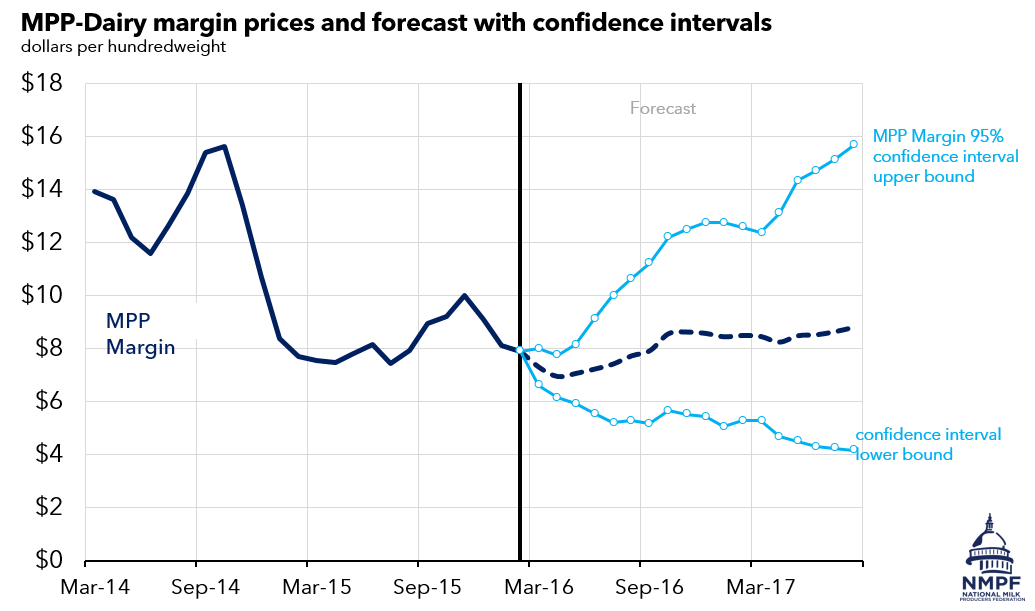
The USDA Farm Service Agency announced last week that the Margin Protection Program’s milk-over-feed cost margin for August was $9.26 per hundredweight, which, taken together with the July margin of $7.59, gives a two-month average of $8.42 per hundredweight –above the $8 threshold for program payouts.

Current forecasts using USDA’s MPP decision tool suggest that the margin will be above $8 per hundredweight during the remainder of 2016 USDA’s MPP margin forecasts are updated daily.

Dairy farmers have from now until Dec. 16 to enroll in MPP for coverage in 2017, or to change their coverage level if they are already participating. NMPF’s Future for Dairy website offers a variety of educational resources to help farmers select the desired coverage level.

Vilsack Explains USDA Actions to Help Dairy Farmers as NMPF Works on MPP Changes

The economic challenges facing America’s dairy farmers – and what more can be done to help farmers in the future – were among the main topics of discussion last month at a Senate Agriculture Committee hearing on the state of the farm economy.

At the hearing on Sept. 21, Agriculture Secretary Tom Vilsack was asked a variety of questions about the steps USDA has taken to help dairy producers as they deal with a second year of depressed milk prices. In addition to explaining USDA’s recent cheese purchase, Vilsack cited the actions USDA has taken to make NMPF-recommended improvements to the Margin Protection Program (MPP). These improvements include extending the annual sign-up periods, conducting farmer education initiatives and adjusting the program’s coverage levels to ensure producers get the maximum coverage during catastrophic periods while enabling them to choose their protection level between $4-$8.

Vilsack was also asked about MPP’s feed-cost adjustor, which he indicated would need to be addressed by Congress. That same message was delivered to the House Agriculture Committee earlier this year, when NMPF Chairman Randy Mooney testified before the House Committee on Agriculture and asked lawmakers to revisit the reduction in the MPP feed calculation in the 2014 farm bill. If the original feed adjuster NMPF proposed were to be reinstated, the program would better reflect actual producer feed costs and provide more effective coverage. Also in his testimony, Mooney strongly stated that MPP is the right program for dairy’s future and that NMPF would continue to work with both Congress and USDA to ensure that the program better meets its intended goals.

Avoiding a Collision

Any trip to a supermarket or restaurant these days would suggest that many safe, effective, science-based and common practices in agriculture are on a collective collision course with expectations down the food chain about how food “ought” to be produced.  That clash is what led to the new federal law on the disclosure of GMOs in food products.  The same pressures are being felt when it comes to how livestock are handled and housed, as companies move to source cage-free eggs and stall-free pigs.

If that weren’t enough, we also are facing another clash between how farmers strive to maintain healthy herds and flocks, and some consumers’ demands that no antibiotics be used – ever – in raising animals. We in the dairy industry need to be proactive and vigilant about this issue, because despite our long and proud history of judicious antibiotic use in dairy, both regulatory pressures and marketplace demands threaten to restrict the tools available on the farm.

The spread of bacteria resistant to one or more antibiotics is clearly a public health concern.  According to the Centers for Disease Control and Prevention (CDC), in the United States alone, at least 2 million people become infected annually with bacteria that are resistant to at least one antibiotic. An estimated 23,000 people die each year as a result.  Health officials are concerned that new antibiotics are not being introduced as quickly as antibiotic-resistant germs are spreading – which represents another type of collision.

Just last month, the United Nations held a high-level summit to find new ways to battle the rise of antibiotic-resistant bacteria.  Even though the science is at best unclear about the contribution played by farm antibiotic use, there was a clear international consensus at the New York meeting that reducing the use of antimicrobial drugs in agriculture should be a major public health goal to slow the spread of antibiotic-resistant germs.

That sentiment, which has been growing for some time, has already prompted changes in U.S. drug regulation.  Starting three months from now, farmers will have to comply with new limits on how they feed antibiotics to their cattle, pigs and poultry.  The use of medicated feed will need to be supervised by a veterinarian, who must write a prescription for a farmer to follow.  And the use of any shared-class drugs (meaning antibiotics used in human as well as animal medicine) for growth promotion is no longer permitted.

For dairy farmers, the advent of this new Veterinary Feed Directive will not have a major impact because of the way we use antimicrobials.  Most of the current uses of antibiotics in dairy farming are therapeutic, meaning they treat or prevent a specific disease. They are not used to make animals grow faster or larger.  The biggest impact will be felt by poultry producers, who are already scrambling to eschew any use of antibiotics because major foodservice brands are wanting to use the “no antibiotics ever” pledge for their offerings.

Such an expectation on the cattle side, however, would create a serious collision between what farmers know is best for the health of their animals, and what food marketers want to promote as an absence claim.  While chickens live relatively short lives before they are harvested, the life cycle for a dairy cow is much longer — measured in years, not weeks. At some point in their lives, many dairy animals – just like humans – will need antibiotic therapy to treat an infectious disease.  Withholding that treatment could shorten the life of the animal, prolong its suffering, and possibly spread the disease further in the herd.  The judicious use of antibiotics is always about weighing treatment options. But treatment is not optional if saving the life of a cow is the goal.

The dairy sector has an exemplary track record on the proper stewardship of antibiotics.  Routine testing of every tanker load of milk, supported and enforced by the industry, state and federal authorities, helps eliminate the possibility of any antibiotic residues in retail dairy products.  In the past five years, the FDA has sampled more than 200,000 retail dairy products, and not one has tested positive for antibiotics. 

To build on that record, NMPF’s National Dairy FARM program places a specific emphasis on ensuring that farmers have a relationship with a veterinarian, so that proper antibiotic use is supervised.  NMPF recently cosponsored a day-long education session at a national veterinarian’s meeting to deepen the relationship between dairy farmers and their veterinary providers. And the FARM program offers a manual on how producers can avoid drug residues when they do use antibiotics.

Woven throughout all of NMPF and the dairy community’s efforts on this front is the notion that we must communicate with both customers and consumers all that’s being done. There is a real and understandable concern about the danger of antibiotic resistance. But that cannot, from an animal welfare perspective, mean that we eliminate the use of antibiotics to prevent and control disease. Rather, we must continue to communicate, collaborate, and explore new technologies that advance animal health and reduce the need for antibiotics.