U.S. Dairy Leaders Promise Steadfast Commitment to Mexico

MEXICO CITY –The leaders of three major U.S. dairy organizations Wednesday promised to continue a strong commitment to their time-tested partnership with Mexico’s dairy industry and consumers.

“We have always seen Mexico as a partner first and a customer second,” U.S. Dairy Export Council (USDEC) President and CEO Tom Vilsack told Mexican dairy leaders attending the National Dairy Forum in Mexico City. “That’s why we intend to continue working with you and your industry to expand the consumption of dairy products in a way that benefits both countries.”

“Mexico is our friend, ally and most important trading partner,” said Jim Mulhern, President and CEO of the National Milk Producers Federation. “Our goal this week in visiting Mexico is to communicate our steadfast commitment to our partnership with the Mexican industry, even as we continue to explore ways to deepen that relationship by working on issues of mutual benefit.”

“The United States proudly provides the majority of imported dairy products to Mexican consumers,” said Michael Dykes, D.V.M., President and CEO of the International Dairy Foods Association, which represents dairy food companies and their suppliers. “We strongly believe that it’s in the best interest of both countries to preserve and enhance our excellent trade relationship, now and in the future.”

Vilsack and Mulhern spoke at the Femeleche conference here, which brought together Mexican dairy industry leaders, farmers and government officials. As part of the coordinated message of collaboration and partnership with Mexico, the three CEOs of the leading U.S. dairy policy organizations are also meeting with a variety of government officials, including the Mexican Minister of Agriculture and the U.S. Ambassador to Mexico.

The reassurance from U.S. dairy leaders comes during a time of political uncertainty on both sides of the border.

Since NAFTA became law in 1994, U.S. dairy exports to Mexico have more than quadrupled to $1.2 billion. That makes Mexico the U.S. dairy industry’s No. 1 export market, accounting for nearly one-fourth of all U.S. dairy exports last year.

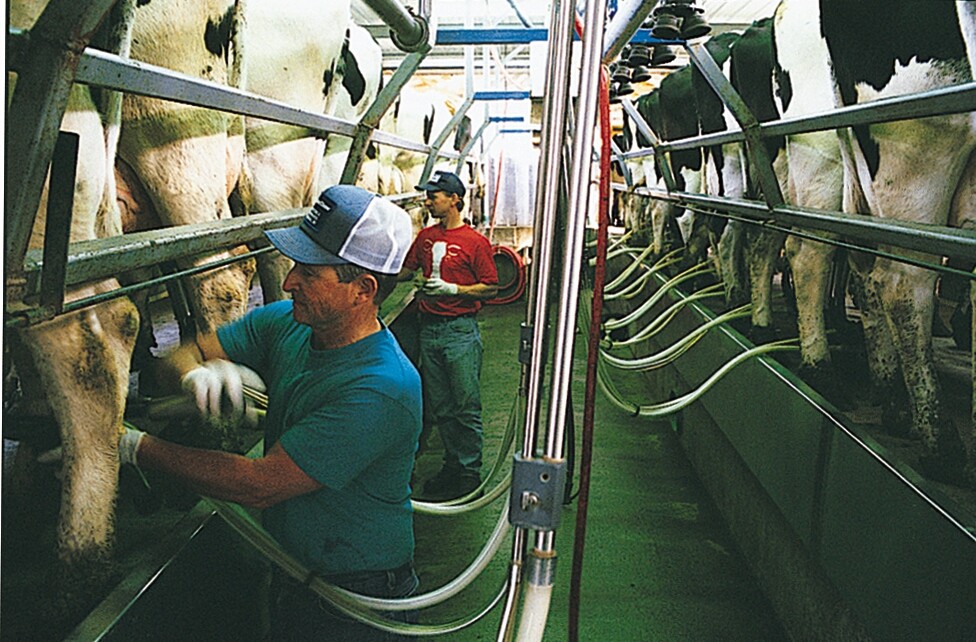
Put another way, exports to Mexico require the milk of 345,000 American cows. They create approximately 30,000 U.S. jobs, according to USDA, and $3.6 billion in U.S. economic impact.

###

The National Milk Producers Federation (NMPF), based in Arlington, Va., develops and carries out policies that advance the well-being of U.S. dairy producers and the cooperatives they collectively own. The members of NMPF’s cooperatives produce the majority of the U.S, milk supply, making NMPF the voice of dairy producers on Capitol Hill and with government agencies. For more on NMPF’s activities, visit www.nmpf.org.

The U.S. Dairy Export Council (USDEC) is a non-profit, independent membership organization that represents the global trade interests of U.S. dairy producers, proprietary processors and cooperatives, ingredient suppliers and export traders. Its mission is to enhance U.S. global competitiveness and assist the U.S. industry to increase its global dairy ingredient sales and exports of U.S. dairy products. USDEC accomplishes this through programs in market development that build global demand for U.S. dairy products, resolve market access barriers and advance industry trade policy goals. USDEC is supported by staff across the United States and overseas in Mexico, South America, Asia, Middle East and Europe.

The International Dairy Foods Association (IDFA), Washington, D.C., represents the nation’s dairy manufacturing and marketing industries and their suppliers with a membership of nearly 525 companies within a $125-billion a year industry. IDFA is composed of three constituent organizations: the Milk Industry Foundation (MIF), the National Cheese Institute (NCI) and the International Ice Cream Association (IICA). IDFA’s nearly 200 dairy processing members operate more than 600 manufacturing facilities and range from large multi-national organizations to single-plant companies. Together they represent more than 85 percent of the milk, cultured products, cheese, ice cream and frozen desserts produced and marketed in the United States. Visit IDFA at www.idfa.org.

MARCH 7 – NMPF Recommends Changes to Margin Protection Program to Make It Viable Safety Net for Farmers

ARLINGTON, VA – The National Milk Producers Federation Board of Directors today unanimously approved a series of recommended changes to the dairy Margin Protection Program (MPP) that will restore several key elements first proposed by NMPF during development of the 2014 Farm Bill. These changes to the MPP will ensure an effective safety net for the nation’s dairy farmers – if the recommendations are adopted by Congress.

Farmers Need Solution to Immigration Challenge

Too many of the nation’s dairy farmers are facing an ongoing, daunting challenge: finding enough American workers to fill jobs on their farms, even when they provide wages higher than those paid by other local jobs.  This “between a rock and hard place” dilemma has grown more acute as the national unemployment rate has dropped – and will likely get even more dire, now that U.S. Immigration and Customs Enforcement has begun stepping up its efforts to locate and remove undocumented individuals.

That’s why NMPF has continued to drive home the point with lawmakers that it is critical that any effort to solve the immigration quandary will require not just additional law enforcement, but also a means to ensure that farm employers – including dairy operations – have access to a legal, secure workforce.

This is not a new problem, nor is it limited to just a few large dairies in certain parts of the country.  To illustrate the extent of the concern, NMPF twice worked with economists at Texas A&M during the past decade to assess the role played by foreign-born workers in dairy production – and the potential consequences of not having those employees. In its most recent national survey, the university researchers estimated that 150,000 employees worked on U.S. dairy farms as of 2014, and that approximately 51 percent of them were immigrants.

Because such a large volume of milk production depends on them, losing even just a portion of foreign-born undocumented workers would have serious implications for both farmers and consumers. In the worst-case scenario, a complete loss of immigrant labor in dairy farming could cut U.S. economic output by $32 billion, resulting in 208,000 fewer jobs nationwide.  Not only would farm workers be lost, but those further down the value chain whose jobs are tied to crop, produce and livestock production would be at risk.

The current environment is filled with a great deal of uncertainty and confusion about the scope of the recent, stepped-up enforcement actions. I received a note last month from a farmer in the Midwest who, after hearing of workers being deported from farms in her state, expressed her growing level of concern:

“Our employees are very jittery. We’ve coordinated driving to grocery stores and outlined ‘safe’ roadmaps (county & town roads) to get to the dentist, doctor and grocery store. They’ve gotten their papers in order if they are deported so that their children can be taken care of.  They are scared, frustrated, and a little angry. We as dairy farmers are too.”

Recognizing that the absence of a workable immigration policy is a threat to the economic viability of dairy farms, NMPF continues to work with elected officials on implementing a policy solution that adhere to two key principles:

1. Providing an affordable and efficient guest-worker program that ensures the continued availability of immigrant labor for all of agriculture, including dairies; and

2. Permitting those currently employed or with employment history in the U.S. to earn the right to work here legally, regardless of their current legal status.

Our point to elected officials is that, as important as border security and interior law enforcement procedures are, such measures must be paired with a focus on current and future agricultural labor needs.  Creating a guest-worker program to bring in legal employees will allow federal and state governments to focus resources on removing bad actors from the U.S., and prevent the migration of others who are not coming here for legitimate work opportunities.

The only current means of addressing domestic labor shortages in agriculture is the H-2A temporary and seasonal foreign agricultural workforce program, intended to help employers with short-term labor needs.  Many jobs in farming and food processing are not seasonal and thus can’t use the H-2A program at all – which is why dairy farmers need another approach, not one centered on reforming H-2A.

Farm and ranch groups have collaborated in the past in formulating ideas for a new national visa program that can provide a legal source of foreign-born workers to farm employers.  And we continue to reach out to the Administration and Congress in support of workable policies to control our borders and provide a stable workforce. Agriculture in America can’t grow without a reliable workforce. Immigrant workers are an essential part of that picture today, and they must be part of it in the future. This is a message we will continue to advance so that agriculture can help grow its contributions to America’s economy.

FARM Program Launches New Website, Training Materials

The National Dairy FARM Program released more resources in February to help farmers train their employees in quality animal care – and to better educate consumers about the proper care being taken of cows on America’s dairy farms.

The FARM program website has been updated to feature more technical information and training materials for all three silos of the program: Animal Care, Antibiotic Stewardship and Environmental Stewardship. Each component has its own page containing frequently asked questions, technical resources and background information. This is to better help consumers find relevant information on any part of the program.

Because FARM Animal Care Version 3.0 requires annual employee training, the program is expanding its collection of educational resources. This includes a stockmanship training video, in partnership with the National Beef Quality Assurance program, that is now available on the FARM Program website. The first video in the FARM training series focuses on cattle flight zones, points of balance and tools to utilize when moving cattle. It will eventually also be offered in Spanish.

The program is also hosting a new training course for evaluators and evaluator trainers on April 25-26 in Grand Rapids, Mich. Registration is now open.

CWT February Assistance Totals 6.5 Million Pounds of Dairy Exports

Cooperatives Working Together member cooperatives gained 44 contracts in February to sell 6.54 million pounds of cheese and 52,360 pounds of butter to customers in Asia, Central America, the Middle East, North Africa and Oceania. The product will be shipped from February through May 2017.

These CWT-assisted transactions will move the equivalent of 132.12 million pounds of milk on a milkfat basis to customers in 11 countries on five continents.

Assisting CWT member cooperatives gain and maintain world market share through the Export Assistance program in the long-term expands the demand for U.S. dairy products and the U.S. farm milk that produces them. This, in turn, positively impacts all U.S. dairy farmers by strengthening and maintaining the value of dairy products that directly impact their milk price.

The amounts of dairy products and related milk volumes reflect current contracts for delivery, not completed export volumes. CWT will pay export assistance to the bidders only when export and delivery of the product is verified by the submission of the required documentation.

All cooperatives and dairy farmers are encouraged to add their support to this important program. Membership forms are available on the CWT website.

NMPF Backs CFTC Decision Not to Limit Dairy Futures Contracts

NMPF has endorsed a recent decision by the Commodity Futures Trading Commission not to propose position limits on Class III milk futures, options and equivalent swaps contracts. The CFTC rule is a victory for dairy farmers and cooperatives using risk management tools, and the latest development in a multi-year process through which the Commission is attempting to further regulate speculative activity in futures markets by limiting the positions any individual party could take in such contracts.

In a response to provisions of the Dodd-Frank Act to regulate speculative activity in futures markets, the CFTC proposed limits in 2013 for Class III milk and 27 other physical commodity contracts. At that time, NMPF, several of its member cooperatives and others in the dairy industry argued that such limits would reduce the effectiveness of Class III contracts for dairy farmers.  National Milk said the proposal would diminish the liquidity needed in dairy futures contracts and make it more difficult for NMPF’s cooperatives to offer risk management programs for their members.  In such programs, cooperatives take offsetting, non-speculative Class III milk futures positions on often sizeable volumes of member milk production.

NMPF also argued that, in contrast to delivery-settled futures contracts, position limits were less appropriate for dairy futures contracts, which are cash-settled to a USDA announced price, and in which open interest positions remain high through contract expiration, thus making the risk of distorting speculative activity very minor.

The Commission cited this earlier push-back from NMPF and dairy groups as a key reason for its recent decision to defer imposing limits on Class III milk and two cash-settled contracts for other animal agriculture commodities. However, CFTC declined to exempt cash-settled contracts altogether, and indicated it would revisit the issue of position limits on such contracts at some future time.

In its recent comments to the CFTC, NMPF again argued that there is little reason to impose limits on dairy futures contracts, and it will continue to argue to this effect in response to any future Commission proposals on the issue. The CME exchange has rules that are adequate to guard against any distorting speculative activity in dairy futures contracts, NMPF said.

MPP Margin Above $11 in January

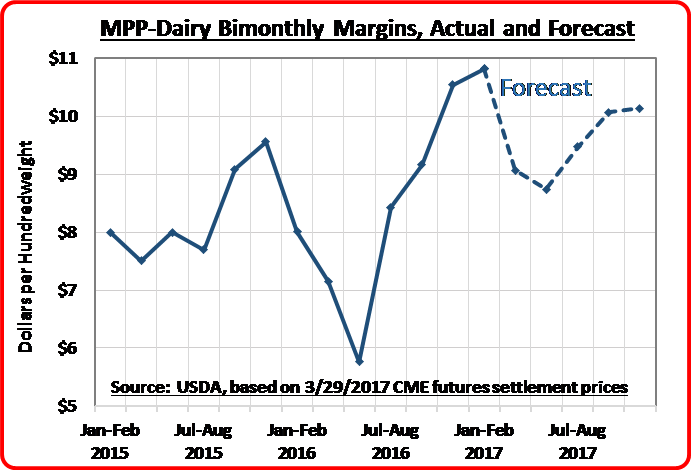
The U.S. average all-milk price rose $0.10 a hundredweight in January to $18.90 per hundredweight, as reported by USDA’s National Agricultural Statistics Service (NASS). NASS also said the ingredient prices in the MPP monthly feed cost were $7.84 per hundredweight, generating a monthly margin of $11.06 per hundredweight. The January MPP margin was down $0.04 a hundredweight from the December margin.

USDA’s current MPP margin forecast, based on the March 3 CME futures settlements, projects the margin will remain above $9 per hundredweight during most of 2017. However, this forecast has been dropping in recent weeks, and the department now projects a 25-percent probability that the margin will fall somewhere below the $8-per-hundredweight coverage level during both the May-June and the July-August bimonthly periods. USDA’s MPP margin forecasts are updated daily online.

NMPF’s Future for Dairy website offers a variety of educational resources to help farmers make better use of the program.

NMPF Challenges FDA’s Hazard Analysis Guidance

In late February, NMPF challenged a number of flaws in FDA’s Hazard Analysis and Risk-Based Preventive Control for Human Food Draft Guidance for Industry, also known as the Preventive Control for Human Food rule, under the Food Safety Modernization Act (FSMA).

In the guidance, the U.S. Food and Drug Administration (FDA) identified hazards that the dairy industry should consider when developing food safety plans, as required by the rule. NMPF replied that FDA’s definition of a “hazard” includes consideration of the severity of a potential injury or illness, as well as the probability that one will occur. FDA listed many hazards that NMPF argued would not result in an injury or illness or had little to no probability of occurring.

FDA identified drug residues in dairy products as a chemical hazard that should be considered when conducting a hazard analysis. NMPF challenged this concern, pointing out that the dairy industry tests approximately 99 percent of the raw milk supply for beta-lactam residues. Last year’s national survey of milk tankers found that only 0.011 percent tested positive, while the testing of retail-ready dairy products found zero residues. In addition, a review of the scientific literature failed to identify any allergic reaction to drug residues in milk. FDA also identified lactose as a potential hazard, and suggested allergen labeling as a form of preventive control. However, lactose is not an allergen and therefore would not trigger an allergic reaction. NMPF asked for that section of the guidance to be redrafted to avoid confusing consumers about the distinction between milk protein allergies and lactose intolerance.

However, NMPF did concur with FDA that pathogens in raw milk are a hazard that should be addressed, which is why milk and dairy products are pasteurized and raw milk sales should be restricted.

In a second set of comments on the guidance, NMPF pointed out that the product categories were inappropriately named. NMPF argued that for the sake of consistency, clarity, and to avoid consumer confusion, the names of non-dairy alternatives should reflect federal standards of identity. NMPF requested the names for some products to be changed to rice or soy “beverage” and “soy-based frozen dessert,” or else include the word “imitation.” NMPF will continue to argue for proper use of standardized dairy terms. 

NMPF Welcomes President Trump’s Executive Order to Roll Back Waters of the U.S. Rule

National Milk praised the Trump Administration in late February for its decision to begin rolling back the controversial Waters of the U.S. (WOTUS) rule, which expanded federal authority over certain waters and led to widespread concern from farmers about its ambiguity and potential for serious regulatory overreach.

“President Donald Trump’s decision today to rescind the Waters of the U.S. regulation is a welcome development for the nation’s dairy farmers, who have been concerned by the continuing lack of clarity and certainty generated by this policy,” said NMPF President and CEO Jim Mulhern in a statement. “This action signals that the Trump Administration recognizes we need to go back and rethink the entire process that led us to this point.”

The original WOTUS regulation, proposed in April 2014 by the U.S. Environmental Protection Agency (EPA) and the U.S. Army Corps of Engineers, included “navigable” waters, but was later expanded to include upstream waters and streams, which farmers often use for drainage and irrigation. NMPF was not satisfied with the EPA’s first attempt to develop the regulation, and supported efforts to halt its implementation. WOTUS has since been tangled up in litigation, with numerous lawsuits filed against the EPA by states and industry stakeholder groups. On Oct. 9, 2015, the U.S. Court of Appeals for the Sixth Circuit ordered a nationwide stay of implementation, and earlier this year, the U.S. Supreme Court halted it indefinitely to determine which courts have jurisdiction over the matter.

Trump’s executive order provides the opportunity to rewrite the regulation, Mulhern said, adding that NMPF and the dairy industry will work with EPA and Army Corps of Engineers to find a solution that maintains a healthy ecosystem while protecting farmers from regulatory confusion.

He said: “Clean water is central to healthy ecosystems, safe water supplies for human and animal consumption, and to the production of milk and other dairy products.”

NMPF Raises Concerns over Abuse of Food Names, Dietary Policy with U.S. Trade Representative

NMPF told government trade officials last month that Europe’s restrictions on the use of common food names are a continuing problem that needs attention from trade negotiators. NMPF shared comments with the U.S. Trade Representative’s (USTR) office as the USTR solicits information for an annual report identifying trade barriers to U.S. companies and products due to intellectual property laws in other countries.

National Milk told USTR that geographical indications – restricting the use of certain common names to certain parts of the world – is an abuse of intellectual property rights. NMPF endorsed a detailed, 25-page submission filed by the Consortium for Common Food Names cataloguing the European Union’s (EU) efforts to unjustly block U.S. companies from continuing to sell their American-made products using a variety of common food terms. NMPF said the EU’s actions are leading to harmful impacts on American companies, and bans on what types of products they can freely sell in a variety of countries around the world. NMPF said these results “are not collateral damage of the EU’s GI policy agenda. Rather, they are the express intent of the way in which the EU has pursued its GI agenda.” 

In addition to protesting EU common food name efforts, NMPF expressed concerns to the USTR about the World Health Organization’s (WHO) food marketing guidelines for young children, developed last year. NMPF mounted a campaign in 2016 to protest WHO’s “Guidance on Ending the Inappropriate Promotion of Foods for Infants and Young Children” because it could have negative impacts on children, and was developed through a non-transparent process that did not fully address WHO members’ concerns.

NMPF noted that “[S]everal countries are poised to implement all or parts of the Guidance, without evidence it will improve nutrition for infants and young children. The text of the Guidance document runs contrary to long-standing dietary guidance issued by the WHO, the UN Food and Agriculture Organization (FAO), and national governments recommending that milk and other dairy products can contribute to a healthy, balanced diet for young children.”

NMPF urged USTR to “ensure that countries are not undermining child nutrition by imposing restrictions on milk and other nutritious dairy products and are abiding by their international commitments on trade and intellectual property.” NMPF will continue to champion the critical role that milk and other dairy products play in ensuring that children over age 1 are getting adequate nutrition and the best start in life, in keeping with pediatricians’ and nutritionists’ recommendations.

NMPF’s Focus on NAFTA: Fix What’s Broken, Preserve What’s Not

As informal talks began among the United States, Mexico and Canada on the future of the North American Free Trade Agreement (NAFTA), NMPF told government officials last month that the countries should preserve elements of the pact that are working well, while focusing on the parts of the relationship that are broken – especially trade with Canada.

NMPF used the important opportunity of Canadian Prime Minister Justin Trudeau's visit to the U.S. last month to shine a brighter spotlight on the need to tackle trade issues with Canada. Following NMPF's request, House Speaker Paul Ryan (R-WI) raised the matter during meetings in February with Trudeau and Foreign Minister Chrystia Freeland. Ryan had shared U.S. dairy industry concerns about the importance of breaking down trade barriers and improving market access for America's dairy farmers during these meetings.

Ignoring U.S. concerns, however, Canada last month began implementing its new Class 7 dairy pricing policy, part of its National Ingredients Strategy. The new policy will harm bilateral trade with the United States and dump large amounts of milk powder onto global markets, despite Canada’s trade obligations to limit those practices. NMPF continues to call on Canada to be more transparent on the new program’s details, while also asking Trump to urge Canada to roll back this harmful policy because of the negative effect it will have on American farmers, manufacturers and dairy plant workers.

At the same time, NMPF is working to maintain access to the United States’ largest export market. NMPF President and CEO Jim Mulhern will travel to Mexico this month to speak at a major Mexican dairy industry conference and hold meetings with various members of the Mexican industry and government. U.S. Dairy Export Council President and CEO Tom Vilsack, and International Dairy Foods Association President and CEO Michael Dykes, DVM, will join Mulhern for these joint discussions. NMPF will reiterate its commitment to the U.S.-Mexico dairy industry relationship, further strengthened through the U.S.-Mexico Dairy Alliance created last year.

NMPF Legislative Push Builds Support for DAIRY PRIDE Act

NMPF is continuing to build grassroots support for legislation that would finally rectify the long-standing misuse of dairy-specific terms on plant-based alternatives that are hijacking the term “milk,” despite their inferior nutritional offerings. To rally support from dairy farmers, NMPF is providing its members with legislative action alerts, news articles, infographics and other materials to garner additional support for two bills that would remedy this problem.

In January, Sen. Tammy Baldwin (D-WI) introduced the DAIRY PRIDE Act (DPA) – followed shortly by a companion bill in the House of Representatives sponsored by Reps. Peter Welch (D-VT), Mike Simpson (R-ID) and Sean Duffy (R-WI) – requiring the U.S. Food and Drug Administration (FDA) to enforce the long-standing rule that anything labeled “milk” must come from an animal source. NMPF argues that FDA’s inaction on standardized labeling terms leads consumers to believe that plant-based alternatives are nutritionally similar and thus acceptable substitutes for real milk.

In the last three months, dairy standards of identity have been thrust into the national spotlight, starting with a letter sent in December 2016 by a bipartisan coalition of Congress members asking FDA to enforce the long-standing standard of identity for milk and other dairy products. Both the Senate and House bills followed the next month.

To help spur support from farmers, NMPF created a user-friendly letter on the Legislative Action Center page of its website that allows individuals to send a note of support for the DPA to their House and Senate members. NMPF President and CEO Jim Mulhern has advocated the cause in interviews with the Wall Street Journal, Associated Press and New York Times. In late February, he submitted an op-ed to The Hill, in which he argued for why the DPA is important to consumers and farmers alike.

“From a nutritional standpoint, the stakes for consumers are high,” he said. “It is misleading for these highly processed products to be marketed as something they are not: a consistent package of nine essential nutrients like the one found in milk. FDA needs to step up and do its job. These bills will force the agency to finally take action.”

NMPF has also created a series of colorful graphics on Facebook and Twitter that promote the DPA.