NMPF Opens New Phase of Fake-Milk Debate With “Road Map” Petition on FDA’s Next Steps

The National Milk Producers Federation opened the next phase of the battle against fake milk on Feb. 21, submitting a citizen petition to the U.S. Food and Drug Administration outlining a road map for the agency as it considers more than 14,000 comments on what to do about milk imposters that are attempting to flood the marketplace.

The petition argues that the use of standardized dairy terms such as “milk,” “yogurt,” “cheese,” “ice cream” and “butter” in the statements of identity for non-dairy plant-based substitutes “falsely implies that the non-dairy substitutes are equivalent to and interchangeable with standardized dairy foods.” They also fail “to disclose the material facts concerning how these non-dairy substitutes differ from standardized dairy foods or adequately distinguish non-dairy substitutes derived from different plant sources,” according to the petition.

“The FDA comment docket gave us the chance to explain why there is a compelling need to resolve this labeling issue to address consumer confusion over nutritional content,” said National Milk Producers Federation Executive Vice President Tom Balmer. “This petition lays out a constructive solution to the false and misleading labeling practices existing in the marketplace today, and provides clear, truthful and understandable labeling options for marketers of plant-based imitation dairy products.”

The NMPF petition notes that any manufacturer not wishing to use modifiers such as “imitation,” “substitute” or “alternative” may simply eschew the use of dairy terms altogether – an approach that’s already common in the rest of the world and practiced by some companies in the U.S. including Chobani, Trader Joe’s and Quaker.

NMPF also addresses First Amendment arguments that have been raised by opponents, via a thorough discussion of relevant case law on commercial speech rights. Beginning with the landmark Central Hudson Gas & Electric Corp. v. Public Service Commission and running through more recent decisions such as Zauderer and American Meat Institute vs. USDA, the petition explains how NMPF’s proposed solutions focus on disclosure requirements narrowly tailored to improving labeling transparency and promoting informed consumer choice – and are emphatically not a “ban” on the use of dairy terms by plant-based products.

“Our approach does not advocate for any so-called “bans,” Balmer said. “It simply relies on proper disclosures that allow for appropriate, truthful, non-misleading messaging. In the end, products that are ‘milk-like’ or ‘yogurt-like’ are not actual milk or yogurt – and the nutritional distinctions are critical to informed consumer decision-making. That’s what our petition is all about.”

FDA opens new docket

The NMPF petition was filed in the wake of the agency’s request for public comment on related issues that closed on January 28, 2019.  While many of those comments were strongly anti-dairy, they delivered very little substance, in contrast with pro-dairy comments from organizations including the American Academy of Pediatrics, which noted that:

Pediatricians report that using the term “milk” in the labeling of dairy-free alternatives has caused parental confusion, leading to the purchase of products that they assume contain traditional dairy ingredients and, thereby, unintentionally causing harmful nutritional deficiencies in their children.

The comments filed by the dairy industry and others on the other hand were substantive and clearly showed that consumers are confused about the nutritional inferiority of plant-based substitutes and that there is ongoing public health harm as a result.

In response to the NMPF petition, FDA will has opened a docket, FDA-2019-P-0777, to accept feedback from the regulated community and interested stakeholders. The docket can be found at: https://www.regulations.gov/docket?D=FDA-2019-P-0777. NMPF urges stakeholders to comment on the docket, ensuring that the agency continues to pay attention to this crucial consumer issue.

NMPF Helping USDA Implement Farm Bill, Step by Step

USDA Secretary Sonny Perdue’s Feb. 26 announcement of a June 17 signup start for the new Dairy Margin Coverage program has galvanized NMPF efforts to aid members in understanding the new plan as farmers begin to decide how to best incorporate much-needed – and much-improved — assistance into business planning.

In hearings before the House and Senate agriculture committees, Secretary Perdue set the following key dates for dairy-program implementation:

  • March 18 – Producers locked out of the Margin Protection Program last year because they were already enrolled in Livestock Gross Margin-Dairy policies may begin to retroactively enroll in Margin Protection Program coverage for 2018, pursuant to the program as modified last year by the Bipartisan Budget Act.
  • April 15 – Producers will have access to an updated online decision tool to help evaluate their options under the new Dairy Margin Coverage Program, the successor to the Margin Protection Program.
  • April 30 – Producers will be able to receive to partial refunds of Margin Protection Program premiums pursuant to a farm-bill provision allowing the payback.  Secretary Perdue noted that this provision is happening later than hoped; for the first two years of MPP, producer premium and payment information was recorded by hand rather than electronically, thus creating a need to first re-enter that information electronically.
  • June 17 – DMC signup scheduled to begin.
  • July 8 –DMC payments scheduled to begin, retroactive to Jan. 1.


Perdue and top USDA officials, at NMPF’s urging, have prioritized DMC implementation as part of the farm bill – and indeed, dairy signups rules will be in place before those of crop programs such as the ARC and PLC programs.

NMPF is also engaging key government leaders who have oversight over the process. When the government shutdown ended in late January, NMPF sent a letter to Secretary Perdue urging USDA to quickly open DMC sign-up while allowing producers adequate time for decisions. NMPF also asked the department to conduct aggressive outreach to producers across the country, using multiple mediums to target not only those who had signed up for the previous program, but also those who had not.

NMPF Outlines Dairy-Program Priorities

Those efforts complement NMPF’s own efforts, which include a farm bill resources page on its website and presentations on the importance of the program before producer groups and farm organizations.

NMPF is urging USDA to implement the DMC in a responsive, farmer-friendly manner. This includes:

  • Providing producers with their net premium refunds under the old Margin Protection Program in advance of the DMC sign-up, which will be important in many cases to producers’ sign-up decisions for the future.
  • Showing significant flexibility to producers who have made changes to their production history due to changes in the structure of their operations, especially due to intergenerational farm transfers or cases where farmers have exited the business and later reconstituted as new entities.
  • Allowing producers to pay their premiums in installments, whether they select annual enrollment or the five-year enrollment option.
  • Allocating funding to updating the decision tool and other related producer education efforts.
  • Incorporating high-quality alfalfa hay costs now required of the National Agricultural Statistics Service into the DMC feed cost formula to ensure that the formula more accurately reflects producer costs.
  • Urging USDA to ensure that the Farm Service Agency, which runs DMC, and the Risk Management Agency, which runs the Livestock Gross Margin and Dairy-Revenue Protection programs, are fully coordinated and informed on this point so that producers do not face any hurdles in signing up for both programs – an option now available under the new farm bill — should they choose to.

NMPF looks forward to continuing close engagement with USDA and Congress to ensure prompt, effective implementation of the much-improved dairy safety net and risk-management options.

NMPF Board Meeting Updates Members With Talks From Staff – and Friends

Top policy-makers from Capitol Hill and USDA highlighted the March meeting of the NMPF Board of Directors as the organization’s leaders learned more about implementation of the new Dairy Margin Coverage program and discussed new initiatives in the Farmers Assuring Responsible Management (FARM) program and NMPF’s ongoing efforts to address labeling of fake dairy products.

Richard Fordyce, administrator of the U.S. Department of Agriculture’s Farm Service Agency, updated the Board on   farm-bill implementation on March 4, the first day of the two-day conference Fordyce said he was pleased that dairy programs were on a fast track to implementation while warning about some of the technical barriers to putting initiatives in place, including problems with past MPP record-keeping and the need to quickly create a high-quality decision tool to help farmers make the best decisions for their operations.

“FSA has done a good job of delivering customer service, and we’re going to get better at it,” he said. “Get in, understand the program, get farmers to understand it, not have a lot of glitches, that’s our priority and our goal,” he said, reiterating Agriculture Secretary Sonny Perdue’s promise the previous week to have DMC signup starting June 17, with the first payments to farmers under the new program starting by July 8.

House Agriculture Committee Chairman Collin Peterson (at left, speaking with AMPI chairman Steve Schlangen) spoke to the board at its Monday evening dinner. Praising the program, Peterson said “dairy needed the most help in this farm bill, and I’m pleased we were able to deliver.”

“I wanted to make sure that we had a program that worked, and this program should work for everyone,” including larger and smaller producers, he said. “We’re hoping that we have a good sign-up.”

Wide-ranging efforts

The board meeting featured presentations from NMPF staff on a wide range of issues in which the voice for dairy in Washington serves its members:

  • Emily Yeiser-Stepp, senior director of the FARM program, outlined proposed updates to the FARM Animal Care, now in a public comment period, explaining how FARM will remain the leader in dairy-care standards. Nicole Ayache, sustainability director, updated the group on expansion of the FARM environmental stewardship program and FARM’s development of materials to assist members on workforce development issues;
  • NMPF regulatory chief Clay Detlefsen detailed potential impacts for dairy farmers under a new proposed Waters of the U.S. rule, which NMPF has been reviewing to find opportunities to advance improvements. He also updated board members on the latest phase of the fight against various foods misappropriating dairy terms – the NMPF’s citizen petition outlining a course of action for the FDA to take in resolving the issue;
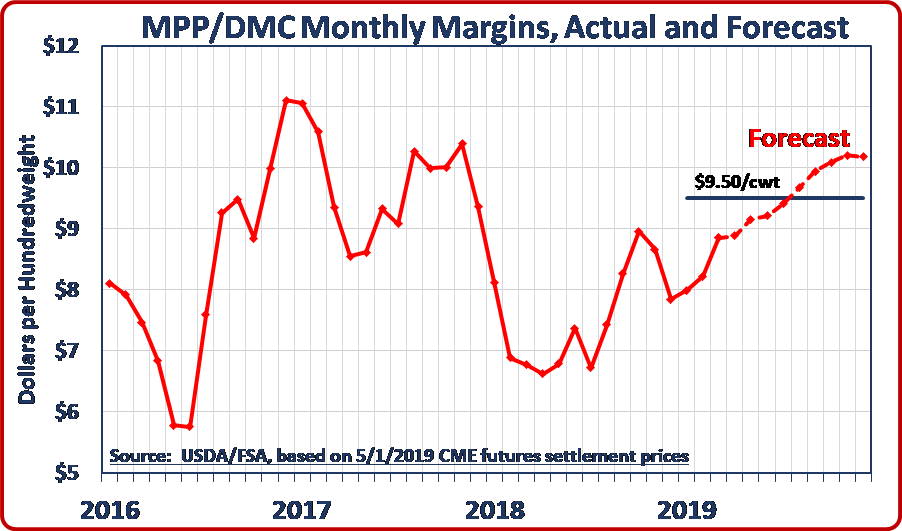
  • Chief economist Peter Vitaliano gave an update on the dairy economy, forecasting a modest price recovery in the second half of the year;
  • Jaime Castaneda, head of policy strategy, and government relations head Paul Bleiberg, , discussed NMPF’s work with USDA on farm-bill implementation and current Capitol Hill challenges, including immigration reform and infrastructure legislation;
  • Shawna Morris, vice president for trade, gave an update on trade talks and turmoil, along with an analysis of the prospects for the U.S.-Mexico-Canada Agreement before Congress; and
  • Jamie Jonker, vice president for sustainability and scientific affairs, discussed antibiotic and animal health issues.

“It’s a great honor to lead this staff,” NMPF President and CEO Jim Mulhern said in his introductory remarks. “As you will hear in these reports, on issue after issue, their depth of knowledge and the dedication they bring is unparalleled here in Washington.”

National Dairy FARM Animal Care Version 4.0 Proposed Standards Available for Comment

The National Dairy Farmers Assuring Responsible Management (FARM) Program, the dairy industry’s on-farm quality assurance program, this week released proposed Animal Care Version 4.0 standards for input from industry stakeholders.

Currently, 98 percent of the U.S. milk supply participates in FARM, an initiative developed as part of dairy’s commitment to producing the highest quality milk with integrity. Its Animal Care Program standards are revised every three years to reflect current science and best management practices.

“The FARM Animal Care comment period is an important opportunity for stakeholders to advance our goal of encouraging the highest standards of animal care and herd management,” said Jim Mulhern, president and CEO of the National Milk Producers Federation. “We are excited to work with industry partners in this next step.”

Standards, rationale, and accountability measures behind the proposal have been reviewed and revised by the FARM Animal Care Technical Writing Group made up of dairy producers, veterinarians, animal scientists and industry personnel. Before being released for comment, the National Milk Producers Federation Animal Health and Well-Being Committee reviewed and provided feedback into the proposed changes.

After the comment period closes on Sunday, March 31st, FARM staff, Technical Writing Group and the NMPF Animal Health and Well-Being Committee will review and consider revisions based upon the comments, then present final proposed standards for approval by the NMPF Board of Directors in June. The FARM Program encourages all those involved in the dairy supply chain to participate. To review proposed standards and provide feedback, please visit https://nationaldairyfarm.com/animal-care-open-comments/.

These draft standards have been proposed for FARM Animal Care Version 4.0. FARM Version 3.0 will remain in effect until December 31, 2019. To learn more, please visit www.nationaldairyfarm.com.


About the National Dairy FARM Program

Open to all U.S. dairy farmers, co-ops and processors, the National Dairy FARM (Farmers Assuring Responsible Management) Program works with dairy farmers, the producer community and industry partners to show customers and consumers that the dairy industry is taking the very best care of cows and the environment, producing safe, wholesome milk and adhering to the highest standards of workforce development. Created by the National Milk Producers Federation in partnership with Dairy Management Inc., FARM helps ensure the success of the entire industry by demonstrating that U.S. dairy farmers are committed to producing the best milk with integrity. FARM is open to all farms, milk processors and cooperatives and program components are guided by their respective advisory groups.

NMPF Supports Wisconsin Effort to Improve Water-Quality Trading

ARLINGTON, Va. – The National Milk Producers Federation (NMPF) is pleased to see that the state of Wisconsin is considering legislation to improve its water-quality trading, applauding a market-based approach to solving environmental challenges.

Senator Robert Cowles, a Green Bay Republican, earlier this week announced new legislation intended to boost Wisconsin’s three water-quality trading programs, leading to more transactions, better use of public and private dollars and noticeable water quality improvements. The bill provides certainty for Wisconsin’s currently underutilized water quality programs and improves access to them, a necessary step to help farms, industry and wastewater treatment plants to work together toward shared water-quality goals at a lower cost.

“The NMPF has long supported market-based approaches to solving environmental challenges, backing efforts in Maryland to create a water quality trading program and legislation in Pennsylvania to create a competitively-bid clean water procurement program,” said Jim Mulhern, president and CEO of the National Milk Producers Federation. “The Wisconsin approach is a proactive attempt to tackle crucial environmental issues of great importance to dairy producers.”

The legislation is consistent the Environmental Protection Agency’s recent update of its water quality trading policy that’s designed to promote market-based mechanisms for improving water quality. The updated policy reiterates EPA’s strong support for water-quality trading and other market-based programs to maximize pollution reduction effort.


The National Milk Producers Federation (NMPF), based in Arlington, VA, develops and carries out policies that advance dairy producers and the cooperatives they own. NMPF’s member cooperatives produce the majority of U.S. milk, making NMPF the voice of dairy producers on Capitol Hill and with government agencies. For more, visit www.nmpf.org.

NMPF “Road Map” Petition to FDA Outlines Next Steps in Dairy-Labeling Rules

ARLINGTON, Va. – The National Milk Producers Federation today filed a citizen petition with the U.S. Food and Drug Administration, outlining a labeling solution to the use of dairy terms on non-dairy products as the agency considers public input from a recently concluded comment period.

The petition reinforces current FDA labeling regulations, with some additional clarification, to show how marketplace transparency can be enhanced and consumer harm from confusion over nutritional content can be reduced. It also addresses several specious arguments raised by marketers of vegan foods as part of the ongoing debate on dairy labeling, such as the false idea that creating consistent, clear labeling of non-dairy products would somehow limit the use of dairy terms on products that clearly aren’t marketed as dairy substitutes, such as peanut butter. (The petition may be accessed here.)

“The FDA comment docket gave us the chance to explain why there is a compelling need to resolve this labeling issue to address consumer confusion over nutritional content,” said National Milk Producers Federation Executive Vice President Tom Balmer. “This petition lays out a constructive solution to the false and misleading labeling practices existing in the marketplace today, and provides clear, truthful and understandable labeling options for marketers of plant-based imitation dairy products.”

In its petition, NMPF urges FDA Commissioner Scott Gottlieb to “Take prompt enforcement action against misbranded non-dairy foods that substitute for and resemble reference standardized dairy food(s) (e.g., milk, yogurt, cheese, ice cream, butter), yet are nutritionally inferior to such reference standardized dairy foods.” Under existing FDA rules, such foods are required to use the word “imitation” if they reference a standardized dairy food but do not have the same nutritional value. The petition also points to long-standing rules that provide for using the words “substitute” or “alternative” in conjunction with a dairy term when such products are deemed nutritionally equivalent to the dairy products they reference.

“Marketers of plant-based foods that are designed to resemble standardized dairy foods actually have several labeling options under current FDA regulations, as we point out in this petition,” Balmer said. “The unfortunate reality today is that many of them are playing fast and loose with the labeling rules to mask their nutritional inferiority to real dairy products.”

The NMPF petition notes that any manufacturer not wishing to use modifiers such as “imitation,” “substitute” or “alternative” may simply eschew the use of dairy terms altogether – an approach that’s already common in the rest of the world and practiced by some companies in the U.S. including Chobani, Trader Joe’s and Quaker.

NMPF also addresses First Amendment arguments that have been raised by opponents, via a thorough discussion of relevant case law on commercial speech rights. Beginning with the landmark Central Hudson Gas & Electric Corp. v. Public Service Commission and running through more recent decisions such as Zauderer and American Meat Institute vs. USDA, the petition explains how NMPF’s proposed solutions focus on disclosure requirements narrowly tailored to improving labeling transparency and promoting informed consumer choice – and are emphatically not a “ban” on the use of dairy terms by plant-based products.

“Our approach does not advocate for any so-called “bans,” Balmer said. “It simply relies on proper disclosures that allow for appropriate, truthful, non-misleading messaging. In the end, products that are ‘milk-like’ or ‘yogurt-like’ are not actual milk or yogurt – and the nutritional distinctions are critical to informed consumer decision-making. That’s what our petition is all about.”

NOTE: NMPF is holding a teleconference TODAY at 1:30 p.m. (EST) to answer questions on its petition. Interested journalists may join by calling 1-888-537-7715. The participant passcode is 61546962 #


The National Milk Producers Federation (NMPF), based in Arlington, VA, develops and carries out policies that advance dairy producers and the cooperatives they own. NMPF’s member cooperatives produce the majority of U.S. milk, making NMPF the voice of dairy producers on Capitol Hill and with government agencies. For more, visit www.nmpf.org.

NMPF Thanks Chobani for Standing Up for Labeling Integrity

ARLINGTON, Va. –  In a letter today to Hamdi Ulukaya, chief executive officer of Chobani, National Milk Producers Federation (NMPF) President and CEO Jim Mulhern thanked the company for supporting transparency in the use of dairy terms on food-product labels, the subject of a recently ended FDA comment period.

“As you state in your company’s comments, ‘The improper – and illegal – use of dairy terms on plant-based alternatives poses a public health risk, in that this terminology may confuse consumers and cause them to displace the nutrients that would otherwise be provided by dairy foods,’” Mulhern wrote on behalf of NMPF. “We at National Milk share your concerns that consumers are being misled over the nutritional content of dairy versus plant-based products, and we appreciate your willingness, as the No. 1 seller of Greek yogurt in the U.S. and the nation’s second-largest yogurt manufacturer, to use your voice to speak out on this issue.”

Mulhern also noted that Chobani follows FDA rules and eschews the use of dairy terms on its non-dairy products, a contrast with competitors that flout proper practices to the detriment of consumers. “We will always strongly advocate for dairy as the superior consumer choice, but we have no objection to the presence of properly labeled plant-based imitators,” Mulhern wrote. “As Chobani is showing, such products can compete on their own merits without misappropriating dairy terms. We wish your example would be emulated by your competitors, including Danone North America, that currently peddle mislabeled products.”

NMPF will host a teleconference with the media at 1:30 P.M. (EST) on Thursday, Feb. 21, outlining the organization’s recommendations for FDA as it considers revisions to regulations regarding the use of dairy terms on labels for plant-based products. This is a time change from a release issued Friday, made due to the likelihood of a winter storm disrupting government operations on Wednesday and Thursday.

For this on-record briefing, interested journalists may call:

Toll-free number: 1-888-537-7715
Participant Passcode: 61546962 #


The National Milk Producers Federation (NMPF), based in Arlington, VA, develops and carries out policies that advance dairy producers and the cooperatives they own. NMPF’s member cooperatives produce the majority of U.S. milk, making NMPF the voice of dairy producers on Capitol Hill and with government agencies. For more, visit www.nmpf.org.

NMPF Accepting Applications for 2019 Scholarship Program

NMPF is now accepting applications for its National Dairy Leadership Scholarship Program for academic year 2019-2020. The deadline to apply is Friday, April 5.

Each year, NMPF awards scholarships to outstanding graduate students (enrolled in master’s or Ph.D. programs) who are actively pursuing dairy-related fields of research of direct interest to NMPF member cooperatives and the greater U.S. dairy industry.

Graduate students pursuing research of direct benefit to milk marketing cooperatives and dairy producers are encouraged to apply. (Applicants do not need to be members of NMPF to qualify.)  The top scholarship applicant will be awarded the Hintz Memorial Scholarship, which was created in 2005 in honor of the late Cass-Clay Creamery Board Chairman Murray Hintz, who was instrumental in establishing NMPF’s scholarship program.

Recommended fields of study include but are not limited to: Agriculture Communications and Journalism, Animal Health, Animal and/or Human Nutrition, Bovine Genetics, Dairy Products Processing, Dairy Science, Economics, Environmental Science, Food Science, Food Safety, Herd Management, and Marketing and Price Analysis.

For an application or more information, please visit the NMPF website or call the NMPF office at 703-243-6111.

NMPF Prepares for the 2019 Conference on Interstate Milk Shipments

In the past few months, NMPF and its NCIMS Committee have engaged in discussions about its participation in the 2019 National Conference on Interstate Milk Shipments (NCIMS) in St. Louis, Missouri.

The conference is a collaborative process by which the states, industry and federal government come together to determine how to best regulate the production of Grade “A” milk and milk products. NMPF has played a key role in the bi-annual conference since its inception.

On April 3 in Arlington, NMPF and members will meet in person to review any proposals for changes to the Pasteurized Milk Ordinance. Proposals were due Feb. 1 – NMPF submitted four. In past conferences, there have been more than 100 proposals up for deliberation.

The conference will take place in St. Louis from April 26-May 1 at the Hyatt Regency St Louis at the Arch. For more information about this year’s conference or NCIMS in general, visit the NCIMS website. For more information about participating in the conference, contact Clay Detlefsen.

Annual FDA Drug Sales and Residue Reports Find Continued Progress

In what has become an annual affirmation of dairy farmers’ commitment to keeping antibiotic residues out of the milk supply, the 2018 U.S. Food and Drug Administration (FDA) report tracking residue levels continued to show a decline in positive drug test results.

Released in late December, the 2018 National Milk Drug Residue Data Base survey found that only 0.010 percent of all bulk-milk tankers – or 1 in 9,900 loads – showed any sign of animal antibiotic drug residues. On-farm vigilance in following drug withdrawal times has led to a steady decline in detectable antibiotic residues, with 2018’s figure falling from an already low level of 0.028 percent in 2008, a decline of over 65 percent in the last decade. All milk loads are tested for antibiotics. Any tanker that tests positive for a drug residue is rejected before entering a dairy plant and does not enter the market for human consumption.

In December, FDA announced that domestic sales and distribution of all medically important antimicrobials intended for use in food-producing animals decreased by 33 percent between 2016-2017. This reduction in sales volume indicates that ongoing efforts to support antimicrobial stewardship are having a significant impact.

CWT Starts Year Strong with 14.7 Million Pounds of Assisted Sales in January

Cooperatives Working Together (CWT) helped member cooperatives secure 60 contracts, resulting in sales of 11.7 million pounds of American-type cheeses, 707,684 pounds of butter and 2.2 million pounds of whole milk powder. The product is going to 38 customers in Asia, Central America, the Middle East, North Africa, Oceania and South America. The product will be shipped during the months of January through July 2019. These transactions will move overseas the equivalent of 140.6 million pounds of milk on a milkfat basis.

Assisting CWT member cooperatives to gain and maintain world market share through the Export Assistance program in the long-term expands the demand for U.S. dairy products and the U.S. farm milk that produces them. This, in turn, positively impacts all U.S. dairy farmers by strengthening and maintaining the value of dairy products that directly impact their milk price.

The amounts of dairy products and related milk volumes reflect current contracts for delivery, not completed export volumes. CWT will pay export assistance to the bidders only when export and delivery of the product is verified by the required documentation.

All cooperatives and dairy farmers are encouraged to add their support to this important program. Membership forms are available online.