NMPF Chairman, President Cite Successes at Annual Meeting

SAN DIEGO, CA – The leaders of the National Milk Producers Federation (NMPF) stood before their members today during NMPF’s 2011 Annual Meeting here this week as they reported on the organization’s progress during the past year.

NMPF Chairman Randy Mooney, along with President & CEO Jerry Kozak, started the joint presentation by discussing NMPF’s most prominent initiative to reform U.S. dairy policy through Foundation for the Future (FFTF), which this fall evolved into the Dairy Security Act (DSA) of 2011 (HR 3062). FFTF began in June 2009 with the creation of a Strategic Task Force instructed to come up with a better safety net for dairy farmers.

Mooney and Kozak stressed that although NMPF has come a long way toward achieving its goal of better dairy policy, there is still more work to be done. “Success is coming up with a better, more innovative way of preventing an economic crisis down on the farm,” Mooney stated. “Ultimately, success in dairy policy reform is working together to get something better than before.”

The initial FFTF provisions were refined after NMPF staff went on the road during the summer of 2011 and presented the proposal to dairy farmers in 12 cities and 11 states across the country. Kozak explained that although the primary purpose of the tour was to speak directly to farmers about the need for dairy reform, it also allowed NMPF staff to listen to farmers’ perspectives. “This gave us an unfiltered insight into the producer community’s view of FFTF,” Kozak said.

The changes that resulted from the summer tour were incorporated into the DSA under the leadership of Congressman Collin Peterson (D-MN), with support from co-sponsor Congressman Mike Simpson (R-ID). Mooney thanked both congressmen for their hard work on the bill and urged all producers to rally behind it.

Although dairy reform was the most visible initiative in 2011, NMPF was busy throughout the year working on other priority issues, which Mooney and Kozak also discussed in their presentation.

The organization worked on several regulatory efforts in 2011, including advocating for a reduction in somatic cell count levels to 400,000 and grappling with the Food and Drug Administration on drug residue violations in dairy animals. A significant regulatory victory came from the Environmental Protection Agency’s final exemption of milk storage from its Spill, Prevention, Control and Countermeasure regulation.

“Reforming immigration policies to address the labor needs of farmers remains a paramount concern for NMPF,” Mooney continued. Although there had not been any significant progress made on immigration in 2011, the issue was getting the attention of Congress through a Senate hearing, the H-2A visa program, and E-Verify.

Mooney and Kozak noted various successes on Capitol Hill, such as minimizing the impact of the estate tax, overturning the proposed tax reporting requirement known as the IRS form 1099, passing three Free Trade Agreements with Colombia, Panama and South Korea, and resolving the trucking dispute that was negatively impacting U.S. cheese exports to Mexico.

NMPF also was pleased to see the final implementation of the promotion checkoff on imported dairy products. “Ultimately, the outcome of this issue is not about equity, but justice for America’s farmers,” Kozak explained.

Annual Meeting attendees learned that Cooperatives Working Together will continue in 2012 and 2013 after the program reached its 70% membership goal this year.

The joint presentation concluded with Mooney and Kozak affirming that NMPF will continue to work on the issues important to its membership. “We won’t settle for mediocrity…We will never settle on anything less than what our members expect,” they said.

The full text from Mooney and Kozak’s joint speech is available on the NMPF website.

The National Milk Producers Federation, based in Arlington, VA, develops and carries out policies that advance the well being of dairy producers and the cooperatives they own. The members of NMPF’s 31 cooperatives produce the majority of the U.S. milk supply, making NMPF the voice of more than 32,000 dairy producers on Capitol Hill and with government agencies.
NMPF’s 2012 Antibiotic Residue Prevention Manual Now Available

Updated Manual, Additional Materials Available Online for Free


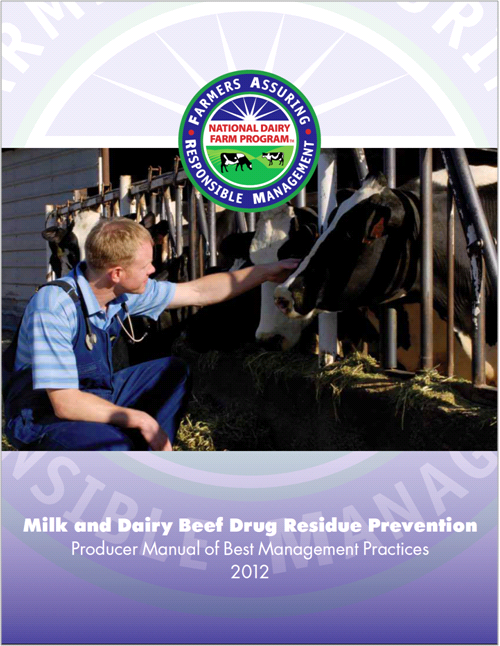
ARLINGTON, VA – The National Milk Producers Federation (NMPF) announced today that it is releasing an updated version of the Milk and Dairy Beef Drug Residue Prevention Manual for 2012. One of the areas of focus for the National Dairy FARM ProgramTM, the residue prevention manual can be found online at www.nationaldairyfarm.com.

The Milk and Dairy Beef Drug Residue Prevention Manual is a concise review of appropriate antibiotic use in dairy animals. The manual is a quick resource to review those antibiotics approved for dairy animals, and also can be used as an educational tool for farm managers as they develop their on-farm best management practices necessary to avoid milk and meat residues. Additions to the 2012 version include a section on meat drug residue testing, an expanded list of products and risk factors for residues, as well as an updated drug and test kit list. The 2012 manual includes a certificate of participation that can be signed by a producer and their veterinarian to demonstrate their commitment to proper use of antibiotics on the dairy.

“The use of antibiotics in livestock is undergoing increased scrutiny, and this manual will help ensure that veterinary treatments are used appropriately,” said Jerry Kozak, President and CEO of NMPF.

The dairy industry is committed to producing safe, abundant, and affordable milk and dairy beef of the highest quality. Healthy animals help make for safe food and disease prevention is the key to keeping cows healthy.

The National Dairy FARM Program was created by NMPF to demonstrate and verify that U.S. milk producers are committed to providing the highest levels of quality assurance including animal care, residue prevention, and other on-farm practices.

The Residue Prevention manual was sponsored by Charm Sciences, IDEXX, and Pfizer Animal Health. No check-off finds were used in the development and distribution of this manual.

For more information on the National Dairy FARM Program, contact Betsy Flores at (703) 243-6111 or log on to www.nationaldairyfarm.com.

The National Milk Producers Federation, based in Arlington, VA, develops and carries out policies that advance the well being of dairy producers and the cooperatives they own. The members of NMPF’s 31 cooperatives produce the majority of the U.S. milk supply, making NMPF the voice of more than 32,000 dairy producers on Capitol Hill and with government agencies.

Regulatory Register Revamped and Available Online

The fall issue of the NMPF Regulatory Register is now available online. This represents a re-launch of the publication, and will resume publication on a quarterly basis.

Highlights from the current issue include:

  • FARM participation now available
  • EPA releases Total Maximum Daily Load for the Chesapeake Bay
  • NMPF discusses Dietary Guidelines report
  • Template available for Spill Prevention Control and Countermeasure plans


Free Trade Agreements Win Congressional Passage

NMPF and the U.S. Dairy Export Council (USDEC) applauded the passage last month by the House and Senate of three free trade agreements (FTAs) with South Korea, Panama and Colombia.

“We wish to thank President Obama and his trade team, and leaders in both houses of Congress, who worked hard in recent months to make these favorable votes possible,” said Jerry Kozak, president and chief executive officer of NMPF.

“The FTAs will expand U.S. dairy exports and, when fully implemented, will create thousands of export-supporting jobs in the dairy industry,” said Tom Suber, president, USDEC. “We hope that all necessary steps can be taken in the coming months by all four countries so that the agreements may enter into force at the beginning of the year and benefits to the U.S. economy can begin to be felt immediately.”

“The U.S. dairy industry stands ready to assist in any way possible to help ensure that the FTAs take effect as soon as possible,” added Kozak. “Our producers are excited about the new export opportunities that will be realized once the agreements take effect, especially the trade pact with South Korea. The export gain for dairy from the Korea FTA in the first few years after implementation will be approximately $380 million per year, on average, and the gains from the Colombia and Panama FTAs will add another $50 million annually.”

Dairy Groups Support Program to Comply with NAFTA Trucking Agreement

NMPF and USDEC hailed the full and complete lifting of retaliatory tariffs by Mexico last month to resolve a lingering cross-border trucking dispute. This action came after the U.S. Department of Transportation (DOT) implemented a pilot program to allow a selected number of Mexican carriers to operate on the U.S. side of the border under strict safety standards.

“These actions mean that dairy products on Mexico’s retaliation list will now be free of the 20-25% tariffs that were restricting access to our best foreign market,” said Tom Suber, president of USDEC. Mexico’s retaliation against a total of $2.4 billion in U.S. exports had come after successfully challenging the U.S. ban on Mexican trucks that has remained in place, despite a 1994 U.S. commitment under NAFTA to lift it.

The DOT pilot program announced in April provided for a 30-day comment period and another period of approximately 30 days to assess the comments received. Subsequently, DOT published a final Federal Register Notice, which outlined the implementation process for the project. Based on this notice, a final agreement was signed by the U.S. and Mexico, and Mexico immediately reduced its retaliatory tariffs on all products by 50%. Removal of the remaining tariffs only awaited today’s Mexico Federal Register announcing the Mexican President’s action of accepting that the first Mexican carrier as eligible to operate across the border.

Farm Bill Negotiations Tied to Supercommittee Budget Process

The leaders of the House and Senate Agriculture Committees in recent days have been negotiating the framework of the next Farm Bill in an effort to limit the amount of money cut from agricultural spending programs by the so-called joint supercommittee, which itself has been negotiating over how to drastically reduce government spending.

A final Farm Bill framework is expected to be presented by the Ag Committee to the supercommittee in the next few days, although the details of that proposal are not available as of press time for this newsletter.

As part of the Farm Bill negotiations, the Ag Committee leaders have looked at the Dairy Security Act as a means to reduce the dairy budget portion of the Farm Bill by 20%, while providing farmers a better safety net. The Dairy Security Act contains the concepts of NMPF’s Foundation for the Future program.

The joint supercommittee has a self-imposed deadline of November 22 by which to find $1.2 trillion in budget cuts over the next decade. If such an agreement can’t be reached, the cuts will come automatically in an across-the-board fashion.

CFTC Issues Improved Final Rule on Position Limits for Futures, Swaps

On October 25, the Commodity Futures Trading Commission (CFTC) approved an improved final rule on position limits for futures and swaps. The rule will impose new limits on the number of future and swap contracts that speculators can hold.

This action is part of the raft of rules that CFTC is writing to implement its part of the Dodd-Frank Wall Street Reform and Consumer Protection Act. The legislation was passed last year in response to the 2008 financial crisis, and swept up many agricultural risk management tools with the riskier and more complicated derivatives that played a central role in that crisis.

Speculators in agricultural markets have long been limited on the size of their positions, in order to prevent market distortion and manipulation. Agricultural hedgers often need to buy or sell more contracts than these limits allow, and hedging exemptions have always been extended to ‘bona fide’ (true) hedgers to meet those needs. Because of this, and because these limits will soon be applied to agricultural swaps, it is very important that CFTC has a broad definition of hedging that allows farmers, their cooperatives and their customers to manage price risks beyond the speculative limits.

When first proposed in January, the position limits rule defined hedging very narrowly, and only identified a limited set of hedging practices as legitimate. NMPF worked with other agricultural groups, all urging CFTC to broaden this definition, and provided detailed comments in support of this position.

The resulting final rule is a considerable improvement over the original proposal, providing much more leeway to conduct legitimate hedging, and providing latitude for CFTC to recognize legitimate new hedging practices.

NMPF was specifically recognized within the rule notice itself for convincing CFTC not to require hedgers to unwind cash-settled future contracts before their final settlement. Under the proposed rule, for example, a cooperative that bought Class III futures contracts to hedge a milk price would have had to sell those contracts at least five days before the Class III price was announced. In the final rule, that restriction is eliminated.

Again, this rule is one of many that CFTC will issue by next summer. NMPF has commented on many of them, and continues to work on these rules to allow the dairy industry ready access to sound risk management tools and effective price discovery. If you have questions or specific concerns, please contact Roger Cryan in the NMPF office.

Until the rule is published in the Federal Register, it can be found on the CFTC website.

USDA Announces Final FY11 REAP Funding

Last week, Agriculture Secretary Tom Vilsack announced the final round of Fiscal Year 2011 (FY11) funding for the Rural Energy for America Program (REAP). The final round will provide funding for 16 anaerobic digesters, an incredible investment in renewable energy production on U.S. dairy farms. Altogether, the program has provided nearly $21 million in assistance for biodigesters, and leveraged over $110 million in total project development in FY11.

Anaerobic digesters are critical tools for dairy farmers to not only produce renewable energy, but also help mitigate environmental challenges. REAP also provides funding opportunities for energy efficiency measures on the farm, which allows farmers to identify and implement measures to reduce their energy use and realize critical savings for their operations.

With lawmakers negotiating strict fiscal limits on Capitol Hill, NMPF has been working diligently to ensure REAP continues to be a well-funded, strong program for the nation’s dairy farmers. Through the appropriations process and the ongoing negotiations of the Joint Select Committee on Deficit Reduction, also referred to as the supercommittee, NMPF has made it a priority to spare the REAP from the cuts sought out by Congress.

EPA Administrator Jackson Calls to Retain Current Dust (PM10) Standards

The Environmental Protection Agency (EPA) said last month that it will not seek to revise the standards for dust, alleviating major concerns for farmers and ranchers throughout the country, especially in the West.

Recently, EPA Administrator Lisa Jackson announced her plans to retain the current National Ambient Air Quality Standards (NAAQS) for coarse particulate matter (PM10). There is still anxiety by some that this announcement is just a slight victory, while the days of farm dust being regulated further by EPA is not too far down the road.

There have been ongoing efforts in Congress to delay or halt EPA from revising the standards. Legislation has been introduced by Rep. Kristi Noem (R-S.D.) and Sen. Mike Johanns (R-Neb.) that would contain EPA’s regulatory overreach, and virtually exempt farm dust from ever being regulated by the agency. A large coalition of agriculture stakeholders, including NMPF, have signed a letter pledging support for Rep. Noem’s legislation (HR 1633).

EPA Proposes to Delay SPCC Compliance Deadline for Farmers

With the compliance deadline rapidly approaching, the EPA has proposed to amend the date by which farms must prepare or amend and implement their Spill Prevention, Control and Countermeasure (SPCC) plans to May 10, 2013. Currently, farmers and ranchers are required to have these plans in place and finalized by Nov. 11, 2011. If there are no adverse comments to the proposed delay, the postponement will come into effect after the 15-day public comment period closes.

It important to note that this does not remove the regulatory requirement for owners or operators of farms in operation before August 16, 2002, to maintain and continue implementing an SPCC plan in accordance with the SPCC regulations then in effect. Also, this amendment does not relieve farms from the liability of any spills that occur while there is not an SPCC plan in place.

For detailed information on the proposed amendment, please visit the Government Printing Office website.

NMPF Chairman Honored with Ag Award

NMPF Chairman Randy Mooney of Rogersville, MO, was given his state’s Governor’s Award for Agricultural Achievement last month, which honors outstanding farmers, growers and processors in a variety of agriculture commodities. Missouri Governor Jay Nixon visited Mooney’s farm M&M Dairy LLC to present the award and tour the facilities.

Mooney, his wife, Jan, and partner Kent Miller milk 300 dairy cows at M&M Dairy, which utilizes an innovative grass-based dairy system. This pasture management system was adopted in 1992, and is designed to maximize forage use by intensively managing plant growth and grazing time.

In addition to his role as chairman of NMPF, Mooney also serves as chairman of Dairy Farmers of America and is active in other various dairy organizations.

Dairy Producers Prepare to Navigate Their Way to San Diego

Members of the dairy industry will be packing their bags next week and heading West to attend the joint annual meeting of NMPF, the National Dairy Promotion and Research Board and the United Dairy Industry Association. The meeting will be held November 14 – 16 at the Town and Country Resort & Convention Center in San Diego, CA, and focus on the theme “Navigating a New Course.”

The activities will begin with a leadership and development program on Monday, November 14 for the Young Cooperators, as well as various board and committee meetings. General programming for all attendees will begin at 9:30 am on Tuesday, November 15th, with NMPF’s Town Hall Meeting, where NMPF staff members will discuss efforts to dramatically reform U.S. dairy policy through Foundation for the Future and the Dairy Security Act of 2011. After the Opening Luncheon, with a presentation by NFL commentator John Lynch, participants will hear from Marci Rossell, a former CNBC chief economist and “Squawk Box” co-host, as well as leading executives from the dairy industry’s policy and promotion groups. The first day will conclude with the annual cheese reception, which will feature the winning entries from NMPF’s cheese competition.

On Wednesday, November 16th, the day will begin with a welcome from Rep. Collin C. Peterson (D-Minn.), the ranking member of the House Agriculture Committee. That will be followed by speakers representing a range of dairy processor, cooperative and promotional organizations. After the Awards Luncheon, the NMPF Focus Session will delve into issues such as immigration reform and antibiotic residue testing. The meeting will end with the annual reception and banquet, which will feature the Hodads, a southern California party band.

Although early registration for the annual meeting has closed, anyone interested in attending may still register (subject to a $150.00 late fee). Visit www.nmpf.org/nmpf-joint-annual-meeting for more information about the meeting. During the meeting, updates will be posted whenever possible on NMPF’s Facebook page, and Twitter users can follow the conversation using #JAM11, led by NMPF’s Twitter handle.