U.S. Dairy Industry Urges Passage of Trade Agreements by Congress

The National Milk Producers Federation (NMPF) and the U.S. Dairy Export Council (USDEC) applaud the submission to Congress by President Obama of the legislation to implement the three pending free trade agreements (FTAs) with South Korea, Panama and Colombia. The dairy industry is also supportive of the bipartisan compromise on the Trade Adjustment Assistance (TAA) legislation.

These FTAs have the potential to expand U.S. exports and create thousands of export-supporting jobs in the U.S. dairy industry, in particular. NMPF and USDEC “thank members of Congress for their diligent work in supporting the drafting of this legislation,” said Jerry Kozak, president and CEO of NMPF.

The U.S. dairy sector will see significant gains from each of the agreements, but particularly from the agreement with South Korea. “We are pleased that achieving these benefits is finally within sight,” said Kozak. “These agreements will not only expand export sales for such products as cheese, whey, skim milk powder, and other dairy products, they will also prevent our competitors from taking market shares that we currently have in those countries.”

Tom Suber, president of USDEC, agreed, pointing out that the industry estimates that as many as 10,000 additional U.S. jobs, both on and off the farm could be created by the Korea agreement alone. “The growth in exports of dairy products from these agreements will not only help bolster milk prices for America’s dairy farms, it will also expand jobs in the dairy processing and transportation sectors,” he said. “The FTAs represent a big win-win for all elements of the U.S. dairy industry.”

The dairy organizations noted that the export benefit from the Korea FTA to the U.S. dairy industry in the first few years after implementation will be approximately $380 million per year, on average, and the gains from the Colombia and Panama FTAs will add another $50 million annually. NMPF and USDEC highlighted the growing importance of export sales to dairy producers’ bottom lines and the need to continue to open and develop new markets regardless of their size. In international trade, “unless we continue to move forward, we risk falling behind our competitors,” Suber said.

“We urge members of Congress to approve the implementing bills for all three FTAs, and support the economy of thousands of America’s dairy farmers,” said Kozak. “Our producers are pleased that after four years, a breakthrough has been achieved, and Congress will finally have an opportunity to act on the FTAs. Now, we just need a “yes” vote.”

The U.S. Dairy Export Council (USDEC) is a non-profit, independent membership organization that represents the export trade interest of U.S. milk producers, proprietary processors, dairy cooperatives, and export traders. Its mission is to enhance international demand for U.S. dairy products and assist the industry to increase the volume and value of exports. USDEC accomplishes this through market development programs that build overseas demand for U.S. dairy products, resolving market access barriers and advancing the industry’s trade policy goals. USDEC activities are supported by staff in Mexico, Japan, South Korea, China, Taiwan, Hong Kong, Southeast Asia, South America, Middle East and Europe. Website: www.usdec.org.

The National Milk Producers Federation, based in Arlington, VA, develops and carries out policies that advance the well being of dairy producers and the cooperatives they own. The members of NMPF’s 31 cooperatives produce the majority of the U.S. milk supply, making NMPF the voice of more than 40,000 dairy producers on Capitol Hill and with government agencies.
The Correct Course


In the development of any new concept or product, there comes a time when the pursuit of perfection ultimately shifts toward the exploration of what’s possible. We’ve now reached that point in the development of new federal dairy policy.

From the summer of 2009 – when the brutality of the Great Dairy Depression first manifested itself – to this past summer, NMPF solicited and then synthesized a variety of viewpoints in the development of a radical reassessment of the best safety net for dairy farmers. We called it Foundation for the Future, and a great deal of spadework was done by a full cross-section of the dairy industry in providing unique, and sometimes opposing, perspectives on how best to form that foundation.

We took the resulting product this summer and road-tested it. At 13 meetings in 12 towns across the country, we walked through the detailed elements of Foundation for the Future in front of 1,300 dairy producers, and others involved in our business. It’s fair to say that no other dairy program has received the same degree of scrutiny or self- assessment, either within the industry, or by Congress. Even the safety net policy we have today, featuring the MILC and the price support programs, hasn’t received nearly the thorough examination that Foundation for the Future was subject to this year.

What we heard during our summer grassroots tour was a uniform agreement that the status quo is not acceptable, because it didn’t prevent the loss of billions of dollars in equity two years ago, and it leaves farmers equally vulnerable when the next market downturn arrives. Most farmers clearly see the value in a margin-based safety net, since our current price-centered programs were designed in the 20th century, for milk price targets that are no longer relevant in the new era of much higher feed costs. Thus, a margin insurance program was well received.

Many producers also see the value in having a means of managing the market during periods of low margins, in order to hasten a recovery. The current approach where individual farms make decisions to keep putting out more milk when margins are bad, even if the collective impact of those specific choices is bad for every farmer, is less than desirable. Hence, Foundation for the Future initially contained a mandatory Market Stabilization program to put the brakes on milk output when dire conditions imperil every farm’s bottom line.

But a compulsory approach to stabilizing the market in such a fashion proved to be a daunting goal. In essence, it was the potentially perfect solution that, for a variety of reasons, was not going to be politically possible to achieve.

So now, we’ve engaged in a course correction. No longer is the Dairy Market Stabilization Program going to be mandatory. In fact, the approach we have endorsed, which is now embodied in the new “Dairy Security Act of 2011,” introduced last week in the House of Representatives, offers farmers a clear choice.

Those who wish to have government-subsidized margin insurance, at both a basic and supplemental level, can opt for that safety net…but they must also then agree to participate in the market stabilization program, so they are expected be part of the solution when the problem of poor margins appears. On the other hand, those who for whatever reason don’t want the government to tell them what to produce will not be asked to help stabilize the market…but they don’t receive any help from the government if and when market conditions are poor.

The beauty of this approach is that it preserves a safety net for those who want it, and yet it also offers others a complete free-market approach. And just as the federal government is being forced to cut back spending and entitlements in other areas, there is no more free lunch with this new dairy program: there is no free government money without a corresponding obligation to help the greater good of the industry. We are past the point as a country where people can expect something for nothing from Uncle Sam.

In addition to the safety net components, the Dairy Security Act requires the U.S. Department of Agriculture to reform the way the Class III price is determined, doing away with end product pricing formulas and make allowances, and going to a competitive pay price.

Is this pivot toward a compromise approach a perfect solution? Of course not, and there will remain those who either feel it does too much, or doesn’t go far enough. But it’s a sound foundation, economically and politically. Compared to current program, the DSA saves taxpayers $131 million over ten years, which is good politics and good policy. Beyond being a necessary course correction, it’s the correct course for America’s dairy producers.

Congress Leaves Dairy Farmers Without Safety Net In Absence of New Farm Bill

Key Farm Programs Among First To End

ARLINGTON, VA – Dairy farmers have lost a safety net because the 2008 farm bill expired Sunday and Congress has yet to pass a new Farm Bill, according to the National Milk Producers Federation (NMPF), which said today that farmers need to continue to voice their dissatisfaction with the lack of action in Washington on farm policy.

Members of the House left Washington last month without completing work on the 2012 Farm Bill. Although Congress is expected to return to Capitol Hill after the November elections, the status of many farm and food programs is in limbo until then, along with the rest of the pending farm bill that contains a new and better safety net for dairy farmers.

“Dairy is among the first sectors in agriculture to feel the impact of Congress’s inability to reach accord on most anything, including a new Farm Bill,” said Jerry Kozak, President and CEO of NMPF. “Had the House leadership brought the bipartisan farm bill to the floor, I believe we could have passed a bill containing the Dairy Security Act. Instead, we are in uncharted waters, and one of our life rafts has disappeared.”

Dairy farmers continue to suffer from high feed costs, and the other program intended to serve as a safety net – the dairy product price support program – was created years before feed costs started to escalate, Kozak said.

That’s why NMPF has been urging Congress to pass the Dairy Security Act, which instead of focusing simply on milk prices, takes into account the margin between farm-level milk prices and feed costs.

“We strongly encourage our dairy farmer members to visit with their members of Congress during the pre-election recess to determine a path forward for the 2012 Farm Bill soon after the elections,” Kozak said. “We need a full, five-year bill to be passed in the House, sent to a conference committee, and approved before the end of the year.”

The National Milk Producers Federation (NMPF), based in Arlington, VA, develops and carries out policies that advance the well being of dairy producers and the cooperatives they own. The members of NMPF’s 30 cooperatives produce the majority of the U.S. milk supply, making NMPF the voice of more than 32,000 dairy producers on Capitol Hill and with government agencies.

NMPF Hails Introduction of Dairy Security Act Legislation

House Bill Embodies Improved Version of Foundation for the Future Package

ARLINGTON, VA – The National Milk Producers Federation (NMPF) is giving its full support for a new bill introduced today in the House of Representatives that would make broad improvements in dairy policy.

The bipartisan “Dairy Security Act of 2011” was formally introduced today by the House Agriculture Committee’s Ranking Member Collin Peterson (D-MN), along with senior House Republican Mike Simpson (R-ID). The bill is modeled on the dairy reforms developed and promoted by NMPF, and would revamp and improve the farm-level safety net for dairy producers.

“It’s been a long journey of reforming dairy policy following the difficult days of 2009, when America’s dairy producers lost billions of dollars in equity, but the introduction of the Dairy Security Act is a huge step towards ending an ineffective program, and replacing it with something much better,” said Jerry Kozak, President and CEO of NMPF.

“We are thankful for Congressman Peterson’s diligent attention this issue, as well as his commitment to real reform, and we look forward to working with him and Congressman Simpson to get this bill passed,” Kozak added. The bill reflects the changes endorsed this week by NMPF to its initial “Foundation for the Future” proposal to reform dairy policy.

The Dairy Security Act (DSA) bill is somewhat different from the legislative discussion draft introduced by Peterson this summer, in that it now makes voluntary the Dairy Market Stabilization Program (DMSP), which will help reduce milk output during times of low margins. However, if dairy producers wish to elect to enroll in the subsidized margin insurance program through the U.S. Department of Agriculture, they will automatically be enrolled in the Dairy Market Stabilization Program so that they are promptly alerted when additional production may affect their overall margins.

The new legislation is also an improvement over the earlier version, according to NMPF, because extends the Basic level of margin insurance coverage to 80 percent of a producer’s production history, from 75 percent as initially proposed. The Supplemental margin coverage option is also improved, as it will now allow producers to purchase insurance for growth in their milk production history.

Other changes to the final version of the legislation include a refined provision in the Dairy Market Stabilization Program to ensure that it does not activate during times when signals for farmers to reduce production may impinge on the ability of the U.S. to export dairy products.

Lastly, the Dairy Security Act of 2011 simplifies the Federal Milk Marketing Order pricing system through a formal hearing process conducted by USDA. The proposal directs changes in the way milk used to manufacture cheese (Class III) is priced, from a complicated end-product formula, to a more market-oriented competitive pricing system.

The Congressional Budget Office has evaluated, or scored, the legislative draft to assess its budget impact, and finds that the DSA will reduce federal spending by $167 million during the next five years, and $131 million during the next ten. That level of savings “represents one of the major benefits of this approach, since it will not only provide farmers better security, but also save the government money when the main topic of conversation in Washington is on reducing the deficit,” Kozak said.

The National Milk Producers Federation, based in Arlington, VA, develops and carries out policies that advance the well being of dairy producers and the cooperatives they own. The members of NMPF’s 31 cooperatives produce the majority of the U.S. milk supply, making NMPF the voice of more than 40,000 dairy producers on Capitol Hill and with government agencies.

NMPF Board Advocates Changes to Peterson-Simpson Dairy Policy Reform Package

New Version Would Give Farmers Choice of Opting for Government Safety Net

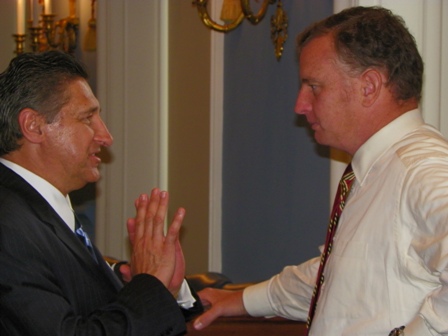
ARLINGTON, VA – The National Milk Producers Federation’s Board of Directors voted today in favor of a revised approach to reforming federal dairy policy, with the key change of allowing farmers an individual choice between receiving the financial protection of a government safety net, or opting out of such protection.

As originally proposed back in 2010, NMPF’s Foundation for the Future (FFTF) program contained a government-subsidized safety net, the Dairy Producer Margin Protection Program, to protect against periods of low milk prices, high feed costs, or a combination of the two. This program offered a Basic level of subsidized insurance coverage, plus the option of Supplemental fixed-cost coverage partially paid by farmers. The FFTF program also contained the Dairy Market Stabilization Program, which was a mandatory means to reduce market volatility by discouraging new milk production during periods of compressed margins.

Under the revised approach backed today by NMPF, the Dairy Producer Margin Protection Program (DPMPP) would continue to be voluntary, but if a producer opts to participate in the DPMPP, his/her participation in the Dairy Market Stabilization Program (DMSP) would then be mandatory. If a producer chooses not to participate in the insurance program, then participation in the DMSP would not be required. As with NMPF’s original reform package, the Milk Income Loss Contract program would be eliminated, as would the Dairy Product Price Support Program.

The NMPF Board believes that the new approach will result in beneficial changes to the legislative version of Foundation for the Future, which is expected to soon be formally introduced in the House of Representatives by Reps. Collin Peterson (D-MN) and Mike Simpson (R-ID).

“Based on the feedback we received this summer from our cooperative membership, and during our grassroots tour, when 1,300 farmers came to 12 cities to talk with us about Foundation for the Future, we decided that a slightly different approach to reforming dairy policy was the best way to go,” said Randy Mooney, NMPF Chairman, and a dairy farmer from Rogersville, MO. “Clearly, a number of farmers are uncomfortable about having a mandatory government program to manage milk production. So we are endorsing a new approach which gives farmers a clear choice.”

“This new approach of making the Market Stabilization program optional will appeal to those who philosophically do not want government telling them what to produce. At the same time, those who want the benefits of a government safety net must accept some government-led market stabilization as the price of that protection,” Mooney said.

The other changes endorsed today by NMPF include:

  • Increasing the Basic Plan’s coverage to 80% of a producer’s production history on margins between $0.00 and $ 4.00 per cwt. In the legislative draft of FFTF released earlier this summer, the Basic coverage was limited to 75% of a farm’s production history.
  • Giving farmers the option of acquiring coverage for their production growth under the Supplemental Plan. Under such an option, the production history would be revised annually as the producer’s production grows. The percentage of the producer’s production history to be covered, and the premium rate per cwt., would remain fixed over the life of the Farm Bill.
  • Accepting an administrative fee to be charged to all producers signing up for margin protection coverage under the DPMPP, with modest fees on a sliding scale. This will help keep the cost of the program to a minimum.
  • Eliminating the distribution of 50% of producer-generated funds to the U.S. Treasury under the Dairy Market Stabilization program, ensuring that all of the monies generated by producer withholdings would be available to purchase dairy products for donation to non-commercial food assistance programs as originally proposed.

Lastly, the revised FFTF package endorsed by NMPF alters how reforms to the Federal Milk Marketing Order system would be pursued. Under NMPF’s original approach, the legislation would have specifically prescribed how competitive prices and a streamlining of the classified pricing system were to be implemented by the USDA, without a hearing process. The new version directs the USDA to eliminate the cumbersome end product price formulas and make allowances for Class III, and use a competitive pay price instead to determine the Class III price. It also specifies that after USDA makes its decision, a majority vote by producers will put the changes into effect. If the changes are not approved, the current Federal Order provisions remain in place.

“The underlying objectives we have been pursuing for the past two years – offering a better dairy program featuring protection, stability, and growth – remain intact in what our Board has endorsed today,” according to NMPF President and CEO Jerry Kozak. “But by making some adjustments, we strongly believe that many of the concerns raised in the past year to our first approach now have been addressed and eliminated.”

Kozak went on to point out that NMPF’s Foundation for the Future proposal, along with the initial legislative discussion draft released this summer by Rep. Peterson and cosponsored by Rep. Simpson, allowed the dairy industry and Congress “to kick the tires and really scrutinize the best way to reform dairy policy. We’ve listened, we’ve analyzed and considered options, and now we’re endorsing a course correction that will still take us to the same place, only with greater unanimity and support from dairy farmers, and hopefully from others across the industry and on Capitol Hill.”

Mooney added that “it’s time everyone in the dairy industry recognizes that the Peterson-Simpson bill offers the best – and perhaps only – opportunity to create an effective safety net that allows us to take advantage of the challenges and opportunities of a global marketplace.”

The National Milk Producers Federation, based in Arlington, VA, develops and carries out policies that advance the well being of dairy producers and the cooperatives they own. The members of NMPF’s 31 cooperatives produce the majority of the U.S. milk supply, making NMPF the voice of more than 40,000 dairy producers on Capitol Hill and with government agencies.

Reforms of Federal Order Dairy Pricing System, Featured in Foundation for the Future Package, to Simplify Milk Pricing

          ARLINGTON, VA – Past attempts to reform – and simplify – federal regulations affecting dairy pricing have achieved mixed results at best, but the changes included in the National Milk Producers Federation (NMPF)’s Foundation for the Future (FFTF) program represent a once-in-a-generation opportunity to make major improvements, NMPF said today.Dave Fuhrmann

Reforming the current complex milk pricing system is one of the key elements of FFTF, along with providing a better margin-focused, farm-level safety net, and a means of temporarily adjusting milk production when conditions warrant.

But revamping the Federal Milk Marketing Order system “is perhaps the most daunting, because the current structure is difficult to alter unless comprehensive and specific adjustments are written into legislation,” said Dave Fuhrmann (above), President of Foremost Farms USA, a dairy cooperative based in Baraboo, WI. Fuhrmann chaired an NMPF committee that developed the Federal Order improvements featured in the FFTF package.

Under the proposal that NMPF has helped to design, and which has been drafted into legislative form by Rep. Collin Peterson (D-MN), the U.S. Department of Agriculture will no longer specify a monthly minimum price for four classes of milk, derived from a weekly price survey of dairy commodities.

Instead, the system will feature just two classes: one for fluid milk, and another for manufactured products. This will “allow the discovery of a true, competitive market price for milk, rather than a price derived from an unwieldy and divisive formula-based approach,” Fuhrmann said, noting that the current end-product pricing formulas, featuring make allowances for manufacturers, will be eliminated. This change, along with the elimination of the Dairy Product Price Support System, “will significantly enhance the ability of the U.S. to grow export markets over the long term.”

Reducing the system to two classes not only simplifies things, it will also reduce price volatility, because more milk is moving in response to the same prices and adjusts supply and demand more quickly and more consistently, according to Fuhrmann.

The FFTF proposal maintains a minimum price for fluid milk, using the “higher of” feature in the current system, to help maximize the return to dairy producers for bottled milk sales. Current Class I differentials in the ten Federal Order areas are also maintained as they are, as is the overall geographic structure of the Federal Order regions. Farmers in states like California, which are governed by a state pricing system, would not be impacted by the changes to the federal system.

Some farmers have expressed concern that the proposed change to a competitive pricing system will not mandate component pricing, featuring a regulated minimum value for the protein in their milk.

However, “producers and cooperatives will still be able to negotiate for components values in their milk, since the proposal doesn’t preclude the use of component pricing, particularly when the plant buying the milk places an importance on protein for their products,” Fuhrmann said.

Fuhrmann noted that those who are calling for the complete elimination of any type of milk marketing orders “have to realize that dairy farmers support Federal orders. We’re taking great strides in reforming it, but we’re not looking to end the system entirely,” he said.

There is still widespread support for the beneficial aspects of Federal Milk Marketing Orders, including the fact that they help enhance the bargaining power of producers, and help balance supplies of milk to ensure adequate fluid milk for bottling.

The National Milk Producers Federation, based in Arlington, VA, develops and carries out policies that advance the well being of dairy producers and the cooperatives they own. The members of NMPF’s 31 cooperatives produce the majority of the U.S. milk supply, making NMPF the voice of more than 40,000 dairy producers on Capitol Hill and with government agencies.

NMPF Statement on House Agriculture Subcommittee Hearing

ARLINGTON, VA – The House Agriculture Livestock, Poultry and Dairy Subcommittee held a dairy policy hearing on Thursday, September 8. The hearing witnesses included U.S. Department of Agriculture (USDA) officials from the Farm Service Agency (FSA) and Agriculture Marketing Service (AMS).

After attending the hearing, NMPF President & CEO Jerry Kozak issued this statement:

“The general tone of the questions at today’s hearing from the committee members indicates a concern that current dairy programs are not up to the task of providing a meaningful farm-level safety net.

“NMPF shares that concern, and that’s what has driven the creation of Foundation for the Future. We believe we have the best answer to the bottom line question of what should come next for dairy policy.”

NMPF President & CEO Jerry Kozak (l) discusses dairy policy with Congressman Tom Rooney (R-FL), Chairman of the House Agriculture Subcommittee on Livestock, Dairy and Poultry.

The National Milk Producers Federation, based in Arlington, VA, develops and carries out policies that advance the well being of dairy producers and the cooperatives they own. The members of NMPF’s 31 cooperatives produce the majority of the U.S. milk supply, making NMPF the voice of more than 40,000 dairy producers on Capitol Hill and with government agencies.

Dairy Legislation Among Items Congress Expected to Deal With This Fall

Congress returns to Washington this week with a busy agenda, including a heavy focus on economic issues, such as the Obama Administration’s unveiling of a new job growth plan, and the first meeting of the congressional budget-cutting “super committee,” both set for tomorrow.

Dairy policy is also likely to be a lively topic, as House Agriculture Committee Ranking Democrat Collin Peterson prepares to formally introduce legislation modeled after NMPF’s Foundation for the Future package. Last month, Congressman Mike Simpson of Idaho’s second district, a senior Republican from one of the largest dairy states, announced he will be a cosponsor of the draft legislation, once it is introduced. The current draft is available online.

NMPF believes Simpson’s support is “an important step in demonstrating the bipartisan, national scope of the effort to reform dairy policy,” according to NMPF President and CEO Jerry Kozak. “We’ve come a long way in the past two years in devising a sensible compromise approach to new dairy policy. While still have a great deal of work ahead of us, the advent of legislation based on Foundation for the Future is a huge opportunity to make badly-needed changes in the status quo system.”

Peterson, along with Simpson, will now be seeking additional cosponsors, in both parties, to cosponsor the legislation.

House Subcommittee to Review Dairy Federal Dairy Programs Thursday

The House Agriculture Livestock, Poultry and Dairy Subcommittee will host a dairy audit hearing on Thursday, September 8. The hearing witnesses will only include U.S. Department of Agriculture (USDA) officials from the Farm Service Agency (FSA) and Agriculture Marketing Service (AMS). A video stream from the hearing, which starts at 2 pm EDT, is available here.

USDA will testify and answer questions regarding current dairy policies and programs. NMPF will be preparing written testimony for the record outlining why Foundation for the Future (FFTF) is the best approach for reforming dairy programs. For more information on FFTF, please visit www.futurefordairy.com.

CWT Continues to Build Exports

The Cooperatives Working Together (CWT) Export Assistance program continued in August to assist CWT member cooperatives in exporting dairy products to benefit all dairy farmers. Last month, CWT accepted requests for export assistance totaling 4.6 million pounds of Cheddar and Monterey Jack cheese to six different countries in Asia, North Africa, and the Middle East. The product will be delivered in 2011.

That brings the total cheese that CWT has provided assistance for in 2011 to 62.3 million pounds of cheese export sales. When combined with the export sales it assisted in 2010 that have been or will be delivered in 2011, a total of 86 million pounds of cheese will be leaving the domestic market in 2011. That’s equivalent to 860 million pounds of milk, or the annual production of over 40,000 cows.

CWT will continue to assist CWT member cooperatives in building overseas markets of U.S. cheese through the remainder of 2011.

The program also continues to build membership participation for 2012-13 with a goal of achieving the 70 percent level. As of August 31st, 16 cooperatives representing 41 percent of the nation’s milk production have joined CWT for the next two years.

There is no question that moving the equivalent of 860 million pounds of milk overseas enhances the milk price every dairy farmer receives. That’s why every cooperative, whether they export dairy products or not, should be making the two-cent per hundredweight investment in CWT.

Mexico Trucking Agreement Reached, Implementation Delayed

The United States and Mexico signed a Memorandum of Understanding (MOU) on July 6, 2011 formally outlining a pilot program to allow Mexico-domiciled motor carriers to operate throughout the United States.

Despite concern raised in a recent report by the Inspector General of the U.S. Transportation Department, the Federal Motor Carrier Safety Administration (FMCSA) is ready for implementation of the U.S. – Mexico cross border trucking program. Some areas of concern in the Transportation Department IG’s report are: clarification of how it will accomplish compliance reviews inside Mexico’s borders, site specific plans for verification of drivers and trucks at the border, implementation plans for electronic on board recorders for pilot program trucks, and training for inspection personnel for the pilot program.

In addition, Department of Transportation (DOT) has stated that approximately 46 Mexican carrier companies will need to participate in the pilot cross-border trucking program before it terminates in three years. A Federal Register notice stated that this “statistically valid sample” must be achieved by the pilot program before a longer-term cross-border trucking program can be implemented. However, analysts suggest that, absent a longer-term cross-border trucking program, Mexico is entitled under NAFTA to re-impose “retaliatory tariffs” on US goods previously lifted.

Dairy Producers Encouraged to Register for NMPF Annual Meeting

Registration is open for those wishing to attend the 2011 annual meeting that NMPF hosts jointly with the National Dairy Promotion and Research Board and the United Dairy Industry Association. This year’s meeting will be held November 14 – 16 at the Town and Country Resort & Convention Center in San Diego, CA.

With the theme of “Navigating a New Course,” the meeting offers attendees several days of informative programming in addition to opportunities to interact and network with dairy producers and industry leaders from across the country. Dairy producers, cooperative staff, Young Cooperators (YCs), industry suppliers, trade press, and others from within the dairy sector are all invited to attend.

Individual and group meeting registration, along with hotel reservations, can be made online at www.dairyevents.com. Although online registration is preferred, a registration form may also be filled out and submitted via mail or fax. Online, mail, and fax registration must be submitted with payment by Monday, October 24. Visit www.nmpf.org/nmpf-joint-annual-meeting for more information about the annual meeting.