Use Science in Regulating Antibiotics, Agriculture Coalition Says

Use Science in Regulating Antibiotics, Agriculture Coalition Says

A coalition of agricultural organizations, including NMPF, sent a letter earlier in June to Rep. Louise Slaughter (D-NY), who was seeking to severely restrict antibiotic use in livestock and poultry production, pointing out the stringent federal approval process and regulation of antibiotics, the lack of human health risks from their judicious use in livestock production, and the benefits they offer in food animal production.

Members of the coalition included the American Farm Bureau Federation, American Feed Industry Association, American Meat Institute, Animal Health Institute, American Veterinary Medical Association, National Cattleman’s Beef Association, National Chicken Council, National Pork Producers Council, National Meat Association and the National Turkey Federation.

Slaughter in February asked food companies to submit to her by June 15 their purchasing policies related to antibiotic use in food animals. She is the primary author of the “Preservation of Antibiotics for Medical Treatment Act” (H.R. 965), which seeks to ban the use in livestock and poultry production of several classes of antibiotics employed for preventing and controlling diseases and for promoting nutritional efficiency.

“Antibiotics used in veterinary medicine are reviewed and approved by the U.S. Food & Drug Administration (FDA),” the coalition stated in its letter. For animal antibiotics, the safety assessment is more stringent than that for human antibiotics in three ways: 1) If there are risks to humans, FDA will not approve the antibiotic for animals; 2) FDA requires a food safety assessment to ensure meat is safe; and 3) FDA studies the pharmaceutical thoroughly to guarantee it does not increase the risk of antibiotic-resistant bacteria in food. The coalition further explained that FDA recently issued new regulations that effectively prohibit the use in food animals of “medically important” antibiotics for improving nutritional efficiency. The rules also ensure veterinarians will be involved in overseeing all uses of these products.

The coalition cited several published, peer-reviewed risk assessments showing any threat to human health from antibiotic use in livestock and poultry production is negligible, and pointed out many of the bacterial illnesses becoming resistant to antibiotics in human medicine have little or no link to antibiotic use in food animals.


Americans Commemorate National Ice Cream Month

Americans Commemorate National Ice Cream Month

Following June Dairy Month on the calendar, members of the dairy industry, along with consumers, will spend the hot, muggy days of July celebrating National Ice Cream Month. Started in 1984, then-president Ronald Reagan designated July as the official time of year to acknowledge the importance of ice cream in the U.S.


He also declared the third Sunday of the month (July 15 this year) as National Ice Cream Day. Reagan recognized that ice cream was a fun and nutritious food enjoyed by 90% of the nation's population. President Reagan's proclamation called for all people of the United States to observe these events with "appropriate ceremonies and activities."


Government Relations Staff Member Departs as New One Welcomed

Government Relations Staff Member Departs as New One Welcomed

After serving as NMPF's Manager of Government Relations for over a year and a half, Jonathon Glueck will be leaving the organization to pursue graduate studies on scholarship at Rice University. His last day on the job will be Monday, July 16th.

A native of the Texas panhandle who grew up involved in the dairy industry, Glueck assisted NMPF staff on a number of issues, including immigration, farm policy and trade, and management of NMPF's Political Action Committee. He was also responsible for legislative issues regarding animal welfare and care.

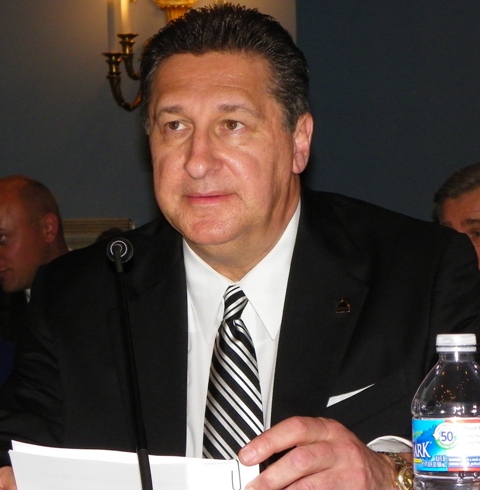
To fill Glueck's position, NMPF has welcomed Ryan Bennett (left) to serve as a new Director of Government Relations. Bennet grew up in Maryland where his family raised beef cattle. His active role in 4-H and livestock judging ultimately provided him with the opportunity to be on scholarship for livestock judging at Butler Community College in El Dorado, KS. He graduated with a B.S. in Agricultural Communications from Kansas State University in 2009. After college, Bennett interned for Senator Pat Roberts (R-KS). He most recently spent the past two years at the National Grain and Feed Association.

Starting this week, Bennett may be reached at rbennett@nmpf.org.


A Drought of Leadership


In a year when the country has suffered the worst drought in decades, you would think the added public attention to the importance of securing our nation’s food production would make it easier to adopt a Farm Bill. Of course, you’d be wrong.

As September ended, Congress failed to build on the legislative momentum from the spring and summer, when the 2012 Farm Bill passed the Senate Agriculture Committee, then the full Senate, then the House Agriculture Committee….and then, stalled out.

Even in the face of additional pressure from farm groups, food groups, and key Republicans in the House and Senate, the House leadership finally acknowledged late last month that it didn’t have any intention of bringing the House farm bill to a vote. This, despite the fact that it passed the Ag Committee by a three-to-one margin last month, and that many current programs expired Sept. 30th.

Any major piece of legislation will have its critics as well as supporters, and the Farm Bill is no exception. But the response to any concerns should have been to bring it to a vote before the full House of Representatives, so amendments could be debated and the bill could progress. That’s what happened in the Senate, which is usually the chamber in Congress noted for a tortuously slow deliberative process. This time, though, it’s the House that has failed to lead. Doing nothing aptly illustrates the reason why many voters hold Congress in such low esteem.

So where does that leave dairy policy? In uncharted waters, at best. The MILC program expired Sept. 30. Even though some lawmakers wanted to help dairy farmers by passing a short-term extension of the program, our concern at NMPF is that any extension, even if only for a few months, takes the pressure off of Congress to act on a new bill. The risk of delaying a day of reckoning simply isn’t worth the modest reward of one more MILC payment.

The other safety net programs intended to help farmers – the Dairy Product Price Support and Dairy Export Incentive programs – don’t expire till the end of December. And here’s where it gets interesting. While neither has been active since 2009, the wrinkle concerning the price support program is that come January 1st, 2013, the support level reverts back to parity pricing. Specifically, under permanent law governing USDA, the minimum price of milk becomes 75% of whatever the parity level is come January. We calculate that 75% of August’s parity price is $39 per hundredweight. This would result in support prices of $3.65/lb. for butter, $2.79/lb. for powder, and $4/lb. for cheese.

Those who believe Agriculture Secretary Tom Vilsack would never permit the Commodity Credit Corporation to purchase products at these levels shouldn’t pin their hopes on his failure to act. First, he’s bound by law to do so. Second, he believes a new farm bill is a necessity – and if the possibility of dramatic price spikes are a short-term incentive to getting the job done, then so be it. As we’ve found in recent years, it takes a crisis in order for policy makers to act. A near-quadrupling of cheese support prices may be the crisis we shouldn’t let go to waste.

While some may believe that the dairy title of the Farm Bill remains a sticking point, I also want to point to why the latest report from the Congressional Research Service – a non-partisan “think-tank” office providing detailed analysis to Congress of various policy options – affirms that the Dairy Security Act is the best choice for farm policy.

In a report released September 18, the CRS’s review of dairy policy noted that the DSA’s combination of margin insurance and market stabilization “appears to substantially mitigate the dairy operating margin volatility”; provides “a stronger safety net in extremely low margin events”; and may help “net milk exports actually expand.”

In a crucial rebuke to those who continue to cry that market stabilization is some Canadian-style quota system, the CRS report said that the market stabilization program, while “referred to as a supply management program, is perhaps more accurately described as a production disincentive program, since there are no production limits or quotas, and the dairy operator may continue to run his operation at any production level.”

The report also reiterates a key fact about the effort to strip out the market stabilization program, as Agriculture Committee members Reps. Bob Goodlatte and David Scott attempted to do this summer. CRS noted that under the Goodlatte-Scott method, “no production growth is permitted,” and insurance coverage is limited to only 80% of a farm’s production – compared to 90% under the Dairy Security Act.

It’s a point worth repeating: this alternative guts the insurance protection of the dairy title by putting more risk and cost onto the backs of farmers. It reduces the amount of historic production they can insure, and eliminates the ability to insure new milk production during the lifespan of the farm bill. Since those who support this alternative share my concern about the growth of the U.S. dairy sector, let’s be frank that it’s a real, de facto quota system that would severely hamper the ability of our industry to be the healthy, growing, future-oriented business that we want.

We expect Congress to address the farm bill in a lame duck session after the November elections. The drought of leadership, and action, must end.

Congress Leaves Dairy Farmers Without Safety Net In Absence of New Farm Bill

Key Farm Programs Among First To End

ARLINGTON, VA – Dairy farmers have lost a safety net because the 2008 farm bill expired Sunday and Congress has yet to pass a new Farm Bill, according to the National Milk Producers Federation (NMPF), which said today that farmers need to continue to voice their dissatisfaction with the lack of action in Washington on farm policy.

Members of the House left Washington last month without completing work on the 2012 Farm Bill. Although Congress is expected to return to Capitol Hill after the November elections, the status of many farm and food programs is in limbo until then, along with the rest of the pending farm bill that contains a new and better safety net for dairy farmers.

“Dairy is among the first sectors in agriculture to feel the impact of Congress’s inability to reach accord on most anything, including a new Farm Bill,” said Jerry Kozak, President and CEO of NMPF. “Had the House leadership brought the bipartisan farm bill to the floor, I believe we could have passed a bill containing the Dairy Security Act. Instead, we are in uncharted waters, and one of our life rafts has disappeared.”

Dairy farmers continue to suffer from high feed costs, and the other program intended to serve as a safety net – the dairy product price support program – was created years before feed costs started to escalate, Kozak said.

That’s why NMPF has been urging Congress to pass the Dairy Security Act, which instead of focusing simply on milk prices, takes into account the margin between farm-level milk prices and feed costs.

“We strongly encourage our dairy farmer members to visit with their members of Congress during the pre-election recess to determine a path forward for the 2012 Farm Bill soon after the elections,” Kozak said. “We need a full, five-year bill to be passed in the House, sent to a conference committee, and approved before the end of the year.”


The National Milk Producers Federation (NMPF), based in Arlington, VA, develops and carries out policies that advance the well being of dairy producers and the cooperatives they own. The members of NMPF’s 30 cooperatives produce the majority of the U.S. milk supply, making NMPF the voice of more than 32,000 dairy producers on Capitol Hill and with government agencies.

Congressional Report Concludes Dairy Security Act in Farm Bill Best for Farmers

Safety Net with Margin Insurance, Market Stabilization, Steadies Milk Prices, Lowers VolatilityARLINGTON, VA – A new analysis issued by the Congressional Research Service (CRS) points out the advantages of the margin insurance and market stabilization-based approach to reforming dairy policy, according to the National Milk Producers Federation (NMPF), which urged members of Congress to review the report and act on the Farm Bill yet in 2012.

The CRS report was released earlier this week in order to help members of Congress and their staffs better understand the details of current dairy policy, and potential changes to those programs. More importantly, the CRS report provides an impartial view of the specific programs contained in the Dairy Security Act of the pending Farm Bill.

NMPF President and CEO Jerry Kozak said that the CRS report “should greatly clarify and simplify the decision-making process on Capitol Hill. It dispels the scare-mongering distortions offered by opponents of the Dairy Security Act, highlights the benefits of a new, voluntary approach to providing a safety net to farmers, and reinforces the need to include the Dairy Security Act in a new farm bill.”

Kozak said that even though the House has failed to act on the farm bill in September, the CRS report should expedite the process of considering the bill after the November elections in a lame duck session of Congress.

Under the Dairy Security Act, those farmers who voluntarily elect to receive support through the margin protection program will be subject to the Dairy Market Stabilization Program (DMSP), which sends signals to participants to reduce their production when margins are severely compressed. The CRS analysis clarifies the function of the DSMP by stating (p. 17) that “Although the DMSP is referred to as a supply management program, it is perhaps more accurately described as a production disincentive program [emphasis added], since there are no production limits or quotas, and the dairy operator may continue to run his operation at any production level.” CRS reported that the resulting milk production reductions, along with greater demand stimulated by USDA purchases of dairy products using funds collected by the DMSP, “is expected to result in a high future farm price for milk.”

CRS also flagged (p. 20) a key provision: that the DMSP ends either when margins improve, and/or when U.S. prices for cheddar cheese and nonfat dry milk exceed world prices by a certain percentage, thus preventing a loss of export markets and a surge of imports.

The CRS report also reviewed a competing approach to providing margin insurance: the Goodlatte-Scott House amendment, which offers a weaker insurance program that does not contain a market stabilization element. CRS noted (p. 22) that with the Goodlatte-Scott approach, “no production growth is permitted,” and insurance coverage is limited to only 80% of a farm’s production – compared to 90% under the Dairy Security Act.

The CRS report points out (p. 10) that the margin insurance program creates “a timely and transparent measure of a dairy production margin that will be useful across all dairy production regions.” The margin’s feed costs are calculated comparing the national all-milk price with national average costs for corn, soybean meal and alfalfa hay.

In reviewing other empirical studies of the provisions of the Dairy Security Act, CRS highlighted (p. 23-24) several major improvements compared to current programs:

  • The combination of the margin insurance and market stabilization programs “appears to substantially mitigate the dairy operating margin volatility.”
  • The Dairy Security Act “will provide a stronger safety net in extremely low margin events.”
  • An analysis by agricultural economist Mark Stephenson found that net milk exports actually expand under the Dairy Security Act.

The congressional analysis of the Dairy Security Act also notes that the proposed Farm Bill programs are voluntary. Farmers would elect to participate in the margin protection and market stabilization programs, rather than choose private insurance that is already available.


The National Milk Producers Federation (NMPF), based in Arlington, VA, develops and carries out policies that advance the well being of dairy producers and the cooperatives they own. The members of NMPF’s 30 cooperatives produce the majority of the U.S. milk supply, making NMPF the voice of more than 32,000 dairy producers on Capitol Hill and with government agencies.

NMPF Urges Congress to Pass New Farm Bill at Capitol Hill Rally

Time Running Out for Legislators to Improve Dairy Farmer Safety Net

WASHINGTON, DC – Members of the National Milk Producers Federation (NMPF) joined hundreds of other farmers on Capitol Hill today at a rally urging Congress to pass a new, five-year farm bill before current farm programs expire in less than three weeks.

NMPF is a founding member of the Farm Bill Now coalition, which brought dozens of groups and hundreds of farmers together Wednesday at the steps of the U.S. Capitol. One of them was NMPF First Vice Chairman Ken Nobis (in the photo), a dairy farmer from St. John, Michigan, who told those assembled that politics shouldn’t stand in the way of helping America’s farmers.

“Dairy farmers have worked with Democrats and Republicans, in the Senate and the House, to create a farm bill that saves taxpayers money, and at the same time offers dairy producers a more effective safety net when times are tough,” Nobis said. “It would be a tragic mistake, after this bill has already passed the Senate, and the House Agriculture Committee, to let it wither and die on the political vine, rather than make the necessary effort to get it passed in the coming weeks.”

Nobis reminded lawmakers that the dairy reforms included in the new farm bill will reduce government expenditures compared to current policy, which should appeal to those members of the House concerned with the deficit.

“If the question in Washington is how to reform government programs and make them more effective, we have an answer: pass the 2012 Farm Bill. The dairy title, along with the rest of the program, is budget-friendly. By not acting on this measure, Congress actually increases federal spending next year,” Nobis said.

There are fewer than ten days left on the legislative calendar of the House of Representatives before the Congress adjourns in October. If the bill can’t be approved this fall, the path forward is murky at best. Other possible outcomes include a farm bill being passed by a lame duck session of Congress after the November elections, or a one-year extension of current farm programs.

NMPF’s Board of Directors earlier this year came out against the latter option, asserting that an extension of current policy through 2013 does dairy farmers no real good, and leaves the tough choices about budget priorities unresolved.

NMPF President and CEO Jerry Kozak said that if Congress can’t generate the necessary effort to pass a new farm bill this year, the organization would not support an extension of current dairy programs, and instead would insist on getting the Dairy Security Act – the dairy reform bill already included in the Senate version of the Farm Bill – included in any extension package of other farm programs.

“We’ve come too far to acquiesce to another serving of the status quo. Dairy farmers need more than platitudes from Congress – we need action and leadership,” he said.

The National Milk Producers Federation (NMPF), based in Arlington, VA, develops and carries out policies that advance the well being of dairy producers and the cooperatives they own. The members of NMPF’s 30 cooperatives produce the majority of the U.S. milk supply, making NMPF the voice of more than 32,000 dairy producers on Capitol Hill and with government agencies.

Registration Available for NMPF Annual Meeting

With less than two months to go, dairy farmers are encouraged to register soon for the 2012 annual meeting that NMPF hosts jointly with the National Dairy Promotion and Research Board and the United Dairy Industry Association. The meeting will be held October 29 – 31 at the Walt Disney World Dolphin Hotel in Lake Buena Vista, FL.

With the theme of “Securing Dairy’s Future,” the meeting offers attendees several days of informative programming, in addition to opportunities to interact and network with dairy producers and industry leaders from across the country. Dairy producers, cooperative staff, Young Cooperators (YCs), industry suppliers, trade press, and others from within the dairy sector are all invited to attend.

Individual and group meeting registration, along with hotel reservations, can be made online at www.dairyevents.com. Although online registration is preferred, a registration form may also be filled out and submitted via mail or fax. Online, mail, and fax registration must be submitted with payment by Friday, October 5. Visit www.nmpf.org/nmpf-joint-annual-meeting for more information.


Former YC Chairman Honored for Environmental Stewardship

In recognition of his dedication to environmental stewardship on his dairy farming operations, NMPF’s 2010 Young Cooperator (YC) Chairman Marty Burken was selected last month as a recipient of the 1st annual Iowa Farm Environmental Leader Awards. The awards were sponsored by the Iowa Governor’s Office, Iowa Department of Agriculture & Land Stewardship, Iowa Department of Natural Resources, and Monsanto. Burken was chosen because of the steps he has taken and leadership he has demonstrated to help protect Iowa’s natural resources. The nomination was approved by a committee representing multiple commodity, conservation, and environmental groups.

The awards were presented at the Iowa State Fair on August 17th by Iowa Secretary of Agriculture Bill Northey, Iowa Governor Terry Branstad, and Iowa DNR Director Chuck Gipp.

In the photo: Burken receives his award from Gov. Terry Branstad. He is joined on stage by his youngest daughter Hillary and his father Loran Burken.


CWT Assists with Export Sales Totaling 12.2 Million Pounds in August

Cooperatives Working Together (CWT) received 76 requests for export assistance from member cooperatives in August. Of those requests, CWT accepted 42, which accounted for sales of 10.6 million pounds of cheese, 1.6 million pounds of butter, and 44,092 pounds of anhydrous milk fat. On a milkfat basis, those exports are the equivalent of 118.1 million pounds, or the annual production of 5,600 cows.

For the year, CWT has helped member cooperatives to sell 79.1 million pounds of cheese, 56.7 million pounds of butter, and 123,459 pounds of anhydrous milk fat. Those products are equivalent to 1.969 billion pounds of milk on a milkfat basis, or the annual production of 93,700 cows.

Through the end of August, CWT will have accounted for 55.5 million pounds of total American cheese export shipments, with another 24.8 million pounds scheduled to be shipped by the end of the year.


Farm Bill Now Campaign Pushing for Congressional Action This Month

NMPF has joined forces with nearly 40 other farm and agricultural groups in a coalition called “Farm Bill Now,” whose purpose is to get Congress to pass a new, comprehensive, five-year farm bill before current programs expire at the end of September.

The Farm Bill Now coalition comprises associations representing commodity crops, livestock, specialty and minor crops, farm cooperatives and financial groups.

“National Milk stands united with these other groups – each of which has strong and distinct policy priorities – yet all of whom are committed to passing a new, comprehensive bill this year,” said Jerry Kozak, President and CEO of NMPF. “Dairy farmers have been working for three years on developing a new and better safety net, and we need a new farm bill to bring that effort to fruition.”

Farm Bill Now has launched an interactive web portal at www.FarmBillNow.com, through which visitors can connect to their members of Congress and show their support for a new five-year farm bill. Using messages to Congress via social media, event locations and times, and an online petition, FarmBillNow.com gives both farmers and consumers the resources they need to make their voices heard, telling Congress that the farm bill needs to be completed before the current farm food law expires in September.

One focal point of the collective effort will be a Capitol Hill rally this week. On Wednesday, Sept. 12, at the Capitol Reflecting Pool, farm leaders and key members of Congress will gather to encourage Congress to pass a Farm Bill. Now that Congress has returned to Washington this week, there are fewer than 10 legislative days on the calendar to debate legislation prior to the anticipated end of the congressional session.


A Cheese By Any Other Name

The U.S. cheese business is built on a heritage dating back hundreds of years, since the time when immigrants, mostly from Europe, brought their food preferences with them from the Old World to the New. Unfortunately, the Europeans now want to ignore that global migration, and reclaim some products’ names just for themselves.

For the past several years, trade negotiators with the European Union (EU) have been making greater inroads in restricting the use of the names and translations – in trade parlance, the Geographic Indications (GIs) – for some foods and beverages made in certain parts of the world. Champagne from France is an obvious example. But so are cheeses such as Feta from Greece, Gorgonzola from Italy, and others. The EU asserts that if the principle of Geographic Indications is applied to these cheeses, any similar food products made elsewhere, from Argentina to the U.S., are not just pale imitators, but in violation of international trade laws.

While clawing back these names of common and popular consumer products may seem like a far-fetched goal, the EU has already had success in restricting the use of several key GIs in a free trade agreement it reached with South Korea. For instance, any cheeses labeled as Asiago, Feta, Fontina, and Gorgonzola now sold in Korea can only come from Europe. And even though the U.S. just signed its own free trade deal with South Korea, we’re now subject to the cheese GI restrictions written into the deal between the EU and Korea.

The stakes for this battle are big and growing. More than $20 billion in U.S. cheese production utilizes European-origin names. Last year, almost $1 billion in U.S. cheeses were exported; many of these could be harmed by the EU’s aggressive attempt to confiscate common names.

In order to fight this trend, NMPF earlier this year joined with the U.S. Dairy Export Council and other domestic and international organizations to form the Consortium for Common Food Names (CCFN). The CCFN is devoted to informing consumer groups, farmer associations, manufacturers, trade and intellectual property officials of the damage that will be caused in their own countries if efforts to restrict the use of common food names go unchecked. CCFN provides an internationally-organized counterbalance to the EU’s overly-aggressive approach to restricting product names. Its website, www.commonfoodnames.com, provides information to companies interested in joining this important effort, as well as to policy makers around the world.

While focused on more than just dairy foods, the Consortium for Common Food Names is reaching to all manufacturers of cheeses and milk producers to encourage them to challenge the EU’s attempt to produce more free trade deals like the one between Europe and South Korea. While the World Trade Organization talks are in suspended animation, other broad, multi-party talks are moving forward, where a discussion of limiting the use of GIs may be on the table. The EU has concluded free-trade agreement talks with South Korea, Colombia, Peru, and Central America in the past few years. Negotiations with India, Brazil, Singapore, Malaysia and more than 30 other countries are ongoing. And once a precedent is set among these countries to restrict GIs, the limitations could be very damaging to future commerce, even if the U.S. isn’t a party to the agreement.

Moreover, the biggest prize of all – the U.S. market – is one the EU is keenly eyeing as it insists on imposing its views on GIs on the U.S. With a potential U.S.-EU trade deal currently under consideration, the U.S. cheese sector faces a very real threat if negotiators write any GI restrictions into a resulting agreement.

A reasonable path exists to protect location-specific GIs, say, for Parmigiano Reggiano, as opposed to the much more generic Parmesan. The U.S. has some interest in using GIs of its own, but a clear and limited scope of protection is what is needed, not a blanket restriction. It doesn’t help that Europe has been incredibly arbitrary in fighting for some GIs, such as Asiago, but not others, such as “Cheddar.”

As global trade barriers gradually come down, bit by bit and country by country, groups like NMPF and the CCFN have to ensure that new barriers in different forms – or in different names – don’t rise to take their place. The U.S. versions of Feta and Gorgonzola should be able to compete with versions made elsewhere. Consumers around the world will be the ultimate judges as to which are best.