With the turn of the calendar, the time has come again for arguably the most important month observed by dairy farmers, processors, retailers, consumers, and others throughout the industry: National Dairy Month. Since 1939, June has been celebrated as National Dairy Month, honoring the important role the dairy industry has played in the economic and nutritional well-being of Americans. On June 14, 2010, Congress unanimously passed a bipartisan resolution that officially recognized June as National Dairy Month.
Uncategorized
Farm Bills Approved by Senate, House Agriculture Committees; Chambers to Vote in June
Dairy policy reform took two big steps forward in May, when first the Senate Agriculture Committee, then the House Agriculture Committee, approved separate versions of the 2013 Farm Bill, each containing the Dairy Security Act (DSA) supported by NMPF.
Both ag panels tackled farm policy the week of May 13th. The Senate committee finished its work on the 14th, approving a reform-oriented Farm Bill that cut spending by $24 billion. The following day, the House committee worked through dozens of amendments to its own version of the Farm Bill. One of them, offered by Reps. Goodlatte and Scott, would have gutted the DSA by removing its market stabilization component. Members of the committee defeated that amendment by a vote of 26-20.
The dairy industry “needs the stability that the DSA will provide, and we need it now. The House version of the bill is on the right path, and its dairy title now matches the farm bill approved by the Senate Agriculture Committee,” said NMPF President and CEO Jerry Kozak after the House panel finished its work.
The full Senate began consideration of the Farm Bill last week, but it didn’t complete its consideration of amendments prior to recessing for Memorial Day. The bill is now back before the Senate, and committee chairwoman Sen. Debbie Stabenow is pushing for final passage this week. Meanwhile, the full House of Representatives is likely to take up its Farm Bill version during the middle of June.
“We hope that the House Agriculture committee’s decision will be the final word on the matter. It is time for dairy processors to end their campaign of divisiveness, and assist us in moving the farm bill toward completion,” Kozak said.
Farmers can contact their elected officials to support the Dairy Security Act.
Immigration Reform Legislation Passes Key Test, Heads for Debate on Senate Floor
 Another key policy focus of NMPF – reforming the nation’s immigration laws to address farm labor needs – was advanced on Capitol Hill in May when the Senate Judiciary Committee approved the Border Security, Economic Opportunity and Immigration Modernization Act (S. 744) by a bipartisan vote of 13 to 5. NMPF, together with the organizations that constitute the Agriculture Workforce Coalition, worked through the process to ensure that the nearly 300 amendments that were proposed didn’t negatively affect the measure’s agriculture provisions. All of the amendments backed by legislators opposed to immigration reform were defeated.
The Senate immigration reform bill is expected to be taken up by the full Senate in mid-June, after the Senate leadership agrees to a limited number of amendments. Although expectations are that the Senate will approve the legislation, efforts must continue to ensure a strong showing of support by the entire Senate.
The House Judiciary Committee is working on its own immigration reform measure, but the timing for its consideration is still undetermined.
New REAL® Seal Campaign to Launch in Celebration of National Dairy Month
 In celebration of June Dairy Month, NMPF’s efforts to revitalize the REAL® Seal are taking a big leap forward this month. A new campaign is being launched that allows consumers to learn more about the benefits of real, American-made dairy products and foods made with them, using a new Facebook page, blogger outreach, and digital advertising.
The REAL® Seal Facebook page creates a new voice and visual feel to engage target audiences, especially moms and heads of households, encouraging them to buy dairy products and foods containing dairy products. The page’s content includes interactive updates, multimedia presentations, contests, polls, and quizzes. One of the elements of the launch later in the month will be a “Name the Character” contest for a new, animated REAL® Seal cartoon character (in the photo). It can be viewed on the REAL® Seal website www.realseal.com.
Reaching out to bloggers writing about the mom/parenting, food/cooking, health/wellness, and lifestyle topic areas will generate online conversation and awareness surrounding the REAL® Seal campaign and lead consumers to official REAL® Seal web pages.
In July, a special Buyer’s Guide section will be added to the REAL® Seal website, where consumers will be able to go to find dairy products and foods made with dairy products that are using the REAL® Seal, as well as restaurants that serve only REAL® dairy products. REAL® Seal users will have the option of providing links to their company’s website as well.
The marketing environment has changed dramatically in the 30 years since the REAL® Seal became a national icon, and NMPF’s efforts to work with dairy processors to use the Seal must harness new tools to reach consumers. The challenge will be to use social media and other digital outreach efforts to remind older consumers of what the Seal means, and to educate a new generation to look for the REAL® Seal on packages.
Currently the REAL® Seal is being used primarily on dairy products and pizza, said Jim Mulhern, Chief Operating Officer of NMPF. “By stacking messages like ‘Made With, ‘We Only Use’ and ‘American Made’ above the iconic REAL® Seal symbol and dairy product descriptors like cheese, butter, dairy ingredients, we believe its use can be extended to a host of products made with real dairy products sold here and in export markets,” Mulhern said.
Time to Move Ahead
It’s been four years since the National Milk Producers Federation (NMPF) formed a strategic planning task force to identify the economic challenges affecting farmers, and formulate ways the industry could realistically work to address those challenges. It’s been a long road, but we’re now on the last portion of that journey.
Farmers in 2009 were confronting the twin troubles of low milk prices, driven by the Great Recession, and high input costs, due to increased competition for corn beyond just other livestock sectors. Between 2007 and 2009, America’s dairy farmers collectively lost $20 billion in net worth. For most of calendar year 2009, farmers lost money on every gallon of milk that left that farm.
Since that time, our organization worked across all of agriculture, and throughout the dairy industry, to come up with an alternative to the safety net programs that existed then – and that still exist today. These programs didn’t really help farmers then, nor are they effective in 2013. As a result, one of the first things that NMPF’s task force did was to advocate for the removal of the Dairy Product Price Support and MILC programs, along with the Dairy Export Incentive Program. Processors have long advocated for the elimination of them, and our organization took the lead in advocating that change in Congress.
In their place, NMPF developed a margin insurance-based approach to help farmers deal with extraordinary bouts of volatility, of both milk prices and feed costs. This new philosophy – a shift from targeting milk prices, to insuring margins – remains a dramatic pivot away from the programs of the 20th century, when the U.S. dairy sector was mostly a closed market, and the cost of milk production was far less.
In order to make margin insurance economically effective, NMPF’s initial proposal two years ago called for a mandatory market stabilization element to temporarily reduce production on every dairy farm when margins were compressed. This component was intended to keep farm-level margins from flat-lining for months at a time, as they did in 2009. It was also a way to help reduce the cost to the government of the insurance premiums. But due to concerns raised by processors and some producers, it became clear that a mandatory system of supply management was not going to be acceptable. So we compromised, by making the entire endeavor voluntary, when the Dairy Security Act (DSA) was introduced as legislation in Congress two years ago.
Since that time, we have worked tirelessly to build support for the measure, and to explain why the dual approach of margin insurance and market stabilization will produce the best bang for the buck – not just for farmers, but for taxpayers as well. Those who voluntarily opt to use this benefit must help share in its cost. It’s become clear from the third-party assessments performed on the DSA that the alternative supported by some processors – margin insurance alone – is very costly, since it lacks the disciplinary element that will trim milk production just enough to restore margins to a point where insurance payouts are no longer required. Absent that restraint, we’ll likely see a repeat of 2009 at some point in the near future. In fact, the Midwestern economists’ analysis of the DSA indicates that a prolonged period of low margins is six times more likely without market stabilization.
This raises the prospect of a return to another difficult time: not to 2009, but to the early 1980s. Those who’ve been in the industry the past three decades remember when Congress adopted a measure in the late 1970s to help farmers, in the form of a huge hike in the price support program. Ratcheted up to unsustainably generous levels, the program generated so much milk that the industry, USDA and Congress spent most of the following decade mopping up the mess.
It’s precisely this type of scenario that could be repeated if a margin insurance program gets instituted without the cost controls necessary to keep a lid on production. Our concern is that if the Goodlatte-Scott approach is somehow adopted, it will be the first and last time Congress does so. The resulting budgetary impact will be so enormous that after 2013, it will never be part of the farm bill again, at least not at the same level of margin protection. And thus, we’ll end up with the 21st century equivalent of the price support program: a safety net that has been so attenuated that it has no protective value to farmers.
At every step in this four-year evolution, we’ve listened, compromised and balanced competing interests. But this process is nearing its conclusion. The Dairy Security Act was approved by the House and Senate Agriculture Committees this spring, just as it was last year. Twice now, the House committee has rejected the Goodlatte-Scott bill. The DSA faces opposition in the full House, but a desperate campaign to strip out market stabilization is only going to further poison the well without changing the ultimate outcome. It’s time for processors to end the divisiveness around the compromise that is the DSA, and to move the industry forward.
NMPF and IDFA Criticize Nevada Raw Milk Bill, Urge Governor Sandoval to Veto Legislation Permitting Sales of Unpasteurized Milk
 ARLINGTON, VA – Two national dairy organizations are urging Nevada Governor Brian Sandoval to veto legislation that would allow the sales of raw milk directly to consumers, arguing that the food safety risks of the measure represent too great a gamble with the public’s health.
In a letter sent Tuesday to Sandoval, the National Milk Producers Federation (NMPF) and the International Dairy Foods Association (IDFA) said that Assembly Bill No. 209, which is awaiting review by the governor, would greatly increase Nevadans’ risk of serious illness because of the potentially dangerous bacteria that are often present in milk that has not been properly pasteurized.
“Gambling with the health of your state’s residents – particularly its children – is a bad bet,” said NMPF President and CEO Jerry Kozak in the letter. “While choice is an important value, it should not pre-empt consumers’ well-being,” he said, likening consumption of unpasteurized milk to a game of Russian roulette.
The letter cited a 2012 report from the Centers for Disease Control and Prevention (CDC) which found that between 1993 and 2006, unpasteurized dairy products resulted in 73 known outbreaks – causing 1,571 cases of foodborne illness, 202 hospitalizations, and 2 deaths. The CDC also concluded that unpasteurized milk was 150 times more likely to cause food-borne illness outbreaks than pasteurized milk, and such outbreaks had a hospitalization rate 13 times higher than those involving pasteurized dairy products. The CDC has reported that nearly 75% of raw milk-associated outbreaks have occurred in states where sale of raw milk was legal.
“Legalizing the state-wide sale of raw milk in Nevada increases the risk to public health, opening up the State’s consumers to the inevitable consequence of falling victim to a foodborne illness,” said Connie Tipton, President and CEO of IDFA.
Gov. Sandoval has until the end of the week to either sign or veto the assembly bill.
Federal law prohibits the interstate sales of raw milk but leaves it up to each state to determine how to regulate the product within their borders. An increasing number of states have liberalized sales of raw milk in recent years, which the dairy organizations say is a threat to public health and runs counter to other trends in the food industry to take additional steps to prevent unsafe foods from reaching consumers.
“Raw milk is a known source of life-threatening pathogens such as Campylobacter, Salmonella, Listeria and E. coli. It’s an abdication of a public servant’s role to take actions that will result in more people, including children, becoming sickened by these bacteria,” Tipton said.
The National Milk Producers Federation, based in Arlington, VA, develops and carries out policies that advance the well-being of dairy producers and the cooperatives they own. The members of NMPF’s 30 cooperatives produce the majority of the U.S. milk supply, making NMPF the voice of more than 32,000 dairy producers on Capitol Hill and with government agencies.
The International Dairy Foods Association (IDFA), Washington, DC, represents the nation’s dairy manufacturing and marketing industries and their suppliers, with a membership of 550 companies representing a $125-billion a year industry. IDFA is composed of three constituent organizations: the Milk Industry Foundation (MIF), the National Cheese Institute (NCI) and the International Ice Cream Association (IICA). IDFA’s 220 dairy processing members run more than 600 plant operations, and range from large multi-national organizations to single-plant companies. Together they represent more than 85% of the milk, cultured products, cheese and frozen desserts produced and marketed in the United States. IDFA can be found online at www.idfa.org.
Agriculture Workforce Coalition Statement on Senate Judiciary Committee Approval of the Border Security, Economic Opportunity and Immigration Modernization Act
WASHINGTON, DC — “The Agriculture Workforce Coalition (AWC) strongly applauds the Senate Judiciary Committee for approving S. 744, the Senate’s comprehensive immigration bill, out of committee on a strong bi-partisan vote of 13-5.
“The legislation includes agricultural provisions that reflect the agreement that the AWC and the United Farm Workers union reached earlier this spring. These provisions are vital to ensuring that America’s farmers and ranchers can find the workers they need to pick crops, prune trees or care for animals.
“Agriculture stands united in support of the agriculture provisions contained in the Senate bill, and we look forward to seeing the process advance to the Senate floor after the Memorial Day recess.”
About the Agriculture Workforce Coalition
The AWC brings together organizations representing the diverse needs of agricultural employers across the country. It serves as the unified voice of agriculture in the effort to ensure that America’s farmers, ranchers and growers have access to a stable and secure workforce.
To help achieve this goal, the AWC has reached a landmark agreement with the United Farm Workers union that presents a viable solution to agriculture’s labor needs. The proposal includes both an earned adjustment in status for current agricultural employees who presently lack legal status and a program to ensure an adequate farm workforce in the future. Also, unlike current programs such as H-2A, this agreement would mean that all types of producers—including both those with seasonal labor needs and ones with year-round labor needs—have access to the workforce they need to remain productive and competitive.
To learn more about AWC, visit our website at www.agworkforcecoalition.org.
The National Milk Producers Federation, based in Arlington, VA, develops and carries out policies that advance the well-being of dairy producers and the cooperatives they own. The members of NMPF’s 30 cooperatives produce the majority of the U.S. milk supply, making NMPF the voice of more than 32,000 dairy producers on Capitol Hill and with government agencies.
NMPF Lauds House Agriculture Committee Vote to Support Dairy Security Act in Farm Bill
 From Jerry Kozak, President and CEO, NMPF:
“The National Milk Producers Federation (NMPF) is pleased with today’s vote in the House Agriculture Committee in support of the Dairy Security Act (DSA). The committee’s decision to once again reject an amendment by Reps. Bob Goodlatte and David Scott that would have undermined the House Farm Bill’s dairy safety net is gratifying to the thousands of dairy farmers across the country who support the DSA.
“We very much appreciate the efforts of committee Chairman Frank Lucas and ranking member Rep. Collin Peterson for their leadership in including the Dairy Security Act in the Farm Bill. The DSA provides the best combination of effective risk management for dairy farmers, while minimizing farm program costs to the taxpayer.
“Dairy farmers have labored for four years to develop the reforms contained in the DSA. We have worked with leaders of both the House and Senate Agriculture Committees to construct a new safety net that offers dairy farmers more effective protection than current policy. We appreciate the fact that House Agriculture Committee members are concerned with fashioning the best dairy policy possible, and we are heartened by their decision today to back the DSA.
“The House committee has now twice rejected the Goodlatte-Scott effort to undermine establishment of a workable national dairy policy. As the farm bill moves to the House floor, we hope that the committee’s decision today will be the final word on the matter. It is time for dairy processors to end their campaign of divisiveness, and assist us in moving the farm bill toward completion.
“The dairy industry needs the stability that the DSA will provide, and we need it now. The House version of the bill is on the right path, and its dairy title now matches the farm bill approved Tuesday by the Senate Agriculture Committee. We urge Congress to move quickly to complete action on the farm bill this summer.”
The National Milk Producers Federation, based in Arlington, VA, develops and carries out policies that advance the well-being of dairy producers and the cooperatives they own. The members of NMPF’s 30 cooperatives produce the majority of the U.S. milk supply, making NMPF the voice of more than 32,000 dairy producers on Capitol Hill and with government agencies.
New Economic Assessment of Farm Bill Dairy Security Act Says It’s Better for Farmers and Taxpayers
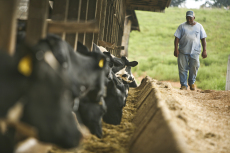 ARLINGTON, VA – A new analysis of the key Farm Bill dairy proposals under consideration in the House Agriculture Committee finds that the Dairy Security Act (DSA) is better for farmers – as well as taxpayers – compared to the Goodlatte-Scott alternative proposal that will be offered in the committee deliberations tomorrow.
The new report, prepared by University of Missouri agricultural economists Scott Brown and Daniel Madison, assessed how the Dairy Security Act would have affected farm-level economics during the period 2009 through 2012 compared with the impact of an alternative plan offered by Reps. Goodlatte and Scott (G-S). The DSA program offers dairy farmers margin insurance, coupled with a market stabilization mechanism that improves farm prices during low periods while also controlling the program’s cost. The Goodlatte-Scott amendment lacks the market stabilization feature.
According to Brown and Madison’s economic modelling, the DSA would have increased net farm revenues by $0.55 per cwt. over the period studied, while the Goodlatte-Scott amendment would have raised farm revenue by only $0.48 per cwt. More important from a budgetary standpoint, the Goodlatte-Scott proposal would have hiked government expenditures by $1 billion over the 2009 to 2012 period compared to the DSA, because G-S would encourage more milk production – even at lower margins.
“This new analysis gets to the heart of the question that our lawmakers must answer: do they support a plan that will save the government money while helping farmers, or will they instead endorse an alternative that results in the worst of all worlds — lower farm milk prices and higher taxpayer outlays?,” said Jerry Kozak, President and CEO of NMPF. “Regardless of your politics, the Dairy Security Act is the more fiscally responsible choice.”
Contrary to claims that the DSA would short the market of milk, affecting both the domestic and export aspects of the U.S. dairy sector, the Missouri report found that “Milk production on average is virtually unchanged under either option.” Brown’s report did note that the DSA’s market stabilization program would slow milk output in response to market signals, but that it would not have been in place frequently enough to produce long-term changes in milk production.
The National Milk Producers Federation, based in Arlington, VA, develops and carries out policies that advance the well-being of dairy producers and the cooperatives they own. The members of NMPF’s 30 cooperatives produce the majority of the U.S. milk supply, making NMPF the voice of more than 32,000 dairy producers on Capitol Hill and with government agencies.
NMPF Pleased with Senate Agriculture Committee Farm Bill Approval
 From Jerry Kozak, President and CEO, NMPF:
“We commend the members of the Senate Agriculture Committee for approving a farm bill today to transform dairy policy, while making necessary improvements in other farm and nutrition programs. The dairy title of the committee’s bill contains the long-awaited reforms offered by the Dairy Security Act, which provides the best combination of effective risk management for dairy farmers, while minimizing program costs to the taxpayer.
“Committee Chairwoman Debbie Stabenow (D-MI) has again proved to be an effective leader of her committee, and we thank her, Ranking Member Thad Cochran (R-MS), and the other members of the Agriculture Committee for working together on the overall farm bill. Dairy farmers look forward to that same leadership as the bill reaches the Senate floor in the coming days.
“We also urge members of the House Agriculture Committee, during their markup of the farm bill tomorrow, to approve the Dairy Security Act and oppose an effort by Rep. Bob Goodlatte that aims to weaken the bill’s protection of dairy farmers. The Dairy Security Act is the best approach to providing milk producers an effective safety net, while avoiding a scenario that Goodlatte’s amendment could cause where dairy margins are low for long periods, hurting farmers and taxpayers alike.”
The National Milk Producers Federation, based in Arlington, VA, develops and carries out policies that advance the well-being of dairy producers and the cooperatives they own. The members of NMPF’s 30 cooperatives produce the majority of the U.S. milk supply, making NMPF the voice of more than 32,000 dairy producers on Capitol Hill and with government agencies.
Farm Bill to be Debated This Week in House and Senate
The Agriculture Committees in both the Senate and House will be working this week on the Farm Bill, with the fate of a new safety net for dairy farmers hanging in the balance.
On Tuesday, May 14th, the Senate Agriculture Committee will mark up its version of the Farm Bill. The Dairy Security Act (DSA), the reform packaged supported by dairy farmers, will be included as part of committee Chairwoman Debbie Stabenow’s overall Farm Bill draft. NMPF issued a statement last Thursday thanking the committee leadership for its support of the DSA.
The next day, on May 15th, the House Agriculture Committee will work on its own version of the Farm Bill. The House committee released its version of the farm bill Friday afternoon, and that bill also contains the Dairy Security Act as its dairy program provisions. While committee Chairman Rep. Frank Lucas and ranking member Rep. Collin Peterson both support the DSA, the committee is expected to debate an alternative approach, the so-called Dairy Freedom Act, which would effectively gut the DSA.
NMPF has been working hard on a bipartisan basis to build support for the DSA, and expose the flaws of the Dairy Freedom Act, which will be offered by Reps. Bob Goodlatte and David Scott. NMPF circulated a letter signed by its members, along with nearly two dozen other national and state associations, demonstrating the depth and breadth of support for the DSA among the dairy farmer community. The letter reiterates the reasons why members of the House and Senate should support the Dairy Security Act, including the fact that the DSA has the support of farmers; it is the fiscally-responsible approach to providing a dairy farmer safety net; farmers have already compromised with processors by eliminating three programs and moving to a voluntary program featuring the market stabilization component; and the real threat to the future of our dairy industry is not the DSA, but rather a processor-backed approach that will generate cheap milk and lower prices for our farmers.
Farmers can contact their elected officials in support of the DSA by using our online Dairy GREAT tool.
Senate Judiciary Committee Reviews Immigration Reform Legislation

The Senate Judiciary Committee last week began consideration of S. 744, the comprehensive immigration reform bill containing the crucial agriculture worker provisions backed by NMPF.
The Senate legislation is the product of NMPF’s efforts in recent years to resolve the employment needs of dairy farmers, and agriculture overall. This legislation under consideration includes farm worker provisions crafted by the Agriculture Workforce Coalition (AWC) – of which NMPF is a member – and the United Farm Workers (UFW). More than 300 amendments have been filed to the Senate legislation. Many of these could have a direct or indirect impact on farmers, and NMPF staff members are carefully weighing positions on each. Despite the sensitive nature of the immigration issue, NMPF is optimistic that this legislation will advance through the Judiciary committee with the vital reforms needed by dairy farmers as part of the package. The committee will likely take a number of days to complete consideration of the bill.
Meanwhile, in the House of Representatives, Judiciary Committee Chairman Bob Goodlatte recently introduced H. R. 1773, the Agricultural Guestworker Act. While the AWC remains committed to the agreement reached with UFW, the coalition remains deeply engaged with Rep. Goodlatte and other House members on this matter. The House Judiciary Committee will have an agriculture-focused hearing this week to begin the process of developing a farm worker immigration plan. While the path ahead remains unclear in the House, NMPF will continue working to ensure that the needs of dairy farmers are addressed.