IDFA and NMPF Urge South Dakota Lawmakers to Reject State Legislation Easing Regulations of Sales of Unpasteurized Milk

Due to the significant public health risks associated with the consumption of raw milk, the two organizations representing the nation’s dairy farmers and dairy companies jointly urged state lawmakers in South Dakota to reject efforts easing regulations surrounding raw milk sales directly to consumers.

In a letter sent Wednesday to South Dakota state senators, the International Dairy Foods Association and the National Milk Producers Federation said that the risks inherent in raw dairy products are not worth any purported benefits to either consumers or producers of unpasteurized milk products. The two associations urged lawmakers to reject Senate Bill No. 126, legislation designed to further ease the sale of unpasteurized milk in South Dakota. The measure is the subject of a hearing in Pierre, S.D. on Friday.

“Consumption of raw milk is a demonstrated public health risk. The link between raw milk and foodborne illness has been well‐documented in the scientific literature, with evidence spanning nearly 100 years. Raw milk is a key vehicle in the transmission of human pathogens, including E. coli O157:H7, Campylobacter, Listeria monocytogenes, and Salmonella,” the organizations wrote.

Federal law prohibits the interstate sale of raw milk, but allows states individual discretion to regulate raw milk sales within their borders. Several states in recent years have considered legislation expanding the sales of raw milk, even as the product has been repeatedly linked to serious illnesses from coast to coast. At a school event in Wisconsin in 2011, 16 individuals, including fourth-grade students and adults, drank raw milk donated by a parent and later suffered from diarrhea, abdominal cramping, nausea, and vomiting from Campylobacter infections.

The two dairy groups mentioned in the letter that “the Centers for Disease Control (CDC) has reported that nearly 75 percent of raw milk‐associated outbreaks have occurred in states where sale of raw milk was legal. Legalizing the state‐wide sale of raw milk in South Dakota increases the risk to public health, opening up the state’s consumers to the inevitable consequence of falling victim to a foodborne illness. No matter how carefully it is produced, raw milk is inherently dangerous. Americans have become ill after consuming raw milk obtained from farms of varying sizes, from cow‐share programs, and from licensed, permitted, or certified raw milk producers.”

“Nationally, our dairy industry benefits from a very high degree of consumer confidence – confidence built in large part due to the excellent food safety record of milk and dairy products. Current statistics estimate only 1‐2 percent of reported foodborne outbreaks are attributed to dairy products. However, of those, over 70 percent have been attributed to raw milk and inappropriately‐aged raw milk cheeses. In a 2007 report, the CDC concluded that “State milk regulations and methods for their enforcement should be reviewed and strengthened to minimize the hazards of raw milk”. Loosening the regulations surrounding raw milk through SB 126 would be a step in the wrong direction.”

“While choice is an important value, it should not pre‐empt consumers’ well‐being. To further ease the regulations surrounding the state-wide sale of raw milk is an unnecessary risk to consumer safety. Therefore, we strongly urge you to oppose Senate Bill 126,” the letter said.


The International Dairy Foods Association (IDFA), Washington, D.C., represents the nation’s dairy manufacturing and marketing industries and their suppliers, with a membership of 550 companies within a $125-billion a year industry. IDFA is composed of three constituent organizations: the Milk Industry Foundation (MIF), the National Cheese Institute (NCI) and the International Ice Cream Association (IICA). IDFA’s nearly 200 dairy processing members run nearly 600 plant operations, and range from large multi-national organizations to single-plant companies. Together they represent more than 85 percent of the milk, cultured products, cheese, ice cream and frozen desserts produced and marketed in the United States. IDFA can be found online at www.idfa.org.

The National Milk Producers Federation (NMPF), based in Arlington, VA, develops and carries out policies that advance the well being of dairy producers and the cooperatives they own. The members of NMPF’s cooperatives produce the majority of the U.S. milk supply, making NMPF the voice of more than 32,000 dairy producers on Capitol Hill and with government agencies.

U.S. Calls on Russia to End Olympic-Size Games Being Played over Dairy Exports

The U.S. Dairy Export Council (USDEC) and the National Milk Producers Federation (NMPF) are calling on Russian authorities to end its country’s three-year embargo of U.S. dairy products. The groups’ call for action follows Russia’s refusal to accept a New York company’s Greek yogurt for consumption by U.S. athletes at the winter Olympics in Sochi, Russia. “This is yet another example of how Russia’s blockade of U.S. dairy products is harming U.S. companies,” says Tom Suber, USDEC president.

Media reports have indicated that a large shipment of yogurt from Chobani was refused entry into Russia, even though the company is a major sponsor of the U.S. Olympic team. “Russia has turned a cold shoulder to many U.S. businesses trying to ship dairy products to Russia, despite our ample efforts during the past three years to prove their safety and quality. Reopening this market on a permanent basis would be a great benefit for U.S. companies and Russian consumers,” says Suber.

Jim Mulhern, NMPF president & CEO, concurs: “With Russia’s membership in the World Trade Organization (WTO), it’s incumbent on them to live up to WTO trading obligations on fundamental food safety requirements. There is no rational reason why safe, wholesome dairy products consumed by millions of Americans on a regular basis would not be equally healthful for Russians. It’s a shame they want cultural exchanges like the Olympics, but fear cultured dairy products. They’ll welcome our Olympians but not their food.”

In September 2010, Russia closed its market to U.S. dairy products due to changes in what it demanded on a health certificate, the official U.S. government-issued statements that have long accompanied product shipments in international trade and provide assurances regarding product safety. Russia and its Customs Union partners, Kazakhstan and Belarus, have not sufficiently engaged with the United States in laying out a reasonable path that would lead to a long-term solution.

USDEC and NMPF declare that it is time for Russia and its Custom Union partners to finally provide opportunity for U.S. athletes in the Olympics, as well as Russian consumers, to enjoy safe and nutritious U.S. dairy products. Both organizations urged Russian officials to work with the U.S. government to negotiate a breakthrough.


The U.S. Dairy Export Council (USDEC) is a non-profit, independent membership organization that represents the global trade interests of U.S. dairy producers, proprietary processors and cooperatives, ingredient suppliers and export traders. Its mission is to enhance U.S. global competitiveness and assist the U.S. industry to increase its global dairy ingredient sales and exports of U.S. dairy products. USDEC accomplishes this through programs in market development that build global demand for U.S. dairy products, resolve market access barriers and advance industry trade policy goals. USDEC is supported by staff across the United States and overseas in Mexico, South America, Asia, Middle East and Europe.

The National Milk Producers Federation (NMPF), based in Arlington, Va., develops and carries out policies that advance the well-being of U.S. dairy producers and the cooperatives they collectively own. The members of NMPF’s cooperatives produce the majority of the U.S, milk supply, making NMPF the voice of nearly 32,000 dairy producers on Capitol Hill and with government agencies.

Compromise Farm Bill Creates Margin Insurance Program

When two years of Congressional wrangling over the farm bill and the federal dairy program finally ended this week with Senate approval of the measure, no one, including milk producers, got exactly what they wanted. But the $956 billion, 950-page bill does feature the most significant rewrite of dairy policy in more than a generation, through the creation of a new margin insurance program.

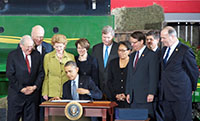
“Despite its limitations, we believe the program will help address the volatility in farmers’ milk prices, as well as feed costs, and provide appropriate signals to help address supply and demand,” said Jim Mulhern, President and CEO of NMPF.  In the end, the bill, given up for dead more than once, passed both the House and Senate with sizable margins, and is expected to be signed by President Obama on Friday.

Once it became apparent that House Speaker John Boehner would not allow the consideration of a farm bill containing a market stabilization component, NMPF worked intensively in the past three weeks to come up with an alternative system to discourage excessive milk production.

Mulhern noted that by placing a limit on how much future milk production growth can be insured, “the measure creates a disincentive to produce excess milk. The mechanism used is not what we would have preferred, but it will be better than just a stand-alone margin insurance program that lacks any means to disincentivize more milk production during periods of over-supply.”

He said that an important change from the MILC program is that the new margin protection plan “doesn’t discriminate against farms of differing sizes, or preferentially treat those in differing regions.”

The dairy title also requires the Agriculture Department, when margins shrink dramatically, to purchase finished dairy products, stimulating demand when dairy farmers need it most. To avoid displacing commercial sales, these products would be donated to food banks or other low-income food programs.

The bill also continues three additional dairy programs through 2018: the dairy check-off program, forward pricing and the Dairy Indemnity Program. A detailed explanation of all the dairy provisions in the farm bill is posted on the NMPF website.

The overall farm bill also contained:

  • A major rewrite of commodity programs, with an end to direct payments, but no new caps on how much government help individual farms can receive;
  • An $8 billion cut in food stamps and $23 billion in savings over all, but not enough cuts to satisfy many conservative lawmakers; and,
  • Desperately needed disaster assistance for livestock farmers, but no relaxation of country-of-origin labeling rules or protection from restrictive state animal welfare laws.

The final dairy package represents a sea change in how the federal government buffers producers in hard economic times. It eliminates three ineffective programs—price supports, the Dairy Export Incentive Program and the Milk Income Loss Contract program—and replaces them with the voluntary, new margin insurance plan. Margin insurance was one of two pillars of the Dairy Security Act, conceived by NMPF after a more than a year of consultation with farmers in the wake of the disastrous 2008-09 recession.

The farm bill requires the margin protection program to be established no later than September 1. NMPF will spend the coming months working closely with the Agriculture Department to ensure the new program is implemented in a farmer-friendly way.

House Republicans Announce Standards for Immigration Reform

In a major step towards finding a political pathway to address the controversy surrounding immigration reform, the House Republican leadership issued last week a set of immigration reform standards. The reform standards include a provision for which NMPF has advocated strongly: the granting of legal status to undocumented workers in agriculture.

The standards call for the creation of a legalization program that does not include a special path to citizenship for agriculture workers, as is provided in the Senate legislation adopted last year. However, the standards do not bar these individuals from adjusting their status to “Lawful Permanent Resident” (i.e. a Green Card holder) through family or employment, once they have gained legal status under this program. The standards also call for enforcement and border security with verifiable triggers to be reached before any legalization can begin.

While the standards outlined by the House Republican leadership specifically cite the importance of ensuring agriculture’s access to a temporary workforce, the document does not address specific measures that would ensure that farmers could maintain the current workforce.

“It is imperative that any legislation provide incentives to help farm workers stay at the farm rather than leave the farm to pursue employment opportunities that may be available to them with their newly granted legal status,” said Jim Mulhern, President and CEO of NMPF.

“NMPF views this announcement as an important step in the effort to improve and revamp our immigration system. Importantly, the standards released last week allow for the potential of achieving the primary goals of legalizing the undocumented in our current workforce and creating a future flow of agriculture workers,” Mulhern said.

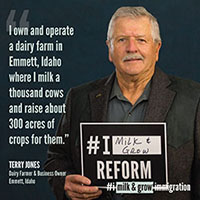
In related news, NMPF, through the Agriculture Workforce Coalition (AWC), is working with the Partnership for a New American Economy, a coalition that brings together more than 500 Republican, Democratic, and Independent mayors and business leaders who support immigration reform as a way of creating jobs for Americans today. Through this joint effort, NMPF and the AWC will expand their outreach efforts on Capitol Hill and in the public to advance needed reforms in immigration with regards to agriculture.

REAL® Seal Buyers Guide Debuts

Dairy marketers that make, sell, or distribute foods composed of real American milk can tout their offerings in the new Buyer’s Guide on the new, consumer-oriented REAL® Seal website.

The guide, the latest REAL® Seal innovation, is designed to make it easy for consumers to find stores, restaurants and brands that feature products made from cows on U.S. dairy farms. There are categories for manufacturers, distributors, retailers, wholesalers, restaurants, and more. Listings include a company’s name, address, and telephone number, along with an email contact.

To be included, email REAL® Seal Administrator Carol O’Connell at info@realseal.com. She will validate those who meet the guidelines for using the REAL® Seal and add them to the Buyers Guide.

NMPF took over management of the REAL® Seal in 2012 and has been promoting the seal heavily on the internet and in social media. In February, these efforts will focus on Valentine’s Day and the winter Olympic Games. A new YouTube video reminds the public that foods made with real dairy products are a good complement to winter sports.

European Union Raises Concern in Pursuit of Geographical Indications

Through its membership in the Consortium for Common Food Names (CCFN), NMPF strongly supports efforts designed to shine a spotlight on European attempts to monopolize use of many common food names. Two particularly egregious actions took place in the past couple weeks that drew fire from CCFN.

The most recent was a United Kingdom (UK) appeal court’s ruling declaring that only yogurt made in Greece could be labeled as “Greek Yogurt.” The ruling was issued in response to a court case brought against a U.S.-based company over its sale in that market of “Greek Yogurt.” The European Union (EU) maintains a list of protected terms known as geographical indications (GIs), but “Greek Yogurt” does not appear on that list of GIs, nor is it currently even under consideration by the EU authorities for registration as a GI. Despite that, the court still found that the U.S. company was not permitted to sell “Greek Yogurt” in the UK market. This is yet another example of the European crusade to limit the use of many common food names that can trace their roots back to a regional linkage. This also builds on a statement last fall by the Greek authorities that they intend to use the U.S.-EU FTA negotiations to impose similar restrictions on U.S. usage of the term “Greek Yogurt.”

The other major development was the EU’s decision two weeks ago to allow Denmark to move forward with an application for a GI that would grant it exclusive use of the name “Havarti” in the EU. The decision is noteworthy because the term not only is used widely around the world, but also because there is a Codex Alimentarius international product standard for Havarti. In the United States alone, Havarti cheese is produced by more than 40 companies in a dozen states.

Raw Milk Bills in State Legislatures Gain Attention

The month of January is when many state legislatures convene their new sessions and, as has been the case in recent years, that means a rash of state-level bills to legalize the sales of raw milk. NMPF has offered scientific counsel to several states where such legislation is pending, including recently in the state of Maryland.

At a January hearing in Annapolis, Vice President for Dairy Foods & Nutrition Beth Briczinski reminded the health and government operations committee of the Maryland House that every major health organization in the country discourages consuming raw milk, including the Food and Drug Administration.

“We pasteurize milk for a reason,” Briczinski told the legislators. “Raw milk is a key vehicle in the transmission of human pathogens including E. coli, Campylobacter, Listeria and Salmonella. The state should not create new opportunities for these bacteria to make people sick.”

Briczinski also discounted the supposed health benefits of raw milk often touted by advocates and the media. “No claim related to the purported health benefits of raw milk has been substantiated in any of the medical literature,” she said. “The only scientific consensus is that raw milk can cause serious illnesses and hospitalizations, and can result in life-long negative health complications and death.”

Currently, 30 states allow distribution of unpasteurized milk, which is also where nearly 75 percent of raw milk-associated outbreaks have occurred. Americans have become ill after consuming raw milk from numerous sources, including cow-share programs and raw milk producers who are licensed, permitted, or certified.

NMPF Urges Focus on Dairy in Diets at Federal Guidelines Hearing

The federal government has begun a year-long process of updating its guidelines for what Americans should eat. NMPF urged the advisory panel working on the next edition of the government’s basic nutrition advice to continue recommending three servings of dairy products a day for most Americans.

“Dairy foods are uniquely nutrient-rich and virtually irreplaceable in the diet if we want to meet nutrient recommendations,” Beth Briczinski, Vice President for Dairy Foods & Nutrition, said. “We strongly urge the (Dietary Guidelines Advisory Committee) to maintain the current recommendation of three daily servings of dairy, and to focus on the serious public health problem of under-consumption of milk and dairy products.”

Briczinski reminded the group that milk, cheese, and yogurt contribute more than half the calcium and vitamin D in the American diet, and are the number-one source of seven other essential nutrients in children’s diets: phosphorus, magnesium, potassium, vitamins A, B12, D, and riboflavin.

“Even if calcium levels can be maintained with alternative foods, the levels of other nutrients such as protein, potassium, and vitamin D are adversely affected,” she said.

Briczinski told the panel research published since 2010 has strengthened the case that dairy helps reduce the risk of several chronic diseases, “The good news is that if people who under-consume dairy would add even one serving a day, that would bring average daily intakes of Americans much closer to meeting Dietary Guideline recommendations,” she said.

Briczinski spoke at the second of two days of hearings on the 2015 edition of the Dietary Guidelines for Americans. The guidelines are issued jointly by the departments of Agriculture, and Health and Human Services every five years.

NMPF Now Accepting Applications for Scholarship Program

In an effort to support future leaders of the dairy industry, NMPF is accepting applications for its 2014 scholarship program.

Each year, NMPF allocates monies toward scholarships for the purpose of supporting graduate students actively pursuing dairy-related fields of research that will directly benefit milk marketing cooperatives and the U.S. dairy industry at large. In past years, the average scholarship awarded has been $6,000.

Graduate students from a variety of academic disciplines serving the dairy industry have received scholarships from NMPF in recent years. General research areas which have provided useful information to our milk marketing cooperatives include, but are not limited to:

  • Agriculture Communications
  • Animal Health
  • Animal and/or Human Nutrition
  • Bovine Genetics
  • Dairy Products Processing
  • Dairy Science
  • Economics
  • Environmental Science
  • Food Science
  • Food Safety
  • Herd Management
  • Marketing and Price Analysis

Completed applications must be received by NMPF no later than April 4, 2014. Applications are available on the NMPF website. 

The NMPF Board of Directors will select the winning applicants in June 2014. The winners will be notified soon thereafter. For more information, please visit the NMPF website or contact Beth Briczinski at 703-243-6111 or bbriczinski@nmpf.org.

Another Door Opens

It has been five years now since the dark days of early 2009, when the combined assault of collapsing milk prices and elevated feed costs produced a hemorrhage of red ink from America’s dairy farms. Collectively, dairy farmers lost $20 billion in net equity between 2007 and 2009, with most of that money disappearing in huge chunks during 2009, when gallon after gallon of milk left the farm at a severe loss. Five years later, the pain and memory lingers, even as balance sheets are recovering.

The problem for farmers in 2009 was that the public policy response was inadequate to the scope of the challenge – because our policy itself was lacking. In the intervening half-decade, NMPF worked within and across the dairy industry to devise an improved policy, to better reflect the realities of how milk is produced in America today, and by whom. We knew the new program would have to deal with the fact that federal budgets are limited, and the days of billion-dollar support programs, a la the 1980s, are not going to be repeated in the future.

After a year of deliberation, what emerged was a new risk management proposal to enable farmers to insure the margin between milk prices and feed costs. Without the limitations of the MILC program, much more of the nation’s milk supply could be covered by this voluntary program.

But NMPF also knew that to provide the most cost-effective insurance coverage for farmers, we needed to ensure that the program wouldn’t generate too much milk and send us into a downward spiral of low market prices and high insurance program costs. Thus was born the market stabilization element, which was designed to operate in low margin situations.

The power of that mechanism proved to be a real threat to processors, who railed against the program and disingenuously argued that our effort to prevent farm-level prices from flat-lining for month after month was equivalent to shorting the market enough to spike retail prices under normal conditions.

This debate was ultimately decided by one man: House Speaker John Boehner, who, in an ironic turn, likened the market stabilization element to a Soviet-style program, even as he strong-armed the farm bill conferees against taking a vote that he was afraid he would lose.

That brings us to the beginning of February, where those of us working on behalf of dairy farmers had to regroup and, using the tools at our disposal, re-craft the margin insurance program so that it can still provide an effective safety net while not encouraging excessive milk production and high taxpayer costs.

The package that has just passed the House and Senate should do just that. Adjustments that have been made in our original margin insurance program will make it affordable and effective, and should ensure that the margin protection safety net is just that – a safety net, and not a production stimulus.

The revised bill also will direct that, if farm-level margins again fall to 2009 levels, USDA will purchase consumer-ready (as opposed to bulk commodity) dairy foods for speedy donation to food banks. The federal budget cost of this program is likely to be higher than the program NMPF initially advocated. If that is the case, policymakers who proclaim the mantle of fiscal responsibility yet opposed our efforts to control program costs have no one to blame but themselves.

With the signature of President Obama, we reach the end of a long, tortured path leading to a new five-year farm bill. I believe the resulting dairy program will provide an effective and reasonable safety net, one that we have been striving to create these last many years. Whatever its shortcomings, it is far better than the programs it replaces.

2014 certainly appears, at this early stage, to be shaping up as a good year for milk producers. But the roller-coaster of pricing always cycles back down, eventually, necessitating a safety net for the bad times that follow the good. Creating such a safety net was the goal of NMPF five years ago, and while we haven’t gotten exactly what we hoped, the end result most certainly is badly needed, and will be helpful in the years ahead.

NMPF Statement on Passage of Farm Bill by House and Senate

From Jim Mulhern, President and Chief Executive Officer, NMPF:

“It has been a long and torturous road toward the creation of a better safety net for dairy farmers, but with today’s vote in the Senate to approve the farm bill, coupled with last week’s House vote, that five-year journey has reached its end.

“We didn’t wind up precisely where we wanted in terms of the dairy program, but the milk glass is more than half-full. The new farm bill replaces three outmoded programs intended to help farmers – but that often failed in that effort. In their place is a new, more modern, and more comprehensive margin protection program offering dairy producers a far better and more effective safety net. Because it is designed to protect against periods of both low milk prices as well as high feed costs, margin insurance is a better risk management tool to help farmers deal with the global volatility in commodity prices in the 21st century.

“On behalf of our dairy farmer members, I want to thank the farm bill conference committee principals – Sens. Debbie Stabenow and Thad Cochran, and Reps. Frank Lucas and Collin Peterson – as well as Sen. Patrick Leahy, for all of their enormous efforts, and those of their staffs, to fashion this new dairy policy.

“I also want to express my appreciation to all of the farmers, cooperatives, and farm organizations that have helped throughout this long process. The members of NMPF have worked tirelessly since 2009 to build a new and better dairy program. The farm bill’s margin protection program is a tribute to their dedication and commitment.”


The National Milk Producers Federation, based in Arlington, VA, develops and carries out policies that advance the well-being of dairy producers and the cooperatives they own. The members of NMPF’s cooperatives produce the majority of the U.S. milk supply, making NMPF the voice of more than 32,000 dairy producers on Capitol Hill and with government agencies.

Maryland House of Delegates Urged to Oppose Bill Legalizing Sale of Raw Milk

ANNAPOLIS, MD – At a hearing here today before the Maryland House’s Health and Government Operations Committee, the National Milk Producers Federation (NMPF) urged the state’s delegates to oppose a bill that would legalize the sale of unpasteurized milk in Maryland through the use of cow-share programs.

NMPF’s Beth Briczinski, Vice President of Dairy Foods and Nutrition, testified that unpasteurized milk, also known as raw milk, carries significant public health risks. Its consumption “is discouraged by every major health organization in the United States, including the American Medical Association and the American Academy of Pediatrics, as well as federal health agencies like the Food and Drug Administration,” Briczinski said.

“We pasteurize milk for a reason,” Briczinski said. “The link between raw milk and foodborne illness has been well-documented, with evidence spanning nearly 100 years. Raw milk is a key vehicle in the transmission of human pathogens including E. coli, Campylobacter, Listeria, and Salmonella. The state should not create new opportunities for these bacteria to make people sick.”

While it may be one thing for adults to make the decision to consume raw milk, the product is particularly dangerous for children, who are unable to understand the risks presented to their health. Briczinski noted that “nearly two-thirds of all outbreaks associated with raw-milk or raw-milk products involve children.”

Briczinski also addressed the misinformation and supposed health benefits of raw milk that are often touted by advocates and the media.

“No claim related to the purported health benefits of raw milk has been substantiated in any of the medical literature,” she explained. “The only scientific consensus is that raw milk can cause serious illnesses and hospitalizations, and can result in life-long negative health complications and death.”

Currently, 30 states allow the legal distribution of unpasteurized milk, which is also where nearly 75% of the raw milk-associated outbreaks have occurred. Americans have become ill after consuming raw milk from numerous sources, including cow-share programs and raw milk producers who are licensed, permitted, or certified.


The National Milk Producers Federation (NMPF), based in Arlington, VA, develops and carries out policies that advance the well-being of dairy producers and the cooperatives they own. The members of NMPF’s cooperatives produce the majority of the U.S. milk supply, making NMPF the voice of more than 32,000 dairy producers on Capitol Hill and with government agencies.