NMPF Works with Dairy Farmers to Voice Their Support of DAIRY PRIDE Legislation

Dairy farmers in April continued to speak out in support of the DAIRY PRIDE Act (DPA), legislation that would prompt the U.S. Food and Drug Administration (FDA) to enforce its own law stating that any food product using the term “milk” on its label must come from an animal source, not a plant.

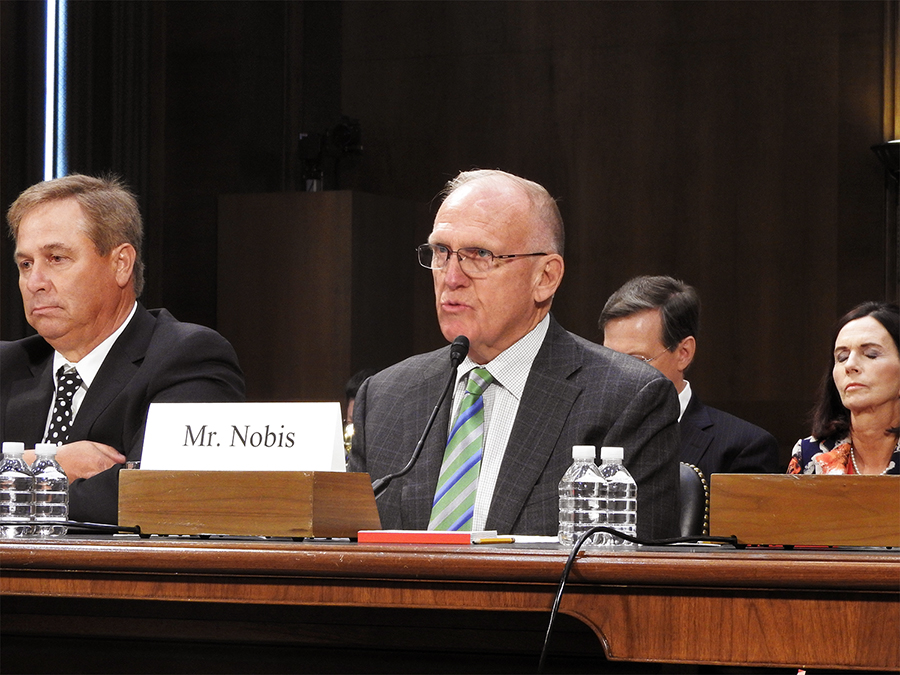
In April, two Virginia dairy farmers submitted op-ed columns to prominent local newspapers explaining their support of the DPA and why their elected officials should back the bill. Matt Nuckols (right), of Beaverdam, Va., wrote in the Richmond Times-Dispatch that is it unfair for FDA to ignore its own food labeling laws when dairy producers strictly follow government regulations to produce a safe, healthy food.

“We ask that these agencies honor their side of the deal, and enforce the rules for other ‘milk’ makers, too,” Nuckols said.  He indicated that government regulators should not be able to pick and choose which policies to enforce, any more than farmers should be able to.

Mark Sowers (left), of Floyd, Va., used his column in the Roanoke Times to note the importance of DPA for Virginia’s 1,000 dairy operations and the state’s robust agriculture sector.

“In 2014, milk was the state’s third-most profitable agricultural product, bringing in $478 million from over 1,000 operations,” he said. “Virginia’s reputation as a strong agriculture state is too great to risk the invasion of these imitators.”

Earlier in April, Sen. Angus King (I-ME) announced his support for the DPA, following another column from Maine dairy farmer Travis Fogler in the state’s largest newspaper, the Portland Press-Herald. To date, the DPA has been backed by the following senators and congresspersons: King, Tammy Baldwin (D-WI), Debbie Stabenow (D-MI) and Jim Risch (R-ID) in the Senate; and Reps. Peter Welch (D-VT), Mike Simpson (R-ID), Sean Duffy (R-WI), Joe Courtney (D-CT), David Valadao (R-CA), Susan DelBene (D-WA), Collin Peterson (D-MN), Mike Gallagher (R-WI), Glenn Grothman (R-WI), Ron Kind (D-WI), Thomas Rooney (R-FL), James Sensenbrenner (R-WI), Richard Nolan (D-MN) and Elise Stefanik (R-NY)  in the House.

NMPF continues to publicize legislative action alerts, news articles, infographics and other materials that inform and encourage support for DPA. NMPF strongly encourages cooperatives to share these materials with staff, producer-members and on social media to whip up industry and congressional support.

CWT Member Co-ops Capture 6.2 Million Pounds of Export Sales in April

Cooperatives Working Together (CWT) assisted member cooperatives in securing 40 contracts to sell 6.2 million pounds of cheese to customers in Asia, Central America, the Middle East and Oceania in April 2017. The product will be shipped from April through July 2017.

Adding these transactions to the other sales made so far this year raises the total CWT-assisted product sales to 29.7 million pounds of cheese and 1.4 million pounds of butter. These sales are destined for customers in 14 countries in five regions, and will move overseas the equivalent of 306 million pounds of milk, on a milkfat basis, in the first seven months of 2017.

Helping CWT member cooperatives gain and maintain world market share through the Export Assistance program in the long-term expands the demand for U.S. dairy products and the U.S. farm milk that produces them. This, in turn, positively impacts all U.S. dairy farmers by strengthening and maintaining the value of dairy products that directly impact their milk price.

The amounts of dairy products and related milk volumes reflect current contracts for delivery, not completed export volumes. CWT will pay export assistance to the bidders only when export and delivery of the product is verified by the submission of the required documentation.

All cooperatives and dairy farmers are encouraged to add their support to this important program. Membership forms are available on the CWT website.

MPP Forecast: May

The USDA’s National Agricultural Statistics Service (NASS) reported that the U.S. average all-milk price dropped $1.20 per hundredweight from February to March, to $17.30 per hundredweight. The price deterioration resulted from declines of more than one dollar per hundredweight in both the Class III and the Class IV federal order prices from February to March. The Class III price has weakened as milk production growth in the past several months has led to increased domestic cheese production and stocks. The Class IV price has weakened as skim milk powder remains oversupplied on world markets.

Feed ingredient prices for March announced by NASS and USDA’s Agricultural Marketing Service showed small and partially offsetting changes from February. These translate into a monthly Margin Protection Program (MPP) feed cost of $7.95 per hundredweight, up $0.03 from February.  That slight increase, coupled with the decline in the milk price, generated a MPP margin for March of $9.35 per hundredweight, down $1.23 per hundredweight from February.

USDA’s current MPP margin forecast, based on early May CME futures settlements, projects the margin will remain above $8 per hundredweight during 2017. However, USDA currently projects a slight probability that the margin will fall below the $8 coverage level during May-June, with lower probabilities that this level will trigger MPP payments during other bimonthly periods this year.

USDA’s MPP margin forecasts are updated daily online. NMPF’s Future for Dairy website offers a variety of educational resources to help farmers make better use of the program.

NMPF Concerns about Loss of Common Cheese Names Reflected in New U.S. Government Report

NMPF’s campaign to challenge the erosion U.S. cheese makers’ ability to use common food names was reflected in a new report from the Trump Administration cataloguing the potential loss to American businesses caused by European trade policy.

Last week, the U.S. Trade Representative’s Office (USTR) outlined the Trump Administration’s commitment to curtailing the damaging abuses of geographical indications (GIs) – particularly by the European Union (EU). NMPF joined the Consortium for Common Food Names (CCFN) in hailing the report as a strong, positive signal on how the administration plans to tackle these types of trade and intellectual property issues in the next four years.

The report highlighted ongoing threats to U.S. companies that legally use common food names both within the United States and in global trade. This report is released each year by the USTR’s office, and outlines extensive efforts that the administration is making around the world to stem the EU’s efforts erect barriers to U.S. exports.

Earlier this year NMPF expressed its concerns to USTR about the growing threat to U.S. manufacturers of foods with common names, including cheeses such as parmesan, feta and Asiago. Among NMPF’s specific requests to the USTR: hold trading partners accountable for their commitments; preserve market access negotiated through earlier trade agreements; and prevent competitors from monopolizing widely used generic food terms.

“We cannot allow our trading partners to chip away at the value of prior World Trade Organization or free trade agreement concessions,” said Jim Mulhern, president and CEO of NMPF. “Just because the free trade agreement with Europe is off the table for now doesn’t mean Europe’s dairy sector will sit by.  They are aggressively pursuing other trade deals that could limit our export opportunities, and we will continue to be vigilant about challenging those practices”

New Agriculture Secretary Reinstates 1% Flavored Milk in Schools

Acknowledging the importance of providing school children with more milk options, Agriculture Secretary Sonny Perdue – in one of his first formal actions – said the USDA will change its regulations to allow school districts to once again offer 1% flavored milk as part of the National School Lunch and School Breakfast programs. NMPF has fought for the return of low-fat flavored milk in schools since the product was removed following passage in 2010 of the Healthy, Hunger-Free Kids Act.

Since the USDA regulations implementing the act limited milk options in the school meal and a la carte programs to nonfat flavored milk and low-fat white milk, consumption of school milk declined, as has overall participation in the school lunch program.

NMPF thanked Perdue for recognizing the role of healthy dairy foods in childhood nutrition.

“In just the first two years after low-fat flavored milk was removed from schools, 1.1 million fewer students drank milk with their lunch,” said Jim Mulhern, president and CEO of NMPF. “Secretary Perdue’s action recognizes that a variety of milks and other healthy dairy foods are integral to child nutrition programs in schools.”

Perdue’s announcement at a school in Leesburg, Virginia, came less than a week after his Senate confirmation. National Milk pledged to work with Perdue on nutrition and health issues, along with other economic and policy challenges facing U.S. dairy producers, including improvements to the Margin Protection Program (MPP) and immigration policy.

During his confirmation hearing last month, Perdue said he wants to improve the MPP, and is open to creating additional risk management coverage for milk through USDA’s Risk Management Agency.

Regarding immigration reform, Perdue told the Senate Agriculture Committee that he would explore an exemption to the H-2A program so dairy farms can hire workers for year-round labor. The current seasonal H-2A visa does not apply to dairy farms because of their perennial need for farm labor.

No MPP Fix in Federal Spending Bill; NMPF to Continue to Seek Opportunities

NMPF is continuing its efforts to impress upon Congress the urgent need to improve the Margin Protection Program to make it an effective risk management tool for dairy farmers.  NMPF has developed and recommended a series of improvements, including changing the feed formula and altering the premium rate structure to make the program more effective and affordable for dairy farmers.

As Congress worked to finalize its annual government spending bill last week, NMPF worked with legislators in an effort to identify funding options to improve MPP in that bill.  But that effort, like many other requests, was unable to be included due to budgetary constraints on the overall spending package, which dealt with funding for all federal programs. Cotton interests also sought to address deficiencies in their safety net, but unfortunately, neither was included in the final package approved by Congress this week.

NMPF will continue to work on a bipartisan basis with dairy policy leaders and other members of the House and Senate to identify every possible opportunity for MPP reform and drive home the point that our dairy producers need this safety net to work for them – and that will require resources from Congress.

President Trump Joins U.S. Dairy Sector, Members of Congress in Criticizing Canada’s Damaging New Pricing Scheme

National Milk’s efforts to reverse Canada’s damaging dairy trade policy changes made international news last month when President Donald Trump spoke publicly about how Canada’s trade violations are “a disgrace,” and harm U.S. dairy producers. Farmers and dairy company leaders reinforced this message during high-level meetings with administration officials and Congress members at the beginning of May.

NMPF has been warning since mid-2016 that Canada’s new Class 7 pricing scheme, piloted last year in Ontario as Class 6 and now being used in numerous provinces, gives unfair advantage to domestic milk ingredients in an industry that already benefits tremendously from Canada’s high-cost supply management dairy structure. This new policy has pulled the rug out from under U.S. exports of U.S. ultrafiltered milk, while at the same time undercutting U.S. exports to other global markets.

This national ingredients strategy “has resulted in lost markets for companies in Wisconsin and New York, threatening the livelihoods of numerous dairy farm families,” said Jim Mulhern, president and CEO of NMPF.

Even more worrisome, he said, is that the policy “also enables Canada to dump excess dairy proteins onto world markets, posing a larger and longer-term threat to U.S. dairy farmers relying on overseas milk powder sales.” Reports have already surfaced of Canadian milk powder being offered on global markets at fire sale prices – a new development since the introduction of Class 7.

During a fly-in rally organized NMPF and the U.S. Dairy Export Council (USDEC), more than 30 farmers and dairy company executives fanned out on Capitol Hill to emphasize that trade opportunities both north and south of the U.S. are crucial to America’s dairy sector. The dairy coalition also met with Agriculture Secretary Sonny Perdue, Acting U.S. Trade Representative Stephen Vaughn and White House agriculture advisor Ray Starling (second photo: producers with House Speaker Paul Ryan).

NMPF and other U.S. dairy groups have repeatedly raised concerns about Canada’s efforts to undercut competition from the United States. NMPF has worked to bring this issue to the attention of Trump Administration officials, members of Congress and dozens of governors, most recently in an April 13 letter asking Trump to urge Canadian Prime Minister Justin Trudeau to halt the new pricing policy and restore the flow of U.S. ultrafiltered milk.

These engagement efforts bore fruit in mid-April when, during a speech in Wisconsin, Trump reprimanded Canada for its pricing scheme, calling the resulting impact on U.S. farmers “unfair,” followed by a tweet reiterating this point. Other political leaders, including House Speaker Paul Ryan and Senate Minority Leader Chuck Schumer, have also pressed Canada on the negative impacts of its approach to dairy trade. Both congressional leaders have written to the administration on this issue in the past month.

Other members also chimed in to create a swelling chorus of concern about Canada’s actions. Most recently, a bipartisan group of 68 House members sent a letter in late April to the White House, asking Trump to insist Canada comply with its trade obligations. NMPF worked closely with the offices that led this letter: Reps. Collins, DelBene, Stefanik, Kind, Duffy and Welch.

“Canada has repeatedly sought ways to evade its trade commitments and erode U.S. export gains, both within Canada and around the world,” Mulhern said. “We are pleased to see our efforts to insist that Canada play by the rules are building a broad base of bipartisan awareness about the urgent need to take action on this issue.”

Even as Canada and the future of the North American Free Trade Agreement (NAFTA) have dominated headlines, NMPF has been vocal about the need to preserve the agreement in light of the stable and reliable partnership with Mexico, U.S. dairy’s No. 1 export market. The United States sold $1.2 billion worth of dairy products last year to customers in Mexico, amounting to roughly one-fourth of total U.S. exports. Those exports create tens of thousands of U.S. jobs and $3.6 billion in U.S. economic impact.

Mulhern said “NMPF will continue to insist that any renegotiation of NAFTA maintain this vital export market, and preserve the strong working relationship with customers and counterparts in Mexico.”

Michigan Dairy Farmer Outlines Changes Needed in Farm Bill Safety Net at Senate Hearing

FRANKENMUTH, MI – Dairy farmers in Michigan and across the nation need federal lawmakers to revise the safety net created in the 2014 Farm Bill to provide them adequate risk management protection, according to a dairy farmer from eastern Michigan who testified in Frankenmuth on Saturday at a Senate hearing.

Darrin Siemen of Harbor Beach, Mich., told a Senate Agriculture Committee field hearing held at the Saginaw Valley Research Center that the Margin Protection Program (MPP), created in the 2014 Farm Bill, “has failed to deliver the protection farmers need and expect. While MPP remains the right model for the future of our industry, changes are needed if Congress wants to prevent dairy farmers like me from going out of business,” he said.

Siemen is a fourth‐generation family farmer and owner of Prime Land Farm in Harbor Beach, in Michigan’s Thumb region. He testified on behalf of his cooperative, Michigan Milk Producers Association, as well as the National Milk Producers Federation, of which MMPA is a member. His full testimony can be found here.

Siemen said that the MPP is designed to help farmers insure against either low milk prices or high feed costs, but the way the program calculates the relative value of feeds such as corn, soybean meal and hay was “significantly changed” as it was written into law. This change “fundamentally altered the safety net designed by NMPF and other dairy leaders around the country. Unfortunately, as a direct result of these changes, the MPP safety net has failed to deliver the protection farmers need and expect,” he said.

He explained that in the first two years of the program, 2015 and 2016, farmers have paid $90 million in fees and premiums to USDA while receiving only $14 million in insurance payouts, even though margins have been tight during much of that period.  This has led to a drastic reduction in the number of farmers paying premiums to selecting higher levels of margin protection. Most are now only paying the minimum annual $100 administrative fee, for which they receive only a low level of insurance coverage.

“I am not asking for a program that guarantees a profit, nor do I want a program that will incentivize excess production,” Siemen said. “However, when Congress made changes to the program, rendering it ineffective, dairy farmers like me lost faith in the idea that MPP could serve as a viable risk management tool under its current formulation. If Congress makes changes to ensure that MPP more accurately reflects the actual costs of production for businesses like mine, participation in the program will increase.”

Siemen said that in addition to adjusting the feed cost formula and the data sources for the prices of feed and milk, Congress should reassess the MPP’s premium rate structure, and consider expanding access to the Livestock Gross Margin program, a separate risk management tool offered by USDA.

The combination of suggested changes to the MPP “will require this committee to make significant and necessary improvements to the program,” Siemen said, so that “it functions as intended and that producers participate in the program. A safety net is not a safety net if no one participates.”

Siemen pointed out that dairy farmers are also facing other policy challenges, including immigration and labor shortages, tax reform, child nutrition and environmental sustainability. He thanked Senate Agriculture Committee Ranking Member Debbie Stabenow for arranging the hearing in Michigan, and for her engagement on behalf of the U.S. dairy sector in its recent struggle against Canada’s new pricing policy, which will have long-term negative consequences for Michigan farmers’ export opportunities.
He also recognized the efforts of Stabenow and Senate Agriculture Committee Chairman Pat Roberts for their recent efforts to bring more milk options and flexibility to the School Lunch and School Breakfast programs.

###

About the Michigan Milk Producers Association
The Michigan Milk Producers Association (MMPA) is a dairy farmer owned cooperative founded in 1916. MMPA serves approximately 2,000 dairy farmers in Michigan, Indiana, Ohio and Wisconsin, handling approximately 5 billion pounds of milk annually. MMPA operates two SQF Level 3 certified dairy ingredient plants in Michigan and a cheese plant in Indiana.

About NMPF
The National Milk Producers Federation, based in Arlington, VA, develops and carries out policies that advance the wellbeing of dairy producers and the cooperatives they own. The members of NMPF’s cooperatives produce the majority of the U.S. milk supply, making NMPF the voice of dairy producers on Capitol Hill and with government agencies. Visit www.nmpf.org for more information.

Making Headway Despite Headwinds

The first four months of 2017 have been rather stormy for America’s dairy farmers, and for National Milk’s advocacy on the main policy challenges affecting them. The good news is that on almost every issue in which we’re engaged – from fixing the farm bill’s Margin Protection Program, to holding countries like Canada accountable for their unfair trade practices, to improving federal nutrition programs – we’ve made tangible headway already this year.

As 2017 began, it was clear there would be both opportunities and challenges in the days ahead. We geared up to deal with major challenges on some issues, such as immigration, while marshaling resources to pursue potential opportunities on others, such as demanding that FDA enforce federal dairy labeling standards.  Here’s a brief assessment of where things stand this spring:

Fixing the farm bill safety net.  Following months of review by our Economic Policy Committee, earlier this year the NMPF board unanimously approved a series of recommended improvements to the Margin Protection Program (MPP). In order to secure these necessary changes, we will need congressional action. Now in its third full year, the program in its current form has been a disappointment, and needs to be revamped in order to function as an effective risk management program and regain the faith of dairy farmers. NMPF’s recommendations – including restoring our originally proposed feed formula, recalculating margins, and adjusting the price levels of premiums – have a price tag for which Congress will need to allocate additional resources.  We had worked with leaders in Congress on the recently passed FY 2017 federal spending bill in an effort to find additional money for some of the badly-needed changes, but the new funding didn’t develop.  So, we will continue to work with bipartisan leaders in both the House and Senate, to drive home the message that our dairy producers need a functioning safety net working for them – and that will require resources from Congress.   We need to get the right policy for farmers, and not let the budget tail wag the dog.

Maintaining and expanding export markets.  We discovered the power of the “Trump Tweet” when the President last month used Twitter to express his solidarity with dairy farmers hurt by Canada’s new milk pricing scheme.  Along with support we’ve garnered from many governors and congressional leaders, having President Trump talk about the issue has made our trade dispute with Canada front page news.  Now that nearly all of those farmers most immediately impacted by the loss of milk protein sales have found new markets, the real challenge will be to keep the pressure on Canada to end its national ingredients strategy.  This becomes even more imperative as Canada unfairly offloads its milk protein exports and drives down world market prices for milk powder, harming all U.S. dairy farmers, as well as those in other exporting nations like New Zealand, Australia and the 28-country European Union.  This is part of a pattern of misbehavior by Canada, and it simply cannot stand. 

At the same time, as NAFTA is reassessed by the Administration, we are continuing to stress the need to preserve our partnership with America’s #1 export market: Mexico.  I traveled to Mexico in March, joined by Tom Vilsack and Michael Dykes, my colleagues who head the U.S. Dairy Export Council and International Dairy Foods Association, respectively.  In meetings with farmer and industry groups, as well as Mexican government officials, we drove home our commitment to our customers there. In the days and weeks ahead we must keep our focus on both the north of the border confrontation with Canada, as well as the continued value of our relationship with customers south of the border in Mexico.

Reforming immigration policy and addressing labor needs.  As the new year began we anticipated that the Trump Administration was going to ramp up enforcement against illegal immigrants – actions that could create concerns for farm employers who rely on immigrant workers.  National Milk continues to emphasize in Congress that conversations about law enforcement approaches to immigration also must recognize that we need realistic solutions to the labor challenges farmers face.  This is particularly true for dairy, because the only existing farm worker visa system, the seasonal H-2A program, cannot be used by our sector with its year-round labor demands.  The good news is that we’re seeing evidence our message is being heard: in his first days on the job, Agriculture Secretary Sonny Perdue has discussed the labor dilemma dairy farmers face, and pledged to address the issue as he gets situated at USDA.  Members of Congress are also suggesting legislative avenues to help milk producers, giving me greater hope that we can find a way to rectify this years-long challenge.

Improving school nutrition.  In one of his first official acts as Agriculture Secretary, Sonny Perdue announced a series of changes to the federal school lunch program, including one advocated by NMPF for more than five years: bringing low-fat flavored milk back to the lunch line.  Chocolate and other flavored 1% milks were removed from the school lunch program in 2011, with only non-fat white and flavored milk, and 1% white milk, remaining.  Milk consumption in many schools across the country declined as a result of that regulatory change. The policy change announced this month will harmonize USDA policy with that of the federal Dietary Guidelines for America, which recognize the value of low-fat flavored milk as an important vehicle to deliver nine essential nutrients to our children.  This common-sense regulatory change is welcome news for dairy farmers and processors, with whom we’ve worked to get 1% flavored milk back in schools, and augurs well for our future relationship with Secretary Perdue.

These four issues are just a part of National Milk’s efforts to advance member interests so far this year.  Later this month we’ll advocate for common sense regulatory changes at the biennial meeting of the National Conference of Interstate Milk Shipments in Michigan.  One of our proposals aims to make sure that milk imitators are not able to take advantage of the halo of the real milk products they wish to copy.  Also on the regulatory front, we’re encouraging efforts to roll back the Environmental Protection Agency’s controversial Waters of the U.S. regulation.  We’re also working to create a new tax credit to incentivize the adoption of nutrient recovery and biogas systems to capture the value of manure.

Meanwhile, from an economic standpoint, our Cooperatives Working Together program, in the first four months of 2017, has been busy assisting our member cooperatives find markets for the equivalent of 306 million pounds of milk in 14 countries.  As domestic milk production grows and global competition for international markets intensifies, our CWT program provides a critically important and unique tool to assist America’s farmer-owned cooperatives in being more competitive in overseas markets.

As spring gives way to summer, we’re going to continue our intense focus on these and other policy issues to improve the economic environment for farmers and find creative ways to put our community on better footing as we move through 2017.

NMPF Urges Dairy Imitators to Comply with Food Labeling Standards

ARLINGTON, VA – America’s dairy farmers have a clear message for plant-based food companies that have been meeting in California this week to assess the consistency of the labeling of their products: Dairy imitators must start complying with federal regulations that require foods such as milk, cheese, ice cream and yogurt to be made from real milk.

“At a time when consumers want real food, this ‘fake food’ movement has gone in the opposite direction, flaunting U.S. Food and Drug Administration (FDA) standards that define milk as the product of cows, not heavily processed and unrecognizable plant sources,” said Jim Mulhern, president and CEO of NMPF. “These companies are also aware that playing fast and loose with labeling regulations is a potential legal liability and a source of confusion in the marketplace.”

Members of the Plant Based Foods Association are meeting this week in San Francisco to review the potential compliance challenges their products may have with FDA’s existing standards of identity.

Mulhern pointed out that some plant-food makers have acknowledged the inconsistency in the labeling terms and nutritional content of their offerings, citing these first-person assessments from recent news articles:

“I think where there is real consumer confusion, and where the FDA really should get involved, is that there is no meaningful standard of identity that I know of for almond milk, cashew milk or soy milk,” he said. “You could have one cashew in an entire package and the rest could be water and sugar and call it cashew milk. So consumers are being duped.”

Dora’s Naturals founder Cyrus Schwartz

BevNet.com – Jan. 5, 2017

“The new labels clear any confusion. MALK is not nut milk pretending to be dairy. It’s an alternative to dairy, meaning dairy-free, and the new labels clearly show this.”

MALK co-founder/CEO August Vega

Food Navigator – March 10, 2017

“Lowry says the dairy industry has a point about the nutritional benefits of some milk alternatives, which are often significantly lower in protein. Lowry believes that milk should be defined based not on whether it comes from a ‘hooved animal’ but whether it’s nutritionally equivalent.”

Ripple co-founder Adam Lowry

Fortune – Feb. 16, 2017

NMPF’s Mulhern said that standards of identity exist for a range of foods, not just in the dairy category.

“You can’t take powdered sugar, mix it with water, add orange flavorings and color, and call it orange juice. The FDA standard of identity for ‘orange juice’ prohibits labeling beverages that are only orange in color as ‘orange juice.’ But this is the misleading practice that occurs when nuts and grains are mixed together with whiteners and sugars and marketed as ‘milk.’ FDA’s failure to do its job on food standards means it’s time for Congress intervene,” he said.

NMPF continues to build support for legislation called the DAIRY PRIDE Act (DPA), which would ensure food labels are policed by regulators. The measure, introduced earlier this year in both the House and Senate, prompts FDA to implement its long-standing regulation specifying that milk and similar dairy foods must come from an animal source. Properly enforcing labeling standards “ultimately benefits the manufacturers of plant products as much as it helps dairy farmers,” Mulhern said, by establishing a predictable regulatory environment in the marketplace.

Mulhern said terms such as “almondmilk” and “soy milk” are not found on plant beverages sold in the European Union, the United Kingdom and Canada. Other nations have food labeling standards similar to those in the United States, but their governments “actually enforce those regulations, unlike FDA,” he said. “The United States has been lax, but that doesn’t mean such violations will go unnoticed indefinitely, either by regulators or those misappropriating dairy terms.”

Mulhern said the DAIRY PRIDE Act continues to attract support. The Senate version has the following sponsors: Tammy Baldwin (D-WI), Angus King (I-ME) and Debbie Stabenow (D-MI), the leading Democrat on the Senate Agriculture Committee. The House version’s supporters include: Reps. Peter Welch (D-VT), Mike Simpson (R-ID), Sean Duffy (R-WI), Joe Courtney (D-CT), David Valadao (R-CA), Susan DelBene (D-WA), Collin Peterson (D-MN), Mike Gallagher (R-WI), Glenn Grothman (R-WI), Ron Kind (D-WI), Thomas Rooney (R-FL), James Sensenbrenner (R-WI), Richard Nolan (D-MN) and Elise Stefanik (R-NY).

###

The National Milk Producers Federation (NMPF), based in Arlington, VA, develops and carries out policies that advance the well-being of dairy producers and the cooperatives they own. The members of NMPF’s cooperatives produce the majority of the U.S. milk supply, making NMPF the voice of dairy producers on Capitol Hill and with government agencies. For more on NMPF’s activities, visit our website at www.nmpf.org.

NMPF, USDEC Organize Dairy Fly-In on Capitol Hill to Build Support for Trade with Canada, Mexico

WASHINGTON, D.C. – U.S. dairy leaders from across the country visited Washington, D.C., this week to urge Congress and Trump Administration officials to hold Canada accountable for its trade violations and hasten the repeal of Canada’s controversial new dairy pricing system.

During a fly-in rally organized Tuesday and Wednesday by the National Milk Producers Federation (NMPF) and the U.S. Dairy Export Council (USDEC), more than 40 farmers and dairy company executives fanned out on Capitol Hill to discuss the importance of trade across North America. The group emphasized that trade opportunities both north and south of the U.S. are crucial to America’s dairy sector. In addition to speaking to elected officials, the members of the dairy coalition also met with Agriculture Secretary Sonny Perdue, Acting U.S. Trade Representative Stephen Vaughn and White House agriculture advisor Ray Starling.

“Canada’s new Class 7 milk pricing scheme unfairly undercuts U.S. dairy exports to Canada and around the world.  This is an economic dagger pointed at every farmer in the United States, not just those from a few states,” said Jim Mulhern, President and CEO of NMPF.  “We also were clear that the income of thousands of dairy farmers depends on the valuable partnership that we have with Mexico, our largest export market.”

NMPF and USDEC member cooperative and company leaders explained to lawmakers how they have lost sales to Canada and expressed fears of the consequences of Canada dumping its milk excess onto global markets at prices far below their domestic price – in violation of Canada’s trade agreement concessions.

Dairy leaders emphasized that U.S. dairy exports create jobs across the nation, and distributed fact sheets quantifying the economic impact nationally and state-by-state.

USDEC Senior Vice President Jaime Castaneda said that U.S. dairy groups “have repeatedly stressed that trade has become an integral part of the U.S. dairy industry and we must expand markets and fight to keep those that we have today. We should hold countries accountable when they break the rules.”

NMPF Board member Leroy Plagerman, a farmer from Lynden, Washington, and member of Darigold, said that farmers in his region “are the closest to growing Asian export markets and we rely heavily on our ability to reach those customers – and so we feel very threatened by what Canada is doing.”

Whittemore, Michigan, farmer Rod Daniels, representing the Michigan Milk Producers Association said that “Michigan is producing more milk and we need more export markets. Canada’s repeated efforts to bend or break the trade rules to which it has agreed, makes things worse for dairy farmers in Michigan and across the country. Canada should know that we will continue to sound the alarm about the new pricing policy.”

Legislators and dairy industry members also discussed the future of the North American Free Trade Agreement (NAFTA). Lake Mills, Wisconsin, dairy farmer Charles Untz, representing Dairy Farmers of America, said that as negotiations over the pact continue, “it is critical to preserve the strong and stable trade relationship the U.S. dairy industry enjoys with Mexico. Wisconsin’s dairy sector, like so much of the rest of the country’s, needs to continue building on our export business and Mexico is a big part of that equation.”

Twenty-seven dairy representatives from outside D.C. attended meetings with various members of the House and Senate, including House Speaker Paul Ryan (R-WI), along with the Republican and Democratic leaders of the Senate and House Agriculture Committees, the House Ways and Means Committee, and the Senate Finance Committee. In addition to NMPF and USDEC, executives from the International Dairy Foods Association and the National Association of State Departments of Agriculture also participated in the meetings.

###

The National Milk Producers Federation (NMPF), based in Arlington, Va., develops and carries out policies that advance the well-being of U.S. dairy producers and the cooperatives they collectively own. The members of NMPF’s cooperatives produce the majority of the U.S, milk supply, making NMPF the voice of dairy producers on Capitol Hill and with government agencies. For more on NMPF’s activities, visit www.nmpf.org.

The U.S. Dairy Export Council (USDEC) is a non-profit, independent membership organization that represents the global trade interests of U.S. dairy producers, proprietary processors and cooperatives, ingredient suppliers and export traders. Its mission is to enhance U.S. global competitiveness and assist the U.S. industry to increase its global dairy ingredient sales and exports of U.S. dairy products. USDEC accomplishes this through programs in market development that build global demand for U.S. dairy products, resolve market access barriers and advance industry trade policy goals. USDEC is supported by staff across the United States and overseas in Mexico, South America, Asia, Middle East and Europe.